Now in its seventh edition, View Camera Technique is a unique, comprehensive book that presents clearly and precisely the features, operations and applications of view cameras. It details camera movements, image formation, exposure control, and information concerning lenses and accessories. Diagrams, comparison charts, and more than 500 photographs and illustrations by distinguished professional photographers provide the reader with the tools necessary to analyze a picture situation, set up and manipulate the camera, and portray the subject to meet the expectations of the professional photographer.
This text has been completely revised and updated to include over 100 brand-name view cameras, and offers comparison tables to assist readers in choosing cameras, lenses, and view-camera digital backs. This latest edition offers expanded coverage of the newest technology, including electronic features that simplify the use of view cameras for conventional photography and digital view cameras that eliminate the need for film and make it possible to modify the digital images with image-processing computer software programs
- 344 pages
- English
- ePUB (mobile friendly)
- Available on iOS & Android
eBook - ePub
View Camera Technique
About this book
Information
1
View Cameras
1.1 View Cameras
Modern view cameras are the descendants of many generations of large-format cameras, dating back to the birth of photography in 1839 with the introduction of the daguerreotype process. The first commercially manufactured daguerreotype camera, designed by Daguerre and manufactured by Giroux in 1839, was a two-part wood box with the lens mounted on the outer front box and the ground glass attached to the inner back box, which could be moved back and forth to focus the image (Figure 1-1). A pivoted disk in front of the lens served as a shutter, and a 45° mirror behind the ground glass provided an upright but laterally reversed reflection of the inverted ground-glass image.1
The desire on the part of photographers for camera modifications to meet specific picture-making needs resulted in improvements such as substitution of a flexible bellows for the sliding boxes and the tilt, swing, and shift adjustments on the lens and ground glass that are features of modern view cameras. The desire for camera modifications also generated, over the years, a whole range of other types of cameras, including large-format cameras that could be handheld (thanks to the addition of an optical viewfinder for composing and a coupled rangefinder for focusing), roll-film box cameras, and 35-mm cameras. Introduction of the Exakta 35-mm single-lens reflex (SLR) camera in 1936 and the Zeiss Contax 35-mm SLR with a pentaprism for eye-level viewing in 1949, combined with the continuing improvements in the graininess of 35-mm film, led many to predict the demise of large-format cameras.2 Newspaper photographers, indeed, did switch from 4 × 5-in. press cameras to 35-mm SLR cameras as rapidly as they could talk management into purchasing new cameras. The 35-mm SLR cameras also became very popular with advanced amateur photographers and photojournalists, while the larger roll-film SLR cameras became popular with fashion photographers and some other professional photographers who wanted a compromise between the image quality produced with large-format cameras and the convenience of small-format cameras.
To the surprise of many, however, the popularity of view cameras, rather than declining, actually increased along with that of the smaller-format cameras. Surveys of the number of different models of view cameras available in the United States in 1967 and in 1993 revealed that the number of models of 4 × 5-in. view cameras increased from 16 to 49; when including smaller-format and larger-format view cameras, the total number of different view cameras increased from 34 to 90.3 This edition lists 112 different models, not counting 5 × 7-in. cameras—which typically have the same features as a corresponding 4 × 5-in. or 8 × 10-in. model—or cameras with formats larger than 11 × 14 in.
View cameras can generally be classified as being of either flatbed (Figure 1-2) or monorail construction. Most of the early view cameras were of the flatbed variety, although a wood monorail camera is known to have been made by 1870. In recent decades more models of monorail cameras than flatbed cameras have been marketed. Flatbed cameras generally are constructed of wood. Most can be folded into a compact, self-contained carrying case, an advantage when traveling with a view camera. Monorail view cameras are generally constructed of metal, and many are modular in design, which permits considerable flexibility in modifying the camera to meet special needs. An exploded view of a generic monorail view camera, with the parts identified, is shown in Figure 1-3. Not all monorail view cameras can be disassembled as completely as indicated in the exploded view, but the trend is in that direction.
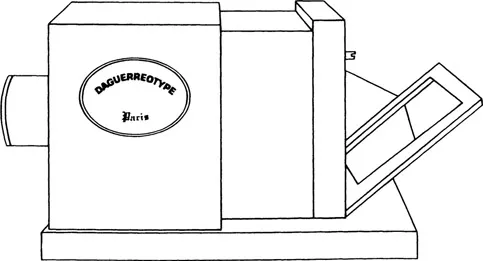
Figure 1-1 Daguerreotype camera designed by Daguerre and manufactured by Giroux in 1839.
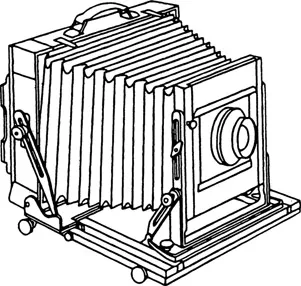
Figure 1-2 Flatbed view cameras typically have wood frames, are relatively light in weight, and can be folded into a compact self-contained case with a carrying handle.
In addition to the camera, a few accessories are considered to be essential. These include a tripod (or camera stand), a focusing cloth or hood to shield the ground glass from extraneous light, a focusing magnifier, a cable release, film holders, an exposure meter, and a carrying case.
During the evolution of the various types of cameras, 35-mm and roll-film cameras have borrowed some view camera features, such as perspective-control (PC) lenses that can be shifted off center to prevent convergence of vertical subject lines, as when photographing a tall building. View cameras also have borrowed features from small-format cameras, such as roll-film adapters, to make the view camera more user-friendly. A number of view camera refinements will be mentioned throughout the book and a comprehensive list will be included in Chapter 11, but we will start with a basic, no-frills generic or Brand X view camera.
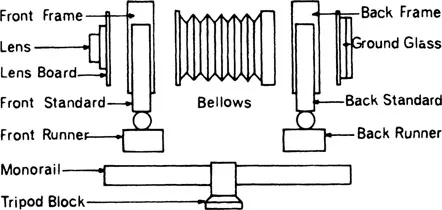
Figure 1-3 An exploded view of a generic monorail view camera.
It is safer to list the major features normally associated with the name view camera than to try to write a rigorous definition. Such features will be listed and considered briefly here, then discussed in a more thorough manner in following chapters. It will be obvious to most readers that view cameras have no monopoly on all of the following features that characterize them:
- Ground-glass viewing for composing and focusing.
- Lateral, vertical, and angular adjustment of the lens and back.
- Accommodation of interchangeable lenses.
- Flexible bellows connecting the front and back of the camera.
- Large film size, usually in sheet form.
- Designed to be used on a tripod.
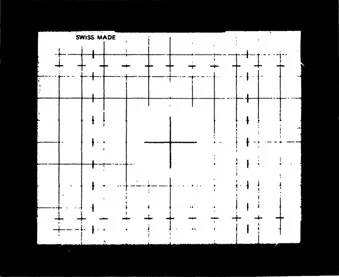
Figure 1-4 Ground-glass viewing.
In this book we are concerned primarily with conventional view cameras, but attention will be given to cameras having some view camera features even though they are not normally classified as view cameras.
A quick look at the characteristic view camera features will help us understand why view cameras have earned a reputation for versatility and the ability to produce photographs of exceptional quality.
1.2 Ground-Glass Viewing
The ground glass on a view camera displays the image exactly as it will be recorded on the film (Figure 1-4).
This enables the photographer to compose the picture precisely to the edges of the usable area of the film, to focus precisely either with the unaided eye or with a focusing magnifier, to check parallelism of image lines, and to check the depth of field at the selected f-number.
These advantages of ground-glass viewing must be weighed against the disadvantages. To see a vivid image it is necessary to shield the ground glass from light from the rear of the camera. This is usually done by placing a focusing cloth over the back of the camera and the photographer’s head or with a focusing hood attached to the back of the camera. Another disadvantage of ground-glass viewing is that the image is inverted. Most experienced view camera users have adapted to the inverted image, and some even claim that it assists them in evaluating the composition. Reflex viewing hoods are available for some view cameras for photographers who prefer to see a right-side-up, but laterally reversed, image.
1.3 Lateral, Vertical, and Angular Adjustments
By adjusting the relative positions of the lens and the film (Figure 1-5), view camera users can exercise the following controls over the image:
- The elimination of convergence or the exaggeration of convergence of parallel lines in the subject.
- The alteration of the plane of sharp focus either to render a subject entirely sharp or to intentionally create unsharpness in parts of the subject.
- The control of cropping—vertically, horizontally, and rotationally.
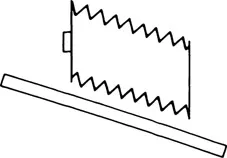
Figure 1-5 View camera adjustments.
The need for perspective, sharpness, and cropping controls by photographers who want to use roll film can be met by attaching a roll-film camera body or adapter to the back of a view camera. A lens that can be moved off center in different directions with respect to the film, providing some perspective and cropping control with a 35-mm camera, was introduced as the PC (perspective control) lens by Nikon in 1962.
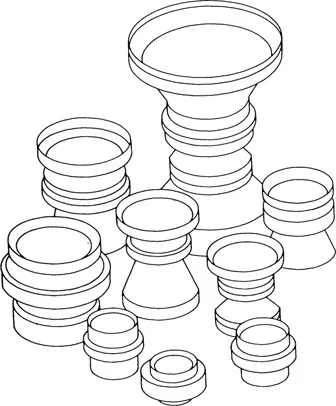
Figure 1-6 Interchangeable lenses.
1.4 Interchangeable Lenses
Since lenses need to be attached only to the proper lens board to be used on a view camera, almost any lens that has adequate covering power can be used (Figure 1-6). This feature provides the photographer with control over the size of the image and the area of the scene included on the film with the camera in a fixed position. It also enables the photographer to change the camera-to-subject distance while maintaining the...
Table of contents
- Cover
- Half Title
- Title
- Copyright
- Contents
- Acknowledgments
- 1 View Cameras
- 2 View Camera Adjustments
- 3 Image Formation
- 4 Exposure Controls
- 5 View Camera Lenses
- 6 Image Size and Perspective
- 7 Depth of Field
- 8 Exposure Meters
- 9 Light-Sensitive Materials and Film Processing
- 10 Filters
- 11 Evolution of the View Camera
- 12 Contemporary View Cameras
- 13 Applications of View Camera Photography
- Index
Trusted by 375,005 students
Access to over 1.5 million titles for a fair monthly price.
Study more efficiently using our study tools.
Frequently asked questions
Yes, you can cancel anytime from the Subscription tab in your account settings on the Perlego website. Your subscription will stay active until the end of your current billing period. Learn how to cancel your subscription
No, books cannot be downloaded as external files, such as PDFs, for use outside of Perlego. However, you can download books within the Perlego app for offline reading on mobile or tablet. Learn how to download books offline
Perlego offers two plans: Essential and Complete
- Essential is ideal for learners and professionals who enjoy exploring a wide range of subjects. Access the Essential Library with 800,000+ trusted titles and best-sellers across business, personal growth, and the humanities. Includes unlimited reading time and Standard Read Aloud voice.
- Complete: Perfect for advanced learners and researchers needing full, unrestricted access. Unlock 1.5M+ books across hundreds of subjects, including academic and specialized titles. The Complete Plan also includes advanced features like Premium Read Aloud and Research Assistant.
We are an online textbook subscription service, where you can get access to an entire online library for less than the price of a single book per month. With over 1.5 million books across 990+ topics, we’ve got you covered! Learn about our mission
Look out for the read-aloud symbol on your next book to see if you can listen to it. The read-aloud tool reads text aloud for you, highlighting the text as it is being read. You can pause it, speed it up and slow it down. Learn more about Read Aloud
Yes! You can use the Perlego app on both iOS and Android devices to read anytime, anywhere — even offline. Perfect for commutes or when you’re on the go.
Please note we cannot support devices running on iOS 13 and Android 7 or earlier. Learn more about using the app
Please note we cannot support devices running on iOS 13 and Android 7 or earlier. Learn more about using the app
Yes, you can access View Camera Technique by Leslie Stroebel in PDF and/or ePUB format, as well as other popular books in Media & Performing Arts & Digital Media. We have over 1.5 million books available in our catalogue for you to explore.