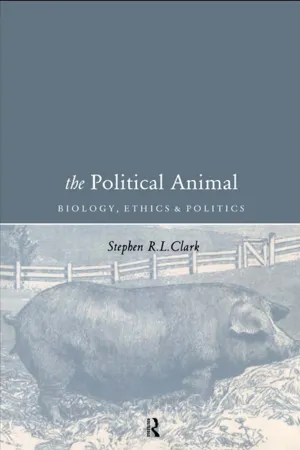
- 224 pages
- English
- ePUB (mobile friendly)
- Available on iOS & Android
eBook - ePub
About this book
People, as Aristotle said, are political animals. Mainstream political philosophy, however, has largely neglected humankind's animal nature as beings who are naturally equipped, and inclined, to reason and work together, create social bonds and care for their young. Stephen Clark, grounded in biological analysis and traditional ethics, probes into areas ignored in mainstream political theory and argues for the significance of social bonds which bypass or transcend state authority.
Understanding the ties that bind us reveals how enormously capable we are in achieving civil order as a species. Stephen Clark advocates that a properly informed political philosophy must take into account the role of women, children, animals, minorities and the domestic virtues at large. Living and comnducting our political lives like the animals we are is a more congenial prospect than is usually supposed.
Information
1 Aristotle’s woman1
When writing a study of Aristotle’s anthropology in the early 1970s (namely, Aristotle’s Man), I assumed that his account of the nature and possible well-being of humankind applied indifferently to male and female.2 I reserved for an appendix those of his remarks which made a radical distinction between the two varieties. On that occasion I attempted the claim that his denigration of women was a relic of Platonism, that there were traces in his thought of a more liberal analysis, and that women should reasonably aim for the same well-being as males. Aristotle, of course, held to Gorgias’s view, not Socrates’, that virtue is a various thing – a young man’s virtue is not an old woman’s; a man would be cowardly if his courage were no more than a courageous woman’s; a woman forward if her modesty were no greater than a good man’s.3 Many such virtues are needed for a good commonwealth, and civic virtues (of the male) must take precedence above familial virtues (largely of the female).
Man is a political animal, whose well-being resides primarily in the exercise of theoretical, secondarily of political and practical, virtue. We ought (compendiously) to worship and serve the divine in the mode proper to a deliberative and social creature. Ought women, in Aristotle’s view, to do the same? If man is a political animal, what is woman?
One answer – the one I gave before – is that ‘man’ here translates ‘anthropos’. There may be differences between male and female, but none that are relevant to intellectual and ethical capacity. This response gains force from the comedy of cherchez la différence, immortalised in Paul Jennings’ duo: man Erith, woman Morpeth (Jennings 1963, p. 16). It is very difficult to think of any significant, nonphysical difference which would not be instantly disproved within our own acquaintance. Socrates, by Xenophon’s account in Symposium II, insisted that women were, or could be, the equals of men in courage and assurance, though perhaps inferior in strength and steadiness of judgement. By Plato’s account (Republic, 451 f.), he argued from the supposed equality of the sexes in animals (e.g. dogs) to that of humans – though here, too, women are accounted generally weaker than males, and it is not clear that the proposed equality of male and female auxiliaries is intended to affect the life of the common people.4
Musonius said that horse riders and huntsmen make no difference in the training of males and females: female dogs are taught to hunt just as male dogs are, and anyone who wants a mare to perform a horse’s tasks gives her the same training as a stallion. So why should male human beings be given a different education and upbringing from females? Don’t men and women need to acquire the same virtues, and can’t they do so from the same education? A man must think; so must a woman. What is the use of a fool, of either sex? And each needs justice as much as the other. A man cannot be a good citizen if he is unjust; a woman cannot manage her household well if she doesn’t do so justly.5
Musonius, a late Roman Stoic, was a good and consistent feminist. But Aristotle would point even here to an admission that male and female duties are diverse: men for the city, women for the household. Luther said the same, at least of fallen humanity:
(Man) rules the home and the state, wages wars, defends his possessions, tills the soil, builds, plants....The woman is like a nail driven into the wall: she should stay at home and look after the affairs of the household, as one who has been deprived of the ability of administering those affairs.6
It is not a view wholly without influence in our own day.
Aristotle rejects Socrates’ proposal on the grounds that humankind is one particular animal species – wild beasts don’t form households (Politics, 2.1264b4 f.). Because humans do, in Aristotle’s view, male and female excellences are significantly different. Xenophon’s Ischomachus suggests that male and female join together in marital companionship to produce and rear children, for the comfort of their own old age, and to keep their possessions (Oeconomicus, 7.18). Marriage, in Athenian terms, is the gift of a daughter for the maintenance of a household, and children are its pledges – childless marriages don’t last.7 Women, being more sensitive to heat and cold, more affectionate to their children, more timorous, are better fitted to the indoor life, and males to the outdoor life. Unlike Aristotle, Ischomachus adds that women can be men’s equals in memory and self-control. Aristotle thought their memory superior:
Woman is more compassionate than man, more easily moved to tears, at the same time is more jealous, more querulous, more apt to scold and strike. She is more prone to despondency and less hopeful than the man, more void of shame or self-respect, more false of speech, more deceptive and of more retentive memory. She is also more wakeful, more shrinking, more difficult to rouse to action and needs less food.
(Historia Animalium, 9.608b11 f.)
In brief, woman is cold and wet (De Generatione Animalium, 1.729a28 ff.).
Aristotle agreed with Socrates in this, that women were weaker than men, and with less steady judgement. Particular cases might appear to refute this claim, but they are precisely ‘unnatural’ pairings, ones in need of special explanation. Women have deliberative capacity, but without authority (Aristotle, Politics, 1.1260a12 f.). That he gives no argument for this claim – as Mulgan complains – is true, but it is easy enough to see what his reasons were.8 Even Xenophon’s Socrates expresses some doubt as to whether women could be responsible for their failings (Oeconomicus, 3.11). Women were so much less able to withstand their own passions as not properly to be called akratic at all.9 A common enough view: ‘to be a slave of pleasure is the behaviour of a licentious woman, not a man’ (Anaxandrides fr. 60.17); ‘I know grown men who are no better than women in defending themselves against the assaults of Aphrodite upon the heart of youth; but they are male, and that helps them’ (Euripides, Hippolytos, 967 ff.). Women can be clever enough, but their cleverness is tricky, not sound moral intelligence. Too often they do what they want, not what they think they should. Xenophon’s Socrates, again, is driven to complimenting Ischomachus on his wife’s ‘masculine mind’ (Oeconomicus, 9.19), displayed in a readiness to draw logical conclusions and attend to her duties. Women need the discipline of a good householder. So Sparta, by Aristotle’s account, was ruined: that the males were dominated by their wives, in whose hands the property had gathered (Politics, 2.1269b12 ff.). Even Athenian women, who could not themselves inherit property, were feared if they brought riches with them. Their power was not only psychological (as might a Victorian wife’s be), but economic: divorce would lose their lord the dowry, or the property they belonged to. ‘It is in their role as transmitters of property that the community displays concern for and extends protection to its women’.10 Property must not be left masterless, and unnatural unions, where women gained too much power, led to trouble (Aristotle, Nicomachean Ethics, 8.1160b33). In Athenian law, by the way, a will could be invalidated if drawn up under the influence of old age, insanity, drugs or women (ps. Demosthenes, 46.14). The Spartan example was a warning: their womenfolk showed less courage than others when their land was invaded.11
How can any of this be defended or made to seem reputable? Is this not the same sort of fantasy as produced the picture of strong, thick-skinned morons to serve as natural slaves? Surely humankind is but one species, one form? Aristotle says as much (Metaphysics, 9.1058a29), adding that ‘male’ and ‘female’ are like ‘dark’ and ‘pale’ – they name no specific difference. But that is not the end. Women are infertile males. When the paternal principle of motion has failed to gain full mastery of maternal material, moulding it to the father’s form, the result is a female (De Generatione Animalium, 4.766a18 f.). The woman cannot sufficiently concoct her blood to produce a living being (Ibid., 2.738a34), because she is colder (Ibid., 4.765b8 f.). Because she is colder, we may conclude, she is also less confident, less strong, less able to resist test and temptation. That, too, is why women, like children, have high voices: the deep voice is the sign of a nobler nature (Ibid., 5.787a1 f.), and women are too weak. Castration turns the male back to the female state (Ibid., 5.787b20 f.), though Aristotle does not seem to notice here that eunuchs do not commonly bear children.12 Intemperate, or undisciplined, women, be it noted, are calmed down by childbirth (Aristotle, De Generatione Animalium, 4.774a3 f.) – their unconcocted residues expelled at last. Note also that Aristotle is not consistent in his ruling that women cannot strictly be ‘intemperate’.
Aristotle is aware that some features of women, as he observed them, are products of social conditioning. Their weakness in pregnancy could be alleviated by exercise (Ibid., 4.775a29 f.), and breath control. The legislator should insist that they pay daily visits to the temple (Aristotle, Politics, 7.1335b14 f.) – women do feature regularly in dedications and processions – and should not bear children till they are 18. Earlier childbearing is bad for children and mother alike – such was the reason why the oracle ‘Plough not the young fallow’ was given to the people of Troezen (Ibid., 7.1335a20). Ischomachus, whose wife was 15, also addresses himself to the need for exercise – though he thinks that sufficient will be gained from the daily potter round the house to see that housekeeper and maids are hard at work, and the wife’s own bread-making and blanket-folding (Oeconomicus, 10.10).
The luxury and cowardice (alleged) of Spartan women was also a failure of discipline. If wives are failing in virtue, the fault may be theirs, but must be the householder’s: Socrates asks Critoboulos if there is anyone to whom he entrusts more important matters and to whom he talks less than his wife (Ibid., 3.12). The good householder gives his wife things to do: his task to get, hers to keep. Thrift is a feminine virtue.13 The beginning of society lies with the independent householder, Cyclops-like, giving laws to his wife and children (Aristotle, Politics, 1.1252b23 f.). In a developed state, there may be a magistrate expressly to maintain order amongst women and children – though who could control the movements of the poor or the luxury of oligarchs’ wives (Ibid., 4.1300a4 ff.). Extreme democracies and tyrants favour women, and do not control them, for their gossiping may reveal plots, and they will not themselves revolt (Ibid., 5.1313b34 f.). Good statesman, good householder must take care.
Women who take too little exercise are sickly; women who are not well brought up nor given their proper duties will be licentious. But the same is true of males. Why should males have a monopoly of civic power or authoritative rationality?
Aristotle clearly thinks that the gap of achievement and character between male and female is not merely a cultural but a biological datum. That generation is a union of form and matter, that it is better for the form-bringer and the matter-bearer to be separate (Aristotle, De Generatione Animalium, 2.732a3 f.) ensures that the male is better endowed than the female. The female loses blood each month, so regularly suffers that debility (Ibid., 1.727a3 f.) that males suffer after seminal emission (Ibid., 1.725b17). The mother, we should note, is not simply an incubator, as other Greek thought sometimes suggests (Aeschylus, Eumenides, 655 f.).
Nature assigns no weapons to females – and so bees are not female (Aristotle, De Generatione Animalium., 3.759b3 f.) – for their ‘residue’ (the stuff not used for basic upkeep) is marked for use as foetal material. Equally, nature allows no males to care intimately for their young – so bees aren’t male either (Ibid., 3.759b3 f.). Fathers love their sons, but less than the mothers do (Aristotle, Nicomachean Ethics, 8.1161b26 f.). ‘Mother-love’ is Aristotle’s chief example of unselfish love (Ibid., 8.1159a28 f.), though he is no more eager than later commentators to give women any moral credit for this. Popular wisdom prefers to reckon a woman who fails in love a moral monster, while a male who manages it deserves the more credit for works of supererogation!
This difference of sexual role is greatest in humankind (Aristotle, Historia Animalium., 9.608b5 f.) just because humankind is the most perfect of animal kinds, one in which the opposites are most clearly distinguished and most fully collaborative. Humankind is a thing of couples, even more than of city-states (Aristotle, Nicomachean Ethics, 8.1162a17 f.; Politics, 1.1252a26 f.), for that is how the kind achieves its natural immortality. Male/female, master/slave, parent/child: these are the polarities on which all human society is founded.
Why does the male/female relationship have the character Aristotle imagines? What indeed is that character? Amongst barbarians women are treated as slaves, for barbarian males, too, are slaves, incapable of reasoned self-control (Politics., 1.1252b5 f.). The same error is made by the Persians in the relation of parent and child (Aristotle, Nicomachean Ethics, 8.1160b28 f.). The relation of natural master to natural slave should be despotic; of parent to child, aristocratic; of man to wife, that of a statesman over his subjects (Aristotle, Politics, 1.1259b1 f.). There is the chance of justice between man and wife, more than between man and children or possessions (Aristotle, Nicomachean Et...
Table of contents
- Cover Page
- Title Page
- Copyright Page
- Acknowledgements
- Introduction
- 1. Aristotle’s Woman
- 2. Slaves and Citizens
- 3. Is Humanity a Natural Kind?
- 4. Children and the Mammalian Order
- 5. Anarchists Against the Revolution
- 6. Bioregional Environmentalism and the Humanistic Culture
- 7. Good and Bad Ethology and the Decent Polis
- 8. Apes and the Idea of Kindred
- 9. Herds of Free Bipeds
- 10. Enlarging the Community
- 11. Nations and Empires
- References
- Publications By Stephen R.L. Clark
Trusted by 375,005 students
Access to over 1.5 million titles for a fair monthly price.
Study more efficiently using our study tools.
Frequently asked questions
Yes, you can cancel anytime from the Subscription tab in your account settings on the Perlego website. Your subscription will stay active until the end of your current billing period. Learn how to cancel your subscription
No, books cannot be downloaded as external files, such as PDFs, for use outside of Perlego. However, you can download books within the Perlego app for offline reading on mobile or tablet. Learn how to download books offline
Perlego offers two plans: Essential and Complete
- Essential is ideal for learners and professionals who enjoy exploring a wide range of subjects. Access the Essential Library with 800,000+ trusted titles and best-sellers across business, personal growth, and the humanities. Includes unlimited reading time and Standard Read Aloud voice.
- Complete: Perfect for advanced learners and researchers needing full, unrestricted access. Unlock 1.5M+ books across hundreds of subjects, including academic and specialized titles. The Complete Plan also includes advanced features like Premium Read Aloud and Research Assistant.
We are an online textbook subscription service, where you can get access to an entire online library for less than the price of a single book per month. With over 1.5 million books across 990+ topics, we’ve got you covered! Learn about our mission
Look out for the read-aloud symbol on your next book to see if you can listen to it. The read-aloud tool reads text aloud for you, highlighting the text as it is being read. You can pause it, speed it up and slow it down. Learn more about Read Aloud
Yes! You can use the Perlego app on both iOS and Android devices to read anytime, anywhere — even offline. Perfect for commutes or when you’re on the go.
Please note we cannot support devices running on iOS 13 and Android 7 or earlier. Learn more about using the app
Please note we cannot support devices running on iOS 13 and Android 7 or earlier. Learn more about using the app
Yes, you can access The Political Animal by Stephen R L Clark,Stephen R.L Clark in PDF and/or ePUB format, as well as other popular books in Philosophy & Ethics & Moral Philosophy. We have over 1.5 million books available in our catalogue for you to explore.