International Cultural Tourism: management, implications and cases provides a comprehensive exploration of the management, operations and marketing of cultural tourism attractions and resources in a global context.
Topics explored include:
* For the first time, an evaluation of the use and transformational impact of global media and new ICT in the management and marketing of cultural tourism attractions and resources.
* The changing nature of the global cultural tourism marketplace (including demand, supply, product development and political changes).
* Consumer behaviour, profiles and motivations of cultural tourists.
* Environmental performance, management and wider issues of social and cultural sustainability.
Written by a team of contributors from Australia, Hong Kong, UK, US, Canada, Mexico, Portugal, South Africa and Finland, this text provides a thoroughly global insight into the issues and techniques involved in the successful management and marketing of cultural attractions.
* An overview of the way in which cultural tourism resources and attractions are managed and marketed in a global context.
* Analysis of the demand, profiles and motivation of tourists
* An investigation of the transformational and dynamic impacts of new technologies on cultural resources and products
* International contributor team provide case studies from first-hand experience and research
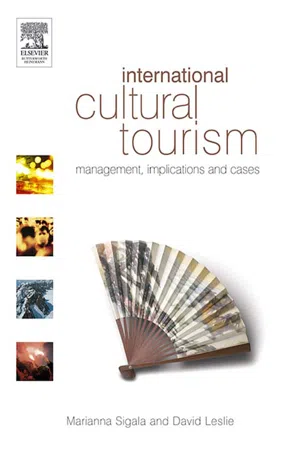
- 288 pages
- English
- ePUB (mobile friendly)
- Available on iOS & Android
eBook - ePub
International Cultural Tourism
About this book
Heritage and Cultural Tourism and Products
DOI: 10.4324/9780080455471-1
Heritage and cultural tourism: a marketing – focused approach
DOI: 10.4324/9780080455471-2
Introduction
As an industry, tourism is highly service driven. Tourism provides products and services for people participating in activities in places other than their residence. According to Leiper (1979), the tourism industry consists of all those firms, organizations and facilities that are intended to serve the specific needs and wants of tourism. A more explicit way of describing tourism is to consider it as ‘… representing the sum of those industrial and commercial activities producing goods and services wholly or mainly consumed by foreign visitors or by domestic tourists’ (Ritchie and Goeldner, 1994, p. 72). However, tourism has unique characteristics that differentiate it from other industries. Unlike other industries, which have their own distinct products or services, tourism usually contains multiple products or services, and these often involve the co-operation of several suppliers. For example, a vacation package may include services provided by travel agents, airlines, hotels, restaurants and other related services. Although each of these individual businesses contributes to developing the tourism product – namely, a vacation – an individual business could not provide the product on its own. As Seaton and Bennett (1996, p. 4) noted: ‘Tourism is not a homogeneous market like that, say, for breakfast cereals, cars or cat food. It is a heterogeneous sector which consists of several product fields, albeit ones which have a degree of linkage’.
The word ‘heritage’ in its broader meaning is frequently associated with the word ‘inheritance’, that is, something transferred from one generation to another. The role of heritage as a carrier of historical value from the past means that it is seen as part of the cultural tradition of society. The concept of ‘tourism’, in contrast, is a form of modern consciousness: ‘Tourism's fundamental nature is dynamic, and its interaction with heritage often results in a reinterpretation of heritage. In its essence, the relationship between heritage and tourism parallels the debate that takes place within a society's culture between tradition and modernity’ (Nuryanti, 1996, p. 250). During the past three decades, heritage and tourism have become inextricably linked throughout the world. Tourism is used as an economic justification for heritage preservation. Tourism also serves to preserve artefacts found in many parts of the world; indeed, historical artefacts and their associations have always been one of the tourism industry's most marketable commodities (Timothy, 1997). It can be argued that the early twentieth-century's ‘grand tour’ around historical sites in search of educational or cultural knowledge was, along with the tradition of the religious pilgrimage, one of the oldest motives for travel (Burkhart and Medlik, 1974).
The definition of heritage tourism is by no means a simple and clear issue. Balcar and Pearce (1996, p. 203) suggested that: ‘… heritage tourism is at present largely characterised by an expanding range of concepts and definitions, by a mix of individual case studies and more general discourses. Little specific agreement exists on what heritage tourism is, if indeed it is a separate phenomenon or how it should best be studied’. As with tourism, there are no widely agreed-upon definitions when referring to heritage tourism or to cultural tourism; in fact, there have been lively discussions (and in some cases strong disagreements) among researchers trying to distinguish cultural tourism from heritage tourism. A review of the best known definitions for heritage tourism and for cultural tourism is presented in the next pages of this chapter. However, for the purpose of this book, and in accordance with other researchers' views (Stewart et al., 1998), it can be stated at this point that the term ‘heritage tourism’ will be used to refer to historic sites and buildings and the experiences which people seek to have in them. In this context, the quality of the interpretative experience, the site's collection of antiquities, the environment surrounding the site and the site facilities will all be part of the ‘heritage tourism’ experience.
Overview of heritage and cultural tourism
The term ‘heritage and cultural tourism’ refers to that segment of the tourism industry that places special emphasis on heritage and cultural attractions. These attractions are varied, and include performances, museums, displays, archaeological sites and the like. In developed areas, heritage and cultural attractions include art museums, plays, and orchestral and other musical performances. Tourists may travel to specific sites to see a famous museum or to hear a special musical performance. In less developed areas, heritage and cultural attractions may include traditional religious practices, handicrafts and cultural performances.
As stated above, there is no single agreed definition of the term ‘heritage and cultural tourism’. Masberg and Silverman (1996, p. 20) expressed the problem in the following terms: ‘… despite the growing interest in heritage tourism, there is a surprising lack of understanding of how visitors define a heritage site and what the activity of visiting a heritage site means to them’. Below follows a summary of definitions found in the Current Literature on heritage and culture tourism. This review of the various suggested definitions lends support to the definition of heritage tourism as proposed for use in this book (historic sites and buildings and the experiences that people seek to have in them).
Exploring definitions for cultural tourism
The term ‘cultural tourism’ has been used interchangeably with ‘heritage tourism’. However, a number of researchers have tried to define cultural tourism by approaching it through a number of alternative ways. One of the best known conceptual definitions of cultural tourism has been provided by Richards (1997, p. 24), who stated that cultural tourism is ‘the movement of persons to cultural attractions away from their normal place of residence, with the intention to gather new information and experiences to satisfy their cultural needs’. However, Richards (1997, p. 24) provided also a technical definition of cultural tourism, stating that cultural tourism includes ‘all movements of persons to specific cultural attractions, such as heritage sites, artistic and cultural manifestations, arts and drama outside their normal place of residence’. According to Silberberg (1995, p. 361), cultural tourism is defined as ‘visits by persons from outside the host community motivated wholly or in part by interest in the historical, artistic, scientific or lifestyle/heritage offerings of a community, region, group or institution’. Fridgen (1991, p. 221) also described cultural tourism from the visitors' perspective, stating that ‘… for outsiders, the culture of an area can represent an attraction in and of itself. This is sometimes called cultural tourism’. Therefore, tourists interested in culture may seek exposure to local behaviours and traditions, to different ways of life or to vestiges of a vanishing lifestyle. Yet tourism permits only selective exposure to other cultures. However, Fridgen (1991, p. 221) also identified the partiality that cultural tourists experience and went on to note that ‘… frequently, an area's culture is displayed through stage presentations often for pay. Because tourists generally stay in an area for a short time, what the tourist actually sees is just a faint reflection of the true culture’.
Tighe (1991) examined three components of cultural tourism_ travel, the tourist and the sites. In particular, in terms of travel he stated that ‘cultural tourism is travel undertaken with historic sites, museums, the visual arts, and/or the performing arts as significant elements’ (Tighe, 1991, p. 387). In relation to the cultural tourist, Tighe (1990, p. 11) argued that he is ‘… one who experiences historic sites, monuments, and buildings; visits museums and galleries; attends concerts and the performing arts; and is interested in experiencing the culture of the destination’. However, in his earlier work Tighe (1986, p. 2) noted that the term ‘cultural tourism’ refers to ‘… historical and heritage sites, arts and crafts fairs and festivals, museums, the performing and visual arts; and is interested in experiencing the culture of the destination’. Hall and Zeppel (1990, p. 54) defined cultural tourism from an experiential approach, stating that cultural tourism is an experience ‘… based on being involved in and stimulated by the performing arts, visual arts, and festivals’. In addition, Hall and Zeppel (1990) observed a significant common element between cultural tourism and heritage tourism, namely the experiential element, and went on to note that heritage tourism, whether in the form of visiting preferred landscapes, historic sites, buildings or monuments, is also experiential tourism ‘… in the sense of seeking an encounter with nature or feeling part of the history of the place’ (Hall and Zeppel, 1990, p. 54).
Finally, the World Tourism Organization has provided a definition of cultural tourism as well, focusing on the travel motivations of tourist: ‘Cultural tourism includes movements of persons for essentially cultural motivations such as study tours, performing arts and other cultural tours, travel to festivals and other cultural events, visit to sites and monuments, travel to study nature, folklore or art or pilgrimages’ (World Tourism Organization, 1985, p. 131).
Exploring definitions for heritage tourism
A recent definition of heritage tourism was provided by Poria et al. (2001), focusing primarily on the tourists' motivations and not on the heritage product. According to Poria et al. (2001, p. 1048) ‘Heritage tourism is a phenomenon based on tourists’ motivations and perceptions rather than on specific site attributes … Heritage tourism is a subgroup of tourism, in which the main motivation for visiting a site is based on the place's heritage characteristics according to the tourists' perception of their own heritage’.
Another approach, mainly focusing on the past and on nostalgia, has been adopted by some other well-known researchers in heritage tourism; according to this view, heritage tourism is a form of special tourism that offers opportunities to portray the past in the present. Nuryanti (1996, p. 257) suggested that heritage tourism ‘… is characterized by two seemingly contradictory phenomena: the unique and the universal. Each heritage site has unique attributes; but heritage, although its meaning and significance may be contested, reinterpreted and even recreated, is shared by all’. In the same vein, Peterson (1994, p. 121) stated that ‘we think of heritage tourism as visiting areas which make the visitor think of an earlier time’. Zeppel and Hall (1992, p. 78) also supported the concepts of ‘nostalgia’ and of ‘special form of tourism’, noting that ‘heritage tourism is a broad field of speciality travel, based on nostalgia for the past and the desire to experience diverse cultural landscapes and forms’. In the same vein, Ashworth and Goodall (1990, p. 162) argued that ‘heritage tourism is an idea compounded of many different emotions, including nostalgia, romanticism, aesthetic pleasure and a sense of belonging in time and space’. Sharpley (1993, p. 132) provided an earlier (though broader) definition in the same approach, noting that ‘heritage is literally defined as what we have inherited from our past. Over the last decade, however, it has become more broadly applied and now the term is used to describe virtually everything associated with a nation's history, culture, wildlife and landscape’. Two years earlier, Yale (1991, p. 21) also adopted the ‘inheritance’ approach, suggesting that ‘heritage tourism is tourism centred on what we have inherited, which can mean anything from historic buildings, to art works, to beautiful scenery’.
A more technocratic approach was adopted by Prentice (1993), who focused on the ‘product element’ of heritage tourism. Prentice (1993, p. 36) suggested that ‘essentially in tourism, the term “heritage” has come to mean not only landscapes, natural history, buildings, artefacts, cultural traditions and the like which are literally or metaphorically passed on...
Table of contents
- Cover Page
- Half-Title Page
- Title Page
- Copyright Page
- Table of Contents
- Biographies of Contributors
- Introduction: The rationale and need for this book
- Part One Heritage and Cultural Tourism and Products
- Part Two Operations and Facilities Management
- Part Three Environmental Management and Sustainability
- Part Four New Media and Technologies
- Conclusion The future of the past: visions and trends for cultural tourism sector
- Index
Trusted by 375,005 students
Access to over 1.5 million titles for a fair monthly price.
Study more efficiently using our study tools.
Frequently asked questions
Yes, you can cancel anytime from the Subscription tab in your account settings on the Perlego website. Your subscription will stay active until the end of your current billing period. Learn how to cancel your subscription
No, books cannot be downloaded as external files, such as PDFs, for use outside of Perlego. However, you can download books within the Perlego app for offline reading on mobile or tablet. Learn how to download books offline
Perlego offers two plans: Essential and Complete
- Essential is ideal for learners and professionals who enjoy exploring a wide range of subjects. Access the Essential Library with 800,000+ trusted titles and best-sellers across business, personal growth, and the humanities. Includes unlimited reading time and Standard Read Aloud voice.
- Complete: Perfect for advanced learners and researchers needing full, unrestricted access. Unlock 1.5M+ books across hundreds of subjects, including academic and specialized titles. The Complete Plan also includes advanced features like Premium Read Aloud and Research Assistant.
We are an online textbook subscription service, where you can get access to an entire online library for less than the price of a single book per month. With over 1.5 million books across 990+ topics, we’ve got you covered! Learn about our mission
Look out for the read-aloud symbol on your next book to see if you can listen to it. The read-aloud tool reads text aloud for you, highlighting the text as it is being read. You can pause it, speed it up and slow it down. Learn more about Read Aloud
Yes! You can use the Perlego app on both iOS and Android devices to read anytime, anywhere — even offline. Perfect for commutes or when you’re on the go.
Please note we cannot support devices running on iOS 13 and Android 7 or earlier. Learn more about using the app
Please note we cannot support devices running on iOS 13 and Android 7 or earlier. Learn more about using the app
Yes, you can access International Cultural Tourism by David Leslie,Marianna Sigala in PDF and/or ePUB format, as well as other popular books in Business & Hospitality, Travel & Tourism Industry. We have over 1.5 million books available in our catalogue for you to explore.