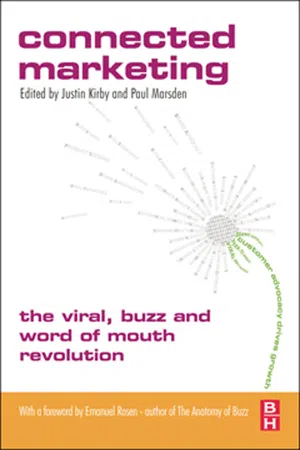
Connected Marketing is a business book about the state of the art in viral, buzz and word-of-mouth marketing. Written by 17 experts working at the cutting edge of viral, buzz and word-of-mouth marketing, Connected Marketing introduces the range of scalable, predictable and measurable solutions for driving business growth by stimulating positive brand talk between clients, customers and consumers.
Edited by marketing consultants Justin Kirby (Digital Media Communications) and Dr. Paul Marsden (Spheeris/London School of Economics), and with a foreword by Emanuel Rosen (author of the bestselling 'Anatomy of Buzz') Connected Marketing is a collaborative work written by 17 opinion-leading consultants and practitioners working at the cutting edge of viral, buzz and word of mouth marketing. Contributing authors to Connected Marketing are Stéphane Allard (Spheeris), Schuyler Brown (Buzz@Euro RSCG), Idil Cakim (Burson-Marsteller), Andrew Corcoran (Lincoln Business School), Steve Curran, (Pod Digital), Brad Ferguson (Informative), Justin Foxton (CommentUK), Graham Goodkind (Frank PR), Justin Kirby (Digital Media Communications), Paul Marsden (Spheeris), Liam Mulhall (Brewtopia), Greg Nyilasy (University of Georgia), Martin Oetting (ESCP-EAP European School of Management), Bernd Röthlingshöfer (Independent), Sven Rusticus (Icemedia), Pete Snyder (New Media Strategies) and Thomas Zorbach (vm-people).
Connected Marketing shows how businesses can harness connectivity between clients, customers and consumers as powerful marketing media for driving demand.
- 216 pages
- English
- ePUB (mobile friendly)
- Available on iOS & Android
eBook - ePub
Connected Marketing
About this book
Part One
Connected Marketing Practice
1
Seed to spread: how seeding trials ignite epidemics of demand
Picture this: a marketing research department operating as a profit centre, not only generating intellectual capital but also driving sales through word of mouth outreach programmes with opinion leaders. Sounds like a fantasy? Well, think again. Big brands such as Procter & Gamble, 3M, DreamWorks SKG, Microsoft and Google are all harnessing the power of research to optimize product launches. How? Through seeding trials – sampling conducted in the name of research, designed to transform opinion leaders into loyal adopters and word of mouth advocates.
Seeding trials: ‘It’s research, Jim, but not as we know it’
When most people think of marketing research, they tend to think of research rather than marketing. Indeed, marketing research is formally defined as identifying and measuring marketing opportunities and problems, evaluating marketing actions, or monitoring marketing performance.1
But there is a new breed of research that is putting the marketing back into marketing research: seeding trials. Seeding trials involve targeted sampling with opinion leaders, conducted in the name of research. Rather than simply offer free samples, previews, test-drives, etc. to opinion leaders, the idea behind seeding trials is to create goodwill, loyalty and advocacy by putting the product or service in their hands and giving them a say in how it is marketed. By involving opinion leaders in this way, by effectively inviting them to become part of your marketing department, you create a powerful sense of ownership among the 10% of your target clients, customers, or consumers who have the power to ignite word of mouth demand. By transforming these opinion leaders into word of mouth advocates through seeding trials, companies are using marketing research to ignite word of mouth networks and accelerate sales. As Star Trek’s Dr McCoy might have said: ‘It’s research, Jim, but not as we know it.’
Seeding trials in action: Post-it Notes
The power of seeding trials in transforming the fortunes of a brand is no better illustrated than through the intriguing history of Post-it Notes, the little yellow stickies from the office supplies company 3M. The story started in 1968, when 3M asked one of its researchers, Dr Spence Silver, to develop a new super-sticky adhesive. Unfortunately Dr Silver failed, and did so quite spectacularly. What he came up with was super-weak glue that wouldn’t stay stuck. Consigned to the back shelves of 3M’s R&D lab for six years, the fruits of the failed innovation project were virtually forgotten.
Then on one Sunday in 1974, Art Fry, a new product development researcher for 3M, had a ‘Eureka’ moment while cursing scrap paper bookmarks that kept falling out of his church choir hymnal. Perhaps the un-sticky glue could be used to make bookmarks? The idea of Post-it Notes was born. Unfortunately, when this concept of temporary sticky paper bookmarks was tested in research, it bombed. Nobody could see a use for them. However, and despite ‘kill the programme’ calls from management, Fry convinced 3M to run a limited test launch of Post-it Notes. Unfortunately, that failed too. Post-it Notes were doomed.
Before pulling the plug on the whole sad affair, 3M decided to run a seeding trial with opinion leaders in its target market – a sampling initiative conducted in the name of research. The company identified secretaries to CEOs in large companies all across America as opinion leaders for office supply products, and sent them boxes of Post-it Notes, inviting them to come up with ideas for how the little yellow stickies could be used.The seeding trial generated goodwill and advocacy from these opinion-leading secretaries who – flattered by the invitation to be involved in the development and commercialization of a new product – were transformed into Post-it Notes brand champions. The ‘useless’ Post-it Notes soon started appearing on memos, desks, diaries, drafts, reports and correspondence, and spread like an infectious rash through and between companies. The rest is, as they say, history. Post-it Notes had been saved by a seeding trial, transformed from failure to a multi-million dollar and highly profitable brand by a group of opinion-leading secretaries.2
The science bit: why seeding trials drive demand
Why did a seeding trial, targeted sampling conducted in the name of research, transform the fortunes of Post-it Notes? To answer this question, we need to understand two things: first, a peculiar psychological phenomenon known as the Hawthorne Effect; and second, the critical role of opinion leaders in driving sales.
The Hawthorne Effect
Back in the 1930s, a team of researchers from the Harvard Business School were commissioned to run some employee research for the telecom giant Western Electric (now Lucent Technologies). Conducted at the company’s production plant in Hawthorne, near Chicago, the research programme involved inviting small groups of employees to trial various new working conditions before rolling them out to the general workforce. To the researchers’ amazement, the participants seemed to like whatever was trialled, to such an extent that their productivity increased! For example, when researchers invited participants to trial working in brighter lighting conditions, productivity increased. But then when they trialled dimmer lighting conditions, productivity also increased. In fact, productivity kept increasing in successive trials of working under progressively dimmer lights, until the lighting was no stronger than moonlight! In another trial, the research participants were invited to test working shorter hours, and sure enough their productivity increased again. Indeed, subsequent trials showed that the more breaks the research participants were given and the less time they worked, the greater their productivity. But then, when the researchers asked them to trial longer hours, productivity went up again – to an all-time high.3
When taken together, the results of the various Hawthorne studies showed that whatever the researchers asked participants to discuss and trial resulted in an increase in productivity. The team of Harvard researchers, led by Elton Mayo, realized that their results had nothing to do with what was being trialled and everything to do with running research trials. By singling out a small group of employees to participate in an exclusive trial, participants felt valued, special and important. The special attention they received gratified their ego and created a positive emotional bond with what they were trialling. The practical upshot was that the research trials effectively transformed the research participants into advocates for whatever it was they were trialling. A series of further trials found this phenomenon to be more or less systematic, and the research team coined the term ‘The Hawthorne Effect’ to describe the goodwill and advocacy that research trials generate among research participants.
The Hawthorne Effect: how to win friends and influence people
If the psychology of the Hawthorne Effect all seems a bit abstract, try it for yourself and see how powerful it is. The next time you want something from someone (a salary increase, a date, or whatever), first do some ‘research’ with them by asking them for their advice on some matter. It doesn’t actually matter what it is that you ask them their advice on; the important thing is to be seen to be listening to what they have to say, and then to tell them that you appreciate their opinion.
Then, simply ask them for whatever it is you want from them. The chances are that your ‘research’ will have triggered the Hawthorne Effect and you will get what you want. By asking them for their opinion you will have not only created goodwill but also flattered their ego. At a subconscious level, they will feel indebted to you. This psychological indebtedness makes them significantly more likely to agree to whatever it is you are asking of them.
By seeing the Hawthorne Effect in action, you’ll realize that it is a very powerful influence technique; you’ll also know to watch out the next time someone asks you for your advice and then asks you for something!
It is this Hawthorne Effect, harnessed by seeding trials, that transforms opinion leaders into loyal adopters and powerful word of mouth advocates. By turning opinion-leading target buyers into product or service evangelists using the Hawthorne Effect, a brand can create a powerful volunteer sales force.
The truth about opinion leaders
Simply by finding and reaching those few special people who hold so much social power, we can shape the course of social epidemics … Look at the world around you … With the slightest push – in the right place – it can be tipped … (Malcolm Gladwell, The Tipping Point).4
With the possible exception of Tom Peters’s Thriving on Chaos,5 The Tipping Point by Malcolm Gladwell is perhaps the most influential and widely read book to date on the power of word of mouth. Voted by Forbes as one of the most influential business books of the past two decades, this international bestseller uses the science of social epidemics (runaway word of mouth) to outline a simple three-point formula for how word of mouth hits happen: ‘the Law of the Few’, ‘the Stickiness Factor’ and ‘the Power of Context’. While the Stickiness Factor and the Power of Context deal with the ‘what’ and the ‘where’ of word of mouth (having something intrinsically worth talking about, in an environment conducive to word of mouth spread), the Law of the Few addresses the ‘who’, reminding us that the opinions of 10% of any target market will drive the buying behaviour of the other 90%.
Although Gladwell uses the language and jargon of epidemiology to unpack the concept of opinion leadership, the idea behind the Law of the Few is an established business truth dating back to the 1940s. Indeed, evidence for the Law of the Few was first produced in a 1940 landmark study on media influence conducted by Columbia University.6 The research found, contrary to what might be expected, that mass-media messages do not directly influence the mass market but instead influence a small minority of individuals who then influence their peers through word of mouth. The researchers coined a new term for these hubs of word of mouth mediating mass-media messages – ‘opinion leaders’ – proposing a new ‘two-step flow’ model of media influence to replace the discredited ‘magic bullet’ or ‘hypodermic needle’ model of direct media influence.
Since the discovery of opinion leaders, research across just about every product and service category has found that the opinions of an opinion-leading 10% do indeed tend to shape the opinions and purchases of the opinion-following 90%.7 Opinion leaders, simply defined as target buyers who frequently offer or are elicited for category-related advice by their peers, can include high-profile industry experts, journalists, reviewers and media celebrities. However, the vast majority of opinion leaders in any target market are simply regular clients, customers, or consumers, except for the fact that they have a peculiar ‘connected and respected’ profile – they are highly connected hubs of word of mouth in their social networks with opinions that are respected by their peers. Thus, the influence of opinion leaders derives not from media appearances but from what sociometricians call ‘network centrality’ – they are word of mouth hubs, who connect everybody to everybody by six degrees of separation, and in doing so connect businesses to their target markets.
Figure 1.1 Models of media influence

Because of the importance of opinion leaders in driving sales, a good deal of...
Table of contents
- Cover
- Halftitle
- Title
- Copyright
- Dedication
- Contents
- Contributors
- Foreword
- Acknowledgements
- Trademarks
- Introduction and summary
- PART One Connected Marketing Practice
- PART Two Connected Marketing Principles
- Index
Trusted by 375,005 students
Access to over 1.5 million titles for a fair monthly price.
Study more efficiently using our study tools.
Frequently asked questions
Yes, you can cancel anytime from the Subscription tab in your account settings on the Perlego website. Your subscription will stay active until the end of your current billing period. Learn how to cancel your subscription
No, books cannot be downloaded as external files, such as PDFs, for use outside of Perlego. However, you can download books within the Perlego app for offline reading on mobile or tablet. Learn how to download books offline
Perlego offers two plans: Essential and Complete
- Essential is ideal for learners and professionals who enjoy exploring a wide range of subjects. Access the Essential Library with 800,000+ trusted titles and best-sellers across business, personal growth, and the humanities. Includes unlimited reading time and Standard Read Aloud voice.
- Complete: Perfect for advanced learners and researchers needing full, unrestricted access. Unlock 1.5M+ books across hundreds of subjects, including academic and specialized titles. The Complete Plan also includes advanced features like Premium Read Aloud and Research Assistant.
We are an online textbook subscription service, where you can get access to an entire online library for less than the price of a single book per month. With over 1.5 million books across 990+ topics, we’ve got you covered! Learn about our mission
Look out for the read-aloud symbol on your next book to see if you can listen to it. The read-aloud tool reads text aloud for you, highlighting the text as it is being read. You can pause it, speed it up and slow it down. Learn more about Read Aloud
Yes! You can use the Perlego app on both iOS and Android devices to read anytime, anywhere — even offline. Perfect for commutes or when you’re on the go.
Please note we cannot support devices running on iOS 13 and Android 7 or earlier. Learn more about using the app
Please note we cannot support devices running on iOS 13 and Android 7 or earlier. Learn more about using the app
Yes, you can access Connected Marketing by Justin Kirby,Paul Marsden in PDF and/or ePUB format, as well as other popular books in Business & Advertising. We have over 1.5 million books available in our catalogue for you to explore.