eBook - ePub
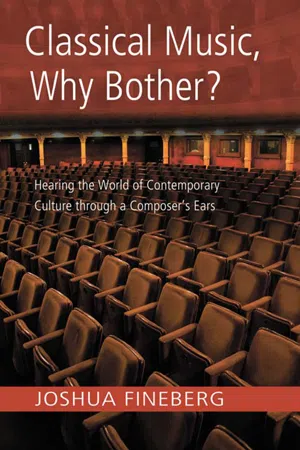
Classical Music, Why Bother?
Hearing the World of Contemporary Culture Through a Composer's Ears
- 184 pages
- English
- ePUB (mobile friendly)
- Available on iOS & Android
eBook - ePub
Classical Music, Why Bother?
Hearing the World of Contemporary Culture Through a Composer's Ears
About this book
The famous quip I don't know much about art, but I know what I like sums up many people's ideas about how to judge a work of art; but there are inherent limitations if we rely on immediate impressions in judging what should be enduring products of our culture. While some might criticize this as a return to elitism, Joshua Fineberg argues that without some way of determining intrinsic value, there can be no movement forward for creators or their audience. He draws on contemporary thought about Design space and Universal Grammar to show how intrinsic values can be rediscovered. He then looks at the importance of multimedia in allowing multiple points of entry for the discovering of new works, finally showing how the composer can Design music for human beings--creating a kind of art that can preserve the research agenda of conceptual work without renouncing the understanding of human listeners and performers embodied by craft. Classical Music: Why Bother? will intrigue all listeners of contemporary music, students of musical thought, and composers-but it will also interest students of contemporary aesthetics. It answers the age-old question How can we bring a new audience to contemporary art? - and challenges both the creators and their audience to broaden their ideas about what is valuable and lasting in today's culture.
Information
1
AESTHETIC VALUE
It is now taken for granted that nothing which concerns art can be taken for granted any more: neither art itself nor art in its relationship to the whole, nor even the right of art to exist.— Theodor W. Adorno
“Wait one second,” you say. “Art is not so imperiled as all that.” You might be thinking something along the same lines as Alice Goldfarb Marquis, an independent scholar who works in various fields as a sort of arts journalist and cultural critic. She likes to take the contrarian's perspective that what the arts need is less government support (not more), therefore she regularly shows up on panel discussions about arts subsidies; in a “crossfire” world people who take an opposing view are always precious, even if the debates are sponsored by subsidized organizations. At the conclusion of Art Lessons: Learning from the Rise and Fall of Public Funding, her rather damning critique of well-meant but, she believes, ultimately misguided arts funding in the late-twentieth century, Dr. Marquis asserts that the National Endowment for the Arts is a group that “purveys a multitude of fictions: […] that non-profit arts deserve support while commercial arts do not; that there exists a distinct cultural realm worthy of subsidy, a realm easily distinguished from simple entertainment; and worst of all that the arts in America would perish without federal intervention.”1
Like Dr. Marquis, you are probably thinking that we have had painting since at least the cave paintings in Lascaux and Chauvet (ca. 25,000 years ago); and it appears that even the Neanderthals made music with tuned bone flutes. Indeed, even in my worst fits of alarmism, I do not claim that music and the visual arts are in any danger of disappearing from the world. But Adorno meant something slightly more, or different, than that when he referred to “art.”
One of the fictions Marquis feels the NEA purveys is the existence of a “cultural realm worthy of subsidy, a realm easily distinguished from simple entertainment.” And it is this particular realm, fictional though it may be, that I fear is in danger of disappearing. I believe the passage of this realm out of our world would be tragic — even for the vast majority of people who have no interest in art that is made there.
Dr. Marquis believes that the arts in America have declined from what she perceived to be a high point in the twenty years after World War II toward ever-lower depths. She blames this decline on the cumulative effects of a centralized bureaucratic source of government arts support (the NEA) and, more generally, of the nonprofit structure of arts organizations and universities in America. She believes that these kinds of institutions inevitably reward mediocrity. By focusing only on America and only on the second half of the twentieth century, she can ignore the defects of earlier funding schemes — used by assorted states, princes, kings, and popes — that nonetheless produced art she would have more trouble summarily dismissing. She can blame ineffective bureaucracies and conservatism, as if these were new problems. All of her sociological and economic data do show changes in the acceptance and importance of subsidized art, but I think they are not the changes she believes them to be. There has been a slow shift in worldview over the last hundred years or so that has accelerated in the last thirty years. This change is as far-reaching in its own way as the Copernican revolution. Fifty years ago the cultural realm that Marquis mocks would still, in fact, have been worthy of subsidy, not because the NEA said so and not because it was easily distinguishable from simple entertainment, but because it was better: The art produced within this realm had more worth, or so the public and government believed. (I do not intend to imply that it was therefore easier to get funding — people's attachment to their money has not changed — only that the premise behind subsidizing art was widely accepted even though this art was no more popular in absolute terms at that time.)
The psychologist Nicholas Humphrey wrote a book debunking claims of paranormal activity, called Leaps of Faith, 2 in which he quite persuasively argues that, in spite of all their surface differences, all religions (and more broadly all belief in the supernatural) are at least tacitly dependent on a dualist view of existence. Belief in afterlives, reincarnations, miracles, divinities, and so on, all fundamentally depend on a more basic belief in an immaterial soul — or at least in the existence of a nonphysical, nonmaterial realm. Likewise, a true belief in art is also predicated on an underlying conceptual framework that depends just as absolutely on a belief in abstract criteria of worth. This notion, which is profoundly out of fashion today, has formed the underpinning of artistic endeavor in the West for a very long time. Adherents of this idea believe that even if societal fashions or institutional structures are opposed to a particular artist or work, some essential greatness (or lack thereof) will ultimately determine the worth of the art object if given the chance. And even if the work is never recognized, it is still of equal (albeit latent) value. In other words, a Rembrandt hanging in the woods would still be great even if no one had the good fortune to see it. Partisans in the “culture wars” tried to attack these notions, but that battle mixed the issue of what should be in the canon with whether there should be a canon at all. Moreover, it constantly mixed artistic values and political ones in a way that eliminates the possibility of really discussing art.
Contrary to most contemporary ways of thinking, I believe that taste and social constructions are of decidedly secondary importance if there is such a thing as intrinsic value or worth. Composers often speak of pieces being well constructed or clever, even sometimes brilliant — and then say that they don't particularly care for them. This is because they see personal preference as being much less important and enduring than these other, harder to define criteria of worth. This should not be an unfamiliar concept, because it is for this very reason that even real Shakespeare haters are unlikely to criticize the quality of his verse. We can all feel the genius even if we are not all sensitive to the charms (at least this is what I tell myself).
Some composers have no doubt begun to bristle by this point, thinking that they are not so cavalier as to completely disregard public taste and societal demand. And though they may even believe this, ultimately they are wrong. If taste and society were the real yardstick, then the Billboard Hot 100 would be the true arbiter of worth and value (in the noneconomic sense, as it already is in the economic sense) and any “classical” composer holding that view is in the wrong business. This is not to say (as some have done) that success is a reflection of low cultural value: It is merely to say that the worth of a work is ultimately either intrinsic to it (as I believe) and therefore completely independent of success or a lack thereof, or it is determined by societal reception — in which case the most flash-in-the-pan “boy band” is “better” than just about any “classical” composer. From this point of view, while an individual composer may feel he is considering both his audience and posterity, the work will ultimately be valued either solely on its intrinsic merits (if there are such things) or solely on the reception it receives. Whether high ideals or low commerce motivated the work is ultimately irrelevant; the value or reception of the work will be what counts, not the creator's intentions or motivations.
Moreover, if you believe that something like intrinsic value exists, then the outreach efforts many arts organizations make seem quite puzzling. If the cost of reaching people is to destroy or at least dilute the “value” of what you are offering, then there is no gain to be had. Arts organizations are being subsidized to promote fine art, not mediocre entertainment. We must not forget that each ticket sold, each show repeated, is usually a financial loss, not a gain — even when the tickets are as expensive as seats at the Metropolitan Opera. The only possible (and therefore mandatory) gain achieved by subsidized art is cultural, not economic.
You may think there ought to be a middle way; things would certainly be easier for all of us if there were. Could we not somehow evaluate quality, accessibility, and popularity in some sort of astutely weighted equation that would make everyone happy? After many years of trying, however, I have never come up with a middle ground that does not sit on a very slippery slope. Every attempt to construct an intermediate framework seems rapidly to devolve into one of two opposing world-views: Any system for evaluating works ultimately depends on either public reception or an attempted assessment of the works' “intrinsic” merits. Ad hoc systems of this kind justify particular actions but don't address the underlying trends.
Some might object to my emphasis on this dichotomy, but our society has reached a junction where making a choice has become inevitable. To return to our analogy regarding the immaterial soul, one can claim to believe in a basically materialistic worldview and yet hope for an aphysical eternal afterlife; this is the essence of Pascal's wager. (Pascal's wager is the calculation that if there is no God there are no negative consequences from falsely believing in one; while if there is a God the price for disbelief is eternal damnation. Thus Pascal asserts that belief is by far the safer bet.) But times occur when one's life is truly in the balance, a choice between flesh and spirit is unavoidable, and neither option is without consequence. (I think this is why some creationists fight so hard against all forms of scientific proof: They realize that ultimately materialism and an immaterial soul cannot coexist.) Facing up to this dichotomous choice is not something most of us like to do.
We live in a deeply inconsistent society, where reliance on science and rationality is much greater (or at least widespread) than at any time in the past, yet large numbers of people still manage to believe in UFOs and government conspiracies conducted with perfect secrecy — not to mention the widespread religious fervor in contemporary America that rivals that of the Medieval era. Current debate about whether Intelligent Design is a rival to evolution that belongs in school or simply a religious fairy tale is only one instance where we will be forced to make a choice that will inevitably seem entirely unacceptable to a large group of people on the other side of the divide. Although humans are very good individually at not reconciling our incompatible beliefs, society ultimately makes choices and sets priorities, even if we don't realize it until many years later. In the domain of subsidized arts, I believe that we have reached such a decision point.
Let's back up a bit and look at what brought us here. It may well be that this crisis in belief, this elimination of hierarchies of value from our worldview, goes back to the secularization of culture that has proceeded since the Enlightenment. In speaking about cultural modernity, Jürgen Habermas recalls the following idea from Max Weber:
He characterized cultural modernity as the separation of the substantive reason expressed in religion and metaphysics into three autonomous spheres. They are: science, morality and art. These came to be differentiated because the unified world-views of religion and metaphysics fell apart. Since the 18th century, the problems inherited from these older world-views could be arranged so as to fall under specific aspects of validity: truth, normative Tightness, authenticity and beauty. Scientific discourse, theories of morality, jurisprudence and the production and criticism of art could in turn be institutionalized. Each domain of culture could be made to correspond to culture professions in which problems could be dealt with as the concerns of special experts.3
This system could work throughout the late eighteenth, nineteenth, and early twentieth centuries because we were willing to accept its premise that “truth, normative Tightness, authenticity and beauty” all existed; moreover, we were willing to believe that they could be evaluated and if not determined in absolute terms, at least they could be arranged hierarchically (e.g., this new theory is more true than the old one; because we can only add one more painting to this room we will take this one because it is more beautiful or more important). By the mid-twentieth century, thinkers like Thomas Kuhn were questioning this premise even with regard to truth. Kuhn believed that because some aspects of older theories might be more valid than some (usually peripheral) aspects of newer theories, it was unfair to think of the new theory as more “true.” Kuhn believed we should simply see these new ideas as a different “paradigm.”4 He felt that any sort of hierarchy was an illusion. He did not, however, take this further and suggest how one might proceed if we were to accept his ideas. Must we teach phlogiston theory along with everything else? If we cannot judge the validity of one idea over another, I think NASA is in for many more disappointing and costly failures in the future.
A belief in intrinsic values that can be evaluated has shaped our entire system of cultural production and delivery over several centuries. Museum curators, artistic directors, ministers of culture, music directors, and all sorts of nabobs from the chattering class were there to sift through the masses of mediocre work and find those with real quality. They were Habermas's “special experts,” and to get their positions they had to demonstrate the acuity of their judgment, at least in principle. With each choice they were to some extent placing their career on the line. A poor judgment reflected even more on them than on the artist who made the work, because they were the person who was supposed to know better. This was almost the inverse of the current pop music or market-oriented system, where music is played for demographically sorted focus groups, and — presuming the sampling techniques are adequate — it's immediately obvious what's a hit and what's a flop.
Over the last few decades, even the most revered cultural institutions have been affected by “market-think.” You need to have a clear theme or a marquee name: something to pull in the customer. But because even hit shows lose money, you also need to convince advertisers to be “sponsors.” Most major symphonies are giving marketing directors the equivalent of veto power over the music directors. If you look at covers of recent recordings by classical soloists you will be amazed at the amount of cheesecake or beefcake that goes into marketing. The fine young violinist Hilary Hahn has a Web site (http://www.hilaryhahn.com) that looks as though it should be the publicity site for a new show on the WB about a beautiful teen violinist and her struggle to balance being a teenager with the rigors of art and touring. (I want credit if they actually launch that series.) In 2004 The New York Times published a piece about how difficult it was for another attractive young violinist to be taken seriously after posing nude (with a carefully positioned violin) on her first album cover. She seemed to feel it especially unfair to judge her in this manner because her taste in music is so conservative. (God forbid we get beautiful, naked, contemporary music performers!) When you look at those photos and the seasons now offered by classical music institutions you have to wonder: Are they listening for the next great composition or performer who will transform how we hear, or are they instead looking for a cute girl or a sexy guy or a performer who wears strapless gowns or has an attitude, in an effort to repackage what they think is a recipe that works?
This is all over the cultural world. Does anyone believe that the Guggenheim exhibits on motorcycles or Armani suits are driven solely by their artistic merit and not the needs of sponsorship and patronage (read: advertising). Moreover, if they are merely being held to attract a “larger” public, what is the point when each ticket is sold at a loss anyhow?
One of the books I came across while doing research for this volume was Alvin Reiss's Don't Just Applaud — Send Money!5 This volume presents 139 pages of gadgets and gimmicks used by real arts groups to trick or at least prod people into supporting their causes. It contains no advice about the quality of art or really trying to help people grapple with what you are offering; it only offers stories of fund-raising successes, like the very successful effort of the Kamloops Art Gallery in Canada, which bought 1,500 ceramic cows, put them on display in a grass field, and then resold them to donors for twice what they paid. This was apparently so successful that the art gallery still stocks and resells (presumably at a profit) these ceramic cows. Other suggestions for how to help the arts in America included sending out joke-filled postcards soliciting donations. Another category of ideas included suggestions for how to completely reshape your programs to supposedly attract a public. The Long Wharf Theatre in New Haven brought in Julia Child to give a cooking demonstration — so perhaps The Food Channel is the real future of the arts. I think the blurb on the back cover sums up the strange attitude we often confront in the arts. Jane Alexander, then chairman of the NEA, says: “The bottom line he [Reiss] illuminates is this: Be as creative in your marketing and fundraising as you are at your art.” With that as her attitude is it any surprise that, tiny though the NEA's budget is, as of 1991 it managed to spend more than half (53 percent) on administration, grants panels, and “infrastructure.”6 After all, I'm sure the NEA feels that its administrative work is just as creative as the artists' projects.
Even the priests of the art religion have lost their faith and are looking for other reasons to convince the masses. The Louvre, an institution whose very existence demands a belief in absolute hierarchy of worth, has trouble with the notion. It held a series of conferences and then released a volume titled “What Is a Masterpiece?” In that volume, Jean Galard put it like this:
It is commonplace and convenient to say a film, a building or a book is a masterpiece: in other words that one places it among the works whose vast superiority, through excellence over all comers, one feels ready to proclaim. However, if forced to give one's arguments, if one has to make explicit the system (or at least the somewhat organized body of ideas) in which this excellence can be established, the idea of a master-piece becomes embarrassing. One might eve...
Table of contents
- Cover
- Half Title
- Full Title
- Copyright
- Contents
- Acknowledgments
- Prelude
- Chapter 1 Aesthetic Value
- Chapter 2 Taste
- Chapter 3 Concept and Craft
- Chapter 4 Elitism
- Chapter 5 Technology
- Chapter 6 Design Space
- Chapter 7 "Understanding" Music
- Chapter 8 Designing Music for Human Beings
- Coda
- Notes
- Index
Trusted by 375,005 students
Access to over 1.5 million titles for a fair monthly price.
Study more efficiently using our study tools.
Frequently asked questions
Yes, you can cancel anytime from the Subscription tab in your account settings on the Perlego website. Your subscription will stay active until the end of your current billing period. Learn how to cancel your subscription
No, books cannot be downloaded as external files, such as PDFs, for use outside of Perlego. However, you can download books within the Perlego app for offline reading on mobile or tablet. Learn how to download books offline
Perlego offers two plans: Essential and Complete
- Essential is ideal for learners and professionals who enjoy exploring a wide range of subjects. Access the Essential Library with 800,000+ trusted titles and best-sellers across business, personal growth, and the humanities. Includes unlimited reading time and Standard Read Aloud voice.
- Complete: Perfect for advanced learners and researchers needing full, unrestricted access. Unlock 1.5M+ books across hundreds of subjects, including academic and specialized titles. The Complete Plan also includes advanced features like Premium Read Aloud and Research Assistant.
We are an online textbook subscription service, where you can get access to an entire online library for less than the price of a single book per month. With over 1.5 million books across 990+ topics, we’ve got you covered! Learn about our mission
Look out for the read-aloud symbol on your next book to see if you can listen to it. The read-aloud tool reads text aloud for you, highlighting the text as it is being read. You can pause it, speed it up and slow it down. Learn more about Read Aloud
Yes! You can use the Perlego app on both iOS and Android devices to read anytime, anywhere — even offline. Perfect for commutes or when you’re on the go.
Please note we cannot support devices running on iOS 13 and Android 7 or earlier. Learn more about using the app
Please note we cannot support devices running on iOS 13 and Android 7 or earlier. Learn more about using the app
Yes, you can access Classical Music, Why Bother? by Joshua Fineberg in PDF and/or ePUB format, as well as other popular books in Media & Performing Arts & Classical Music. We have over 1.5 million books available in our catalogue for you to explore.