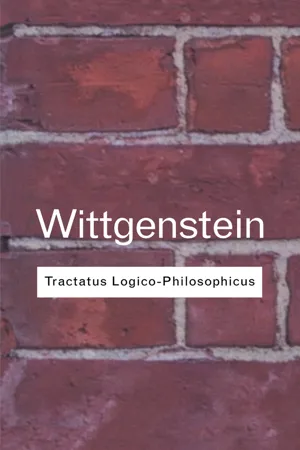
Perhaps the most important work of philosophy written in the twentieth century, Tractatus Logico-Philosophicus was the only philosophical work that Ludwig Wittgenstein published during his lifetime. Written in short, carefully numbered paragraphs of extreme brilliance, it captured the imagination of a generation of philosophers. For Wittgenstein, logic was something we use to conquer a reality which is in itself both elusive and unobtainable. He famously summarized the book in the following words: 'What can be said at all can be said clearly; and what we cannot talk about we must pass over in silence.' David Pears and Brian McGuinness received the highest praise for their meticulous translation. The work is prefaced by Bertrand Russell's original introduction to the first English edition.
- 142 pages
- English
- ePUB (mobile friendly)
- Available on iOS & Android
eBook - ePub
Tractatus Logico-Philosophicus
About this book
Information
Tractatus Logico-Philosophicus Preface
Perhaps this book will be understood only by someone who has himself already had the thoughts that are expressed in it—or at least similar thoughts.—So it is not a textbook.—Its purpose would be achieved if it gave pleasure to one person who read and understood it.
The book deals with the problems of philosophy, and shows, I believe, that the reason why these problems are posed is that the logic of our language is misunderstood. The whole sense of the book might be summed up in the following words: what can be said at all can be said clearly, and what we cannot talk about we must pass over in silence.
Thus the aim of the book is to draw a limit to thought, or rather—not to thought, but to the expression of thoughts: for in order to be able to draw a limit to thought, we should have to find both sides of the limit thinkable (i.e. we should have to be able to think what cannot be thought).
It will therefore only be in language that the limit can be drawn, and what lies on the other side of the limit will simply be nonsense.
I do not wish to judge how far my efforts coincide with those of other philosophers. Indeed, what I have written here makes no claim to novelty in detail, and the reason why I give no sources is that it is a matter of indifference to me whether the thoughts that I have had have been anticipated by someone else.
I will only mention that I am indebted to Frege's great works and to the writings of my friend Mr Bertrand Russell for much of the stimulation of my thoughts.
If this work has any value, it consists in two things: the first is that thoughts are expressed in it, and on this score the better the thoughts are expressed—the more the nail has been hit on the head—the greater will be its value.—Here I am conscious of having fallen a long way short of what is possible. Simply because my powers are too slight for the accomplishment of the task.—May others come and do it better.
On the other hand the truth of the thoughts that are here communicated seems to me unassailable and definitive. I therefore believe myself to have found, on all essential points, the final solution of the problems. And if I am not mistaken in this belief, then the second thing in which the value of this work consists is that it shows how little is achieved when these problems are solved.
L. W.
Vienna, 1918
1*
The world is all that is the case.
1.1
The world is the totality of facts, not of things.
1.11
The world is determined by the facts, and by their being all the facts.
1.12
For the totality of facts determines what is the case, and also whatever is not the case.
1.13
The facts in logical space are the world.
1.2
The world divides into facts.
1.21
Each item can be the case or not the case while everything else remains the same.
2
What is the case—a fact—is the existence of states of affairs.
2.01
A state of affairs (a state of things) is a combination of objects (things).
2.011
It is essential to things that they should be possible constituents of states of affairs.
2.012
In logic nothing is accidental: if a thing can occur in a state of affairs, the possibility of the state of affairs must be written into the thing itself.
2.0121
It would seem to be a sort of accident, if it turned out that a situation would fit a thing that could already exist entirely on its own.
If things can occur in states of affairs, this possibility must be in them from the beginning.
(Nothing in the province of logic can be merely possible. Logic deals with every possibility and all possibilities are its facts.)
Just as we are quite unable to imagine spatial objects outside space or temporal objects outside time, so too there is no object that we can imagine excluded from the possibility of combining with others.
If I can imagine objects combined in states of affairs, I cannot imagine them excluded from the possibility of such combinations.
2.0122
Things are independent in so far as they can occur in all possible situations, but this form of independence is a form of connexion with states of affairs, a form of dependence. (It is impossible for words to appear in two different roles: by themselves, and in propositions.)
2.0123
If I know an object I also know all its possible occurrences in states of affairs.
(Every one of these possibilities must be part of the nature of the object.)
A new possibility cannot be discovered later.
2.01231
If I am to know an object, though I need not know its external properties, I must know all its internal properties.
2.0124
If all objects are given, then at the same time all possible states of affairs are also given.
2.013
Each thing is, as it were, in a space of possible states of affairs. This space I can imagine empty, but I cannot imagine the thing without the space.
2.0131
A spatial object must be situated in infinite space. (A spatial point is an argument-place.)
A speck in the visual field, though it need not be red, must have some colour: it is, so to speak, surrounded by colour-space. Notes must have some pitch, objects of the sense of touch some degree of hardness, and so on.
2.014
Objects contain the possibility of all situations.
2.0141
The possibility of its occurring in states of affairs is the form of an object.
2.02
Objects are simple.
2.0201
...Table of contents
- Cover
- Title
- Copyright
- Contents
- TRANSLATORS' PREFACE
- INTRODUCTION
- Dedication
- Tractatus Logico-Philosophicus Preface
- Translation
- INDEX
Trusted by 375,005 students
Access to over 1.5 million titles for a fair monthly price.
Study more efficiently using our study tools.
Frequently asked questions
Yes, you can cancel anytime from the Subscription tab in your account settings on the Perlego website. Your subscription will stay active until the end of your current billing period. Learn how to cancel your subscription
No, books cannot be downloaded as external files, such as PDFs, for use outside of Perlego. However, you can download books within the Perlego app for offline reading on mobile or tablet. Learn how to download books offline
Perlego offers two plans: Essential and Complete
- Essential is ideal for learners and professionals who enjoy exploring a wide range of subjects. Access the Essential Library with 800,000+ trusted titles and best-sellers across business, personal growth, and the humanities. Includes unlimited reading time and Standard Read Aloud voice.
- Complete: Perfect for advanced learners and researchers needing full, unrestricted access. Unlock 1.5M+ books across hundreds of subjects, including academic and specialized titles. The Complete Plan also includes advanced features like Premium Read Aloud and Research Assistant.
We are an online textbook subscription service, where you can get access to an entire online library for less than the price of a single book per month. With over 1.5 million books across 990+ topics, we’ve got you covered! Learn about our mission
Look out for the read-aloud symbol on your next book to see if you can listen to it. The read-aloud tool reads text aloud for you, highlighting the text as it is being read. You can pause it, speed it up and slow it down. Learn more about Read Aloud
Yes! You can use the Perlego app on both iOS and Android devices to read anytime, anywhere — even offline. Perfect for commutes or when you’re on the go.
Please note we cannot support devices running on iOS 13 and Android 7 or earlier. Learn more about using the app
Please note we cannot support devices running on iOS 13 and Android 7 or earlier. Learn more about using the app
Yes, you can access Tractatus Logico-Philosophicus by Ludwig Wittgenstein, Brian McGuiness,David Pears in PDF and/or ePUB format, as well as other popular books in Philosophie & Sprache in der Philosophie. We have over 1.5 million books available in our catalogue for you to explore.