eBook - ePub
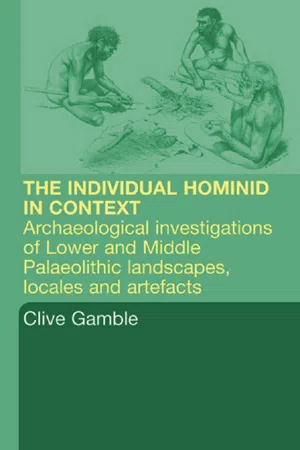
Hominid Individual in Context
Archaeological Investigations of Lower and Middle Palaeolithic landscapes, locales and artefacts
- 336 pages
- English
- ePUB (mobile friendly)
- Available on iOS & Android
eBook - ePub
Hominid Individual in Context
Archaeological Investigations of Lower and Middle Palaeolithic landscapes, locales and artefacts
About this book
This book explores new approaches to the remarkably detailed information that archaeologists now have for the study of our early ancestors. Rather than explaining the archaeology of stones and bones as the product of group decisions, the contributors investigate how individual action created social life. This challenge to the accepted standpoint of the Palaeolithic brings new models and theories into the period; innovations that are matched by the resolution of data preserving individual action among the stones and bones. The volume brings together examples from recent excavations such as Boxgrove, Schöningen and Blombos Cave and the analyses of artefacts from Middle and Early Upper Pleistocene excavations in Europe, Africa and Asia.
Information
Chapter 1
From Empty Spaces to Lived Lives
Exploring the Individual in the Palaeolithic
Introduction
For too long the Palaeolithic was regarded by archaeologists as the most un-promising of all periods for the reconstruction of society and economy (e.g. Childe 1951; Wheeler 1954). However, in the past fifty years it has been demonstrated that this widespread impression has no basis either in the supposed lack of evidence or in its quality. Well-preserved, high-resolution sites are known from all periods and regions of the Palaeolithic world (e.g. Carr 1984; Conard 2001b; Cziesla et al. 1990; Gamble and Boismier 1991; Goring-Morris 1987; Hietala 1984; Kind 1985; Kroll and Price 1991) and from these have come abundant artefacts and ecofacts to examine such issues as site structure, chaînes opératoires and contextual associations at the scale of both the site and region. The dictum that archaeologists should dig for relationships not facts (Binford 1964) has become standard Palaeolithic practice and the results, as this volume shows, are impressive.
However, while Palaeolithic archaeologists have made the case for the study of economic adaptation and social change at Pleistocene timescales, they are now faced with a wealth of detail requiring further analysis and interpretation. It is time to re-examine what those relationships we are excavating might be. In order to start this examination we have selected the individual hominid as the focus for this book. We are aware that such a focus may not be readily accepted, even by some of our contributors, since the Palaeolithic is predominantly seen as the preserve of group behaviour and selection, especially in the Earlier Palaeolithic which we concentrate upon here.
Moreover, even among those who champion the individual as the locus for selection in a Neo-Darwinian approach the prospects for the Palaeolithic are regarded as grim: ‘Ethnographies record the behaviour of individuals, a capacity that is beyond the techniques of archaeology today, and in the forseeable future’ (Kelly 1995: 340). While we disagree with Kelly’s pessimism (see Mania and Mania, Thieme, Pope and Roberts, Petraglia, Shipton and Paddayya, Adler and Conard this volume), neither must we confuse a richly detailed record, where the shadow of the individual can often be seen among the stones and bones, with the concept of the individual agent as the source for social and economic life. It is the latter concept which is our ultimate target. But we acknowledge that seeing those shadows in the empty spaces were the inspiration to consider the lived lives we want to investigate through our data. Our aim in this introduction is to explore these issues and provide a framework for the contributions which follow. Our goal in this volume is to showcase spatial and artefactual data from the Earlier Palaeolithic that range in archaeological integrity and temporal resolution from high to low, fine to coarse grain (Gamble 1986: 22–4), and ask: What should we be doing with them?
The Paradigm of the Collective
The first thing you must realise is that power is collective. The individual only has power in so far as he ceases to be an individual
George Orwell, 1984
With hindsight, no one doubted that the archaeology of modern humans would yield high-resolution results and, at an early stage, the models of Star Carr (Clark 1954), Kostenki (Efimenko 1958) and Pincevent (Leroi-Gourhan and Brézillon 1966) pointed the way for their social and economic interpretation. In the subsequent half century the archaeology of the Lower and Middle, or Earlier, Palaeolithic has extended the high-resolution record back to the earliest appearance of stone tools. Among many such studies the work of Mary Leakey (1971) at Olduvai Gorge deserves special mention. Her model of hominid living floors, and its elaboration by Isaac (1978b, 1980) into home bases with central place foraging, proved immensely influential in raising expectations about the social and economic inferences which could be made from simple stone tools and scatters of bones. Subsequently these models were criticised (Binford 1981a) and a greater role assigned to carnivores and hydraulic processes. However, while some of the key sites such as Olduvai and Ambrona have been unflatteringly subjected to the taphonomic lens, there have been others such as Boxgrove (Pope and Roberts this volume), Wallertheim (Adler and Conard this volume), Schöningen (Thieme this volume), Bilzingsleben (Mania and Mania this volume) and Hunsgi (Petraglia, Shipton and Paddayya this volume) which have retained their integrity.
While we can congratulate ourselves on these achievements we also need to take stock of the interpretive frameworks that are applied to such evidence. While the Earlier Palaeolithic has been investigated at ever finer spatial and temporal scales our interpretations generally use a traditional unit of analysis. Palaeolithic archaeologists continue to affirm the primacy of the group, and the wider organisational system of adaptation, when it comes to understanding patterns in the data. Altogether, the successes of Palaeolithic archaeology in the last fifty years have been achieved at the expense of the individual.
One reason was the reaction during this period to the explanations of variation by culture historians. As summed up by Binford (1978b: 2), ‘for many years … the dynamic standing behind an archaeological fact was thought to be simply the maker of the artefact’. The preferred dynamic was the organisational system (Flannery 1967: 106) because the intentions, motives and indeed decisions of individuals were regarded as invisible to the archaeologist and hence not amenable to scientific investigation (Clark 1992: 107). The system is archaeologically visible because it summarises the decisions made by individuals in the interests of adaptation, reproductive success, risk minimisation, competitive advantage and any other process which ensured their survival. To paraphrase Orwell (1949: 276), quoted above: in the Palaeolithic the individual only exists in so far as he ceases to be an individual.
The paradigm of the collective has been traced by Bettinger (1991: 153) and Kelly (1995: 48–53) to the neo-functionalism of cultural ecology (Steward 1936) and the techno-environmental determinism of cultural materialism (Harris 1968), both of which shaped the New Archaeology of the 1960s. As Bettinger (1991: 213 ff.) has rightly argued, such approaches are not evolutionary in a Darwinian sense because they express only a theory of consequences that stem from adaptation. Significantly, cultural ecologists attributed groups and populations with decision-making capacities that can, in fact, only reside with the individual (Kelly 1995: 48). Archaeological examples would include the Cambridge Palaeoconomy school (Higgs 1972, 1975) and numerous case studies with an adaptive focus inspired by the New Archaeology (e.g. selected papers in Bailey 1983, Binford 1977). The collective paradigm is also much broader since it includes Marxist approaches, although few Palaeolithic case studies exist (Bender 1978; Gilman 1984).
Neither is the paradigm of the collective confined simply to the study of occupations in caves and open sites. It is also applied to the analysis of artefacts and minds. Two examples will suffice. First, the widespread application of trace analysis to stone tools has added considerably to our understanding of the frequency of edge use and the function of some tool types. When combined with re-fitting, chaîne opératoire studies and experimental technology, a dynamism is returned to those site plans with piece-plotted data (Cziesla et al. 1990). Former movements of artefacts can now be visualised, and can be turned into traceable, short-term biographies as they move from ‘cradle’ to ‘grave’ within the excavated area (Close 2000), and sometimes between sites (Scheer 1993).
But, as Dobres (2000) has commented, when it comes to interpretation it is as if the evidence takes on a life of its own. And although reference is often made to individuals they remain abstract – demiurges to the will of the stones and bones – reminiscent of Richard Dawkins’ (1976) view that bodies are just vehicles for genes to reproduce themselves which translates, in a Palaeolithic setting, into the statement that a hominid is just a way for a stone tool to make more stone tools (pace Dennett 1991). In other words, we all know that individuals were responsible, but we prefer a collective summary of the evidence.
Our second example concerns two influential models of the development of hominid minds. In his pioneering work, Wynn (1989, 1993a, 1993b) made inferences about the development of hominid cognition most notably through the analysis of the shape and manufacture of stone tools. In Mithen’s (1996b) important study, the Palaeolithic mind is analysed in terms of discrete mental modules. The characteristics of different hominid species emerge from the degree of linkage and feedback between these cognitive compartments. Such a systemic approach to the mind is a good example of how a universal approach to the question of hominid cognition is achieved. This is possible by reference to a paradigm of the collective rather than one based on the individual. The mind, in both Wynn and Mithen’s approaches, may be a social one but it is corporately owned and applied. In both models individuals are not given an active role and serve only as a background idea rather than a foreground principle in our evolutionary history.
Explaining the Paradox
Whatever the Party holds to be truth, is truth.
George Orwell, 1984
The successes of high-resolution Palaeolithic archaeology have therefore contributed paradoxically to the disappearance of the individual hominid. On the one hand field methods and analytical advances provide information on land use and the technological strategies of hominids, so that very detailed site histories and artefact biographies can now be reconstructed. To this end the excavation of high-integrity, high-resolution contexts reveals traces of precise, individual activity between 1.5 million and ~60,000 years ago, the time frame covered in this volume. These traces are preserved primarily as knapping and butchering events set within environmental contexts, which on occasion can be shown to have also been ephemeral when measured on a Pleistocene timescale. But on the other hand, these dramatic signatures of individual action, equally well represented by the single stone tool, cut-marked bone or piece of shaped ochre, are routinely analysed as collective action. The quality of data is not at issue. In fact, the Palaeolithic is better off than many later periods in archaeology where, aside from graves, ‘special’ deposits and the floors of Pompeii, most evidence comes from so-called secondary contexts such as middens, ditches and pits. The mobility of Palaeolithic hominids is a positive advantage for a study of the direct traces of individual activity through the archaeological record. But the general consensus is that this approach is neither possible nor desirable. And herein lies the paradox between data relating to individuals and their interpretation.
Why is this the case? We identify two main reasons. In the first place the success of the Palaeolithic is founded on an interdisciplinary approach designed to illuminate adaptation to ecological processes and changing environmental conditions. This has not always been done within an evolutionary framework. As forcefully represented in the writings of Lewis Binford, a scientific approach to Palaeolithic hominids requires an understanding of group dynamics where patterning can be causally related to the properties and organisation of environmental systems (see Gamble and Gaudzinski this volume). The unit of analysis in such a framework is therefore an aggregate of behaviour, and the purpose of enquiry is to understand variation in that aggregate. In this conception, interpretation in the Palaeolithic depends on a frame of reference that is universal – hence the various ‘world-models’ of hunters and gatherers that exist (Binford 2001; Kelly 1995).
Second, we must consider the importance of origins research in the Palaeolithic (Gamble and Gittins 2004). Questions such as the origins of modern humans, the origins of art and the origins of the hominid lineage structure Palaeolithic investigations (Alexandri 1995). Within archaeology more generally, the Palaeolithic provides an origin point for the many different approaches to the interpretation and reconstruction of societies in later prehistory and the historic, text-aided, periods. To put it in another way: very often the Palaeolithic has not been studied in its own right, but rather for its potential to shed light on to issues in later periods. Its importance is as a complete point of contrast to the complexities of culture, technology, settlement, economy and society that followed agriculture. As a result there has not been much interest, until recently, in exploring a social archaeology for the Earlier Palaeolithic (Gamble 1999). Neither is the individual a useful focus for Palaeolithic analysis if questions such as the origins of language and the human mind are being pursued. Individuals, by themselves, did not evolve tools, language, symbolism, bipedal locomotion or modern behaviour and therefore the individual as a unit of analysis is not needed.
A Fresh Look at the Individual
Even a back can be revealing.
George Orwell, 1984
So far it might be said: ‘Well, if it ain’t broke don’t fix it!’ and probably many Palaeolithic archaeologists would agree. However, we are then faced with a fundamental problem: Why bother to investigate the composition of sites, assemblages and industrial traditions when all that is needed are broad collectives set within a more precise chronological framework? Do we really need the spatial detail that is currently being produced at great expense? What exactly is the place and value of ‘those rare and precious moments of contact between the archaeologist and another human being across ages of time’ (Roe 1981: 197) within the existing scientific and origins-based approaches?
Keeping this in mind, it is interesting to note the differences between excavation strategies in Europe and Australia (e.g. Julien and Rieu 1999; Smith et al. 1993). In Europe attention has focused, where possible, on spatially extensive excavations of in situ camp sites. The detailed recording of spatial information at the micro-level implies that archaeologists are interested in the individual. But further inspection reveals a greater interest in using these data to unravel taphonomy and site formation. In Australia the focus has been rather different. Many sites, often rock shelters, have been sampled with small ‘telephone-booth’ size trenches. Multiple radiocarbon samples are obtained and artefacts and ecofacts counted against age-depth curves. The goal is to acquire regional information about phases of settlement and to identify changes in technology. The individual is unnecessary to such goals and the phone-booth sampling strategy is therefore entirely appropriate.
European archaeologists seem to have opted for an excavation strategy that is cost in-effective when it comes to addressing the research questions that really occupy Palaeolithic specialists. Those ‘telephone booths’ are very well suited to describe the transition from the Middle to the Upper Palaeolithic and to establish criteria to see where and when hominid behaviour became human by finding the oldest art and the right kind of fossil skulls. Moreover, the extension of new chronometric dating techniques beyond the range of radiocarbon in Africa and Asia has led to a longer timescale for the introduction of many cultural items and behaviours once thought the exclusive preserve of the last 40,000 years (Henshilwood and d’Errico this volume). As a result, the timing, pattern and process of change have become more complex and not necessarily as a result of those large area excavations.
Our suggestion is to amend the questions enshrined in the existing framework and to find within it a place for the individual. Currently there are two main pathways illustrated by several chapters in this book. First there are approaches stemming from behavioural ecology with its emphasis on the individual as the unit of selection in neo-Darwinian evolution. A promising line of enquiry is raised by cultural transmission theory (Shennan 2002) and is here touched upon in chapters which deal with palimpsest (Hosfield), cave (Henshilwood and d’Errico) and landscape data (Petraglia, Shipton and Paddayya). These enquiries take into account Kelly’s (1995: 340) view that ‘coarse as it may be, the archaeological record was nevertheless produced by the behaviour of individuals’.
The second pathway would replace behaviour in Kelly’s quote with social actions. The chapters in this volume address artefacts (Porr, Field, Hopkinson and White, Gowlett, Pope and Roberts) and fauna (Gamble and Gaudzinski). They stem from our proven ability to see individuals in our micro-level data and the requirement to conceptualise them as a social and economic agent who created those patterns and so structured the archaeological record from the earliest Palaeolithic.
At the moment there is little common ground between these two approaches which champion the individual. The Palaeolithic naturally inclines to the paradigm of behavioural ecology and we welcome a more explicit evolutionary approach to the period. But this can only be done by recasting the individual as our unit of analysis. Such methodological individualism does not, of course, imply the scale at which evolutionary processes operate (Bettinger 1991: 153). It only refers to the initial approach and ultimately explanation can be either collective or individual as revealed by analysis.
Our concern here is more with the other approach derived from a social theory of action since this is alien to the Palaeolithic. To extend it we need a concep...
Table of contents
- Cover
- Half Title
- Title Page
- Copyright
- Contents
- List of Figures
- List of Tables
- List of Contributors
- Preface
- 1. From Empty Spaces to Lived Lives: Exploring the Individual in the Palaeolithic
- 2. The Acheulean and the Handaxe: Structure and Agency in the Palaeolithic
- 3. Transformations in Dividuality: Personhood and Palaeoliths in the Middle Pleistocene
- 4. Seeking the Palaeolithic Individual in East Africa and Europe During the Lower-Middle Pleistocene
- 5. The Making of the Biface and the Making of the Individual
- 6. Observations on the Relationship Between Palaeolithic Individuals and Artefact Scatters at the Middle Pleistocene Site of Boxgrove, UK
- 7. The Natural and Socio-Cultural Environment of Homo Erectus at Bilzingsleben, Germany
- 8. The Lower Palaeolithic Art of Hunting: The Case of Schöningen 13 II-4, Lower Saxony, Germany
- 9. Tracking Hominins During the Last Interglacial Complex in the Rhineland
- 10. Bones and Powerful Individuals: Faunal Case Studies From the Arctic and the European Middle Palaeolithic
- 11. All in a Day’s Work: Middle Pleistocene Individuals, Materiality and the Lifespace at Makapansgat, South Africa
- 12. Life and Mind in the Acheulean: A Case Study from India
- 13. Individuals Among Palimpsest Data: Fluvial Landscapes in Southern England
- 14. Being Modern in the Middle Stone Age: Individuals and Innovation
- 15. Concluding Remarks: Context and the Individual
- Bibliography
- Index
Trusted by 375,005 students
Access to over 1.5 million titles for a fair monthly price.
Study more efficiently using our study tools.
Frequently asked questions
Yes, you can cancel anytime from the Subscription tab in your account settings on the Perlego website. Your subscription will stay active until the end of your current billing period. Learn how to cancel your subscription
No, books cannot be downloaded as external files, such as PDFs, for use outside of Perlego. However, you can download books within the Perlego app for offline reading on mobile or tablet. Learn how to download books offline
Perlego offers two plans: Essential and Complete
- Essential is ideal for learners and professionals who enjoy exploring a wide range of subjects. Access the Essential Library with 800,000+ trusted titles and best-sellers across business, personal growth, and the humanities. Includes unlimited reading time and Standard Read Aloud voice.
- Complete: Perfect for advanced learners and researchers needing full, unrestricted access. Unlock 1.5M+ books across hundreds of subjects, including academic and specialized titles. The Complete Plan also includes advanced features like Premium Read Aloud and Research Assistant.
We are an online textbook subscription service, where you can get access to an entire online library for less than the price of a single book per month. With over 1.5 million books across 990+ topics, we’ve got you covered! Learn about our mission
Look out for the read-aloud symbol on your next book to see if you can listen to it. The read-aloud tool reads text aloud for you, highlighting the text as it is being read. You can pause it, speed it up and slow it down. Learn more about Read Aloud
Yes! You can use the Perlego app on both iOS and Android devices to read anytime, anywhere — even offline. Perfect for commutes or when you’re on the go.
Please note we cannot support devices running on iOS 13 and Android 7 or earlier. Learn more about using the app
Please note we cannot support devices running on iOS 13 and Android 7 or earlier. Learn more about using the app
Yes, you can access Hominid Individual in Context by Clive Gamble,Martin Porr in PDF and/or ePUB format, as well as other popular books in Social Sciences & Anthropology. We have over 1.5 million books available in our catalogue for you to explore.