- 264 pages
- English
- ePUB (mobile friendly)
- Available on iOS & Android
eBook - ePub
About this book
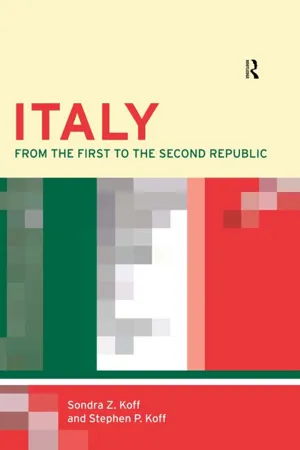
This textbook has been designed to provide students with an up-to-date and accessible introduction to the complexities of Italian politics during the 1990s. It will equip students with a sound understanding of the basics of Italian politics and government, and will provide clear and simple insights into the intricacies of Italian political behaviour.
The comprehensive coverage includes:
* an introduction to contemporary history, political geography and economic issues as well as Italian political values and attitudes.
* a section on political behaviour which explores political parties, interest groups and the electoral earthquakes of the 1990s.
* a section on government institutions and their roles, including discussion of the executive, the legislature, the judiciary and the subnational government.
* analysis of Italy's often stormy relationship with the European Union
* an exploration of recent events, such as attempts at institutional reform
Information
1 Italian politics
A tale of contradictions
Introduction
Because of its many dualities, Italy has frequently been described as a study in contradictions. Youth versus antiquity, continuity versus sharp change, the North versus the South, competition versus co-operation, persistent economic cycle crises versus outstanding long-term performance, regionalism versus centralization, clericalism versus secularism and democracy versus authoritarianism are just a few of the dichotomies which will be explored in this book as the Italian political system and its problems are discussed. Often these contradictions involve deep social, economic and political cleavages, which in some cases can be traced back for hundreds of years. They have contributed to deadlock politics, making problem solving in the public sector very difficult.
Although it is not totally clear, a more current contradiction is the distinction between the Old and the New politics. In Italy, it has become common to speak of the First and Second Republics. The First Republic begins in 1948, when the postwar constitution was put into effect, and ends in the early years of the 1990s. It is difficult to state precisely when one republic ends and the other begins. The seeds of the Second Republic are easily identified in the last years of the 1980s. The first years of the following decade can appropriately be described as a period of transition between republics. No change in regime took place, but a sufficient transformation of parties, major political actors and style of politics occurred to justify the description of a new republic. A victory in the March 1994 election by a totally different coalition of parties and the creation of a centre-right government are generally cited as the formal beginnings of the Second Republic. This government was followed two years later by one based on a centre-left coalition. Both were involved in major changes in Italian political behaviour.
A series of dramatic events and resultant attitude changes wrought havoc with traditional patterns of politics. The fall of the Berlin Wall in 1989, symbolizing the demise of East European communism, was an earth-shaking event. For many Italians, the fear of communism was removed as a crucial determinant of political behaviour. This fear had been a stabilizing factor in Italian politics. Apprehension of communism made many people loath to leave parties they saw as the bulwark of their democratic society. At the same time, along with the decline of the threat of communism came extensive scandals that severely tarnished the reputation of the traditional governing parties and their leaders. In 1992, corruption in Italy became a serious political problem. A seemingly isolated incident – the arrest of the administrator of a retirement facility in Milan, who was too slow in flushing down the toilet cash he had just received as a bribe – had momentous consequences and exposed the exceptional extent of public corruption. This led to a string of scandals, known as Tangentopoli (Kickback City), which transformed the political arena. In this case, every contract issued was subject to a tangente or kickback. It was revealed that the practice was common throughout Milan and other cities according to a specific formula. The coffers of major political parties and the bank accounts of politicians were swollen with bribes from the business community competing for public contracts. Such payments, considered a normal business expense, were linked directly to specific favours, such as a contract or the bending of a regulation (Cazzola 1992b; Della Porta 1992). A prosecuting magistrate now turned politician, Antonio Di Pietro, spearheaded the judicial campaign to remoralize public life, labelled Mani Pulite (Clean Hands).
The investigation spread throughout the peninsula and up the political ladder to the highest rungs. Estimates vary as to the number of suspects involved, but run as high as 5,000 persons representing a cross-section of Italy’s political, social and economic elite. These were no ordinary scandals. They involved the foremost companies in Italy, and some foreign ones, that had paid bribes to political parties in order to gain public contracts. This led to suicides and imprisonment of some of the biggest names in the commercial world. It has been estimated that payments for large government contracts throughout the 1980s were around 6.5 trillion lire (approximately 4 billion dollars) a year. There was concern that, with so many businessmen involved, the management of top firms would be irrevocably damaged. The activities of the leaders of political parties seemed more dramatic. The number of people involved was greater, and included former prime ministers, parliamentarians and local party leaders. At one point, over half the members of Parliament were under indictment. More than 400 city and town councils were dissolved because of corruption charges. There was a difference in the nature of Tangentopoli in northern and southern Italy: in the North the political parties were in complete control of bribery, while in the South they worked with criminal organizations. The Tangentopoli scandals struck at the heart of the clientelist network.
It was obvious that bribery was the rule, not the exception. Corruption was a collective phenomenon, and although its specifics were unknown to the populace at large, they were known within restricted circles (Magatti 1996). Clientelism was systemic and tolerated throughout the First Republic. Tangentopoli erupted when the Republic encountered difficulties with increasing demands, a depletion of resources and growing bitter internal conflict. Coupled with the fall of the Berlin Wall, Tangentopoli set the stage for a generalized protest movement focusing on political corruption. The ‘moral question’ was critical to the emergence of new political actors. Italy experienced a legitimacy crisis. Within a span of two years, political corruption produced a massive de-legitimation process that obliterated not only an entire political elite, but the system which had governed the country for almost fifty years.
Tangentopoli relates to a contradiction in Italian society: the existence of many strict rules to govern the conduct of public officials so that the public interest will prevail, and the universal practice of clientelistic behaviour. It remains a critical element in Italian politics.
Other events and problems also paved the way for change. The spread of the Mafia beyond its traditional base in Sicily to all parts of Italy was accompanied by the increased use of violence by criminal organizations. The spiral of government spending seemed out of control and this, coupled with a huge public debt, threatened the economy. Long-term problems such as unemployment, inefficient social services and an unsatisfactory education system appeared to be worsening. An obsolete bureaucracy, the part of the government which the people encountered most frequently, remained inefficient, overstaffed and arrogant. Involving 6–7 per cent of the workforce, the Italian bureaucracy is per capita the largest in size of any western democracy. A comment often made in the 1980s was that Italy was not governable. Italians, especially the younger generations, demanded change. The traditional parties and the usual way of doing political business were rejected overwhelmingly by the electorate. It became clear that people no longer had confidence in the government. It should be noted that in the First Republic there was no rotation of power, in sharp contrast to the other western democracies.
Political geography: the North–South dimension
Although Italy can be divided into a number of geographical divisions, for purposes of simplicity, a generally recognized dichotomy is that between the North and South, with the divide being the capital city, Rome (Coppola 1997). This division has given rise to the Southern Question, the core of which is the striking social, economic, political and cultural differences between the two parts of the nation. This dichotomy, the basis of which existed prior to unification of the country in 1861, has been central to all facets of Italian development. Reasons for this diversity include late unification, excessive centralization and events identified with Fascism and the Resistance movement. The North has been dominant throughout Italian history.
From unification, the most prominent facet of the duality has been economic. The South, because of its poverty of resources, its lack of vital links to international markets, its feudal structure which was reinforced after unification, its harsh climate and topography and its restricted entrepreneurial class, has always had an economic status inferior to that of the North. This situation was also heavily influenced by the illiteracy rate, which was in any case high compared to other European countries, but in the South it was two to three times greater than in the North (Cafagna 1994). Clientelism pervaded the southern social and political fabric immediately after unification, with the advent of a national ruling coalition of the southern aristocracy and the conservative bourgeoisie of the North. The South lacked a new middle class capable of governing and representing the public interest in the new state. Its ruling class consisted of the old landowners who, representing themselves and their own parochial interests, served as a screen between the masses and the government (Bevilacqua 1993).
In the international framework, both North and South were politically subordinate and economically marginalized. They only began to count for something in Europe and beyond after unification. The birth of the Italian state guaranteed development of the peninsula (Pescosolido 1998). However, this development was not evenly distributed throughout the various regions and classes. Part of the duality between North and South relates to separateness, not only in terms of distance in kilometres. North and South did not have much contact. They were like separate countries. In the middle of the 1800s, the seeds of industrialization were planted in the North. A healthy banking industry invested in agriculture as well as industry. However, none, or very little, of what was in the North existed in the South. In the latter, commercialization and urbanization were superimposed on a traditional agrarian economic base. The lack of industrialization and modernization and rationalization of agriculture was an obstacle to the formation of stable and homogeneous social classes in the South. The unsound trade, fiscal and industrial policies of the government allowed the ruling class to reinforce its power. Given the predatory ruling class, a fragile administrative structure, an antiquated and clientelistic banking system, an inadequate infrastructure and brigandage, among other negative elements, what the South accomplished was almost miraculous. However, the gap between the two Italies continued to widen.
Under the heel of fascism, the Southern Question worsened. It has been identified as ‘the single most serious failure of the Fascist regime’ (Cafagna 1994: 64). A mistaken agricultural policy which damaged the soil, structural unemployment, the halt of political and economic development and the Second World War all added to the problems of the South. Reconstruction efforts in the postwar South, which experienced greater destruction than the North, were late and slow. Laissez-faire policies also worked to the disadvantage of the area. It was not until 1950 that the state assumed responsibility for southern development through a variety of agencies and programmes. Efforts focused on transferring payments and making investment decisions with the objective of developing the southern economy, especially its industrial sector. This approach ignored the absence of entrepreneurial initiative and an unskilled workforce in the South. Rather than encouraging endogenous initiatives, it discouraged them. This formula produced negative consequences. Government programmes exacerbated the South’s dependency on central government intervention and perpetuated personal, clientelistic linkages and a huge well-oiled patronage machine. Efforts have been dysfunctional and the costs excessive (Mutti 1996; Nanetti 1988).
During the First Republic the infrastructure of the South improved, but hundreds of years of history are not easily overturned. The movement of people from the South to the North or other parts of Europe, the introduction of new industries in the South, the creation of an efficient road system which helped to integrate the nation, national radio and television networks and other factors wrought considerable change. However, extreme poverty can still be found in many southern areas. The way of life in a number of small villages has changed little over the years. On the other hand, in sharp contrast, the accoutrements of life in an advanced nation, ranging from better education to mod fashions and the availability of changed opportunities, are evident among a good portion of the young people in these areas.
In spite of many efforts, the South is still a consistent underperformer. Recent statistics underscore the existence of two Italies. In the North, the average per capita income is 18,715,000 lire; in the South it is 11,934,000 lire, and the gap is increasing. Thirty-six per cent of the population resides in the South, but its contribution to the gross national product is 25 per cent and to exports is 9 per cent. Moreover, only 36 per cent of public funds have flowed to the southern part of the country. In the 1990s, five million lire have been spent on each southern resident, while 5,200,000 lire have been expended on each northern resident. Lesser amounts of public funds are dispensed in the area of greatest need. Southern social services, public facilities and services are of low quality. Over a thirty-nine-year period from 1950 to 1989, the government spent 0.7 per cent of the budget to develop the South; it spent much larger sums to cover the deficit of the national railroad system (Marro 1992).
A recent regional industrialization index demonstrates the superiority of the North. The first ten places are occupied by northern regions, and the industrialization rate of the North is three times that of the South. The dramatic circumstances of the South are confirmed in the last census (1991) and more recently by the fact that the unemployment rate in the South is more than triple that of the North. This tremendous economic cleavage still persists after a decade in which Italian economic growth outdistanced that of all other memberstates of the European Union (EU) (Cecchini 1995; Manca 1995). On the other hand, in terms of personal consumption and accumulation the South is modern and compares favourably with the North. This dichotomy between southern trends in consumption and production has been attributed to the breadth and depth of government intervention. Consumption levels have been maintained via a wide variety of social and economic policies (Leonardi 1995).
Regional development policies have stressed the role of the state and a centralized administrative–political decision-making apparatus. This strategy has not reduced the distance between North and South in terms of productivity. Enhancing Southern dependence on public funds, it has prevented self-sustained development (D’Antone 1996). Pressures related to the Single Market of the EU and reduction of the nation’s deficit also reduced the utility of this approach. The government led by Romano Prodi has undertaken a serious commitment to the Southern Question, especially its high rate of unemployment. It has adopted a new strategy based on decentralization, fiscal federalism, centre–periphery relations with new financial mechanisms and controls congruent with EU policies, industrial and technological innovations, and new systems of professional training. The programme emphasizes a detailed plan for development of the infrastructure, area contracts, territorial pacts, incentives to firms and utilization of EU funds.
A new posture towards development is nurtured by state contributions linked to obligations, including financial ones, which a southern community undertakes. This ‘negotiated planning’ is critical to the creation of new relationships related to development. This is the rationale behind the area contracts and territorial pacts which involve partnerships between northern and southern provinces and industrialists for collaboration in development efforts. Partnerships are based on ‘programme contracts’ initiated by a strong northern district which, through a large financial incentive for the development of new installations, becomes linked with a southern one. Emphasis is not on the capacity of the districts to provide new factories with the latest technology, but rather on the acquisition of knowledge and skills which will eventually allow the weaker partner to compete meaningfully with the stronger one. Guidelines for this endeavour were developed jointly by government, business and trade unions. Such collaboration is important.
In another effort, the government is paying a bonus to firms that hire unemployed persons, especially youth. The longer the individual has been unemployed, the larger the bonus and the longer it lasts. A new development in training programmes is the payment of a fixed sum to young southerners who go to the North for a specified period to learn skills and agree to return to the South. This is a type of internship. The government has also reached an agreement with sub-national units of government on Agenda 2000, a new EU funding programme. The EU Single Market Plan is also important to the South. There is an expectation that with its commitment to help poor peripheral regions in the EU, it will provide considerable aid to southern Italy. However, many observers believe that regions such as the South are destined to fall further behind the more successful European nations. Historic corrupt practices, patronage politics, clientelism, the activities of the Mafia and other criminal organizations and similar ills continue to mark this part of the country. Reforms have been promised and initiated many times, but achievements have been limited. The efforts of the Prodi Government represent good intentions; what is important is the fact that they are being turned into deeds. Time is of the essence. Today the South is what it is because politicians wanted it that way: ‘it is like Vesuvio: a volcano which only seemingly sleeps and which from one moment to the next can explode’ (Fiammeri 1998: 7).
The North–South divide is also of significance in terms of political power, which in the First and Second Republics clearly resides in the northern part of the nation. This political pre-eminence is related to the North’s economic position. Political decisions made in the capital often are fashioned by the prevailing economic interests of the North. What is good for the North has been frequently considered to be good for the nation. In terms of the number of persons having a significant role in the decision-making process, the North takes the lead; persons of northern origin occupy most of the important political party and governmental positions. As far as the former are concerned, northerners account for approximately 63 per cent of the offices; in the case of the latter, over the past decade they have occupied almost 60 per cent of the posts. On the other hand, southerners have dominated the bureaucracy, the police and the judiciary (Coldagelli 1992; N.A. 1997). This has hardened northern attitudes against southerners.
The economy
In postwar Italy, economic development has been impressive and tumultuous. The nation is now one of the top five or six most industrialized systems in the world; within the confines of the EU, it ranks third after France and Germany and before Great Britain. Dualism in the economy is very obvious. Different approaches demonstrate several dualistic characteristics. In spite of tremendous economic growth as the march towards the European monetary union progressed, Italy was a prime candidate for second-class membership. The economic system is a capitalist one with considerable state intervention. Although agriculture is central, commerce and industry have overtaken it. In spite of large-scale industrial growth, small firms continue to have an important role. They have been the backbone of the most recent economic development.
Agriculture was for a long time the dominant element in the economy, particularly in the South. While farming is still important, it has changed radically in nature. The introduction of scientific and mechanized agriculture has increased crop yields even as a large part of the workforce left the land. The number of young people engaged in agriculture has declined, while the percentage of women, immigrants and older people has increased. Marginal lands have been abandoned. Italy has become a major exporter of agricultural products.
Although Italy is described as an industrial state, as noted above, the astonishing economic development has not blessed all parts of the nation in equal fashion. Not only has the structure of southern industry been out of phase with efforts concentrating on industrial development, but public policies have not been successful in counteracting the tendency to focus efforts on regions where the industrial base has been and is more secure. This pattern in turn has impacted on regional relationships, which have become more ...
Table of contents
- Front Cover
- Italy
- Title
- Copyright
- Dedication
- Contents
- Preface
- Abbreviations
- Map of Italy
- 1 Italian politics: a tale of contradictions
- 2 Italian political culture: diverse threads
- 3 Political behaviour: a changing party system
- 4 Elections and electors
- 5 Political behaviour: interest articulation and aggregation
- 6 Parliament: a legislature in search of its role
- 7 The executive power: the government and the President of the Republic
- 8 The public administration of the Republic
- 9 Legal careers: attorneys, judges and prosecutors
- 10 The territorial distribution of power: the Italian regional state
- 11 Italy and the European Union
- 12 Italy: difficulties in facing the millennium
- 13 Postscript
- Biblography
- Index
Trusted by 375,005 students
Access to over 1.5 million titles for a fair monthly price.
Study more efficiently using our study tools.
Frequently asked questions
Yes, you can cancel anytime from the Subscription tab in your account settings on the Perlego website. Your subscription will stay active until the end of your current billing period. Learn how to cancel your subscription
No, books cannot be downloaded as external files, such as PDFs, for use outside of Perlego. However, you can download books within the Perlego app for offline reading on mobile or tablet. Learn how to download books offline
Perlego offers two plans: Essential and Complete
- Essential is ideal for learners and professionals who enjoy exploring a wide range of subjects. Access the Essential Library with 800,000+ trusted titles and best-sellers across business, personal growth, and the humanities. Includes unlimited reading time and Standard Read Aloud voice.
- Complete: Perfect for advanced learners and researchers needing full, unrestricted access. Unlock 1.5M+ books across hundreds of subjects, including academic and specialized titles. The Complete Plan also includes advanced features like Premium Read Aloud and Research Assistant.
We are an online textbook subscription service, where you can get access to an entire online library for less than the price of a single book per month. With over 1.5 million books across 990+ topics, we’ve got you covered! Learn about our mission
Look out for the read-aloud symbol on your next book to see if you can listen to it. The read-aloud tool reads text aloud for you, highlighting the text as it is being read. You can pause it, speed it up and slow it down. Learn more about Read Aloud
Yes! You can use the Perlego app on both iOS and Android devices to read anytime, anywhere — even offline. Perfect for commutes or when you’re on the go.
Please note we cannot support devices running on iOS 13 and Android 7 or earlier. Learn more about using the app
Please note we cannot support devices running on iOS 13 and Android 7 or earlier. Learn more about using the app
Yes, you can access Italy by Stephen P. Koff,Sondra Z. Koff in PDF and/or ePUB format, as well as other popular books in Politics & International Relations & European Politics. We have over 1.5 million books available in our catalogue for you to explore.