- 240 pages
- English
- ePUB (mobile friendly)
- Available on iOS & Android
eBook - ePub
Resource Management
About this book
Managing Resources is the absolute guide to all areas of resource control. It includes:
* Thorough coverage of all areas of resource control for supervisors.
* Clear explanations of theories and techniques of control.
* Practical exercises to reinforce skills and knowledge.
* Application of theory to the work-based problem's facing today's managers.
The Team Leader Development Series is an essential tool towards gaining the Supervisory Management Award. Consisting of four practical and interactive textbooks, this series will be invaluable not only to students, but also as a guide individuals and organisations seeking to improve their business performance at the first level of management.
Key learning features:
* Learning Objectives to enable the reader to assess the knowledge gained throughout the series.
* Activities to put the learning into practice.
* Case studies - 'true-life' scenarios!
* Workbased Assignments which will provide evidence for S/NVQ portfolios.
* Language is straightforward and direct, contextualised to relate to team leaders and supervisory managers working in a wide range of industry sectors.
* Influential protagonists in the field will be alluded to as appropriate to support the learning.
* Action plan to take the learning forward.
1 Organizations and their resources
Learning objectives
On completion of this chapter, you will be able to:
• appreciate the structure of different types of organizations
• understand the name of different types of business and non-business organizations
• explain the distinction between different methods of business ownership
• appreciate the differing objectives of organizations
• describe the effects of the environment on organizations
• identify the stakeholders in organizations and their information requirements
• appreciate the importance of information systems in providing information to users
Introduction
An organization is a collection of people, things and systems, which work together towards a common set of objectives. In order to achieve those objectives, the various parts of the organization must have individual objectives, and these need to be controlled in order to ensure a successful outcome.
Organizations do not exist in isolation – they react with other organizations and circumstances. It can be said that every organization is a part of a larger organization. For example, a school is an organization which is part of the national educational system; a waste disposal organization is part of the local council, which in turn is part of the system of government of the country.
Organizations need resources in order to operate. The resources needed will vary according to the type of organization and its aims and objectives. An organization that manufactures goods will probably require the entire range of resources, which includes:
• human resources, i.e. people
• physical resources, e.g. buildings, equipment, materials
• financial resources, i.e. money
• services, e.g. energy, information, communication systems
The management of people, information and activities are covered in the complementary texts.
This chapter looks at the different types of organization and their objectives, the environment in which organizations operate, and the resources that they require.
Types of organization and their nature
Formal and informal organizations
A formal organization is one which has a defined structure. This determines responsibilities and levels of authority. Many organizations have ‘organization charts’ which start with the head of the organization, and work downwards through departmental managers to individual sections.
A ‘tall structure’ is one with several different levels of authority, each level ‘reporting to’ the next level up. The structure starts with one person or group of people at the top, and spreads out as it moves down. It can be pictured as a tall triangle as shown in Figure 1.1.
A ‘flat structure’ is becoming more popular in many organizations, with fewer levels of responsibility (Figure 1.2).
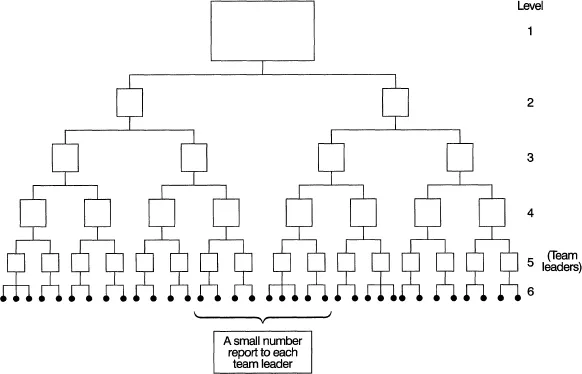
Figure 1.1 Tall organization structure
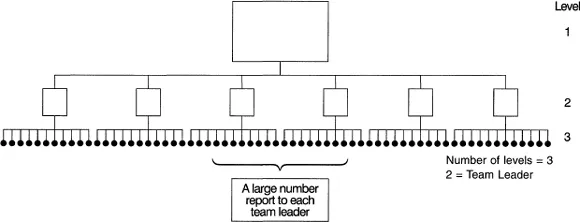
Figure 1.2 Flat organization structure
Other structures exist too, such as the wheel structure illustrated in Figure 1.3. The middle represents a departmental head, with several sections interacting with each other.
Figure 1.4 shows the matrix structure. Each department or team carries out the same functions.
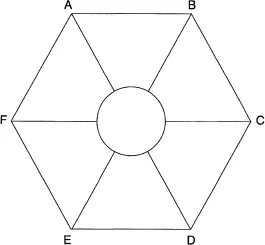
Figure 1.3 Wheel structure
Departments | Functions | |||
1 | 2 | 3 | 4 | |
A | ||||
B | ||||
C | ||||
D | ||||
E | ||||
F | ||||
Figure 1.4 Matrix structure
Investigate 1
Obtain or draw for yourself an organization chart for your own organization. Is your organization a ‘tall structure’, a ‘flat structure’, or some other structure?
Formal organizations have agreed objectives at all levels, and usually have laid down procedures for operating and ensuring that the objectives are met. Most businesses, in particular large ones, are formal organizations.
Informal organizations are less rigid. Often people assume responsibility for things they are interested in, and reporting is haphazard. Membership of such organizations is voluntary, and sometimes temporary. An example might be a toddler group or a pub quiz team. There is less structure with this type of organization, and although there may be some specific roles allocated to the individuals, e.g. a chairperson, a secretary, a publicity officer, these roles often overlap.
Most organizations have both formal and informal characteristics. A formal organization, such as a hospital, will have laid down objectives, rules, procedures and responsibilities, and decisions will be made at meetings which are properly constructed and minuted. But within the hospital there may be groups of doctors who get together at lunchtime to discuss the latest treatments they have read about in the last month. No agenda or minutes will exist for such an informal meeting.
Business organizations
There are many different types of business organizations. The main types are described here.
Public sector organizations
These are organizations which are run for the benefit of the country, usually by government departments. The number of such organizations has declined dramatically in recent years. Many educational establishments which used to be run by local authorities are now controlled independently, although they do still get some of their funding from the government. Hospitals are another example of organizations which are now self-managed and have to control and justify their costs and revenues.
A few public sector organizations do remain, however, and they are mostly quite large. Examples include the armed forces, the BBC, the Post Office and the Inland Revenue.
They are funded by, and answerable to, the government.
Private sector organizations
The majority of organizations fall into the private sector. The word ‘private’ can be misleading, as many of these organizations are owned by members of the public. They are not, however owned by the country as a whole.
...Table of contents
- Fornt Cover
- Half Title
- Title Page
- Copyright
- Contents
- Introduction
- 1 Organizations and their resources
- 2 Financial accounts
- 3 Managing cash resources
- 4 Sources of finance
- 5 Analysing financial statements
- 6 Cost control
- 7 Budgets
- 8 Management accounts
- 9 Costing methods
- 10 Purchasing of goods and services
- 11 Recording and control of stocks, labour and fixed assets
- 12 Decision making
- Feedback
- Further reading
- Index
Trusted by 375,005 students
Access to over 1.5 million titles for a fair monthly price.
Study more efficiently using our study tools.
Frequently asked questions
Yes, you can cancel anytime from the Subscription tab in your account settings on the Perlego website. Your subscription will stay active until the end of your current billing period. Learn how to cancel your subscription
No, books cannot be downloaded as external files, such as PDFs, for use outside of Perlego. However, you can download books within the Perlego app for offline reading on mobile or tablet. Learn how to download books offline
Perlego offers two plans: Essential and Complete
- Essential is ideal for learners and professionals who enjoy exploring a wide range of subjects. Access the Essential Library with 800,000+ trusted titles and best-sellers across business, personal growth, and the humanities. Includes unlimited reading time and Standard Read Aloud voice.
- Complete: Perfect for advanced learners and researchers needing full, unrestricted access. Unlock 1.5M+ books across hundreds of subjects, including academic and specialized titles. The Complete Plan also includes advanced features like Premium Read Aloud and Research Assistant.
We are an online textbook subscription service, where you can get access to an entire online library for less than the price of a single book per month. With over 1.5 million books across 990+ topics, we’ve got you covered! Learn about our mission
Look out for the read-aloud symbol on your next book to see if you can listen to it. The read-aloud tool reads text aloud for you, highlighting the text as it is being read. You can pause it, speed it up and slow it down. Learn more about Read Aloud
Yes! You can use the Perlego app on both iOS and Android devices to read anytime, anywhere — even offline. Perfect for commutes or when you’re on the go.
Please note we cannot support devices running on iOS 13 and Android 7 or earlier. Learn more about using the app
Please note we cannot support devices running on iOS 13 and Android 7 or earlier. Learn more about using the app
Yes, you can access Resource Management by Margaret Weaver in PDF and/or ePUB format, as well as other popular books in Business & Bookkeeping & Budgets. We have over 1.5 million books available in our catalogue for you to explore.