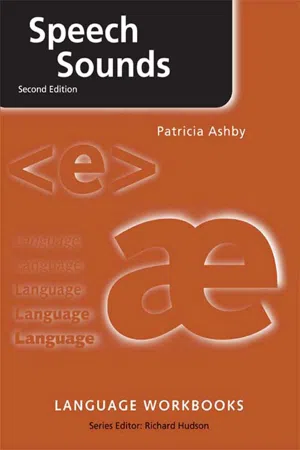
* helps develop the fundamental skills of the phonetician
* investigates the various aspects involved in the production of speech sounds
* uses data-based material to reinforce each new concept
* includes examples from a wide range of languages
* provides dozens of exercises with solutions and cross-references
* can complement existing course or textbook material.
The second edition of Speech Sounds has been revised and updated throughout and includes new examples and exercises, a new appendix giving information on career prospects; and a fully updated further reading section.
Frequently asked questions
Yes, you can cancel anytime from the Subscription tab in your account settings on the Perlego website. Your subscription will stay active until the end of your current billing period. Learn how to cancel your subscription.
At the moment all of our mobile-responsive ePub books are available to download via the app. Most of our PDFs are also available to download and we're working on making the final remaining ones downloadable now. Learn more here.
Perlego offers two plans: Essential and Complete
Essential is ideal for learners and professionals who enjoy exploring a wide range of subjects. Access the Essential Library with 800,000+ trusted titles and best-sellers across business, personal growth, and the humanities. Includes unlimited reading time and Standard Read Aloud voice.
Complete: Perfect for advanced learners and researchers needing full, unrestricted access. Unlock 1.4M+ books across hundreds of subjects, including academic and specialized titles. The Complete Plan also includes advanced features like Premium Read Aloud and Research Assistant.
Both plans are available with monthly, semester, or annual billing cycles.
We are an online textbook subscription service, where you can get access to an entire online library for less than the price of a single book per month. With over 1 million books across 1000+ topics, we’ve got you covered! Learn more here.
Look out for the read-aloud symbol on your next book to see if you can listen to it. The read-aloud tool reads text aloud for you, highlighting the text as it is being read. You can pause it, speed it up and slow it down. Learn more here.
Yes! You can use the Perlego app on both iOS or Android devices to read anytime, anywhere — even offline. Perfect for commutes or when you’re on the go. Please note we cannot support devices running on iOS 13 and Android 7 or earlier. Learn more about using the app.
Yes, you can access Speech Sounds by Patricia Ashby in PDF and/or ePUB format, as well as other popular books in Languages & Linguistics & Linguistics. We have over one million books available in our catalogue for you to explore.
This chapter is concerned with the difference between spoken and written forms of language. The concepts ‘speech sound’, ‘vowel’ and ‘consonant’ are introduced. We also begin to explore differences between different varieties of spoken English.
SPEECH AND WRITING
Say aloud the English word peace in your usual pronunciation. Repeat it several times, and then compare your pronunciation of the word written piece. You will probably find that you pronounce the two words in exactly the same way. The words are written differently, and have different meanings, but for nearly all native speakers of English there is not the slightest difference between them in sound. Words which are pronounced identically are called HOMOPHONES (homo- ‘same’ + phone ‘sound’).
Homophone
EXERCISE
1.1 At least some of the English words in the following groups will be homophones for you. Try to decide which are and which aren’t.
boy
buoy
led
lead (metal)
fool
full
weight
wait
horse
hoarse
which
witch
groan
grown
luck
look
maize
maze
May’s
sees
seas
seize
C’s
or
awe
oar
ore
Comment
There is no single set of ‘right’ answers to this exercise – the answers you give will depend in part on the type of English you speak. For instance fool and full are homophones for many Scots, but not for speakers from England or Wales. Try to make objective decisions about your own speech, and then if possible collect answers from a speaker whose English sounds different from yours.
The homophones we have just considered happen to have distinct spellings, but this is not always the case. For instance, there are three different words tick in English:
tick
(the mark
)
tick
(‘credit’. For instance: he bought it on tick)
tick
(parasite living on cattle, etc.)
Similarly, there are three homophonous words all spelt till:
till
(= until)
till
(to dig and cultivate the ground)
till
(cash register)
Homograph
Words which are written the same way (regardless of how they are pronounced) are termed HOMOGRAPHS (homo- ‘same’ + graph ‘writing’). The words read (rhymes with feed) and read (rhymes with bed) show us that English words can be spelt the same way yet pronounced differently. So not all homophones are homographs, and not all homographs are homophones. The general conclusion is that sameness and difference of sound is a completely different issue from sameness or difference of spelling.
LETTERS AND SOUNDS
Phonetic transcription Symbol
The word cat has three letters c, a and t. Most people can agree that it also has three sounds. We can say the word slowly, splitting it up into parts and counting them out on our fingers. But letters and sounds are not at all the same things. The word cough has five letters in spelling – but when we say it, it too only has three sounds. The first is like the first sound of kite, the second is like the middle sound of top, and the last is like the end of roof. A more logical spelling for the wor...
Table of contents
Front Cover
Title Page
Copyright
Contents
List of illustrations
Using this book
Acknowledgements
1 Spoken and written language
2 Phonetic transcription, consonant and vowel sounds
3 Consonants: the role of the larynx
4 More about vowels
5 The organs of speech and place of articulation
6 Manner of articulation and airstream mechanisms
7 Consonant description and voice–place–manner labels
8 The International Phonetic Alphabet
9 More about consonant variation
10 Yet more about consonants: secondary articulations