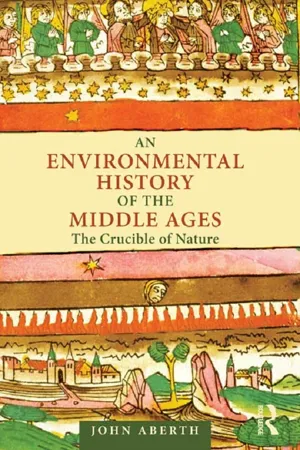
An Environmental History of the Middle Ages
eBook - ePub

An Environmental History of the Middle Ages

The Crucible of Nature

  1. 344 pages
  2. English
  3. ePUB (mobile friendly)
  4. Available on iOS & Android
eBook - ePub

An Environmental History of the Middle Ages

The Crucible of Nature

About this book

The Middle Ages was a critical and formative time for Western approaches to our natural surroundings. An Environmental History of the Middle Ages is a unique and unprecedented cultural survey of attitudes towards the environment during this period. Humankind's relationship with the environment shifted gradually over time from a predominantly adversarial approach to something more overtly collaborative, until a series of ecological crises in the late Middle Ages. With the advent of shattering events such as the Great Famine and the Black Death, considered efflorescences of the climate downturn known as the Little Ice Age that is comparable to our present global warming predicament, medieval people began to think of and relate to their natural environment in new and more nuanced ways. They now were made to be acutely aware of the consequences of human impacts upon the environment, anticipating the cyclical, "new ecology" approach of the modern world.

Exploring the entire medieval period from 500 to 1500, and ranging across the whole of Europe, from England and Spain to the Baltic and Eastern Europe, John Aberth focuses his study on three key areas: the natural elements of air, water, and earth; the forest; and wild and domestic animals. Through this multi-faceted lens, An Environmental History of the Middle Ages sheds fascinating new light on the medieval environmental mindset. It will be essential reading for students, scholars and all those interested in the Middle Ages

Frequently asked questions

Yes, you can cancel anytime from the Subscription tab in your account settings on the Perlego website. Your subscription will stay active until the end of your current billing period. Learn how to cancel your subscription.
No, books cannot be downloaded as external files, such as PDFs, for use outside of Perlego. However, you can download books within the Perlego app for offline reading on mobile or tablet. Learn more here.
Perlego offers two plans: Essential and Complete
  • Essential is ideal for learners and professionals who enjoy exploring a wide range of subjects. Access the Essential Library with 800,000+ trusted titles and best-sellers across business, personal growth, and the humanities. Includes unlimited reading time and Standard Read Aloud voice.
  • Complete: Perfect for advanced learners and researchers needing full, unrestricted access. Unlock 1.4M+ books across hundreds of subjects, including academic and specialized titles. The Complete Plan also includes advanced features like Premium Read Aloud and Research Assistant.
Both plans are available with monthly, semester, or annual billing cycles.
We are an online textbook subscription service, where you can get access to an entire online library for less than the price of a single book per month. With over 1 million books across 1000+ topics, we’ve got you covered! Learn more here.
Look out for the read-aloud symbol on your next book to see if you can listen to it. The read-aloud tool reads text aloud for you, highlighting the text as it is being read. You can pause it, speed it up and slow it down. Learn more here.
Yes! You can use the Perlego app on both iOS or Android devices to read anytime, anywhere — even offline. Perfect for commutes or when you’re on the go.
Please note we cannot support devices running on iOS 13 and Android 7 or earlier. Learn more about using the app.
Yes, you can access An Environmental History of the Middle Ages by John Aberth in PDF and/or ePUB format, as well as other popular books in History & European Medieval History. We have over one million books available in our catalogue for you to explore.

Information

Table of contents

  1. CoverĀ 
  2. Title
  3. Copyright
  4. Dedication
  5. ContentsĀ 
  6. Illustrations
  7. Acknowledgments
  8. Preface
  9. Introduction
  10. Part I: Air, water, earth
  11. Part II: Forest
  12. Part III: Beast
  13. Afterword
  14. Notes
  15. Bibliography
  16. Index