The contemporary challenge of postmodernity draws our attention to the nature of reality and the ways in which experience is constructed.
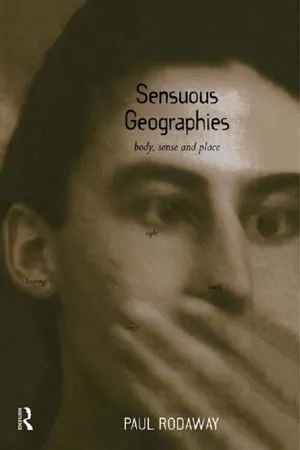
Sensuous Geographies explores our immediate sensuous experience of the world. Touch, smell, hearing and sight - the four senses chiefly relevant to geographical experience - both receive and structure information. The process is mediated by historical, cultural and technological factors.
Issues of definition are illustrated through a variety of sensuous geographies. Focusing on postmodern concerns with representation, the book brings insights from individual perceptions and cultural observations to an analysis of the senses, challenging us to reconsider the role of the sensuous as not merely the physical basis of understanding but as an integral part of the cultural definition of geographical knowledge.
- 216 pages
- English
- ePUB (mobile friendly)
- Available on iOS & Android
eBook - ePub
About this book
Part I
SENSE AND GEOGRAPHY
1
SENSUOUS GEOGRAPHY
Words are like nails. You can bang them in like nails and can try to pull them back, as if retrieving them from the wood with the reverse of the hammer, but always they leave holes.
(Anon. 1990)
INTRODUCTION
‘We learn to see a thing by learning to describe it’ (Williams 1965:39). Sensuous Geographies seeks to describe some of the features of a geography of the senses and to offer some possible explanations of the changing role of the senses in everyday experiences of space and place. This is a surprisingly neglected geography and one rich in possibilities for meaningful investigation (see Ackermann 1990).
Richard Long (Long and Cork 1988), the sculptor, artist and walker, recently argued that: ‘I would like to see art as a return to the senses’. Porteous (1986b) has also argued for a return to more ‘intimate sensing’ in geography as a complement to the current widespread interest in techniques of remote sensing. ‘We are far more out of touch with even the nearest approaches of the infinite reaches of inner space than we now are with the reaches of outer space…what would happen if some of us then started to see, hear, touch, smell and taste things?’ (Laing 1967 in Porteous 1990:xvi). The senses are an important part of everyday experience, not just art, providing us with both information about a world around us and, through their structure and the way we use them, the senses mediate that experience. The sensuous—the experience of the senses—is the ground base on which a wider geographical understanding can be constructed.
Richard Long, therefore, builds his art from walking across the landscape, from an intimate sensual experience with space and the materials of his environment and forms his ‘sculptures’ in pattern with the landscape, its structure and material substance, both by leaving arrangements of stones and other materials in lines or circles in the landscape, and photographs of these and material versions compiled in exhibition galleries (Romey 1987; Long and Cork 1988). Geographers, perhaps, need to return in some way to a kind of sensual study, both intimate in its focus on the information of the senses—touch, smell, taste, hearing, sight—and also wider ranging, inclusive not just of the visual dimension of experience, but also the other senses. Sullivan and Gill have observed: ‘sight paints a picture of life, but sound, touch, taste and smell are actually life itself’ (1975:181). A sensuous geography may therefore lay some claim to reasserting a return of geographical study to the fullness of a living world or everyday life as a multisensual and multidimensional situatedness in space and in relationship to places.
Sensuous Geographies is an exploratory study. Its primary aim is to excite interest in the immediate sensuous experience of the world and to investigate the role of the senses—touch, smell, hearing and sight—in geographical experience. The potential scope of such a text is vast and thus, inevitably, the survey is selective. These four senses are selected as the most immediately relevant to geographical experience and each is considered in turn but this is not to deny the multisensual nature of everyday experience and the value of considering other sensual dimensions of geographical experience.
The sense geographies identified are convenient analytical categories designed to focus attention on the specific qualities each sense gives to geographical understanding and do not suggest independent or alternative worlds. Nevertheless, the senses are not merely passive receptors of particular kinds of environmental stimuli but are actively involved in the structuring of that information and are significant in the overall sense of a world achieved by the sentient. In this way, sense and reality are related.
Interest in sensuous geographies is not new. The aesthetic geography of Vaughan Cornish (1928, 1935), the perception geography of the late 1960s and early 1970s (Lowenthal 1961; Kirk 1963; Gold 1980) and the more recent work of humanistic geographers (Pocock 1983, 1989, 1993; Porteous 1985, 1986b, 1990; Porteous and Mastin 1985; Tuan 1974, 1993) have each brought attention to human perception in geographical understanding. The present book, however, focuses exclusively on the senses and geographical experience.
A number of methods of investigation are possible: a scientific or psychophysical analysis of the spatial dimension of sense perception (e.g. Blauert 1983), a sociological analysis of the socio-historical definition of styles of sensuous experience (e.g. Rose 1986), a cultural analysis of place design and sensuous experience (e.g. Norberg-Schulz 1980). Each approach provides important insights but they all tend to separate out the physical, social, cultural and aesthetic dimensions of human experience. The present study seeks to offer a more integrated view of the role of the senses in geographical understanding: the senses both as a relationship to a world and the senses as in themselves a kind of structuring of space and defining of place. Therefore, the current study is more eclectic in method, drawing on each of these perspectives in conjunction with phenomenological reflection and the introduction of ideas from recent postmodern writing.
Of course, the very act of focusing on the senses is full of presuppositions and constitutes an abstraction. It presumes that distinctive senses can be identified and that their role in geographical experience can be discussed meaningfully individually and separate from the emotional dimensions of experience. Sensual and emotional geographies are closely connected, as is well demonstrated in the writings of Yi-Fu Tuan. However, here we concentrate on sensuous geographies and leave emotional geographies for another project.
Everyday experience is multisensual, though one or more senses may be dominant in a given situation. These abstractions are an analytical device to enable us to highlight often taken-for-granted and hidden dimensions of geographical experience. Here, geography is understood as earth (geo-) drawing (-graphe), that is, a description of the earth and human experience of it, considering issues of orientation, spatial relationship and the character of places. ‘Sensuous geography’ therefore refers to a study of the geographical understanding which arises out of the stimulation of, or apprehension by, the senses. This is both an individual and a social geography, a physical and a cultural geography.
SENSE AND SENSES
This is not a perception geography, nor an experiential geography, but a geography of the senses. The term ‘sense’ has an important duality or ambiguity.
1 Sense, as in ‘making sense’, refers to order and understanding. This is sense as meaning.
2 Sense, or ‘the senses’, can also refer to the specific sense modes—touch, smell, taste, sight, hearing and the sense of balance. This is sense as sensation or feeling.
These two aspects are closely related and often implied by each other. The sense(s) is (are) both a reaching out to the world as a source of information and an understanding of that world so gathered. This sensuous experience and understanding is grounded in previous experience and expectation, each dependent on sensual and sensory capacities and educational training and cultural conditioning.
The ambiguity of the term ‘sense’—referring to specific sense organs (sensation) and broader mental constructs (meaning)—is also a relationship between the immediate experience and metaphorical extrapolation. This metaphorical dimension has been explored by a number of geographers (Tuan 1979a; Pocock 1981a; Porteous 1990). The reason for metaphorical uses of the senses lies, in part, in the multisensual nature of everyday geographical experience and the complex and ambiguous relationship between the individual senses. Synaesthesia—secondary sensation caused by stimulation of another part of the body, such as accompanying sensations of colour with given sounds—is a related phenomenon, but here the more basic inter-relationship and cooperation of the senses in everyday experience is meant. Metaphorical use is also reinforced by language traditions, especially in Western cultures, in which visual metaphors are often preferred (Pocock 1981a) and vocabularies of visual and, to a slightly lesser degree, auditory and tactile experience are rich, whilst those for smell and taste are more limited and dependent on associations and metaphors of the other senses. Sense is sensation and meaning and, therefore, the term ‘sense’—literal and metaphorical—leads to deeper questions about sense and reality. Different cultures in different times and places have employed or defined the senses differently and their associated concepts of reality. Therefore, a sensuous geography cannot just describe the experience of the senses and their role in the constitution of geographical experience, it must also consider more fundamental questions about the nature of person-environment relationships and what constitutes a geographical reality for a given society (or culture) at a given moment in time and space.
GEOGRAPHY, HUMANISTIC OR POSTMODERN?
Sensuous Geographies combines ideas from both humanistic and postmodern thought. At the end of the 1960s, human geographers became somewhat disillusioned with the so-called ‘quantitative revolution’ and the methods of positivist science. Geographers studying perception and behaviour were especially concerned about the important qualitative dimensions of human experience which such aggregate methods missed. There was also a revival of interest in human geography as a whole in the issue of relevance and the need to solve ‘real problems’ for society and the environment. In the 1970s, therefore, a number of competing approaches or new philosophies of geography emerged (Johnston 1983a, 1983b; Buttimer 1993). In human geography, the main alternatives were a form of Marxist social geography grounded in ideas from sociology and political economy and a humanistic individual geography which related more to the humanities and arts. In a ‘battle’ for dominance in the discipline, Marxist geography seemed to triumph over the humanistic approach and the latter became the preserve of a few dedicated researchers (notably Yi-Fu Tuan).
More recently, and especially since the mid-1980s, geographers have re-evaluated their reading of sociology, adopting a broader range of social theories and journeying into the debates about postmodernism (Dear 1988; Soja 1989; Harvey 1989). At the same time, there has also been a revival of interest in humanistic issues and some cross-fertilisation between humanistic and postmodern thinking in geography (Tuan 1993; Buttimer 1993). The present book is situated within this context of a reading of postmodernism and a re-evaluation of humanistic perspectives within the framework of a study of the senses and geographical experience.
Within the complex debates about postmodernism and the contemporary social and geographical experience, one can identify three key issues which are each of immediate relevance to the definition and scope of a sensuous geography.
1 The redefinition of the ‘real’ and the position of the ‘sign’. This is the question of reality versus representation, of sign and referent, and is typified by Baudrillard's concept of hyper-reality (1983a). Here, the senses as an access to a ‘real world’ are not naively defined, that is, not merely as physically absolute characteristics, but are situated within and defined by the socio-economic, cultural and technological context of their employment.
2 The reassertion of ‘space’ in social thought, or specifically the role of spatial (and space-time) frameworks (or logics) in analysis. Social and geographical understanding is always and already situated within specific places and times, and an understanding of both the specific and the general must take account of the complex inter-relationships or networks of past, present and potential operating through a given space. Bakhtin's concept of the chronotope (1986a, 1986b; Folch-Serra 1990) and Foucault's dispositif and detailed studies of the transition to modernity represent this spatialised thinking (Foucault 1970, 1972, 1973, 1975, 1979, 1967/ 1986; Shields 1991; Philo 1992). Each of these contexts implies a changing sensuous geography.
3 The rediscovery of the sensuous (and the body) as a potent part of social, political, historical and geographical experience. This introduces the discussion about rationality and the economy of desire (Lyotard 1971; Deleuze and Guattari 1984) and reasserts the body as a focus of sociopolitical struggle and cultural change. The senses, situated on the body and operating through the body, and the body itself as a sensuous dimension, gain new significance in social and geographical understanding.
Lash (1988) argues that (in the cultural realm) modernism is discursive and textual, whilst postmodernism is figural and sensory. The first is about meaning, the second is about experience. The humanistic perspective and, specifically, the phenomenological approach to perception (Merleau-Ponty 1962) asserts a unity of experience and meaning, that is sense(s) is (are) both sensation and meaning. The re-evaluation of humanistic approaches and specifically phenomenology (Seamon 1979; Seamon and Mugerauer 1985) indicate a number of other key issues for a sensuous geography.
1 Phenomenological reduction or ‘back to the things themselves’ (Husserl 1983). Heidegger describes the phenomenological attitude: ‘to let that which shows itself be seen from itself in the very way in which it shows itself from itself’ (1983:58). Whilst all the senses form part of a multisensual whole, each can be observed individually to appreciate its distinctive ‘voice’ or role in geographical experience and studied to chart its distinctive ‘history’ and changing place in geographical understanding.
Johnson (1983) identifies three stages of reduction in Husserl's phenomenological strategy: phenomenological reduction—suspension of all beliefs characteristic of the ‘natural attitude’, that is, everyday common sense and the scientific method—this is a ‘bracketing out’ of preconceptions; eidetic reduction—when the particular encounter with the phenomena is taken as universal; and, thirdly, a kind of psychological reduction by which we discern the constitution of phenomena in our cognition. (Postmodern cultural analysis or readings perhaps offer a more open and accessible form of reduction. Derrida's (1982) deconstruction could also be interpreted as a kind of reduction in this sense.)
2 Intentionality and anthropocentrism—phenomenology begins and ends with the human subject, seeking to understand the nature of ‘being in the world’ (Heidegger 1983) and the recurring theme of phenomenology, according to Husserl (1983), is intentionality and specifically human intentionality. Our experience—including sensuous experience—is always and already a consciousness of something, and we have a relationship to that thing, it participates with us in constituting a world. The intentionality of experience is therefore a sense of ownness and belonging, of relationship and participation, of situatedness. Phenomenology implicitly gives geography and its fundamental question ‘where?’ a key place in the understanding of human experience.
3 Wholeness and participation—phenomenology is grounded in the realisation that we are already within and part of the world we study. It is not possible to sustain an objective and detached view of the world. Geographical understanding always begins from or is relative to a given location in space, the space which is being studied. Further, the act of studying inevitably effects or changes the thing studied and the individual studying it. There is an interdependence of phenomena studied and methods (Seamon 1983). Therefore, through reflection on sensuous experience and the study of sensuous geographies, we each become both more aware of our own sensuous geographies but also those experiences are changed.
The phenomenological attitude has been variously equated with ‘meditative thinking’ (Heidegger 1966), wonder (Fink 1933; Relph 1985), opening (Giorgi 1970), surrender (Wolff 1963), spiritual discipline (Zimmerman 1985) or love (Laing 1964). It is a kind of heightened experience, more aesthetic than immediately practical.
The present text seeks to combine elements of humanistic and postmodern thinking, taking a journey from phenomenologically inspired reflections on the nature of each sense dimension and its associated geography and going on to explore the cultural definition of that sense and the contemporary experience of sensuous reality (see also Shields 1991).
A GEOGRAPHY OF THE SENSES
The present text falls into three parts:
1 Sense and geography—considers the roots of sensuous geography in perception/behaviour and humanistic geographies, and the general character of the senses....
Table of contents
- Cover Page
- Half Title Page
- Title Page
- Copyright Page
- Contents
- List of Illustrations
- Preface
- Acknowledgements
- Part I Sense and Geography
- Part II Sense, Space, Place
- Part III Sense and Reality
- Bibliography
- Index
Trusted by 375,005 students
Access to over 1.5 million titles for a fair monthly price.
Study more efficiently using our study tools.
Frequently asked questions
Yes, you can cancel anytime from the Subscription tab in your account settings on the Perlego website. Your subscription will stay active until the end of your current billing period. Learn how to cancel your subscription
No, books cannot be downloaded as external files, such as PDFs, for use outside of Perlego. However, you can download books within the Perlego app for offline reading on mobile or tablet. Learn how to download books offline
Perlego offers two plans: Essential and Complete
- Essential is ideal for learners and professionals who enjoy exploring a wide range of subjects. Access the Essential Library with 800,000+ trusted titles and best-sellers across business, personal growth, and the humanities. Includes unlimited reading time and Standard Read Aloud voice.
- Complete: Perfect for advanced learners and researchers needing full, unrestricted access. Unlock 1.5M+ books across hundreds of subjects, including academic and specialized titles. The Complete Plan also includes advanced features like Premium Read Aloud and Research Assistant.
We are an online textbook subscription service, where you can get access to an entire online library for less than the price of a single book per month. With over 1.5 million books across 990+ topics, we’ve got you covered! Learn about our mission
Look out for the read-aloud symbol on your next book to see if you can listen to it. The read-aloud tool reads text aloud for you, highlighting the text as it is being read. You can pause it, speed it up and slow it down. Learn more about Read Aloud
Yes! You can use the Perlego app on both iOS and Android devices to read anytime, anywhere — even offline. Perfect for commutes or when you’re on the go.
Please note we cannot support devices running on iOS 13 and Android 7 or earlier. Learn more about using the app
Please note we cannot support devices running on iOS 13 and Android 7 or earlier. Learn more about using the app
Yes, you can access Sensuous Geographies by Paul Rodaway in PDF and/or ePUB format, as well as other popular books in Social Sciences & Geography. We have over 1.5 million books available in our catalogue for you to explore.