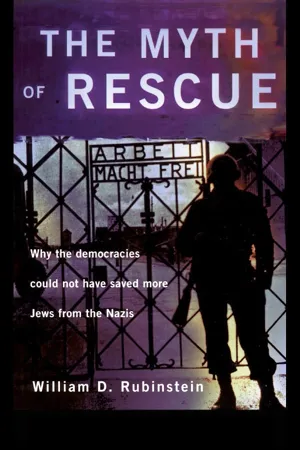
It has long been argued that the Allies did little or nothing to rescue Europe's Jews. Arguing that this has been consistently misinterpreted, The Myth of Rescue states that few Jews who perished could have been saved by any action of the Allies. In his new introduction to the paperback edition, Willliam Rubinstein responds to the controversy caused by his challenging views, and considers further the question of bombing Auschwitz, which remains perhaps the most widely discussed alleged lost opportunity for saving Jews available to the Allies.
eBook - ePub
The Myth of Rescue
Why the Democracies Could Not Have Saved More Jews from the Nazis
- 304 pages
- English
- ePUB (mobile friendly)
- Available on iOS & Android
eBook - ePub
1
THE HISTORIOGRAPHY OF RESCUE
There can be few subjects in the whole range of modern history on which contemporary opinion differed so sharply from the views of later historians and authors than the topic of the rescue of Jews by the democracies during the Nazi Holocaust. During the Second World War, Jews (and non-Jewish anti-Nazis) looked upon the celebrated leaders of the great democracies at war with Nazi Germany—Winston Churchill and Franklin D.Roosevelt—as the heads of the armies of liberation which would free the whole world, and the Jewish people in particular, from the Nazi scourge. In December 1944, Joseph Hertz, the British Chief Rabbi, issued a birthday message to Winston Churchill which read:
But for your wisdom and courage there would have been a Vichy England lying prostrate before an all-powerful Satanism that spelled slavery to the western peoples, death to Israel, and night to the sacred heritage of man. May Heaven grant you many more years of brilliant leadership in the rebuilding of a ruined world.1
American Jews constituted ‘the most loyal and loving’ of Franklin D.Roosevelt’s constituencies;2 to American anti-semites, Roosevelt’s policies were so philosemitic and influenced by ‘Jewish power’ as to constitute the ‘Jew Deal’. A Jewish Republican Congressman of the 1930s, Jonah J.Goldstein, concluded that ‘the Jews have three velten [worlds]: die velt [this world], yene velt [the next world], and Roosevelt’.3 Yet recently much has changed. Commenting upon ‘the strange turn in the attitude of American Jews towards Franklin D.Roosevelt in the recent past’, the famous historian Arthur M.Schlesinger Jr noted that:
For a long time [Roosevelt] was a hero. No president had appointed so many Jews to public office. No president had surrounded himself with so many Jewish advisers. No president had condemned anti-Semitism with such eloquence and persistence. Jews were mostly liberals in those faraway days, and a vast majority voted four times for FDR.4
This great and profound change in the perception of the Allies and their leaders arose fairly abruptly between the late 1960s and the mid-1980s, wholly as a result of a near-universal perception that the Allies did virtually nothing to rescue Europe’s Jews during the Holocaust. By the late 1980s, every examination of the Allied response to the Holocaust was compelled to take into account the belief, by then virtually universal, that the democracies ‘did nothing’ during Hitler’s ‘Final Solution’, and were—to many—guilty of being virtual accomplices in the Holocaust. The list of alleged Allied failures is long, ranging from closing their doors to Jewish refugee emigration prior to and during the Holocaust, forestalling the creation of a Jewish state in Palestine when this was most necessary as a place of refuge, failing to bomb Auschwitz or any other death camp, failing to engage in negotiations with the Nazis with the aim of bartering for Jewish life and failing, until early 1944, to create any specialised government agency to save Jewish lives, oblivious to the fact that Hitler was engaged in a ‘war against the Jews’. The alleged reasons for these failings were also manifold, including strong and pervasive anti-semitism and anti-Zionism among both the American and British opinion-makers and masses, ignorance of Nazi intentions, bureaucratic inertia and an inability to internalise the unbelievable horrors of the Holocaust during the war itself. As well, it is widely suggested that the Jewish communities of the democracies were, by later standards, extraordinarily supine during Jewry’s hour of greatest need, deeply divided and afraid to become overly visible or demonstrative during a world war.
These are seemingly powerful arguments, repeatedly reiterated by expert historians and by now entrenched in the popular imagination. Yet all of these arguments in my opinion are wrong and lacking in merit; the rest of this work will show why they are grossly misleading and inaccurate. It is first worth examining how the historiography of rescue emerged, in its contemporary form, and how the Jewish and anti-Nazi view of Churchill and Roosevelt as supreme heroes and liberators changed so radically.
For the first twenty years or so after the end of the Second World War, probably no historical work on the Holocaust criticised the actions of the Allies or suggested that much more could have been done which was not done.5 All of these early works on the Holocaust, not surprisingly, focused upon the guilt of the Nazis and their allies. Perhaps the first considered work to attack the Allies for their failures in rescuing Jews was a little-noted article by Reuben Ainsztein, a Holocaust survivor who was well known as a historian of Jewish revolt in the ghettos and concentration camps, entitled ‘How Many More Could Have Been Saved?’ Ainsztein’s article, which appeared in the British periodical Jewish Quarterly in 1967, contained a surprisingly large component of the critique of Allied policy which has since become standard, years before other historians made the same point. For instance, it offered an accurate examination of when news of the ‘Final Solution’ first became known in the West, more than a decade before this question was examined in detail by other historians. Ainsztein’s claim (p.) that
the racist and antisemitic elements in the United States, allied with the still powerful isolationist forces, were strong enough even in 1943 to provide President Roosevelt and his State Department with excuses for not doing anything that might be interpreted as making the rescue of Jews one of America’s war aims
has been echoed in dozens of subsequent examinations of this question. Yet it must also be said that, remarkably early, Ainsztein managed to make virtually every historical and logical error one could possibly make in examining this question, including the fons et origio mali, the conviction that the limited number of refugees accepted by the United States after the war began was due to its restrictive immigration laws, rather than to the fact that Hitler prevented these Jews from emigrating, prior to genocide. Perhaps only the alleged failure to bomb Auschwitz —not mentioned by Ainsztein—is absent from the now-standard bill of indictment.
Ainsztein’s unnoticed article appeared shortly before the first books to take the failure of the Allies as their themes: Arthur Morse’s While Six Million Died: A Chronicle of American Apathy (New York, 1968) and David S.Wyman’s Paper Walls: America and the Refugee Crisis, 1938–1941 (Boston, 1968). The 1970s saw yet more books on this theme, among them the balanced and scholarly monograph by Henry L. Feingold, The Politics of Rescue: The Roosevelt Administration and the Holocaust, 1938–1945 (New Brunswick, NJ, 1970), a work which is, nonetheless, critical of American policy and already aware of the new, negative interpretation of this topic, and also such works as Saul Friedman’s No Haven For the Oppressed: United States Policy Toward Jewish Refugees, 1938–1945 (Detroit, 1973) and Herbert Druks’ The Failure to Rescue (New York, 1977), whose titles accurately indicate their perspective.
In the late 1970s and early 1980s there appeared the writings which probably had the most significant impact upon the notion that the Allies failed to rescue Jews during the Holocaust. They were by David S.Wyman, a non-Jewish historian at the University of Massachusetts—Amherst.6 In ‘Why Auschwitz Was Never Bombed’, published in the influential and widely read American Jewish monthly Commentary in May 1978, Wyman did two significant things: he almost single-handedly originated the notion that the Allies could have easily bombed and destroyed the Auschwitz extermination camp in 1944 but, for a variety of thoroughly inadequate reasons, chose not to do so; and he made the alleged Allied failure to bomb Auschwitz into Indictment Number One in the list of American and British failures during the Holocaust. Dramatic and easy for non-historians to comprehend, the bombing of Auschwitz quickly seized the imagination of Jews and non-Jews alike, just at the time when the Holocaust was becoming accepted by almost everyone of good will as perhaps the lowest point ever touched by the human race, as incomprehensible as it was evil, and at a time when the Holocaust came virtually to dominate contemporary Jewish thought.
Six years later, in 1984, Wyman published his considered work on alleged American failure during the Holocaust, The Abandonment of the Jews: America and the Holocaust, 1941– 1945 (New York, 1984), offering a detailed account of America’s manifold failings during the ‘Final Solution’, superficially as disturbing as it was convincing. The villain of the book was clearly President Franklin D.Roosevelt, and some of its popularity was obviously due to its seemingly persuasive evidence that the former god of American liberalism and of the American Jewish community had—to say the least—feet of clay. Wyman also accepted the notion that Revisionist Zionists, Strictly Orthodox Jews and other ‘outsiders’ within the American Jewish community offered realistic and radical plans for the rescue of Europe’s Jews which were rejected by the conservative and unctuous American Jewish ‘Establishment’. He repeated, with more details, his suggestion that Auschwitz could successfully have been bombed by the American military in 1944, and offered a seemingly considered and detailed list of points of ‘what might have been done’. His book—taken in conjunction with the others which appeared at around the same time—has been tremendously influential, greatly shaping our interpretation of Allied action and inaction during the Holocaust.
On every significant point he makes, it is my considered opinion that Wyman is not merely wrong, but egregiously and ahistorically inaccurate: in a sense, this book is a response to Wyman’s work, although it also covers areas such as Britain’s role in rescue, not discussed in The Abandonment of the Jews. Wyman’s book strikes me as wrong-headed in three separate ways, apart from any matter of specific detail. First, the evidence Wyman amasses, when interpreted correctly, in virtually every case goes to show the precise opposite of the interpretation he places upon it. The reason for this consistent inaccuracy is that the situation facing European Jewry after the war began is virtually the opposite of that which underlies his interpretation: the Jews of Nazi-occupied Europe were prisoners, not refugees— the prisoners of a psychopath who was going to kill all of them if he could. Second, many of Wyman’s suggestions as to what might have been done to rescue Jews were simply not proposed by anyone at the time. In this work, we will consider in detail the ways to rescue Jews that were actually proposed in the democracies, and it will become consistently plain that these proposals were futile and useless. Third, Wyman seems in the final analysis to understand this perfectly well. He therefore argues that even schemes whose success was unlikely ‘should have been tried… If that had been done, even if few or no lives had been saved, the moral obligation would have been fulfilled’, mindless of the fact that no government, in wartime, will direct scarce and valuable resources from successfully pursuing a war of liberation into projects whose success was dubious. He is also heedless of the fact that most of his proposals which ‘should have been tried’ were not proposed at the time.7
Wyman’s work, together with the previous body of scholarship in this field and the increasing visibility of this question, themselves generated further books and articles with remarkably similar themes and premises: Monty N.Penkower’s The Jews Were Expendable: Free World Diplomacy and the Holocaust (Chicago, 1983), and his ‘In Dramatic Dissent: The Bergson Boys’ (American Jewish History, 69, 1981); Haskel Lookstein’s, Were We Our Brothers’ Keepers? The Public Response of American Jews to the Holocaust, 1938–1944 (New York, 1985); and Aaron Berman’s Nazism, the Jews and American Zionism, 1933– 1948 (Detroit, 1990), as well as a spate of similar works on Britain and the Commonwealth.
The notion that American Jewry ‘did nothing’ during the Holocaust, acquiescing in the mass murder of their kinsmen in Europe, became something of an obsession among many American Jews at this time. American Jews contrasted the ever-vigorous, ever-vigilant and often highly successful activities in Washington, DC of the legendary post-war ‘Jewish lobby’ over such issues as American support for the State of Israel, with the complete lack of success of American Jewry in deterring the Nazi Holocaust, and—with the evidence apparently provided by such works as those by Wyman—drew the understandable but completely erroneous conclusion that it was the American Jewish community and the Roosevelt administration which had failed European Jewry in their hour of greatest need, rather than the more accurate inference that stopping Hitler’s genocide was impossible without destroying Nazi Germany. There were curious manifestations of this conviction, such as the so-called ‘Goldberg Report’ of 1984, an attempt by a commission of American Jewish politicians and academics, headed by former Supreme Court Justice Arthur Goldberg, to address the question of ‘why were so many American Jews passive or relatively unconcerned about the plight of European Jews?’ (thus prejudging the very question the commission was presumably supposed to examine), which arrived at the conclusion that, in effect, if American Jewry had acted in the 1940s as its progeny acted in the 1980s, more Jews could have been saved—a dubious finding on several grounds.8 The ‘Goldberg Report’ includes statements endorsing its findings by several Jewish politicians of the day, including New York City Comptroller Harrison J.Goldin and Brooklyn District Attorney Elizabeth Holtzman, surely the first occasion since the death of Stalin when a controversial historical interpretation was deemed to be true because some political office-holders said it was true.9 A number of renowned historians of the Holocaust such as Yehuda Bauer and Lucy S.Dawidowicz pointedly declined to join the ‘Goldberg Commission’; both Bauer and Dawidowicz wrote scathingly of this commission and its findings.10
The thesis that America and American Jewry ‘did nothing’ during the Holocaust has since been further expounded in a variety of other media forums, including a 1994 American Public Broadcasting System documentary, America and the Holocaust: Deceit and Deception, and a ‘public trial’ held in Jerusalem in 1990: ‘Why Auschwitz Was Not Bombed.’ Many Holocaust museums, including the US Holocaust Memorial Museum in Washington, DC, contain exhibits or publications on this subject. Most recent histories and general accounts of the Holocaust now contain a chapter on the passivity and indifference (if not far worse) of the ‘bystanders’ who knew what was going on but chose to ‘do nothing’. To cite one very typical example, the excellent work by Michael R.Marrus on the historical questions raised by the Holocaust and discussed by historians, The Holocaust in History, contains a section on the ‘Bystanders’ (pp.) which, while clearly noting that ‘to many it will…seem that these exercises are profoundly unhistorical’, nevertheless concludes that ‘clearly more could have been done— by Jews as well as by non-Jews’.11
As well, beyond Wyman and his school there has emerged since the 1980s a semischolarly, semi-popular group of writings which accuse America and the Western Allies of complicity in carrying out the Holocaust, assigning them a share in the guilt which seems to exceed that of the Nazis themselves. It often seems that some of these authors would frankly have been happier if the bullet-proof glass cage in Jerusalem in 1961 had not held Adolf Eichmann, but Winston Churchill or (if he were still alive) Franklin D.Roosevelt. In 1989 William Perl, an Austrian refugee who holds a doctorate in law from the University of Vienna, published The Holocaust Conspiracy: An International Policy of Genocide (Shapolsky Publishers, New York, 1989), whose aim, according to the book’s dust-jacket, is to show
that it was not apathetic inaction of the world’s powers which made the Holocaust…so tragically effective…[but] deliberate action on the part of many nations [i.e., the Western Allies] that kept millions of those destined for murder, prisoners in a hostile Europe. Those deliberate actions are conclusively shown to result from conspiracies within individual governments as well as between governments.
The tenor of this work may be gauged by the author’s reference (p.) to Anthony Eden as ‘a Jew-hater’ —this of a man who, next to Churchill, was the foremost opponent of Appeasement during the 1930s; the man who officially announced on behalf of the British Government in the House of Commons that the Holocaust was taking place; in 1956 a military ally of Israel.
Two years before, in 1987, Shapolsky Publishers had also produced Rafael Medoff’s The Deafening Silence: American...
Table of contents
- COVER PAGE
- TITLE PAGE
- COPYRIGHT PAGE
- MAPS
- TABLES
- INTRODUCTION
- INTRODUCTION TO THE PAPERBACK EDITION
- 1. THE HISTORIOGRAPHY OF RESCUE
- 2. THE MYTH OF CLOSED DOORS , 1933–9
- 3. THE MYTH OF PLANS FOR RESCUE
- 4. THE MYTH OF BOMBING AUSCHWITZ
- 5. THE MYTH OF THE WAR REFUGEE BOARD
- 6. THE MYTH OF NEGOTIATIONS WITH THE NAZIS
- 7. THE MYTH OF RESCUE
- NOTES
Trusted by 375,005 students
Access to over 1.5 million titles for a fair monthly price.
Study more efficiently using our study tools.
Frequently asked questions
Yes, you can cancel anytime from the Subscription tab in your account settings on the Perlego website. Your subscription will stay active until the end of your current billing period. Learn how to cancel your subscription
No, books cannot be downloaded as external files, such as PDFs, for use outside of Perlego. However, you can download books within the Perlego app for offline reading on mobile or tablet. Learn how to download books offline
Perlego offers two plans: Essential and Complete
- Essential is ideal for learners and professionals who enjoy exploring a wide range of subjects. Access the Essential Library with 800,000+ trusted titles and best-sellers across business, personal growth, and the humanities. Includes unlimited reading time and Standard Read Aloud voice.
- Complete: Perfect for advanced learners and researchers needing full, unrestricted access. Unlock 1.5M+ books across hundreds of subjects, including academic and specialized titles. The Complete Plan also includes advanced features like Premium Read Aloud and Research Assistant.
We are an online textbook subscription service, where you can get access to an entire online library for less than the price of a single book per month. With over 1.5 million books across 990+ topics, we’ve got you covered! Learn about our mission
Look out for the read-aloud symbol on your next book to see if you can listen to it. The read-aloud tool reads text aloud for you, highlighting the text as it is being read. You can pause it, speed it up and slow it down. Learn more about Read Aloud
Yes! You can use the Perlego app on both iOS and Android devices to read anytime, anywhere — even offline. Perfect for commutes or when you’re on the go.
Please note we cannot support devices running on iOS 13 and Android 7 or earlier. Learn more about using the app
Please note we cannot support devices running on iOS 13 and Android 7 or earlier. Learn more about using the app
Yes, you can access The Myth of Rescue by W.D. Rubinstein in PDF and/or ePUB format, as well as other popular books in History & Historiography. We have over 1.5 million books available in our catalogue for you to explore.