- 208 pages
- English
- ePUB (mobile friendly)
- Available on iOS & Android
eBook - ePub
Search Marketing Strategies
About this book
Search Marketing Strategies focuses on how to make the most from the search engine industry. Concentrating on the strategic element rather than the procedural approach, the author demonstrates how to adapt the tactical techniques, such as paid search, site side optimization and analytics packages, into search strategies in order to achieve marketing or corporate objectives such as branding, sales and customer acquisition.
CHAPTER 1
What is Search Marketing?
Introduction
The opportunity from search to the marketer is growing rapidly. Recent statistics published by the Search Engine Marketing Professional Organization (SEMPO) recorded search spending above $4bn for 20041. With over 280 000 advertisers reported by Google (cited in the San Francisco Times) in 2004 and an expected 378 000 in 20052 the number of companies taking advantage of paid search is growing rapidly. Add in the number of advertisers using mechanisms from companies such as MIVA, Overture, MSN and many of the smaller engines and the uptake for this medium is significant.
This is still a novice industry and many of the marketers operating within the space aren’t aware of the necessary approaches to getting the most from the space. With a reported 25 per cent of all advertisers actually engaging in some form of strategy3 or bidding technique the industry is fraught with companies facing poor performance and limited direction. The result is a medium that is proving time and time again as being one of the strongest vehicles for driving qualified visitors with a staggering 75 per cent not using any thought rationale into the strategic direction behind the medium.
Putting this comparison in perspective with other online media types the search mechanisms available, be it paid or organic, are considered and reported to be some of the strongest vehicles for driving qualified visitors. The following chart from eMarketer (see Figure 1.1) demonstrates that apart from in-house email lists search is the strongest at driving qualified visitors for the retail space.
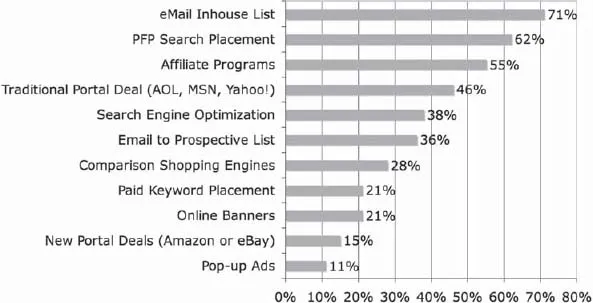
[Fig. 1.1]
eMarketer – Online marketing tactics used by US retailers, 2003 (as percentage of respondents). Source: Shop.org and Forrester Research, May 2003
eMarketer – Online marketing tactics used by US retailers, 2003 (as percentage of respondents). Source: Shop.org and Forrester Research, May 2003
Search marketing is the application of all tactical elements associated with the search industry and manipulated to form a plan or strategy to achieve online goals. Search marketing as a concept is singular; however, depending upon industry and objective it takes many forms.
In identifying each of the elements involved in search marketing the construction of a plan becomes clearer and easier to comprehend. As the ‘search engine’ space is relatively new there is a large amount of confusion as to how to succeed within it but the mechanisms are, with guidance, relatively simple. Success is therefore determined by the way in which these mechanisms and elements are pieced together.
Chapter 2 (Your Search Tool Kit) lists the variables in much detail and gives a clear distinction as to what is available to the marketer to make search marketing a success and to build a credible search engine marketing plan.
This chapter is dedicated to elaborating on how search marketing came about, how the industry has evolved, what the typical goals of search marketing are and what people try to achieve but find that search just can’t support it.
Evolution of the search engine industry
The beginning
The search engine industry has grown rapidly over the past 7 or more years. As the Internet grew so did the demand for vehicles in which Internet searchers could find their way to information quickly and efficiently, in a sense finding that needle in a haystack! Search engines then evolved as the solution to this problem with industry recognized names such as AltaVista, HotBot, and Lycos being some of the first and favored destination search websites.
These search engines were powered by a simple mechanism that saw a script, or spider, crawl the web in search of data that it could index and present to a search engine user if their search was close enough to the data’s content. At the time, as is the case in many instances today, websites were written in Hypertext Markup Language (HTML) which a search spider could skim read and pick up as much information it felt to be of use.
Search engine spiders didn’t necessarily have discernible skills and often failed to match the correct websites with the searchers request. In layman’s terms, search engines couldn’t, and to a degree can’t, associate ‘Wimbledon’ with ‘tennis’ or ‘ford’ with ‘motor sport’ and, as a result, failed to satisfy searchers on many occasions. Search engines recognized this and possessed mechanisms to present results with more detailed results but relied on the searcher to know how to extract the most. The use of search query strings often baffled the user and presented an opportunity for a more desirable way to search, if available.
As the search engines were evolving so were directories. These sites, such as Yahoo! or Open Directory Project (DMOZ) contained links to websites that were edited by human beings with the authority to add or reject a website based upon its relevancy to the category it was being placed within. It was largely recognized, as it still is today in some instances, that results from a directory are of a far higher quality than those of a search engine and most sought after by companies wishing to gain a listing.
As the industry evolved so did the technologies used by the search engines and directories. The most notable improvement was made by an engine called Google, which managed to simplify the search process by providing an extremely simple-to-use interface. Additionally, Google focused not only on the content of a website, such as the wording on the page, but on the number of links pointing into pages from other related websites. This concept, known as link popularity, became, and still exists as, one of the most important variables for successful search engine marketing.
But search engines and directories had their own problems, engines still didn’t produce the most relevant listings at times and directories only had a select number of listings indexed (after all a human is limited to the number of sites he or she can look at) causing both entities problems. So, in an effort to start to appease the user, something at the time rare for search mechanisms (believe it or not!), search engines listed directory listings at the top of their results and directories back filled or used SERPs listings after their human edited listings had been exhausted. For example Yahoo! used Inktomi results; Google used Open Directory Project results.
Optimization and spamming
As the search engines evolved, creating different ways to index sites based upon the content of a site, so began the dawn of organizations that help companies restructure their sites to gain better listings within the engines. Search engine optimization (SEO) meant the development of HTML variables such as meta keyword tags, meta description tags, body copy and link popularity (i.e. how do the pages on a website link to each other and sites from outside link into the site being optimized).
As this was, obviously, a monetary engagement, a measurement guide needed to be applied; after all, how was success to be determined? Interestingly enough, the metrics used then still apply today – traffic and rankings. The difference is that where today companies are scrutinized for their performance and procedures, at the dawn of SEO the industry was rife with unscrupulous techniques that saw search engine results filled with company results that weren’t necessarily relevant just placed higher by means of an optimization technique. Mechanisms such as doorway pages, keyword stuffing and link farming all became prevalent and the industry was put in jeopardy as the main target audience, the searcher, wasn’t getting the results they needed and the engines or companies were considered to be at fault rather than the optimization firms responsible for the poor performance.
Relevance and paid search
As with most aspects of business, money makes a difference and the search industry was no different. Around the turn of 2000 the search engines and directories realized that making advertisers pay for listings would not only increase the relevance of search results but would act as a very welcomed revenue stream. Looking back now it seems somewhat unimaginable that search was free at one point but introducing a payment mechanism improved the search space dramatically and elevated search into a fully fledged online advertising mechanism.
But how did paid listings make search ‘better’ for the advertiser? Quite simply, the interjection of an investment into search resulted in an accountability for action once a visitor hit a website. Why would you pay for traffic that had absolutely no chance of being converted into a sale or lead? Additionally the engines, after being chastised for driving such poor results in the past, created a process of auditing listings and ensuring relevancy was always maintained. So much so that some engines declared that only one listing per page of a website could be submitted at any time to prevent multiple search terms directing the searcher to the same page.
As the search engine marketing continued to grow, the fast pace of ‘paid’ search and its subsequent cost implications (i.e. every click has a cost) resulted in marketers having to think more about the strategic application of search into a marketing plan.
As the industry is settling down and maturing, the three major types of search engines are as follows; they are documented below but covered in far more detail in Chapter 2 (Your Search Tool Kit):
• Paid For Placement (PFP) – these engines allow advertisers to bid for position and obtain a position at the top of major search portal listings by paying a penny more than their competitor regardless of the quality of their sites’ content for search engine spiders.
• Paid For Inclusion (PFI) – this type of search allows an advertiser to pay to have their site included within a search engine index or directories listings. Engines like Overture Site Match xChange™ (formerly Inktomi) guarantee sites express indexing and then require a cost per click thereafter whereas Yahoo! requires a submission fee for consideration for inclusion in their directory.
• Organic search (SSO) – this is the remaining area of search that has a zero cost per click but an upfront optimization cost. Stemming from the days before paid search this is still one of the practiced types of search but requires a great deal of upfront optimization and ongoing maintenance for success. Costs here are associated with the hiring of a search engine optimization company or hiring internally to perform the necessary work for success.
In many instances bad practices within the search industry still exist today and paid search can be as bad as poor SEO optimization. The large numbers of advertisers, who still, to this day, don’t track or analyze their search traffic, are the major cause of this and if you are one of these just ask yourself ‘How do I know if the traffic I’m driving to my site is doing what I want?’
What are the typical goals achieved from search?
Following on from the commentary above (Evolution of the search engine industry), in order to answer the question of determining the success of search it is important to understand exactly what search engine marketing can achieve for a company.
In many respects the answer to this is specific to the individual company in question, as each has its own corporate objectives that form the basis of marketing objectives; this path leads to the objective of the search engine marketing plan. Typically there are many different types of areas search marketing can reach and often companies try to achieve this for more than one, which, if measured correctly, is the best use of this medium and later chapters will study combining strategies to achieve more than one objective from search.
Typical goals from search:
In a prequel to later more detailed chapters the following goals or objectives can be achieved from search:
• Branding (Awareness) – a hot debate within the search engine industry as to whether it’s actually true, but branding really is becoming a good use for search engine marketing. Search is a pull medium (as opposed to a push medium) and the user has to physically enter a search term in order to stand any chance of seeing your listing. The results following a search contain advertisers who feel their products or services are most relevant for that term; for example, should someone type in Walkman™, Sony may feel it appropriate to have a search listing appear as the term is so closely associated with their brand. In many instances companies use the vehicle of search to make people aware of their brand when products and services searched for aren’t directly associated with them. Additionally, and more in the case of the Sony example above, companies often use search to reinforce a presence within the market space or to ensure brand continuity across all marketing mediums. Branding and awareness also assists with the development of offline search and it’s stated that up to 90 per c...
Table of contents
- Cover
- Halftitle
- Title
- Copyright
- Contents
- 1. What is Search Marketing?
- 2. Your Search Tool Kit
- 3. Search Marketing Techniques
- 4. Researching and Mapping the Space
- 5. The Most Common Successful and Unsuccessful Elements of a Search Marketing Campaign
- 6. Objective I: Branding and Awareness
- 7. Objective II: Sales Via Fully eCommerce Driven Websites
- 8. Objective III: Lead Acquisition
- 9. Objective IV: Formulating a Search Engine Marketing Plan
- Glossary
- Resources Guide
- Index
Trusted by 375,005 students
Access to over 1.5 million titles for a fair monthly price.
Study more efficiently using our study tools.
Frequently asked questions
Yes, you can cancel anytime from the Subscription tab in your account settings on the Perlego website. Your subscription will stay active until the end of your current billing period. Learn how to cancel your subscription
No, books cannot be downloaded as external files, such as PDFs, for use outside of Perlego. However, you can download books within the Perlego app for offline reading on mobile or tablet. Learn how to download books offline
Perlego offers two plans: Essential and Complete
- Essential is ideal for learners and professionals who enjoy exploring a wide range of subjects. Access the Essential Library with 800,000+ trusted titles and best-sellers across business, personal growth, and the humanities. Includes unlimited reading time and Standard Read Aloud voice.
- Complete: Perfect for advanced learners and researchers needing full, unrestricted access. Unlock 1.5M+ books across hundreds of subjects, including academic and specialized titles. The Complete Plan also includes advanced features like Premium Read Aloud and Research Assistant.
We are an online textbook subscription service, where you can get access to an entire online library for less than the price of a single book per month. With over 1.5 million books across 990+ topics, we’ve got you covered! Learn about our mission
Look out for the read-aloud symbol on your next book to see if you can listen to it. The read-aloud tool reads text aloud for you, highlighting the text as it is being read. You can pause it, speed it up and slow it down. Learn more about Read Aloud
Yes! You can use the Perlego app on both iOS and Android devices to read anytime, anywhere — even offline. Perfect for commutes or when you’re on the go.
Please note we cannot support devices running on iOS 13 and Android 7 or earlier. Learn more about using the app
Please note we cannot support devices running on iOS 13 and Android 7 or earlier. Learn more about using the app
Yes, you can access Search Marketing Strategies by James Colborn in PDF and/or ePUB format, as well as other popular books in Business & Business General. We have over 1.5 million books available in our catalogue for you to explore.