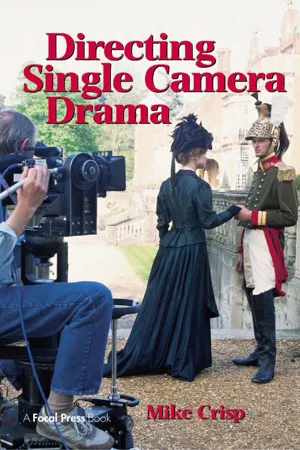
Directing drama for the single camera is like no other form of Filmmaking, or any other medium involving actors. Experience in documentary or theatre may provide useful clues, but the techniques for drama film directors, although not basically complicated, are unique. Experienced directors in other spheres of directing will find this book invaluable if they wish to move into single camera drama, as will students setting out on their careers. Directing Single Camera Drama is a synthesis of the skills required to bring drama to the screen.
Directing drama for the single camera is like no other form of Filmmaking, or any other medium involving actors. Experience in documentary or theatre may provide useful clues, but the techniques for drama film directors, although not basically complicated, are unique. Experienced directors in other spheres of directing will find this book invaluable if they wish to move into single camera drama, as will students setting out on their careers. Directing Single Camera Drama is a synthesis of the skills required to bring drama to the screen.
A unique feature of the book is the inclusion of ten short film drama scripts which need only half a day's rehearsal and one short day's filming. Each have their various technical demands, and they are arranged in ascending order of dramatic and creative difficulty. They can be photocopied and used for non-broadcast training drama exercises.
Mike Crisp worked as Production Manager, and later Director, on many classic BBC TV series, such as Fawlty Towers, Porridge and Steptoe and Son. He was, for 10 years, a senior producer with the BBC's TV Training Department. He is the author of The Practical Director now in its second edition and also published by Focal Press.
Reviews:
'Directors in other spheres of directing who wish to move into single
camera drama will find this book invaluable, as will students setting out on
their careers.'
Voice of the Listener
- 192 pages
- English
- ePUB (mobile friendly)
- Available on iOS & Android
eBook - ePub
Directing Single Camera Drama
About this book
Information
CHAPTER
1 Introduction
When any event is recorded by a camera that image is stylized. The very act of photography reduces our three-dimensional world to a world of two dimensions. If the scene is captured by a motion picture camera then time, which is so inexorable in the three-dimensional world, becomes malleable – even cheatable. The loss of the third dimension endows the film maker with control over time. It may seem esoteric, even pretentious, but an appreciation of that basic truth is the foundation of all creative direction.
Stage and screen
The audience in the theatre can have its attention drawn to particular parts of the stage by all sorts of devices. The simplest would be to have parts of the stage in darkness and only those areas lit which the director wished his audience to notice. On a fully lit stage important action can be placed prominently down-stage centre, dominant characters can stand while the more submissive characters sit. Costume design, stage positions and the sheer charisma of leading players can, and will, work powerfully to draw the audience’s attention. However, should an individual member of that audience be bored, or know someone in the cast, there is nothing to prevent him from casting his eyes over the background action – notice his friend is the second soldier on the left or notice that one of the chorus girls is fatter than the others. In short, whatever devices the theatre director may have employed, he has not got total control of what the audience sees.
Total control is only available to the screen director. In film and television the director can limit the audience–s perception of a scene to precisely the desired framing, controlling not only the size of shot but also the angle of view and, most important of all, the exact point in time that the audience receives the information.
This control of time is the screen director’s most powerful tool and an understanding of its use is essential if drama is to be satisfactorily filmed.
Essentials
We are now so familiar with the screen image that it seems ridiculous to read that, in 1897 when the Lumiére Brothers opened the world’s first commercial cinema, Parisians actually cowered in the seats and some ran for the door when they witnessed the shot of a train pulling into a station. In 1953, when Hollywood had a brief flirtation with 3D films, some moviegoers may have ducked when Vincent Price threw a knife straight at the camera but I doubt if any of them imagined that they were in the same danger that the Parisians of 1897 perceived themselves to be. All sorts of devices have been used to tickle the palates of jaded cinemagoers. (‘Emmergo’ even had plastic skeletons flying over the audience’s head on wires.) The more sophisticated the audience becomes, the easier it is for new film makers to forget the most important truth of the cinema. The basic truth that a moving picture reduces our three-dimensional world to one of two dimensions, a world in which left is always left and right is always right. This is not true of the real world where left and right alter depending on the way you are looking. The human witness to a real incident sees that event in real time and from one point of view. If he wants to take a closer look or see the event from another angle then he moves to get a better look; but this takes time. It does not happen in a 25th of a second. In the two-dimensional world of the screen viewpoints and perspectives change, they are cut together – wide shot followed by a closer shot, then a close-up, then a close–up in the reverse direction. These would be images of hallucination in a real-time three-dimensional world but they are the standard fare of the most mundane TV programme! Early cinema contented itself with a single camera position to record events. It would be fascinating to know if an edited sequence would have been even more terrifying to the Lumiere Brothers’ first audience, or simply so confusing as to be dismissed. It may seem a peculiar form of pedantry to witter on about the two-dimensional screen image but over the years, as I have taught film direction to people with a wide range of backgrounds and talents, it has always amazed me how little this all-important truth has been considered. An acceptance of the limitations of the two-dimensional world brings with it an understanding of just how powerfully that screen world can be manipulated.
Preserving real time
Film makers are often so obsessed with the compression of time and with cinematic excitement that they fail to realize that one of the most important skills for the director of screen drama to acquire is the ability to shoot a simple dialogue scene. A five-minute scene played between two actors could take anything from two hours to two days to film – depending on the complexities of lighting, tracking and location difficulties. However, the audience must believe that the scene took place in the few minutes of real time that the scene takes to play on the screen. This is why continuity is so important. The continuity specialist on the set will be there to worry about whether the actor had his waistcoat buttoned up or not, or on which word he took off his glasses. This is one type of continuity – important, but only part of the many elements of continuity that must be correct if the real time taken to film to scene is to be credibly compressed into its ‘playing time’. Continuity of lighting, sound and performance are equally as important if more subtle, than the more jejeune consideration of whether the actor had his hat on or not.
Continuity and weather
Visitors to a drama shoot are often impressed or perplexed by the amount of lights, and therefore electricians, in use. It is particularly puzzling to the layman to see powerful lamps in use on an exterior shoot in bright sunlight. One of the reasons for this may well be to reduce the contrast levels of the scene (which we will talk about in a later chapter).
However, when lighting a single camera drama, the director of photography has continuity of light as one of the prime considerations. The point is that the sun moves and the weather changes. If the director hasn't the money to pay for a large lighting rig then he must be prepared to wait for matching conditions if the scene is ever going to edit together in a convincing fashion. In the feature film ‘Becket’ there is a scene which illustrates the point perfectly and acts as an awful warning to the impatient director.
About half-way through the film a key scene involves the meeting between Henry II and Becket on a French beach. The scene starts with a glorious wide shot of the sands as Becket (Richard Burton) and Henry II (Peter O’Toole) ride towards each other. The weather is perfect. There is not a cloud in the azure sky. Then the scene cuts to a close-up of O’Toole – the sun is still shining but the sky is full of a ‘Constable’ fluffy white clouds; worse is to come. The cut to Richard Burton’s ciose-up comes like a smack in the face as the sky behind him is grim with dark storm clouds. These three shots are edited together for the rest of the scene resulting in a completely unsatisfactory sequence. No way can an audience ‘suspend disbelief’ when confronted with such a blatant meteorological assertion of real time.
So what should the director have done? Well, either reshot Burton’s close-ups later in the schedule against a clear sky or reshot the whole scene. Obviously both are costly options but the first one shouldn't have proved too difficult The original shot was a slightly low angle, just a close-up of Becket on his horse, backed by the sky. It could have been reshot anywhere – you didn’t really even need a horse – and OToole’s lines could have been spoken off-camera by another actor.
Now any director who identifies with the difficult task that is screen acting might be appalled at the thought of resorting to such artificial devices to solve a continuity problem, but screen drama is all about creating a false reality and experienced screen actors appreciate the fact. Wherever possible the requirements of the actor should be given first consideration but there will be times when the actor has to do something unlikely and just put himself in the hands of the director and the technicians. What is, of course, most important is for the director to have built up a bond of trust with his cast so that the actor understands precisely why his close-up is being retaken in a totally different location (or any of the other circumstances that may arise).
Stanley Kubrick’s ‘Barry Lyndon’ is a tour de force of lighting conditions. Some of the exteriors in the early part of the film are quite beautiful to behold. The patience required to wait for such perfect low sun with its resultant long shadows is all the more remarkable when you consider how short a time such conditions usually last. There are many magnificent skyscapes behind the Irish scenes in the film, but the novice film maker is well advised to analyse these shots carefully. Really dramatic skies change very fast and thus play havoc with continuity. In ‘Barry Lyndon’ the most dramatic skies are used only in simple sequences (one or two shots at the most). The director was then able to get the scene ‘in the can’ before ...
Table of contents
- Cover
- Half Title
- Title Page
- Copyright Page
- Table of Contents
- Acknowledgements
- 1 Introduction
- 2 Location filming
- 3 The director’s role
- 4 Sound
- 5 Cinematography – what the director needs to know about It
- 6 Storyboards
- 7 Filming dance
- 8 Directing techniques
- Appendix 1: Exercise scripts
- Appendix 2: Glossary
- Index
Trusted by 375,005 students
Access to over 1.5 million titles for a fair monthly price.
Study more efficiently using our study tools.
Frequently asked questions
Yes, you can cancel anytime from the Subscription tab in your account settings on the Perlego website. Your subscription will stay active until the end of your current billing period. Learn how to cancel your subscription
No, books cannot be downloaded as external files, such as PDFs, for use outside of Perlego. However, you can download books within the Perlego app for offline reading on mobile or tablet. Learn how to download books offline
We are an online textbook subscription service, where you can get access to an entire online library for less than the price of a single book per month. With over 1.5 million books across 990+ topics, we’ve got you covered! Learn about our mission
Look out for the read-aloud symbol on your next book to see if you can listen to it. The read-aloud tool reads text aloud for you, highlighting the text as it is being read. You can pause it, speed it up and slow it down. Learn more about Read Aloud
Yes! You can use the Perlego app on both iOS and Android devices to read anytime, anywhere — even offline. Perfect for commutes or when you’re on the go.
Please note we cannot support devices running on iOS 13 and Android 7 or earlier. Learn more about using the app
Please note we cannot support devices running on iOS 13 and Android 7 or earlier. Learn more about using the app
Yes, you can access Directing Single Camera Drama by Mike Crisp in PDF and/or ePUB format, as well as other popular books in Media & Performing Arts & Film & Video. We have over 1.5 million books available in our catalogue for you to explore.