Stuck for ideas, inspiration or just want to work differently? Management Extra brings all the best management thinking together in one package. The books are practical and well structured to provide an in depth treatment of these management topics.
Titles in the series:
* Business Environment
* Change Management
* Development for High Performance
* Effective Communications
* Financial Management
* Information and Knowledge Management
* Leadership and Management in Organisations
* Leading Teams
* Making Sense of Data and Information
* Managing Markets and Customers
* Managing for Results
* Managing Health, Safety and Working Environment
* Managing Legal and Ethical Principles
* Managing Yourself
* Positive Working Relationships
* Project Management
* Quality and Operations Management
* Reaching Your Goals Through Innovation
* Recruitment and Selection
* Reputation Management
The series fuses key theories and concepts with applied activities to help managers examine how they work in practice. The books are created with individuals in mind. They are designed to help you improve your management
skills. Management Extra can also be used in conjunction with management programmes of study aligned to standards.
Each of the books has case studies, self assessments and activities all underpinned by knowledge and understanding of the frameworks and techniques required to improve performance. Management Extra provides managers and trainers with a handbook for action and development.
"You found it – what a find! A practical resource packed with all the relevant theory and suggested activities to support your professional development. An essential resource to have at your fingertips, jump in and enjoy."
--Russell Jeans, Learning and Development Manager,
ntl
"All the essential concepts are here, presented in an easily digestible format with lots of up to date case studies and
references – but, most importantly, with plenty of thought provoking activities and self-diagnostic exercises to make the learning personal and transferable."
--Peter Manning, Head of Training & Development, News International Newspapers Ltd
- 132 pages
- English
- ePUB (mobile friendly)
- Available on iOS & Android
eBook - ePub
About this book
1Specify the results
Many of us get the job done, but we sense that our approach is often haphazard. It doesn’t leave room for manoeuvre to cope with unplanned events or to plan for future demands. This theme is about individual and team performance and defining the results you need.
Each organisation is unique.
Results management starts with understanding the context in which you are working by using a framework that considers a number of fundamental questions:
• What are the major external influences on the organisation that create the context in which the results are to be managed?
• What are the internal organisational features and processes that impact on the role of the results manager?
• Is the role of the results manager universal to all organisational contexts?
• What are the benefits to you and the organisation of focusing on results management?
• Next find out how to clearly identify the results you need to achieve. For instance, do you know how complex or risky the task is in relation to previous work you have undertaken? Do you know how to set about organising to deliver the required results and manage the associated risks? These questions are vital to your being a success at managing for results.
This theme looks at clarifying the results you need to achieve. You will:
• Explore the internal and external influences that affect your role and responsibilities for supporting others to achieve results
• Use techniques to help clarify the task
• Reflect on your use of informal and formal approaches to managing for results.
The context for managing results
The basic process for managing results involves the following steps:
• Clarifying the task and the required results
• Assessing the degree of complexity of the task in relation to previous tasks
• Identifying and securing the relevant resources, both people and facilities
• Agreeing how the task outcomes will be evaluated
• Clarifying your role as manager of the task and leader of the team
• Setting up and briefing the team
• Identifying areas of risk with the team and how to manage these
• Assessing the aspirations and motivation of individual team members.
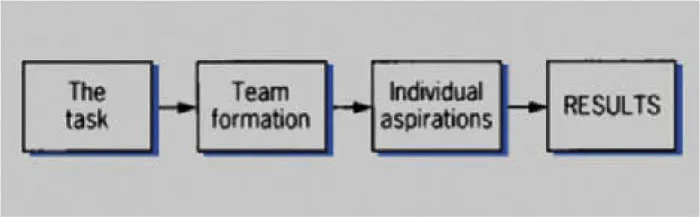
This is a generic process that can be used on any task where teams are involved. Figure 1.1 shows the main elements.
Figure 1.1 The basic results management process
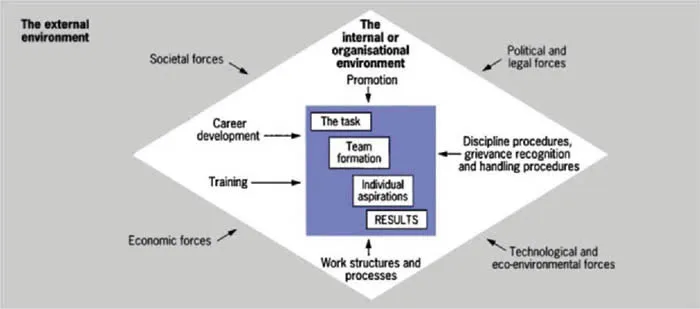
Although the process is generic, it is likely that the context in which it takes place will vary enormously. Figure 1.2 shows the factors that affect this context. The success of the process depends on the skill and experience of the manager in diagnosing where the organisational context is likely to be a help or a hindrance. It is also important to recognise that organisations are not static and the factors that you identify will be in a constant state of change.
Figure 1.2 The context for results management
The external or industry environment
Organisations, and individuals working in them, are influenced by the state of the national economy, political and legal changes, technical and technological developments and societal values. A boost to contracts and investment in an industry will raise people’s confidence in their future job prospects. A breakthrough in the technology that affects the working processes and products will encourage new thinking and enthusiasm towards the job. Where societal values are seen to be in tune with the activities of the organisation, then individuals will be much more prepared to raise their performance than where there is dissonance. Much of this may sound like the American ‘motherhood and apple pie’ message, but if you reflect on the impact of team performance in companies such as The Body Shop, Microsoft, leading children’s and research hospitals, Shell Oil, Dyson Ltd, Planet Organic, Vodafone, Intel and many others, you can see the links at work.
You could do an Internet search to investigate the human resources policies of some of these organisations.
The internal or organisational environment
Each organisation is unique. Managers working in different organisations in the same industry, faced with similar tasks, find that working practices vary enormously. The underlying cause behind such differences can be attributed to differences in organisational culture. Organisational culture can be described as a cognitive or mental framework consisting of values, attitudes, behavioural norms and expectations that are shared by the majority of the workforce (Schein, 1985).
Here is how Chatman and Jehn (1994) characterise seven elements of organisational culture that can be used to describe an organisation.
Innovation: the degree to which people are expected to generate new ideas. The examples they give include MCI Communications where there are no procedure manuals so that staff can be encouraged to be unique. At 3M staff are given free time to develop their own ideas for new products.
Stability: valuing a rule-orientated work environment. They give examples from the Bank of America where only the safest investment advice is given to customers.
Orientation towards people: showing respect for individuals’ rights; being fair and supportive.
Results-orientation: the extent of the concern and focus on achieving the desired results. Motorola, for example, is famous for its processes for reducing defects to zero.
Easygoingness: the extent to which the work atmosphere is relaxed and play is encouraged. They quote the case of Intel where the risk taking and camaraderie go hand in hand.
Attention to detail: the focus on analysis and precision. For example, at Merck, the prescription drug manufacturer, the view is that there is no room for error.
Collaborative orientation: here the attention is on working in teams. Companies such as 3M and Texas Instruments are seen as valuing teamwork as part of the research and product development process.
Being able to diagnose the organisational culture is a key step in understanding the context in which you are working. You must work within this culture to achieve the results you need. However, it is also important to understand how the operation of formal management processes impacts on the commitment of individuals and teams to the task. These processes have been designed to achieve conformity in standards of behaviour and should be understood and applied consistently. They are concerned with:
• training, career development and promotion
• work structuring, evaluation and control
• recognition and reward
• grievance recognition and handling, and discipline.
The skill is in knowing when the formal processes can be a positive help in achieving results and when a more informal or even original approach would be more effective.
Two examples of an informal approach to reward and recognition have been identified by Michael Rose and by Charles Handy:
Southwest Airlines has a sophisticated culture of recognition and celebration. It is reflected in the following guidelines:
• Say thank you often.
• Always celebrate people from the heart.
• Make heroes and heroines of employees who glorify your company’s values.
• Find people who serve behind the scenes and celebrate their contributions.
• Celebrate at work the way you do at home.
• Celebrate at home the way you do at work.
In a 1999 pan-industry survey, 66% of managers said lack of recognition was the main factor that would make them leave their company. And a survey of 1,500 employees reported in Industry Week in 1995 found that the best motivator was to be personally congratulated by your manager.
Source: Rose (2000)
Charles Handy, in his book The Elephant and the Flea (2001), suggests that:
In the short term many large organisations are trying to buy the loyalty of key people with higher salaries. But there is a limit to how much money even the wealthiest organisation can throw at the problem. In time, they will have to rethink their reward strategies. For example SEMCO have 11 different methods of...
Table of contents
- Cover
- Halftitle
- Title
- Copyright
- Contents
- Activities
- Figures
- Tables
- Series preface
- Introduction: Motivation and improvement
- 1. Specify the results
- 2. Motivation theory
- 3. Motivation to achieve results
- 4. Grievance and disciplinary procedures
- 5. A balancing act
- References
Trusted by 375,005 students
Access to over 1.5 million titles for a fair monthly price.
Study more efficiently using our study tools.
Frequently asked questions
Yes, you can cancel anytime from the Subscription tab in your account settings on the Perlego website. Your subscription will stay active until the end of your current billing period. Learn how to cancel your subscription
No, books cannot be downloaded as external files, such as PDFs, for use outside of Perlego. However, you can download books within the Perlego app for offline reading on mobile or tablet. Learn how to download books offline
Perlego offers two plans: Essential and Complete
- Essential is ideal for learners and professionals who enjoy exploring a wide range of subjects. Access the Essential Library with 800,000+ trusted titles and best-sellers across business, personal growth, and the humanities. Includes unlimited reading time and Standard Read Aloud voice.
- Complete: Perfect for advanced learners and researchers needing full, unrestricted access. Unlock 1.5M+ books across hundreds of subjects, including academic and specialized titles. The Complete Plan also includes advanced features like Premium Read Aloud and Research Assistant.
We are an online textbook subscription service, where you can get access to an entire online library for less than the price of a single book per month. With over 1.5 million books across 990+ topics, we’ve got you covered! Learn about our mission
Look out for the read-aloud symbol on your next book to see if you can listen to it. The read-aloud tool reads text aloud for you, highlighting the text as it is being read. You can pause it, speed it up and slow it down. Learn more about Read Aloud
Yes! You can use the Perlego app on both iOS and Android devices to read anytime, anywhere — even offline. Perfect for commutes or when you’re on the go.
Please note we cannot support devices running on iOS 13 and Android 7 or earlier. Learn more about using the app
Please note we cannot support devices running on iOS 13 and Android 7 or earlier. Learn more about using the app
Yes, you can access Managing for Results by Elearn in PDF and/or ePUB format, as well as other popular books in Business & Business generale. We have over 1.5 million books available in our catalogue for you to explore.