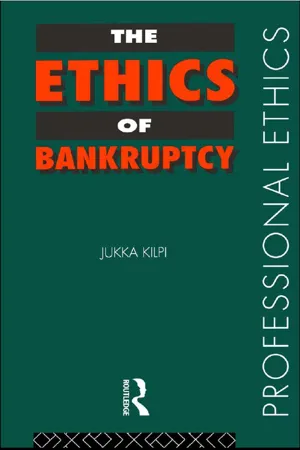
The fundamental ethical problem in bankruptcy is that insolvents have promised to pay their debts but can not keep their promise. The Ethics of Bankruptcy examines the morality of bankruptcy. The author compares and contrasts the Humean doctrine of promises as useful conventions with the Kantian view of autonomous agency constituting promissory obligations; he explores ethical concerns raised by forgiveness, utilitarianism and distributive justice and the moral aspects of insolvents' contractual, fiduciary, tortious and criminal liability. Finally, the author assesses recent bankruptcy law reforms. Bankruptcies severly hurt creditors and society. For the insolvents and their families the experience is painful and stigmatising, yet philosophers have paid little attention to the moral aspects of this violent social phenomenon. The Ethics of Bankruptcy is the first comprehensive study that employs the tools of ethics to examine the controversies surrounding insolvency, which makes valuable and sometimes controversial reading in a decade recovering from the Recession.
- 240 pages
- English
- ePUB (mobile friendly)
- Available on iOS & Android
eBook - ePub
The Ethics of Bankruptcy
About this book
Information
Part I
The ethical trouble and its
makers
A perennial plague
Chapter 1
The institution and the conflicts
behind it
The bulk of this work will focus on the bankruptcy of natural persons. This leaves legal personalities, most notably corporations, to be dealt with in the final section. The reason for the division derives from the ethical point of view of the study: the ethical problems relating to humans differ from those relating to corporate bodies. A basic difference is that, in most cases, the existence of insolvent corporations is terminated when bankruptcy proceedings are brought to an end, while individuals are no longer executed as part of the distribution of an estate.
I shall devote the lion’s share of my attention to personal bankruptcy because of the immediate and perplexing nature of the ethical controversies surrounding it: the insolvent has promised to pay the debt, nonetheless she is not able to keep her promise. What should be the consequences of this dead-end to the promisor, to the promisee and to society? Because the life of a bankrupt natural person is supposed to continue after her property is used to satisfy creditors, we have to decide what to do with her next.
An insolvent corporation breaks promises too, but I will argue that this happens in an environment where there are fewer ethical variables. A corporation is a legal fiat; it does not have the human rights that are attached to each individual by virtue of her human nature. This means that the settlement of the commitments of an insolvent corporation is more a matter of expediency than of ethics.
It should be recognized that some modern ways of handling corporate insolvency involve problems and solutions apparently similar to those seen in personal bankruptcy. Here I have in mind in particular the reorganization schemes modelled after the US Bankruptcy Code Chapter 11. But, regardless of the institutional similarities, I find the ethical dilemmas of these schemes to be in a category of their own.
Before going further, the use of concepts needs to be attended to. As legal terms, the meanings of ‘bankruptcy’ and ‘insolvency’ vary from one country to another. In the United Kingdom the statutory provisions relating both to individuals and to corporations were consolidated, in 1986, under one item of law: the Insolvency Bill. However, the Bill subjects individuals to bankruptcy proceedings while insolvent companies face winding-up. Australia follows earlier British tradition, in which natural persons and legal persons are dealt with by separate laws, and different terminology is applied in each case. In Australia the Bankruptcy Act takes care of bankrupt individuals, and Corporations Law contains provisions for insolvent companies. In the United States procedures for both natural persons and firms are included in the Bankruptcy Code, and the institution is invariably called bankruptcy. In addition to these technical differences, bankruptcy, insolvency, winding-up, liquidation, or whatever technical name a particular law has adopted for the institution, may, as a legal fiat, and depending on the jurisdiction, contain alternative ways of settling with the creditors, such as payment schemes versus straightforward distribution of property among the creditors.
If non-English legislation is placed under scrutiny, the legal terminology gets even more confusing. In the family of Latin languages alone additional notions are used. However, the basic problem the legislation addresses—an agent’s financial default, and consequently the institutional response it specifies—remains much the same everywhere. This explains why, unlike the legal jargon, the ordinary language counterparts of ‘bankruptcy’ and ‘insolvency’ carry the same meaning across all borders: they denote the insufficiency of someone’s means to meet her liabilities. The clarity of plain language is a good reason to follow its guidance for the conceptual definitions of this study.
When I speak without any specific legislation in mind I shall by ‘insolvency’ refer to a factual state of affairs: the inability to pay debts when they are due. By ‘bankruptcy’ I shall refer to any legal institution created to deal with insolvency. Hence, ‘insolvent’ stands for an agent who is unable to pay the due debts, and ‘bankrupt’ for an agent undergoing the institutional procedure of bankruptcy. Nevertheless, if expressed in connection to particular legislation, these concepts will carry the definition given to them in that body of law.
It should be noticed here that, in the sense given above, someone may be insolvent but not bankrupt, and the other way round. If the debtor or her creditors do not initiate legal proceedings, an insolvent never goes bankrupt, or it may well happen that after the liquidation of her assets a bankrupt turns out to be solvent. In the latter case her bankruptcy has been caused, for instance, by the illiquid nature of the assets or her unwillingness to pay. However, as these cases are not relevant to the ethical problems I wish to examine, we can have confidence in the conceptual usage adopted. After these preliminary remarks I proceed to a short summary of the institutional development of bankruptcy.
INSTITUTIONAL HISTORY
The history of credit is as long as human history. It predates the use of money. Indeed, it has been argued that money was introduced out of the need to measure and pay debts.1 Credit represents a pattern of social behaviour. As such, it is not infallible, but subject to human weaknesses and environmental conditions. There is no causal, let alone logical, necessity ensuring that what has been given as a loan will be returned. On the contrary, default is a chance always present. Where there is credit, non-payment can occur.
Although debts are most often paid, the possibility of default can be seen as an inevitable feature of the social phenomenon called credit. Laws reflect this fact. They have attended to credit enforcement and insolvency since the beginning of recorded legal history. The early remedies for default were quite uniform: the law of Hammurab, the Twelve Tables of early Rome, and the laws of ancient Greece all placed both the property and the body of the debtor, as well as those of his kin, in the hands of the creditor.2
The ancient creditor had the right to enslave or even kill the insolvent. If the creditors were many, early Roman law gave them the option of cutting the debtor in pieces to be 1divided among themselves. According to historians, it was not only Western cultures that recognized a creditor’s right to the body of the impecunious. For instance, early Hindu law permitted the killing of a defaulter and subsequent enslavement of his wife. Notable exceptions to these harsh practices were Judaic and Islamic religious teachings which proposed regular extinguishing of debts.
In Greece leveraged speculation was widespread in the seventh century BC. When the boom was over, free Greek citizens who could not service their liabilities ended up in slavery in large numbers. This was one of the evils addressed by the famous laws of Solon. They forbade slavery for debt. For the first time a legal reform was introduced limiting debt enforcement to the debtor’s property only.
The reformist trend was followed in later Roman law. Through Cessio bonorum a penniless borrower was able to avoid the bodily liabilities by handing his property over to the creditors although no cancellation of debts was available. The judicial proceedings involved in Cessio bonorum were adopted in the medieval laws throughout Europe—with the notable exception of the debtor’s bodily immunity. In most medieval states an insolvent was subject to imprisonment at the creditor’s will even after all his property had been seized. The influence of the Roman institution is also present in the manner in which contemporary bankruptcy laws distribute a debtor’s property.
In England the first bankruptcy statute was passed in 1542 by Henry VIII. The term ‘bankruptcy’ is present only in the title of the statute which was aimed at improving the efficiency of debt collection and at introducing justice among creditors. Debtors were seen to be absconding, and the remedy was to bring them to court and seize their property. Creditors were seen as fighting each other because the debt enforcement was on a first come first served basis. The new institution was to end the futile conflict by distributing the estate according to equitable principles.
The etymology of the word ‘bankruptcy’ helps us to grasp better the emphasis of the first English legislation. There are several accounts of the origins of the term, but they all agree that it was used initially around the Mediterranean to refer to traders who ran away from their debts.3 Some authors have claimed that the French expression banque route, used to describe the tracks the escaping trader’s cart left, was adopted by legal language, while most refer to the Spanish and Italian practice of breaking insolvent traders’ benches in the market in order to prevent them from doing further business (banca rupta, banca rotta). It was hardly a wonder that in those days insolvents became fugitives. Confronted by overwhelming debts, it was their only way to avoid an indefinite jail term. Thus, etymologically, ‘bankruptcy’ has a criminal connotation. This is something which seems to have lingered on and which adds to the stigma experienced by present-day bankrupts.
After the 1542 bankruptcy statute the focus of English law changed slowly but consistently.4 The interests of debtors started to surface. The most remarkable milestone was the 1705 Act which, for the first time, made discharge part of the procedure. The possibility of being cleared of liabilities was subject to strict control and open only to traders, who were thought to be prone to unfortunate and unforeseeable accidents in the conduct of their business. Nevertheless, after the idea was introduced it was to play an important role in subsequent reforms which consolidated debtor protection as a central goal of English insolvency laws.
Accordingly, in Australia, and in other countries following British legal tradition, contemporary bankruptcy procedures end in discharge of debts. Discharge has been subject to limitations and conditions, but generally these have been made more lenient in the twentieth century. As a result, in Anglo-Saxon legislation discharge can be seen as a privilege granted to the debtor subject to her conduct being appropriate prior to and during the bankruptcy.
In the United States permanent bankruptcy law was, after a long and furious battle, enacted on Federal level in 1898. The law’s emphasis was heavily on relieving the debtors’ burden, and so has it been in the subsequent amendments—most notably in 1938 and in 1978. The US law allows debtors to choose between Chapter 7, straight liquidation and discharge taking only some months, and Chapter 13. The latter alternative is a payment scheme in which the debtor retains control of her property while paying off at least part of the debts over a few years. Overall, the United States’ proceedings are quicker and limit a bankrupt’s civil liberties to a lesser extent than has been customary in countries closely following the British legal system. The differences are so manifest that they make discharge of debts in the United States a right rather than a privilege.
This is in stark contrast to the laws in Continental Europe.5 In most European countries discharge without creditors’ consent has been unheard of. Only very recently have there been efforts to solve the vast human and social problems caused by lifelong enforcement of an overwhelming debt burden. In the late 1980s a number of Western European countries have initiated insolvency reforms,6 mainly following the example given in Chapter 13 of the US Bankruptcy Code.
DEBTOR PROTECTION AND/OR CREDITOR PROTECTION?
Early societies applied all imaginable means of debt collection to the defaulting debtor. Creditors’ rights were seen as absolute and unproblematic. Suspicions towards this attitude led some ancient legislators to question whether creditors should have access to the insolvent’s body and person. Another source of concern, out of which emerged the insolvency proceedings in Roman law, was the conflict between creditors who pursued competing claims. The main purposes of a bankruptcy law are visible here. On the one hand the law should protect the debtor from unjustified hardships; on the other hand it should protect creditors by enforcing their right to receive a payment whilst preventing their individual collection efforts from damaging or unjustly distributing the debtor’s assets.
From these two aims, and from their conflicting nature, arise the ethical questions. Do we have a moral duty to pay what we owe? Why should society enforce a contractual debt? If it should be enforced, why exempt debtors’ bodies and persons, but not their tangible property? What are the unjustified hardships from which debtors should be saved? In particular, what is the ethical basis of discharge of debts without the creditors’ consent?
These are the central ethical issues that this book seeks to answer. They affect all of the parties involved: the debtor, the creditor and society. In addition, there are questions of ethical relevance only to the creditors and, to some degree, to society. If we accept that contracts are enforceable, what justification is there for substituting individual enforcement efforts by a collective one? And what constitutes a just distribution of assets amongst creditors?
Debtor protection by means of discharge poses the biggest ethical challenge, and has caused most controversies in public debate over bankruptcy legislation. It is a complex ethical problem which has not yet been given a comprehensive explanation. As such, it forms the core of the ethics of bankruptcy and takes us directly to the fundamentals of moral philosophy. The second major objective of bankruptcy laws, creditor protection, involves ethical complications too, but to a lesser extent. So rather than trying to rush straight to the contentious points, I shall start with disputes which have better established solutions.
CREDITORS’ EQUALITY AND COLLECTIVE PROCEEDINGS
Let us for a while put aside the question of whether a creditor has a moral right to collect an outstanding debt. If we assume that she generally has this right, how can we justify an institution which, in case of an insolvent debtor, terminates it at the will of the debtor or other creditors? This question has not often been asked, perhaps because for centuries bankruptcy laws—whether leading to final discharge or not—have made collective measures available to replace individual debt collection. The familiarity of the institution does not, however, amount to its ethical justification.
The need for institutional proceedings arises from the fact that an insolvent debtor who has several creditors exposes a common pool problem: there is a limited pool of assets to which each of the claimants has an equal title. Or, to be exact, we should say that within each class of creditors the titles are equal. Preferred creditors are served prior to ordinary creditors, but within each class the principle of equality applies. Since the titles are equal, no one of the creditors should be able to use her superior strength or swiftness to get more of the common pool than her just share. The substance of justice, entailed by equality, is in legislation governed by the principle of pari passu, which comes from Roman law and stands for a pro rata distribution in proportion to the relative size of the claim of each of the creditors.
Thus, interference in individual debt collection is justified because the target of individual seizure efforts is actually a common pool to which no sole person should have an exclusive right. Ethically it is a recognition that the debto...
Table of contents
- Cover Page
- Title Page
- Copyright Page
- Series Editors’ Foreword
- Acknowledgements
- Prologue
- Part I: The Ethical Trouble and Its Makers: A Perennial Plague
- Part II: Philosophical Fundamentals of Credit: Should Debts Be Paid?
- Part III: Ethical Principles of Insolvency: Should Debts Always Be Paid?
- Part IV: In Defence of Dunning: A Counterattack
- Part V: Applying the Principles: A Current Affair
- Part VI: The Corporate Veil: Chador or Gauze?
- Epilogue
- Notes
- Bibliography
Trusted by 375,005 students
Access to over 1.5 million titles for a fair monthly price.
Study more efficiently using our study tools.
Frequently asked questions
Yes, you can cancel anytime from the Subscription tab in your account settings on the Perlego website. Your subscription will stay active until the end of your current billing period. Learn how to cancel your subscription
No, books cannot be downloaded as external files, such as PDFs, for use outside of Perlego. However, you can download books within the Perlego app for offline reading on mobile or tablet. Learn how to download books offline
Perlego offers two plans: Essential and Complete
- Essential is ideal for learners and professionals who enjoy exploring a wide range of subjects. Access the Essential Library with 800,000+ trusted titles and best-sellers across business, personal growth, and the humanities. Includes unlimited reading time and Standard Read Aloud voice.
- Complete: Perfect for advanced learners and researchers needing full, unrestricted access. Unlock 1.5M+ books across hundreds of subjects, including academic and specialized titles. The Complete Plan also includes advanced features like Premium Read Aloud and Research Assistant.
We are an online textbook subscription service, where you can get access to an entire online library for less than the price of a single book per month. With over 1.5 million books across 990+ topics, we’ve got you covered! Learn about our mission
Look out for the read-aloud symbol on your next book to see if you can listen to it. The read-aloud tool reads text aloud for you, highlighting the text as it is being read. You can pause it, speed it up and slow it down. Learn more about Read Aloud
Yes! You can use the Perlego app on both iOS and Android devices to read anytime, anywhere — even offline. Perfect for commutes or when you’re on the go.
Please note we cannot support devices running on iOS 13 and Android 7 or earlier. Learn more about using the app
Please note we cannot support devices running on iOS 13 and Android 7 or earlier. Learn more about using the app
Yes, you can access The Ethics of Bankruptcy by Jukka Kilpi in PDF and/or ePUB format, as well as other popular books in Philosophy & Bankruptcy & Insolvency Law. We have over 1.5 million books available in our catalogue for you to explore.