eBook - ePub
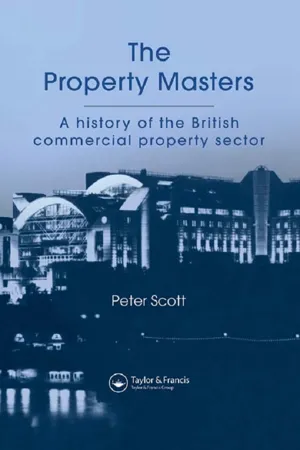
The Property Masters
A history of the British commercial property sector
- 364 pages
- English
- ePUB (mobile friendly)
- Available on iOS & Android
eBook - ePub
About this book
This is a thorough exploration of the evolution of the commercial property investment and development markets from the mid-nineteenth century to the present day. It explains how the current investment scene emerged and fills an important gap in the literature on the property market.
Information
Publisher
Taylor & FrancisYear
2013Print ISBN
9781138983991
9780419209508
Edition
1eBook ISBN
9781136097621
1 Introduction
1.1 THE AIMS OF THIS STUDY
The commercial property sector is of vital importance to the British economy. While the property industry makes a considerable direct contribution to national output, representing about 6% of Gross Domestic Product (GDP),1 the overall significance of the sector to the prosperity of British industry is far greater than this figure suggests. Property forms a substantial element of the cost-base of the service and manufacturing sectors, accounting for 44% of the non-financial assets of UK companies.2 Even this figure understates the true importance of Britain's non-residential property stock to its occupants, since a substantial proportion of properties occupied by corporate tenants are rented rather than owner-occupied, thus not constituting tangible company assets.
Property assets play a vital role in corporate finance. The British banking system has always had a marked preference for loans backed by collateral security, property forming one of the most important classes of acceptable collateral held by corporate borrowers. Indeed, it has been estimated that three quarters of all UK bank lending is dependent on property.3 Property also offers opportunities for gearing which have allowed companies in property-rich sectors, such as retailing, to expand more rapidly than would have been possible with other forms of finance.4 The growth of an active commercial property market has had an important influence on property's acceptability as collateral for corporate borrowing, by facilitating the valuation of property assets and increasing their marketability and liquidity. This link between the commercial property market and corporate investment has a long lineage, property having formed an important source of collateral for industrial and commercial finance since at least the nineteenth century.
Furthermore, in addition to constituting a major corporate asset, the character of Britain's commercial property stock also has an important influence on the technological and organizational flexibility of the work environment, which in turn has a substantial impact on efficiency in many service-sector industries. A large number of technological innovations in the retailing and office-based sectors are most easily introduced by their embodiment in new buildings, the ease with which companies can move to new premises, or redevelop their existing buildings, being a major determinant of the pace of diffusion for such innovations.
Property also plays an important role as an investment medium for the financial institutions and other long-term investors; the total value of British commercial property in 1989 amounted to more than twice that of UK government stock and about half that of the British equity market.5 Much of the ‘prime’ high-quality segment of this stock is held by insurance companies and pension funds, which rely on its rental income and long-term capital appreciation to pay a significant proportion of their financial obligations to policyhold-ers. The commercial property sector is also of considerable importance in employment terms; 236 000 people were employed in the real estate service sector in 1990, employment having increased at an average rate of 4.2% during the previous 30 years.6 This is in addition to the very substantial construction employment which the sector generates.
However, while the property sector has made an important contribution to the British economy, it has also proved particularly prone to the boom-bust cycle which has been a hallmark of Britain's post-war economic growth. Indeed the property development sector has played a leading role in that cycle, particularly during the last 25 years. The 1974 property crash led to the most severe financial crisis the British banking system has witnessed during the twentieth century, while the aftermath of the 1990 crash may have significantly obstructed Britain's subsequent economic recovery by reducing the value of corporate assets and restricting bank lending to the corporate sector.7
Despite its considerable economic importance, the commercial property industry has received much less attention from economists and economic historians than other sectors of similar magnitude. This study seeks to begin to redress this balance by providing the first comprehensive economic history of the British commercial property market, from the nineteenth century to the present. This will focus on the evolution of the commercial property investment market and its interlinkages with the property development industry, institutional investment, corporate finance, government policy, and the changing character of office, retail and industrial property in Great Britain.
The history of the British commercial property sector also casts light on a number of more general issues which are currently subjects of debate in economics and economic history. Questions such as the efficiency of capital markets, the nature and economic role of entrepreneurship, the adoption of inflationary expectations into investment decision-making, and the nature and causes of financial crises are, therefore, discussed in relation to the experience of the commercial property investment and development markets. The analysis of these more abstract issues in the light of the experience of the property market will, it is hoped, both cast light on the validity of different theoretical models which have been used to analyse them and facilitate a better understanding of the economic forces which have shaped the evolution of Britain's commercial property stock.
Many aspects of the British property market — such as the development cycle, the framework of government regulation, town planning legislation, property taxation and the changing nature of user-demand — have been subject to either relatively long-term fluctuations or infrequent shocks. Furthermore, fundamental influences on the growth of the property investment market during this century, such as the expansion of the tertiary sector, the concentration of retailing activity in prime ‘High Street’ pitches, growing geographical concentration of other types of commercial property and the emergence of persistent inflation after 1945, have been even longer-term in nature. The study of the commercial property market therefore lends itself to long-term, historical analysis, since the impact of such influences on the property investment and development markets can only be fully appreciated when examined from a historical perspective, spanning at least several decades.
In addition, as Britain's current property stock has a genesis which, in many cases, originates before the Second World War (and in some cases, dates well before 1900) a study of the history of the property market over the last two centuries is necessary to explain the character of today's built environment. In this study, as in many other areas of academic investigation, the historical approach is justified as only by examining the past can we fully understand the present.
This study will outline the emergence of a commercial property market in Britain during the nineteenth century, and its slow displacement of the previous system of estate management by the landed gentry and ‘tradition institutions’, which had hitherto characterized urban property development. The rise of the multiple retailers during the present century provided a considerable boost to the growth of the property sector, by necessitating the emergence of a national market in commercial property, and providing a substantial flow of attractive, secure, investment properties, as is outlined in Chapters 3 and 4. The cheapmoney period of the 1930s led to the first boom in institutional property investment, property providing a high-yielding asset, but one which offered little capital appreciation as rents were typically fixed for 99, or even 999, years. This period also saw the growth of substantial links between developers, long-term investors and occupiers of commercial property, which were to form the basis of the substantial expansion of the sector following the Second World War.
During the immediate post-war years institutional investors remained happy to buy property on long leases at fixed rents. Selling properties to institutions on this basis, and simultaneously taking out long leases on them, proved an ideal means of raising capital during the 1940s and 1950s when other forms of finance were being severely rationed by government. Money raised by such activity formed the basis of the initial fortunes of many leading property developers, and allowed Britain's first hostile take-over bidders, such as Charles Clore, Isaac Wolfson and Hugh Fraser, to finance their activities.
Eventually, by the mid to late 1950s, institutional investors woke up to the dangers of inflation, and began to press for the transformation of property into an ‘equity’ security. The introduction of the key post-war innovation in the property investment market, the rent review, allowed rents paid on property to be periodically adjusted to market levels at regular intervals specified in leases. Gradual reductions in the intervals between these adjustments during the following years led to a steady upward movement in returns to investment in commercial property, any oversupply of new developments being prevented by the imposition of the ‘Brown Ban’ on office development in and around London in 1964.
However, by the late 1960s the property market was becoming ‘overheated’ with institutional and other funds. The relaxation of controls on office development, and the deregulation of the banking sector, by the Heath government during the early 1970s led to a massive boom in new development. Eventually a reversal of government monetary policy precipitated Britain's first property crash in December 1973, marking the end of the long post-war property investment boom. It was replaced by a regular boom-bust property investment and development cycle, which (intensified during the mid to late 1980s by a variety of short-sighted government policies) produced a further catastrophic collapse in commercial property values in 1990, from which the property sector has yet to recover.
This book looks in detail at the factors contributing to the early growth of the property market, the operation of the property investment market in the non-inflationary world of the 1930s, the symbiotic relationship which emerged between the financial institutions and the property developers during the 1945–1965 property boom, and the causes of the instability which has characterized the recent history of the commercial property sector.
1.2 SCOPE, SOURCES AND METHODOLOGY
This study is confined to investment in, and development of, UK commercial property. It omits any detailed analysis of investment in residential property, overseas property and agricultural land. Residential, agricultural and overseas property are avoided since the economic, and other, factors determining conditions in these markets are very different from those influencing commercial property. In addition, the main investors in, and developers of, commercial property generally undertake little or no activity in these sectors (with the exception of some major property development companies which have expanded into overseas markets). These sectors are, therefore, only discussed where a clear interlinkage between them and the commercial property market (or major ‘players’ in that market) exists.
This book also omits any detailed discussion of the industrial property market, other than with regard to the evolution of institutional investment and property development funding in this sector. While factories and warehouses have been developed on a speculative basis since at least the 1920s, to adequately discuss the evolution of the industrial property development market is beyond the scope of the present study. Such a discussion would require an examination of issues such as the changing framework of government regional, and location of industry, policy; the evolution of the industrial estate; the interaction between industrial location and transport infrastructure; and the histories of the specialist industrial property development companies which have dominated this sector, doing justice to which would be the topic of a book in itself.
There is very little published material covering the history of the commercial property market, the growth of institutional property investment, the property development process and the financial returns to investment in property, prior to the recent past. Secondary sources on the commercial property market fall into four broad categories. Firstly, there are a number of books and articles written by financial journalists, such as Oliver Marriott's classic The Property Boom (1967). These works contain some extremely useful information, but are generally based on interview evidence, the accuracy of which is necessarily questionable with regard to events which occurred many years prior to the time they were written.8
The second group of sources consist of books written by people who have worked in the property industry, such as Charles Gordon's The Two Tycoons (1984) and Jack Rose's The Dynamics of Urban Property Development (1985). These studies sometimes provide considerable insight into the inner workings of the property investment and development sectors, though once again in many cases evidence is largely based on personal recollection, or the recollections of others.
Thirdly, there are a number of academic books, written by urban economists and others, covering various aspects of the property sector. Very few of these discuss the historical development of the sector in any detail, a notable exception being Hedley Smyth's book Property Companies and the Construction Industry in Britain (1985). There are also a handful of published company histories of property companies, property investing institutions and commercial chartered surveyors; two of the best books in this category are R. Redden's The Pension Fund Property Unit Trust: A History (1984) and Michael Cassell's history of Slough Estates, Long Lease (1991). However, compared to other industries of similar economic importance the property sector boasts very few published corporate biographies.
Finally, there are a range of statistical sources published by chartered surveyors, property research companies and other organizations, which provide data on property investment returns, market rents, yields and other market indicators. Few of these date before the 1970s...
Table of contents
- Cover
- Half Title
- Full Title
- Copyright
- Dedication
- Contents
- Acknowledgements
- Glossary of abbreviations and technical terms
- List of tables
- List of figures
- Foreword
- Chapter 1 Introduction
- SECTION ONE THE EVOLUTION OF THE BRITISH COMMERCIAL PROPERTY MARKET SINCE 1800
- SECTION TWO A STATISTICAL ANALYSIS OF THE COMMERCIAL PROPERTY MARKET
- Chapter 10 A statistical overview of the property investment market
- Chapter 11 An econometric analysis of property returns and the volume of institutional property investment
- CHAPTER 12 CONCLUSIONS
- Bibliography
- Index
Trusted by 375,005 students
Access to over 1.5 million titles for a fair monthly price.
Study more efficiently using our study tools.
Frequently asked questions
Yes, you can cancel anytime from the Subscription tab in your account settings on the Perlego website. Your subscription will stay active until the end of your current billing period. Learn how to cancel your subscription
No, books cannot be downloaded as external files, such as PDFs, for use outside of Perlego. However, you can download books within the Perlego app for offline reading on mobile or tablet. Learn how to download books offline
Perlego offers two plans: Essential and Complete
- Essential is ideal for learners and professionals who enjoy exploring a wide range of subjects. Access the Essential Library with 800,000+ trusted titles and best-sellers across business, personal growth, and the humanities. Includes unlimited reading time and Standard Read Aloud voice.
- Complete: Perfect for advanced learners and researchers needing full, unrestricted access. Unlock 1.5M+ books across hundreds of subjects, including academic and specialized titles. The Complete Plan also includes advanced features like Premium Read Aloud and Research Assistant.
We are an online textbook subscription service, where you can get access to an entire online library for less than the price of a single book per month. With over 1.5 million books across 990+ topics, we’ve got you covered! Learn about our mission
Look out for the read-aloud symbol on your next book to see if you can listen to it. The read-aloud tool reads text aloud for you, highlighting the text as it is being read. You can pause it, speed it up and slow it down. Learn more about Read Aloud
Yes! You can use the Perlego app on both iOS and Android devices to read anytime, anywhere — even offline. Perfect for commutes or when you’re on the go.
Please note we cannot support devices running on iOS 13 and Android 7 or earlier. Learn more about using the app
Please note we cannot support devices running on iOS 13 and Android 7 or earlier. Learn more about using the app
Yes, you can access The Property Masters by P. Scott,Peter Scott in PDF and/or ePUB format, as well as other popular books in Business & Business generale. We have over 1.5 million books available in our catalogue for you to explore.