As each week beings more stories of doctors, lawyers and other professionals abusing their powers, while clients demand extra services as at a time of shrinking resources; it is imperative that all practising professionals have an understanding of professional ethics.
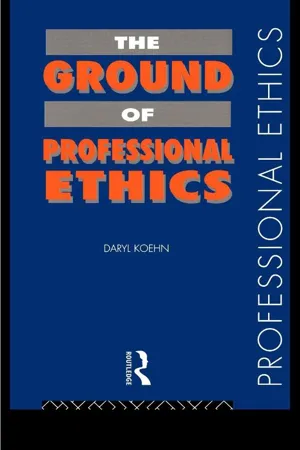
In The Ground of Profesional Ethics, Daryl Koehn discusses the practical issues in depth, such as the level of service clients can justifiably expect from professionals, when service to a client may be legitimately terminated and circumstances in which client confidences can be broken. She argues that, while clients may legitimately expect professionals to promote their interests, professionals are not morally bound to do whatever a client wants.
The Ground of Professional Ethics is important reading for all practising professionals, as well as those who study or have an interest in the subject of professional ethics.
- 240 pages
- English
- ePUB (mobile friendly)
- Available on iOS & Android
eBook - ePub
The Ground of Professional Ethics
About this book
Information
Chapter 1
Introduction
George Bernard Shaw once charged that all professions were conspiracies against the laity. No doubt many today would agree with Shaw’s assessment. Professionals stand accused of craving only status and wealth and even of disabling, rather than helping, their clients.1 In one sense, these modern accusations merely continue the long tradition of attacking professionals. Anti-clerical movements periodically have convulsed Europe. Elizabethans cheered Shakespeare’s oft-quoted proposal, “First, let’s kill all the lawyers.” Patients of early Greek and Roman doctors carped that physicians overstated dangers to health in order to build their reputations.2 Suspicion of individual professions clearly has a long pedigree and is not in and of itself particularly noteworthy. What is remarkable and decidedly uncommonplace is the increasingly voiced suggestion that all professional authority is inherently unethical and consequently illegitimate as presently constituted. This book is an attempt to confront and rebut this challenge to the authority and ethics of professionals by showing that this authority rests upon a secure and morally legitimating ground.
THE CHALLENGE
While adequately confronting this challenge will require developing and defending a full-blown account of the relations among professionals, their clients and the larger community, the challenge itself can be described in a few pages. The attack on professional authority has been mounted by three distinct groups. The first group of critics charges that there is nothing inherently good about professional practice. Although professionals have traditionally been seen as acting in the spirit of public service, these antagonists deny that professionals are benefactors.3 On their view, the ancient Greek physicians erred in seeing themselves as “lovers of mankind.”4 Cicero was wrong to portray the attorney as a servant of the public whose house is “without doubt the oracular seat of the whole community.”5 At best, the professions are houses of trade. They may pretend to operate for the public good. But, at root, professions are just another form of commerce, albeit a particularly well-entrenched and well-organized species of it.6
This view has derived support both from recent Supreme Court decisions construing professions along the model of business and from changes in university disciplines. In America, the learned professions traditionally have been immune from certain anti-trust proscriptions because they were not considered instances of commerce. Since the 1970s, however, courts have struck down lawyers’ bans on the advertising of legal fees and services on the ground that such bans impede free commercial speech.7 Professions are, on this view, not merely economic institutions but also effective monopolistic ones aiming at restricting trade in order to maximize professional income and power.
Changes in university disciplines, especially history and sociology, also have played a part in displacing the notion that professional practice serves the public’s interest:
The academic sociologists of the 1940’s and 1950’s were prone to emphasize as the central characteristics of professions their especially complex formal knowledge and skill along with an ethical approach to their work [emphasis mine]. These and other traits were used to set professionals off from other occupations and to justify the protective institutions and high prestige that also distinguished them. Writers from the late 1960’s on, however, emphasized instead the unusually effective, monopolistic institutions of professions and their high status as the critical factor and treated knowledge, skill and ethical orientations not as objective characteristics but rather as ideology, as claims by spokesmen for professions seeking to gain or to preserve status and privilege.8
So viewed, professions have no inherent legitimacy. They are only a dominant ideology to be replaced, one infers, by institutions or practices that truly aim at the public good.
Unlike the historians and sociologists, the second group of critics, composed mainly of philosophers, has been willing to grant that professions have a non-ideological ethic. For these philosophers, being a professional is akin to being a parent. The parental practice of child-rearing exhibits a distinctive ethos where an ethos is understood as a characteristic devotion to a particular good. This ethos tends to define the practice: parents who do not take care of their children are not parenting. When confronted with non-nurturing parents, the court acts in loco parentis and places minors with persons who it thinks will rear the children well. Professions such as medicine and law can be thought of as similarly defined by a distinctive commitment to benefit the client. If they are so defined, it follows that professionals are legitimately concerned about such things as the untoward effects of advertising upon their clients. True, attempts by professionals to prohibit advertising may be interpreted as an ideological effort to retain monopolistic power. But the philosopher will argue that one can re-describe any activity as narrowly self-interested. Rearing a child may be construed as an attempt to produce an asset which will generate cash for the parents’ old age. It does not follow, however, from the fact that an activity can be so described that, in fact, it is no more than an economic ideology.
Most philosophers, then, accept that professions are not ideological monopolies. Their quarrel with professionalism lies rather with what they take to be the normative claims made by professionals. They charge that professionals understand themselves as ruled by ethical norms or standards which permit, and maybe even oblige professionals, to perform actions not permitted by the “ordinary” norms applicable to the rest of us.9 Some doctors, for example, claim that they are entitled to lie to a patient if doing so protects the patient’s health. This claim qualifies as an instance of an appeal to special norms because we are not ordinarily entitled to lie to others. That there are such special norms is precisely what philosophers doubt.
Again the analogy with parenting is useful. Professionals may, like parents, aim at genuinely aiding others. However, like parents, the professions are not allowed to do just anything in the name of helping another. Parents’ commitment and professed willingness to nurture their children has limits. As a parent, I am not entitled to murder another child so that my daughter will become cheerleader. Any practice, be it that of parents or professionals, must abide by the norms governing all other members of the community. On this second view, no ethic can be self-derived, including a professional ethic sometimes thought to derive from a promise to assist others.
Even if professionals promise to use their expertise to benefit their clients, a promise must be accepted by the affected parties in order to be binding. Under ordinary morality, a promise to cut someone’s hair is not binding upon the promisor if the party in question does not wish to have her hair altered. It would seem to follow that no professional could be bound to promote some good unless the client has accepted the professional’s promise to further that good. And it is not obvious that any promises by professions have been so accepted.
Furthermore, the content of the promise enters into our evaluation of the morality of the promise. If I have promised to keep your confidence and you tell me of a plan to overthrow the United States government, many persons would question whether this confidence should be kept. Thus, while some doctors or lawyers argue that their medical or legal ethic binds them unequivocally to aid their client by preserving secrecy about what has been confided to them, the existence of an absolute unqualified duty to keep confidence seems unlikely.
Concerns such as these have led philosophers to conclude that for professional ethics to constitute legitimate norms or standards for governing professional behavior with respect to clients and non-clients, these ethics must either be derived from, be identical with, or be an intensification of ordinary morality.10 By claiming for themselves the privilege of deriving their own unique ethic from a pledge to serve others, professions have forfeited legitimacy. According to the second group, professionals’ ethics must be re-conceived as part of our general communal ethics if they are to regain legitimacy.
Yet a third group of critics – the organizational analysts – wonder whether there even are such things as professions. They note that there is no single list of professional traits upon which everyone agrees. According to these critics, it would be better to focus less upon whether an activity is professional and more upon whether people are effective at whatever they do. These critics remind us that the process of professionalization is not one of simply acquiring traits, whatever they may be, but rather one of developing skills and strategies for improving performance. The process of professionalization is what matters most.11 To understand professionalization we do not need an inquiry into the legitimating norms of the professions. Instead, we should use the empirical sciences of history, sociology, psychology, and political science to give us an accurate description of what professionals are actually doing. If we can become clear about the actions being performed by individual professionals in specific societies, we will have a better sense of what these agents and their clients want. Increased effectiveness will make the professional appear more expert, and this appearance of enhanced expertise will bestow legitimacy.
THE SERIOUSNESS OF THESE CHALLENGES
These challenges to professional legitimacy and authority should disturb professionals and clients alike. Professionals unquestionably have enjoyed prestige and privileges, such as the testimonial privilege of not having to disclose client-confided matters in court (unless the client so orders). But prestige and privilege have been theirs partly because they are thought to bear more responsibility and a heavier moral charge than other agents in society. J. Cardozo’s claim that “[m]embership in the bar is a privilege burdened with conditions,”12 applies not only to members of the bar but also to other practitioners like those in medicine and the clergy. By severing privilege from professionals’ “atypical moral commitment,”13 critics have ignited, if not fueled, public suspicion of professional activity, privileges and prestige. It is indeed hard to see why clients should trust the medical and legal professions with their lives and liberty if the latter are no more than ideologically driven institutional arrangements designed to gratify doctors and lawyers’ lust for status and wealth. Like the fabled emperor, the professions appear to be bereft of any legitimate trappings of power.
While the nude emperor’s state was merely comic, that of the professions borders on the tragic. We should not forget that professions represent the only mechanism we have for collectively providing ourselves with the goods of health, legal justice, and spiritual peace. If professionals are not trustworthy, whom should we trust? This question must be confronted. We cannot simply hope that the sick, the accused or injured, and the spiritually needy will provide adequately for themselves. Clients grant, or at least permit, professionals access to something of value (e.g. their bodies) precisely because they are unable to secure or promote a desired state of affairs (e.g. a return to health) by themselves or are better able to do so with assistance. Given that the critics are not proposing any alternative source of help, we will be left without recourse if we cease to believe that professionals merit trust under some conditions.14
The question of professional legitimacy merits our attention for a second reason as well. Professions represent our communally chosen response to the problem of delivering help to the ill, the injured or accused, or the sick in spirit. We could have endorsed alternative solutions to this problem. For example, some states have functioned as the church, managing a caste of state priests. Citizens of Western liberal democracies, however, have collectively preferred an arrangement in which the professions are in some sense and to some degree independent of state control. Before we follow the critics’ lead in collapsing the distinction between professional and ordinary morality, we should press for clarification as to whose ordinary morality we are discussing. As I shall show in Chapter 8, it is part of Anglo-American “ordinary morality” to allow professions a rather high degree of autonomy, including the freedom to justify their actions by appealing to special promises professionals have made to patients, litigants, etc. Here I would merely emphasize that if the community begins to doubt the wisdom of permitting professionals to exercise their authority, this skepticism will have ramifications for whatever other democratic values are linked to professionalism. If we care about these values, we should attend to shifts in public support of professionals and responsibly think through any and all attempts to ground professional authority.
Finally, we should not deceive ourselves as to what is at stake in critics’ seemingly innocuous insistence upon a purely descriptive investigation of professionalism. These demands emanate mainly from social scientists who try to describe what behavior is in fact accepted by a group and who eschew any attempt to establish what the norms of professions should be, preferring instead to treat the mechanics of the process of professionalization. While such research has its place, we must be clear that the choice of the descriptive method is itself an ethical matter with enormous consequences for the goods we pursue, the attitudes, practices, and ideas we embrace, and the conclusions we draw. Failure to address questions about the nature of a profession and its proper relation to other human activities can only result in singularly unsatisfying discourse about professionals. Either we will wind up discussing the process of professionalization but never clearly defining the end state toward which professions are allegedly evolving;15 or we will accept as professional anyone who lays claim to the title and never ask under what conditions a claimant acts unprofessionally. Both methodologies amount to a practical refusal to try to delineate how the professional qua professional acts. While it might turn out that there are no distinctive professional norms, we should avoid the fallacy of assuming as true the very thing that needs to be demonstrated.
We must also bear in mind that it is a normative matter to assert that a profession has no inner meaning but rather consists of the sum total of what all or a majority of its members happen to be doing at a certain point in time. Taken to its extreme, this position will yield mind-boggling claims of the sort that Adolph Eichmann’s lawyer offered in defense of that war criminal’s actions: Eichmann was innocent of the killings by gas because gassing “was indeed a medical matter, since it was prepared by physicians; it was a matter of killing, and killing, too, is a medical matter.”16 Unless one is willing to say that doctors and mass murderers belong to the same profession and are equally good and worthy of respect, our practice of holding persons responsible for their actions will eventually force us to confront the question with which I propose to begin: what do professionals do, and what, if anything, legitimates their practice?
THE PROJECT
The argument of this book attempts to justify trust in the practice of professionals by showing that this practice is in fact morally legitimate. I will argue that professional practices qualify as morally legitimate because, and to the extent that, they are structured to merit the trust of clients. Contrary to the assertions of our first set of critics, professions are not mere ideologies but inherently ethical practices. Furthermore, each of these practices has its own special ethic, one deriving its peculiar and distinctive character from its end of engendering and preserving the trust of clients who lack a specific genuine good such as health or legal justice. While each of these professional ethics is not identical with ordinary morality, we shall see that they do not violate its dictates and therefore can escape the philosophers’ charge that they are immoral. Finally, we shall see that the descriptive versus normative distinction dear to the hearts of our third group of critics – the social scientists – cannot be sustained when one is discussing the practice of professions. Since the professions are in their essence st...
Table of contents
- COVER PAGE
- TITLE PAGE
- COPYRIGHT PAGE
- SERIES EDITORS’ FOREWORD
- ACKNOWLEDGEMENTS
- CHAPTER 1: INTRODUCTION
- CHAPTER 2: THE UNTRUSTWORTHINESS OF PROFESSIONAL EXPERTISE
- CHAPTER 3: DELEGITIMATING CLIENT CONTRACTS
- CHAPTER 4: THE PUBLIC PLEDGE AS THE GROUND OF PROFESSIONAL AUTHORITY
- CHAPTER 5: THE LEGITIMACY OF THE PROFESSIONS’ ENDS
- CHAPTER 6: THE LIMITS OF PROFESSIONAL DISCRETION
- CHAPTER 7: THE PROFESSIONAL’S GOOD
- CHAPTER 8: THE PROFESSIONAL AND THE PUBLIC GOOD
- CHAPTER 9: CONCLUSION
- NOTES
- BIBLIOGRAPHY
Trusted by 375,005 students
Access to over 1.5 million titles for a fair monthly price.
Study more efficiently using our study tools.
Frequently asked questions
Yes, you can cancel anytime from the Subscription tab in your account settings on the Perlego website. Your subscription will stay active until the end of your current billing period. Learn how to cancel your subscription
No, books cannot be downloaded as external files, such as PDFs, for use outside of Perlego. However, you can download books within the Perlego app for offline reading on mobile or tablet. Learn how to download books offline
Perlego offers two plans: Essential and Complete
- Essential is ideal for learners and professionals who enjoy exploring a wide range of subjects. Access the Essential Library with 800,000+ trusted titles and best-sellers across business, personal growth, and the humanities. Includes unlimited reading time and Standard Read Aloud voice.
- Complete: Perfect for advanced learners and researchers needing full, unrestricted access. Unlock 1.5M+ books across hundreds of subjects, including academic and specialized titles. The Complete Plan also includes advanced features like Premium Read Aloud and Research Assistant.
We are an online textbook subscription service, where you can get access to an entire online library for less than the price of a single book per month. With over 1.5 million books across 990+ topics, we’ve got you covered! Learn about our mission
Look out for the read-aloud symbol on your next book to see if you can listen to it. The read-aloud tool reads text aloud for you, highlighting the text as it is being read. You can pause it, speed it up and slow it down. Learn more about Read Aloud
Yes! You can use the Perlego app on both iOS and Android devices to read anytime, anywhere — even offline. Perfect for commutes or when you’re on the go.
Please note we cannot support devices running on iOS 13 and Android 7 or earlier. Learn more about using the app
Please note we cannot support devices running on iOS 13 and Android 7 or earlier. Learn more about using the app
Yes, you can access The Ground of Professional Ethics by Daryl Koehn in PDF and/or ePUB format, as well as other popular books in Philosophy & Ethics & Moral Philosophy. We have over 1.5 million books available in our catalogue for you to explore.