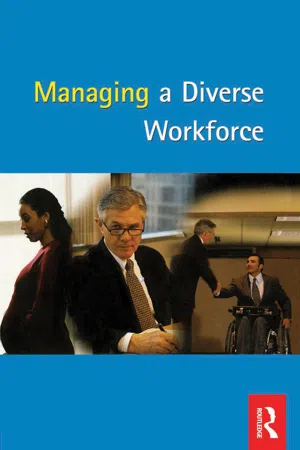
eBook - ePub
Tolley's Managing a Diverse Workforce
- 233 pages
- English
- ePUB (mobile friendly)
- Available on iOS & Android
eBook - ePub
Tolley's Managing a Diverse Workforce
About this book
Legislation governing employee welfare is becoming increasingly strict, and nowhere is this more prevalent than in dealing with a diverse workplace.
Every organisation contains employees who can be considered diverse. Diverse employee can include pregnant women, people with illnesses, young and old workers and those with disabilities. In today's society, where more people with disability and illness are entering the workplace, it is essential for both the organisation and the employee that managers are able to deal effectively with a diverse workplace.
Tolley's Managing a Diverse Workplace provides unrivalled guidance on complying with the legislation and regulations specific to the management of diverse employees. Aimed at both HR and health and safety managers, this unique handbook comprehensively covers the key legislation that affects this important area. Other important features include:
• Legislation, regulation and the employer
• Legislation, regulation and health & safety
• Managing the employment aspects of diverse employees
• Managing the health & safety of diverse employees
• Management systems / tools
• Managing changing relationships
• The future of diverse employees
With corporate social responsibility being such a hot topic, the effective management of diverse employees is high on most companies' agendas. This one-stop reference guide will ensure that organisations are sufficiently equipped to identify those workers considered to be at risk, and manage these risks to their mutual benefit.
1
Introduction
1.1 What is diverse/diversity?
The Collins English Dictionary & Thesaurus (21st Century Edition) defines diverse as:
‘Having variety; distinct in kind, with ‘of every description’ being an alternative phrase. Diversity being: the state or quality of being different or varied.’
Paramount to diversity is the organisational culture and the working environment. Managing people’s diversity effectively can add value to the organisation. Very often companies will limit their actions to compliance with race, sex and disability legislation. As there is no definitive legislation on managing diversity, employers may not even realise that there is a need to promote a culture where differences and diversity are valued. If a workplace is to be free from discrimination and be a place where everyone is treated fairly and equally, diversity has to be managed as part of the safety management system and a positive culture towards diversity promoted.
1.2 Who are diverse employees?
Diverse employees are those employees who do not fit within the stereotype of ‘normal’. They are those people who receive additional protection under employment and health and safety laws. They are perceived as being at ‘risk’ of harm from poor or less favourable treatment.
Diversity includes almost all ways in which people differ, such as education and sexual orientation, as well as the more obvious ones of gender, ethnicity and disability. The difference may also be considered in the role people play within the organisation, for example homeworkers or loneworkers.
The following groups have been identified, for the purpose of this book, as being diverse within the wider group of workers/employees. Some of the groups may only be diverse on either health and safety or employment law grounds, while others are defined as diverse by both.
1.3 Women
This extremely large group of employees are diverse on a number of levels. One of the main reasons is discrimination. Women can be discriminated against in a number of ways. For example, a high percentage of women are still paid less than men in similar roles. They can also be, and are, treated less favourably on the grounds of their sex. Discrimination can effect a number of issues, such as:
• chances of promotion;
• selection for roles and employment; and
• harassment.
This is not to say that men are not discriminated against on the grounds of their sex, merely that it is more likely that a woman will be discriminated against.
Women of childbearing age fall into the realms of diversity by nature of the fact they could become pregnant and the work they are undertaking could harm them or the unborn foetus. More importantly is where a woman is pregnant and subsequently when she becomes a mother (particularly new mothers). There are a number of additional rights afforded to pregnant women, including the right to attend antenatal classes, to receive maternity leave and, if eligible, maternity pay. New mothers (and existing ones who qualify) have the right to request a change in their hours and have time off to look after their child or any other dependants. The latter points do apply to men also and should be borne in mind as society moves towards a more even match of men and women who look after children.
1.4 Religious groups
Employees within this group have been diverse for some time due to the fact that they have additional needs, which are attributed to their religion or belief. For example, when Sunday trading regulations came into force, they had a large impact on Christian workers, as they did not wish to work on a Sunday in accordance with the rules of their faith. However, their rights and those of other religious bodies have now been protected against discrimination following the implementation of the Employment Equality (Religion or Belief) Regulations 2003 (SI 2003/1660) relating to discrimination on the grounds of religion, which came into effect on 2 December 2003.
Religious groups are also diverse on a number of levels. Their religious needs and duties must be considered in respect of their need for prayer time (with regard to Muslims) and their general working week in regard to religious days, for example Sunday/Sabbath working and religious festivals. Companies should also ensure that their policy takes into account religious needs in relation to dress codes. However, it is important to remember that health and safety regulations will be deemed to be a justifiable reason for not allowing a form of religious dress.
These employees are also at risk of discrimination, and not merely due to the additional consideration they require, as mentioned earlier in this section. They can be discriminated against in much the same way as women in relation to selection, promotion and harassment.
1.5 Lone Workers
There are some employees who work on their own as part of their normal day to day work. However, working alone can sometimes put people in a vulnerable position because it may be more difficult for them to summon help if things go wrong or if their health and safety is at risk. People who work alone face the same hazards in their daily work as other workers, however the degree of risk of harm is often greater for them than for other workers.
1.6 Who is a lone worker?
There is no literary definition of a lone worker, but the range of employees working alone is diverse and extensive. In general terms, lone workers are people who work on their own with little or no supervision, in the event of an emergency there is no one to give them assistance or summon help. There is no time limit attached to working alone and so someone could be a lone worker the whole work period or only for a limited time.
The work can be undertaken in a number of situations, for example:
• people who work by themselves in retail premises, eg:
○ in a garage;
○ in a small shop; or
○ in a kiosk;
• home workers;
• people who work separately from others;
• people working outside normal hours such as:
○ cleaners;
○ maintenance; and
○ repair staff.
• mobile workers who work away from their base; such as:
○ health visitors;
○ Environmental Health Officers;
○ HSE Inspectors;
○ postal staff;
○ social workers;
○ home help;
○ drivers;
○ architects;
○ painters and decorators;
○ milkmen;
○ estate agents;
○ doctors;
○ district nurses;
○ midwives;
○ sales staff;
○ police officers;
○ meter readers;
○ window cleaners;
○ lorry drivers;
○ cleaners; and
○ home visitors;
• staff, whom although they are on the company’s premises, are working apart from colleagues:
○ hospital staff;
○ security staff;
○ maintenance staff on large industrial sites;
○ teachers; and
○ prison officers.
This list is not definitive, employees may be lone workers for a number of reasons.
1.7 Home workers
There is a growing tendency for more companies to have their employees working from home. From the employer’s point of view, there is a saving in working space and overheads. The employee also gains by having to avoid spending time and money travelling, and they can enjoy any relevant home comforts. The use of computers and other modern communication aids means that there can be an immediate exchange of information so that employees working from home are no less in touch than employees who work on the employer’s premises. Home working will not suit everybody and management needs to monitor the situation very closely. Some employees need to be in the company of others to work effectively and feel part of the team or organisation, while others are self-motivated and can adapt to what is in effect a lone working environment. Management must ensure that home workers do not become encapsulated in the home and avoid venturing out to meet clients or visit the office. There can also be home life conflicts where members of the family want to take part in an activity and expect the home worker to stop work and participate in the activity.
Nonetheless, the employer’s responsibility for the health and safety of his employees, particularly as set out in s 2(2) of the Health and Safety at Work, etc Act 1974 (HSWA 1974), extends to home workers, and such employees should not be disregarded when producing the diverse employees’ policy.
1.8 Voluntary/charity workers
Despite the increasing importance of volunteering (22 million people volunteer each year), the legal obligations of organisations towards their volunteers with regard to health and safety are less clear than they are for employees. Nevertheless, organisations do have legal obligations towards their volunteers. It is clearly good practice to treat volunteers with equal consideration when it comes to health and safety. A volunteer’ is defined as someone who commits time and energy for the benefit of others and who does so freely, through personal choice, and without expectation of financial reward, except for the payment of actual out-of-pocket expenses. Most voluntary organisations are employers and as such will have a duty towards persons who are not in their employment but who may be affected by their undertaking’, such as clients and volunteers (s 3 of the HSWA 1974). This duty extends to the health and safety of those persons in the same way as with paid employees.
1.9 Agency workers
This group is diverse for completely different reasons in relation to employment law. This is due to the fact that they lack additional protection in the employment law arena. There is still much debate as to whether the agency or the company who requests their services is their employer, although agencies should work on the basis that they that are the employer.
1.10 Disabled
This group of employees are probably the most obvious in their diversity, as they will normally have a physical, mental or sensory condition, which may impede the usual way of working. There are obviously health and safety issues here. But there are also employment law issues. Disabilities, whether physical, mental (which would include those with learning difficulties, such as dyslexia) or indeed newly discovered disabilities, be it illness or injury, require that an employer should treat an employee in a particular manner. This is both in relation to discrimination and making reasonable adjustments to the role and, if necessary, the equipment and premises, as well as ensuring that the company’s policies do not add further damage, for example a highly restrictive sickness policy.
1.11 Young workers
Young workers are those employees between 16 and 18 who are outside the compulsory education age bracket, ie they have completed Year 11 of High School. Obviously this is a vulnerable group of employees, who should be treated carefully in relation to undertaking long hours or arduous and heavy work. They do receive some additional protection under employment law, but are afforded far more in relation to health and safety regulations (Management of Health and Safety at Work Regulations 1999 (SI 1999/3242)).
1.12 Race/ethnic minorities
The employees who fall into this category may also need to be considered alongside religious groups. In general, there is protection against discrimination based on colour, which can effect selection and promotion, as well as bring about the possibility of harassment. However, the situation can be made more complicated where English is not the employee’s first language. The employer would need to ensure that reasonable adjustments were made in respect of performance to targets and the employee’s understanding of their role and instructions.
1.13 Immigrant workers
There are two Acts which employers have to comply with regarding the employment of immigrant workers and they are:
• the Race Relations Act 1976, which makes it unlawful to discriminate on grounds of colour, race, nationality, ethnic or national origins in the recruitment, employment or dismissal of any person; and
• the Asylum and Immigration Act 1996, s 8, which makes it a criminal offence to employ a person who has not been granted leave to enter or remain in the United Kingdom or who is subject to a condition prohibiting employment.
A very important factor when considering the health and safety of the workforce is that the language barriers may not be used as a device to exclude immigrants from employment and attempts to impose language tests have resulted in allegations of racial discrimination. The problem extends not just to immigration from Asian or African countries but under article 48 of the Treaty of Rome the free movement of workers throughout the European Union is guaranteed and an influx of non-English speaking workers from Europe cannot be excluded. Training for safety officers may well include some form of instruction in foreign languages.
1.14 Sexual orientation
Effectively every employee will fall within this category, as the issue is not whether the employee is gay but their general sexual orientation. Since 1 December 2003 employees are protected against discrimination relating to their perceived sexuality. This means that they can be discriminated against in the same ways as has been mentioned above, based on what sexual preferences someone believes them to have, not what they actually do.
1.15 Health service workers
Hospital staff, especially in Accident and Emergency departments, may experience verbal abuse or physical violence because people are kept waiting or from casualties under the effects of drink or drugs.
Community midwives/district nurses/carers/social workers are placed in a lone worker situation and although their work could be considered to be proactive, caring and of low risk they are:
• visiting clients at home;
• visiting locations that may be poor or run down housing estates;
• dealing with unknown people and situations involving domestic violence or drug/alcohol abuse;
• driving on remote country roads and in areas unknown to them;
• working at night;
• working in clinics/health centres in the evenings a...
Table of contents
- Cover
- Title
- Copyright
- Contributors
- Contents
- Table of Cases
- Table of Statutes
- Table of Statutory Instruments
- 1. Introduction
- 2. Legislation, Regulation and the Employer
- 3. Legislation, Regulation and Health and Safety
- 4. Managing the Employment Aspects of Diverse Employees
- 5. Managing the Health and Safety of Diverse Employees
- 6. Management Systems/Tools
- 7. Managing Changing Relationships
- 8. The Future of Diverse Employees
- Index
Trusted by 375,005 students
Access to over 1.5 million titles for a fair monthly price.
Study more efficiently using our study tools.
Frequently asked questions
Yes, you can cancel anytime from the Subscription tab in your account settings on the Perlego website. Your subscription will stay active until the end of your current billing period. Learn how to cancel your subscription
No, books cannot be downloaded as external files, such as PDFs, for use outside of Perlego. However, you can download books within the Perlego app for offline reading on mobile or tablet. Learn how to download books offline
Perlego offers two plans: Essential and Complete
- Essential is ideal for learners and professionals who enjoy exploring a wide range of subjects. Access the Essential Library with 800,000+ trusted titles and best-sellers across business, personal growth, and the humanities. Includes unlimited reading time and Standard Read Aloud voice.
- Complete: Perfect for advanced learners and researchers needing full, unrestricted access. Unlock 1.5M+ books across hundreds of subjects, including academic and specialized titles. The Complete Plan also includes advanced features like Premium Read Aloud and Research Assistant.
We are an online textbook subscription service, where you can get access to an entire online library for less than the price of a single book per month. With over 1.5 million books across 990+ topics, we’ve got you covered! Learn about our mission
Look out for the read-aloud symbol on your next book to see if you can listen to it. The read-aloud tool reads text aloud for you, highlighting the text as it is being read. You can pause it, speed it up and slow it down. Learn more about Read Aloud
Yes! You can use the Perlego app on both iOS and Android devices to read anytime, anywhere — even offline. Perfect for commutes or when you’re on the go.
Please note we cannot support devices running on iOS 13 and Android 7 or earlier. Learn more about using the app
Please note we cannot support devices running on iOS 13 and Android 7 or earlier. Learn more about using the app
Yes, you can access Tolley's Managing a Diverse Workforce by Nikki Booth,Clare Robson,Jacqui Welham,Alison Barnard,Nicki Bartlett in PDF and/or ePUB format, as well as other popular books in Business & Business General. We have over 1.5 million books available in our catalogue for you to explore.