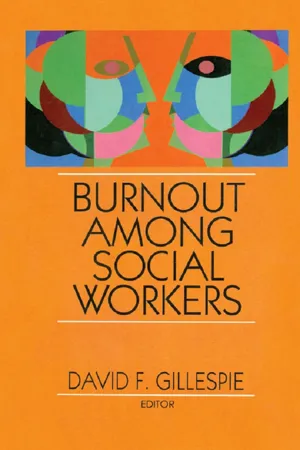
The phenomenon of burnout first became the subject of public attention in the mid-1970s. This landmark volume is one of the first devoted exclusively to theoretical and empirical work on burnout. Each valuable chapter represents the state of the art in social services research on burnout.
Burnout Among Social Workers illustrates and assesses problems with definitions and theoretical orientations to help clarify the overall conceptual vagueness that has plagued burnout research since its beginning. Attention is paid to both personal and job-related variables and coping mechanisms. Expert social work academicians and researchers clearly demonstrate the importance of burnout measurement for theory and practice and establish important guidelines for subsequent research and theory development in this area.
- 116 pages
- English
- ePUB (mobile friendly)
- Available on iOS & Android
eBook - ePub
Burnout Among Social Workers
About this book
Information
Factors Associated with Burnout in the Social Services: An Exploratory Study
Craig Winston LeCroy
Mark R. Rank
Mark R. Rank
Dr. LeCroy is Assistant Professor, School of Social Work, Arizona State University, Tempe, AZ 85287 and Dr. Rank is Assistant Professor, Department of Sociology, Washington University, St. Louis, MO 63130. Requests for reprints should be addressed to Dr. LeCroy. The authors would like to acknowledge the work of the following people on this project: Judy Davidson, Mari Koeplin, Duffy Pcct, Deb Ranger, Kenneth Reid, John Wise and Ruth Yarger.
SUMMARY. Based upon a sample of 106 social workers, factors related to burnout are examined. Several variables related to the job structure within the social services emerge as potentially important determinants of burnout. These include satisfaction, autonomy, self-esteem, and discrepancy. It would appear that the source of the burnout problem is more a function of the job situation than a function of individual personality. A social service agency will obtain higher worker effectiveness and less worker exhaustion by recognizing the need for worker independence self-esteem, acceptance, and support.
Increasing concern has been voiced regarding job-related stress among human services professionals. Social work can be seen as a job which carries a variety of inherent stresses. The nature of social work activity, the problems that social workers must confront, the limitations of knowledge and professional ability, and the structure of the social work profession all converge to produce a job with inherent stresses. Moreover, social work has historically accepted as its task the responsibility and burden of affirming and implementing moral and social values, to which society may give only contradictory or partial expression and support (Rapoport, 1960). Richan and Mendelson suggest that social work has become the “unloved Profession” (Richan & Mendelson, 1973).
Indeed, the social worker’s environment can be quite demanding. Larson, Gilbertson and Powell (1978) call attention to the continual responsibility of meeting the emotional needs and desires of clients that social workers must face. They point out that social workers must be ready to clarify, confront, encourage, suggest, entice, frustrate and feel for clients as the occasion demands. This kind of emotional investment and its effects have been widely discussed in the literature (Burton, 1975; English, 1976; Gillespie, 1980; Pines & Maslach, 1978). However, research on this important topic has not been forthcoming (Gillespie, 1983).
The depth and complexity of factors contributing to burnout is great. How these variables are associated with burnout will vary with the individual and the organization. This research examines the influence of psychological, demographic, and occupational background variables upon burnout. Of particular interest is the extent to which the following psychological constructs are related to burnout: job satisfaction, professional self-esteem, work autonomy, discrepancy, ability to cope, and assertiveness. These constructs are discussed below.
REVIEW OF THE LITERATURE
Job Satisfaction
The relationship between burnout and job satisfaction has received considerable attention (Harrison, 1980; Jayaratne & Chess, 1983,1984). Harrison (1980) uses the concept of job satisfaction and assumes it is closely related to the concept of burnout. However, the extent to which these concepts are overlapping has not received much study. Jayaratne and Chess (1983) did investigate the relationship between job satisfaction and two indices of burnout, depersonalization and emotional exhaustion While overlap was evident, the authors note that the two con-cepts are not identical. In order to continue to examine this relationship, the analysis includes job satisfaction as a predictor of burnout. It is hypothesized that job satisfaction will be negatively related to burnout.
Professional Self-Esteem and Work Autonomy
Kermish and Kushin (1969) examined the reasons for high turnover in a public welfare setting and found that job dissatisfaction and turnover were associated with the workers’ belief that they were unable to help their clients, were not given proper respect, and could not be creative and use their own initiative. Dorman (1971) presents findings that suggest the more bureaucratic the organization, the lower the level of professionalism. Additionally, Dorman indicates bureaucratic agencies produce minimal feelings of autonomy by workers. Furthermore, Clearfield (1977) has found that social workers with a positive professional image develop a sense of identity with their work and are happier than those who are deprived of professional self-esteem.
It is hypothesized that positive professional self-esteem will be negatively correlated with burnout. Professional self-esteem is seen as a subjective evaluation regarding the prestige of the social worker’s job, the worth of the profession and its opportunities for personal growth, self-fulfillment, and service to other people provided by the profession (Kim, Boo & Wheeler, 1978). Additionally, it is hypothesized that an increase in work autonomy, like professional self-esteem, will be negatively associated with burnout.
Discrepancy
Work autonomy and professional self-esteem are often measured by examining “how much is there” items and “how much there should be” items across several facets. This allows for measuring the worker’s present level of attainment and that worker’s aspirations (Dehlinger & Perlman, 1978). This technique of discrepancy measurement gives an indication of perceived deficiency in need fulfillment. It is hypothesized that increases in discrepancy will be positively correlated with burnout.
Ability to Cope
A person’s ability to cope is likely to affect burnout. Interpersonal support systems can be seen as protective buffers against work stresses and reduce the amount of tedium a person experiences (Pines & Kafry, 1978). Recent findings (Maslach & Pines, 1977; Pines & Kafry, 1978; Scholom & Perlman, 1979) suggest that a positive social milieu may provide this buffer to significantly reduce job stress. Austin et al. (1977) found that eighty percent of the social workers interviewed found it helpful to share job-related concerns with their spouse or roommate when under pressure. From this, an index was devised to measure a person’s ability to cope.
Assertiveness
Larson, Gilbertson and Powell (1978) discuss how not setting limits can lead a social worker to burnout. “By failing to say ‘no,’ within reason, to the demands of their communities and governing boards, and by failing to educate the communities to accept their limits, they, in turn, set the stage for their own incompetence and burnout” (p. 564). This suggests the importance of examining whether or not assertiveness, as a personality construct, has any effect on the burnout indices.
METHOD
Sampling
A nonrandom sample was identified for use in the present study. A list of social service agencies was generated in two midwestern towns in two different states. From this list phone calls were made to identify social workers who were employed at the agencies. The workers were then contacted and asked to parttcipate in an interview. Because the communities where this research was conducted were relatively small it was not possible to randomly sample from a larger universe of social service agencies. Consequently, the sample is one of convenience. The per-sonal contacts with the social workers allowed for an open interview format as well as the administration of a questionnaire. This method was chosen over mailed questionnaires so that a larger sample would be obtained over what could be expected if the subjects were asked to complete and mail questionnaires on their own recognizance. All subjects who agreed to be interviewed completed the questionnaire. Only six social workers refused to be interviewed for the study. The entire sample was 106 respondents.
Measurement
The first section of the questionnaire consisted of 14 demographic and occupational background questions including age, sex, education, and nature of the social service job. The second section included 25 questions of the Maslach Burnout Inventory. The third section consisted of 47 questions covering factors which were hypothesized to contribute to burnout. These factors included job satisfaction and autonomy, professional self-esteem, discrepancy, coping mechanisms, and personal assertiveness.
In order to establish the degree of burnout experienced by an individual subject, the Maslach Burnout Inventory, consisting of 25 questions measured on a seven point scale, was used in its complete form. The inventory measures four dimensions of burnout, including emotional exhaustion, negative cynical attitudes toward recipients (depersonalization), negative evaluation of the subject’s own strengths and accomplishments in working with others (reduced personal accomplishment), and the subject’s sense of closeness to clients. Reliability data for the subscales ranged from .71 to .90 (see Maslach & Jackson, 1981).
A modified version of Brayfield and Rothe’s (1951) scale was adopted for use as the job satisfaction index. It included questions on job satisfaction, interest, enjoyment, disappointment, boredom and satisfaction with the agency. Feelings of dissatisfaction and unpleasantness were also covered. All items were scaled as strongly agree to strongly disagree. The authors report a reliability estimate of .87 for the scale.
The job autonomy and professional self-esteem indices were based on the work of Porter and Lawler (1968) as adopted by Kim, Boo and Wheeler (1978). Job autonomy was measured by such questions as the amount of individual authority connected with one’s position, one’s opportunity for determining methods and procedures, one’s opportunity for independent thought and action and one’s opportunity for participation in the setting of goals ,These were measured, as perceived by the subject, on a seven-point scale of “minimal” to “maximum.” Information on the reliability of these instruments was unavailable.
Professional self-esteem was measured on the same sevenpoint scale. Questions included the opportunity in one’s position to give help to other people; the prestige of one’s position, both within and outside the agency; feelings of security, worthwhile accomplishment, self-fulfillment and self-esteem in one’s position; a...
Table of contents
- Cover
- Half Title
- Full Title
- Copyright
- Contents
- Journal of Social Service Research Editorial Board
- Preface
- Introduction
- An Approach to the Study of Burnout in Professional Care Providers in Human Service Organizations
- Factors Associated with Burnout in the Social Services: An Exploratory Study
- Gender Differences in Work Stress Among Clinical Social Workers
- The Association of Burnout and Social Work Practitioners' Impressions of Their Clients: Empirical Evidence
- Social Workers and Burnout: A Psychological Description
- Burnout Among Social Workers Working with Physically Disabled Persons and Bereaved Families
- Burnout Research in the Social Services: A Critique
Trusted by 375,005 students
Access to over 1.5 million titles for a fair monthly price.
Study more efficiently using our study tools.
Frequently asked questions
Yes, you can cancel anytime from the Subscription tab in your account settings on the Perlego website. Your subscription will stay active until the end of your current billing period. Learn how to cancel your subscription
No, books cannot be downloaded as external files, such as PDFs, for use outside of Perlego. However, you can download books within the Perlego app for offline reading on mobile or tablet. Learn how to download books offline
Perlego offers two plans: Essential and Complete
- Essential is ideal for learners and professionals who enjoy exploring a wide range of subjects. Access the Essential Library with 800,000+ trusted titles and best-sellers across business, personal growth, and the humanities. Includes unlimited reading time and Standard Read Aloud voice.
- Complete: Perfect for advanced learners and researchers needing full, unrestricted access. Unlock 1.5M+ books across hundreds of subjects, including academic and specialized titles. The Complete Plan also includes advanced features like Premium Read Aloud and Research Assistant.
We are an online textbook subscription service, where you can get access to an entire online library for less than the price of a single book per month. With over 1.5 million books across 990+ topics, we’ve got you covered! Learn about our mission
Look out for the read-aloud symbol on your next book to see if you can listen to it. The read-aloud tool reads text aloud for you, highlighting the text as it is being read. You can pause it, speed it up and slow it down. Learn more about Read Aloud
Yes! You can use the Perlego app on both iOS and Android devices to read anytime, anywhere — even offline. Perfect for commutes or when you’re on the go.
Please note we cannot support devices running on iOS 13 and Android 7 or earlier. Learn more about using the app
Please note we cannot support devices running on iOS 13 and Android 7 or earlier. Learn more about using the app
Yes, you can access Burnout Among Social Workers by David F Gillespie in PDF and/or ePUB format, as well as other popular books in Social Sciences & Health Care Delivery. We have over 1.5 million books available in our catalogue for you to explore.