eBook - ePub
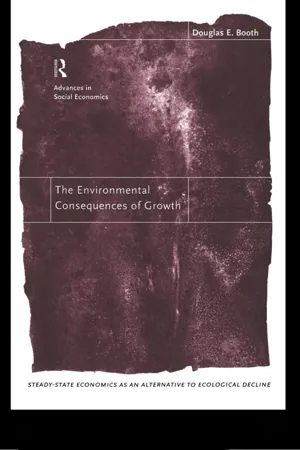
The Environmental Consequences of Growth
Steady-State Economics as an Alternative to Ecological Decline
- 240 pages
- English
- ePUB (mobile friendly)
- Available on iOS & Android
eBook - ePub
The Environmental Consequences of Growth
Steady-State Economics as an Alternative to Ecological Decline
About this book
This book presents a new perspective on the link between economic growth and environmental change. All the key issues in environmental economics are covered, including:
* industry, creation and environmental change
* air, water and toxic pollution
* economic growth and the limits of environmental regulation
* ethics and the limits of environmental economics.
The central thesis is that whilst new industries are necessary for economic growth, their development creates new environmental problems which become difficult to reverse. An alternative approach, 'steady-state economics', based on the concept of ethical commitment, is put forward as a possible alternative to a high-growth, environmentally destructive economy. Providing a welcome alternative to conventional, neoclassical microeconomic thought on environmental issues, this will be vital reading for students of environmental economics and related subjects.
1
INTRODUCTION
Economic growth and environmental change
After a quarter century of environmental regulation in the U.S. under the auspices of the Environmental Protection Agency and other governmental bodies, substantial environmental threats remain. Ambient standards for ozone and other air pollutants are frequently violated in urban areas; lakes and rivers continue to be heavily polluted; ambient levels of toxic chemicals in the biotic food chain are at high levels; little has been done about the potentially serious problem of greenhouse warming; and biodiversity is threatened as a consequence of reduced and fragmented natural habitats. A similar story can be told for other prosperous countries of the world such as Great Britain and its fellow members of the European Community. Why has the regulatory system in the U.S. and elsewhere failed to fully address environmental problems?
The goal of this book is to suggest that the roots of environmental change are deeply embedded in the processes that generate economic growth. The central proposition put forth and evaluated in the pages to follow is that forces leading to economic growth in market capitalist economies also lead to environmental change. Technological change, innovation, and the drive for wealth result in the creation of new high-growth industries required for macroeconomic expansion; these same high-growth industries foster environmental change and resist regulatory efforts to limit such change; consequently, economic forces essential to economic growth are responsible for environmental problems.
Because growth itself is the essence of the environmental problem, a new economic vision is needed, one that is rooted in a wider view of human values and ethics. The alternative vision offered here is a steady-state economy, one with the capacity not only to satisfy real human needs, but to preserve the global environment and its full diversity of forms of life. After an exploration of the causes of environmental change in the first six chapters of the book, the alternative vision and its ethical foundations are then addressed in the next five chapters.
Comparison to the conventional view of environmental issues
Because economic growth and growing environmental problems in the absence of effective regulation go hand-in-hand, the environmental problem in this book is seen as fundamentally macroeconomic in character. The conventional view of environmental problems is, to the contrary, fundamentally microeconomic. Environmental problems in the eyes of conventional economists exist because of a failure of the pricing system (Tietenberg 1994). Market-determined prices fail to fully reflect the social costs of environmental damage caused by economic activity, and the solution to the environmental problem is to “get the prices right.” This is to be done by internalizing the social costs of environmental damage. Instead of allowing an electric power plant or a chemical plant to externalize environmental costs by emitting pollutants and imposing damage from environmental degradation on the larger society, they should be required to bear the costs of pollution control and environmental damage internally. As a result, prices of products would fully reflect the social costs of using environmental resources and such use would be efficient. While this approach is appealing, in a profit- and growth-oriented economy it is fundamentally problematic, as we will now see.
Economic growth as a cause of environmental decline
The microeconomic insight—that profit-oriented economic agents will have a strong propensity to externalize environmental costs—is indeed compelling. That the internalization of environmental costs would reduce environmental problems is undeniable. However, environmental costs in a profit-driven capitalist economy are typically not fully internalized. Why is this?
Conventional microeconomic thinking does not get at the essence of the cost internalization failure problem, an issue better addressed by considering the nature of the capitalist macroeconomic development process as described by Joseph Schumpeter (1939, 1950) and others. According to a Schumpeterian view, the creation of new industries based on new technologies is fundamental to macroeconomic growth. Growth is driven by qualitative change in the structure of the economy, qualitative changes that inevitably seem to lead to changes in the natural environment. New industries invariably seem to create new environmental problems by virtue of their inherent propensity to externalize environmental costs. Once such industries are created, they often form powerful vested interests that oppose environmental regulations and insure that environmental costs remain externalized to the greatest extent possible. Profit-maximizing electric utilities and chemical companies, for example, typically oppose pollution control regulations that increase their costs and reduce their profits. The consumers of the products of these industries also constitute potentially powerful vested interests not wanting to see their costs of consumption rise as a consequence of environmental regulations. The process of economic growth thus creates vested interests opposed to the internalization of environmental costs. The growth process has the potential to defeat the goal of cost internalization. Consequently, growth is in practice the fundamental issue, not prices. As long as growth in its existing form persists, powerful interest groups will work hard at avoiding environmental cost internalization. Simply put, the forces of economic growth oppose cost internalization.
Ethics and the evaluation of environmental change
Even if all environmental costs were successfully internalized, economic growth could still lead to environmental deterioration. This would occur if the added benefits of growth exceeded the added social costs of environmental damage resulting from growth. The added benefits of continuing to use fossil fuels may well exceed the added social costs of future global warming resulting from carbon dioxide emissions associated with fossil fuel use (Nordhaus 1991).1 Nonetheless, global warming is likely to cause significant economic harm to future generations and result in the destruction of ecosystems and species (Cline 1992; Abrahamson 1989). Net economic welfare (taking full account of environmental costs to current and future generations) may well be maximized by continuing to use fossil fuels even though the consequences may be catastrophic for individual members of future generations and for species and ecosystems.
This conclusion results from an implicit acceptance of a utilitarian ethical framework underlying cost-benefit analysis, a framework that neglects the moral worth of human individuals in present and future generations, plant and animal species, and ecosystems. If our ethical framework is broadened to include the well being of human individuals, species, and ecosystems, then cost-benefit analysis and social cost internalization are inadequate criteria for determining acceptable levels of environmental damage. If human individuals, species, and ecosystems are viewed as having moral worth, then a dollar value cannot be meaningfully assigned to them in order to assess the extent of external social costs. For any given act of environmental destruction, there will be social costs that can be calculated, such as the damage to buildings or loss of crops from air pollution. However, there also may be moral costs that cannot be calculated. Most find the idea of assigning a dollar value to human life repugnant. Human individuals may be so poor that they have very little willingness to pay for a clean environment necessary for a full and healthy life. In such circumstances, many would find it morally reprehensible to advocate the continuation of health-damaging pollution even though added social benefits exceed added costs. This suggests that individual human lives are valuable in their own right, not just for the incomes they earn or the utility they deliver to others in society. The same can be said for species and ecosystems, beings that also may have value in their own right apart from any utility they deliver. If so, then assigning a dollar value to them would be repugnant as well.
The point is simple. Social costs are calculable in dollar terms; moral costs are not. Even if social costs are fully internalized, economic growth and environmental deterioration could result in “moral costs” avoidable only through the maintenance of a specified level of environmental quality that may limit economic growth. The moral costs associated with global warming, for example, may be avoidable only by halting or even reversing the global warming trend. This may be the case even though the added social costs of doing so exceed the added social benefits. A central thesis to be explored in the chapters to follow is that the internalization of both the social and moral costs of environmental change will be resisted by those whose interests are tied to unfettered growth, interests that are created by the economic growth process itself.
Sustainability and the steady state
Some argue that economic growth is necessary to provide resources to pay for environmental protection and reverse environmental deterioration (Grossman and Krueger 1993). Herman Daly (1991a) vigorously opposes this view, invoking the entropy principle. For Daly, production is inherently entropic, converting high-quality low-entropy matter and energy into high-entropy environmentally disruptive waste. If Daly is right, then as historically experienced, economic growth is contrary to any notion of sustainability. In its broadest conception, sustainability refers to preserving the ability to produce at existing levels. If our concerns extend beyond production to the protection of human individuals, species, and ecosystems for their own sake, then a more precise definition is needed.
The most concrete concept of sustainability is a steady-state economy. In a steady-state economy, natural resources are consumed at a fixed, sustainable rate and the quality of the environment is maintained at a level that protects the health of human individuals, species, and ecosystems (Daly 1991a). The global ecosystem’s ability to provide material inputs to the global economy and to absorb its waste byproducts is inherently limited, and under a steady-state economy the demands placed upon the global ecosystem by the global economy are appropriately restrained. Daly’s steady-state economics is really the precursor to modern conceptions of sustainable development calling for the passing on of a stock of natural capital to future generations at least equal to that enjoyed by the current generation (Pearce 1993:15–19). Some advocates of sustainable development call for a nondeclining total capital stock, mixing capital goods produced by humans and the natural capital stock. This approach is sometimes referred to as weak sustainability and assumes produced and natural capital are substitutes for one another. Daly’s version of sustainability denies substitutability and argues for a strong version that passes on a nondeclining natural capital stock to future generations.
Nothing in conventional neoclassical environmental microeconomics suggests the concept of sustainability. If benefit-cost analysis argues for the destruction of a natural area, the extinction of a species, or the using up of a natural resource, so be it. An ethical approach, presuming that the well being of future generations is a matter of present concern, and that human individuals, species, and ecosystems have value in their own right, leads more directly to the concept of sustainability. A properly defined steady-state economy assures the provision of adequate natural resources for future generations and the protection of the health and well being of human individuals, species, and ecosystems.
A steady state does not necessarily imply zero economic growth. Economic growth can take place so long as the productivity of natural and environmental resources is increased through technological advance. Rather than labor productivity (output per unit labor) being the focus of attention, environmental resource productivity (output per unit resource) would take center stage in order for there to be significant economic growth. Economic growth would most likely be reduced relative to the historical experience in a steady state since in the past, environmental resource use faced few constraints.
The plan of the book
Each of these claims requires elaboration and justification. Chapters 2 to 5 address the central thesis of the book—new industries are required for long-term economic growth and cause environmental change. The justification for this thesis is necessarily empirical and historical. After the basic theory of the link between economic growth and environmental change has been set out in Chapter 2, historical evidence for the relationship is presented in Chapters 3, 4, and 5. The basic theoretical idea presented in Chapter 2 is the Schumpeterian notion that long-run economic growth proceeds through the addition of new forms of economic activity. If these new forms of economic activity bring forth new kinds of environmental problems, then the forces that lead to economic growth also lead to environmental change. The job of Chapter 3 is to present historical evidence that our existing array of environmental problems can be traced to the industry creation process underpinning economic growth. Chapters 4 and 5 demonstrate the significance of our environmental problems. The serious problem of natural habitat decline is addressed in Chapter 4 and the problems of air, water, and toxic pollution are considered in Chapter 5. To understand and evaluate the full consequences of economic growth for environmental change, we need to know the characteristics of key ecosystems and something about their functioning. Only in this way can we understand what is lost when ecosystems are destroyed or altered by economic growth. This knowledge is especially needed if an ethical framework is adopted where the moral considerability of ecosystems and species must be assessed. Knowledge of something necessarily precedes moral attachment to it, or even the recognition of the possibility of moral attachment. The goal of Chapters 4 and 5 is to give us a better understanding of what is lost exactly as a consequence of environmental change.
In Chapter 6 historical efforts at environmental regulation will be described and assessed. The basic conclusions are that vested economic interests have indeed limited the extent of regulation and that regulation has thus far failed to resolve key environmental problems.
Having established the link between economic growth and environmental change, in Chapter 7 the normative framework for evaluating the problem of environmental decline is presented. The utilitarian benefit-cost framework of conventional neoclassical derivation is rejected in favor of an approach founded on the principles of environmental ethics that sees human individuals, species, and ecosystems as valuable in their own right and thus priceless in the sense that their value is not representable in monetary terms.
Chapter 8 offers the steady-state approach as an alternative to conventional regulation and suggests how a steady state can be implemented. The steady state is justified not in terms of utilitarian benefit-cost analysis, but on the basis of the broader ethical framework suggested in Chapter 7. A steady-state approach is considered for air and water pollution problems, toxins, and natural habitat preservation.
A steady-state economy is a radical departure from a modern high-growth capitalist economy and will require rather different policies for macroeconomic management. This question is addressed in Chapter 9, along with the issue of whether capitalism is even compatible with a steady state. In Chapter 10, the democratically run producer cooperative is evaluated and found to be a more environmentally friendly form of business organization better suited to a steady-...
Table of contents
- Cover Page
- Title Page
- Copyright Page
- Figures
- Tables
- Preface
- 1. Introduction: Economic Growth and Environmental Change
- 2. Economic Growth and Environmental Change: Theory
- 3. The Link Between Industry Creation and Environmental Change
- 4. Economic Growth and Environmental Change: Natural Habitat Loss
- 5. Economic Growth and Environmental Change: Air, Water, and Pesticide Pollution
- 6. Economic Growth and the Limits of Environmental Regulation
- 7. Ethics and the Limits of Environmental Economics
- 8. The Steady-State Alternative
- 9. The Macroeconomics of a Steady State
- 10. Economic Democracy As an Environmental Measure
- 11. Growth, Environmental Change, and Steady-State Economics: Conclusion
- Notes
- Bibliography
Trusted by 375,005 students
Access to over 1.5 million titles for a fair monthly price.
Study more efficiently using our study tools.
Frequently asked questions
Yes, you can cancel anytime from the Subscription tab in your account settings on the Perlego website. Your subscription will stay active until the end of your current billing period. Learn how to cancel your subscription
No, books cannot be downloaded as external files, such as PDFs, for use outside of Perlego. However, you can download books within the Perlego app for offline reading on mobile or tablet. Learn how to download books offline
Perlego offers two plans: Essential and Complete
- Essential is ideal for learners and professionals who enjoy exploring a wide range of subjects. Access the Essential Library with 800,000+ trusted titles and best-sellers across business, personal growth, and the humanities. Includes unlimited reading time and Standard Read Aloud voice.
- Complete: Perfect for advanced learners and researchers needing full, unrestricted access. Unlock 1.5M+ books across hundreds of subjects, including academic and specialized titles. The Complete Plan also includes advanced features like Premium Read Aloud and Research Assistant.
We are an online textbook subscription service, where you can get access to an entire online library for less than the price of a single book per month. With over 1.5 million books across 990+ topics, we’ve got you covered! Learn about our mission
Look out for the read-aloud symbol on your next book to see if you can listen to it. The read-aloud tool reads text aloud for you, highlighting the text as it is being read. You can pause it, speed it up and slow it down. Learn more about Read Aloud
Yes! You can use the Perlego app on both iOS and Android devices to read anytime, anywhere — even offline. Perfect for commutes or when you’re on the go.
Please note we cannot support devices running on iOS 13 and Android 7 or earlier. Learn more about using the app
Please note we cannot support devices running on iOS 13 and Android 7 or earlier. Learn more about using the app
Yes, you can access The Environmental Consequences of Growth by Douglas Booth in PDF and/or ePUB format, as well as other popular books in Economics & Economic Theory. We have over 1.5 million books available in our catalogue for you to explore.