eBook - ePub
British General Staff
Reform and Innovation
- 250 pages
- English
- ePUB (mobile friendly)
- Available on iOS & Android
eBook - ePub
British General Staff
Reform and Innovation
About this book
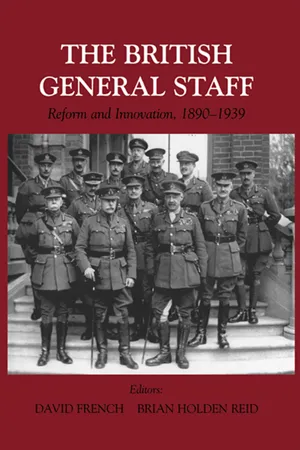
The essays that comprise this collection examine the development and influence of the British General Staff from the late Victorian period until the eve of World War II. They trace the changes in the staff that influenced British military strategy and subsequent operations on the battlefield.
1: Planning for War in the Final Years of Pax Britannica, 1889–1903
Halik Kochanski
The aim of this chapter is to examine how Britain planned for war in the last years of the nineteenth century and why no Chief of Staff was created in the British Army. During this period the army underwent a series of reforms designed to improve its capability to wage war: the so-called Cardwell Reforms. Yet, until the publication of the second part of the report of the Royal Commission under the presidency of Lord Hartington, little serious consideration was given to the desirability of establishing a Chief of Staff. The historical background to the Hartington Commission will be covered briefly, but the main focus of this chapter is to examine who opposed the recommendations of the commissioners and why. The sheer strength of this opposition reveals a great deal about the state of civil-military relations and the links between the Crown, Parliament and the army. The chapter will then analyse the effect of the 1895 Order in Council, which paid some lip-service to the Hartington Commission, but, arguably, damaged the War Office’s ability to plan for war. The consequences were felt on the outbreak of the South African War in 1899. The Royal Commission, under Lord Elgin, examined the issues and highlighted many failures of military planning. It was not, however, until the Esher Committee on the Reconstitution of the War Office reported in 1904 that the political will existed to institute a thorough alteration to the composition of the military side of the War Office and accept the need for a General Staff.
The victories of the German army, first over Austria in 1866 and then over France in 1870, impelled the war departments of the European countries to reconsider their army systems. Britain, under the Secretary of State for War Edward Cardwell, followed suit. Various reforms were introduced following the German model, of which short service, the creation of an Army Reserve and the reorganisation and linking of battalions were the most important. But little thought was given to the adoption of the German system for war planning: the General Staff. Cardwell did suggest the appointment of a Chief of Staff to the Commander-in-Chief (C-in-C), the Duke of Cambridge, but the duke could see little value in such an appointment during peacetime: the Chief of Staff would be ‘a fifth wheel to the coach’.1 Cardwell was unwilling to pursue the subject further. He was aware that the War Office Act, which made the C-in-C subordinate to the Secretary of State, had offended the duke, particularly as he was forced to move his office from Horse Guards to the War Office. Furthermore Cardwell, who had already encountered political difficulties with his reforms, particularly the abolition of the purchase of commissions, was unsure whether he would have the support of the Liberal Party for a Chief of Staff. To many Liberals the army was seen as a threat to freedom and there was a belief that planning for war led to war.
The 1870 War Office Act also set the trend for the administration of the War Office for virtually the remainder of the century. The C-in-C was to be the Secretary of State’s principal adviser on all questions of military policy, including the organisation and the preparation of the army for war. In 1873 an Intelligence Branch was established to collect and collate information on foreign powers. These developments appeared to negate the need for a Chief of Staff. However, the C-in-C also bore heavy administrative duties, with overall responsibility for recruitment, promotion, discipline, training and education as well as command and inspection duties for the home army. In 1888 the abolition of the post of Surveyor-General of the Ordnance meant that the C-in-C now assumed responsibility for the supervision of supply and transport.2 Clearly overburdened by administrative duties, it was apparent that the C-in-C could not devote attention to all areas equally, and consequently some, like the planning for war, suffered.
The weaknesses in the system of planning for war were concealed by Britain’s record in colonial warfare. There were many victories in Britain’s colonial campaigns, and the few defeats, normally soon reversed, could be blamed on the general in command. Planning for war was an ad hoc arrangement. When a crisis arose a general would be appointed to command the field force. He would make his own plans of campaign and discuss his military requirements with the C-in-C and the Secretary of State. This system worked well when responsibility for such campaigns was given to highly skilled individualistic commanders such as Sir Garnet Wolseley and Sir Frederick Roberts but it was not professional. It was assumed that the troops would be found from somewhere and that the navy would be able to transport them to the seat of the war. No system existed to ensure army-navy co-operation. The Egyptian campaign in 1882 highlighted many problems. For example, troops had to be gathered from the United Kingdom, Mediterranean stations and India and, although the navy found the required transport, it did not take any steps to ensure that its policy was in tune with War Office plans. Consequently the bombardment of Alexandria took place when there were no troops in the area to seize control from the Egyptian nationalists.
In 1888 the Adjutant-General, Wolseley, was so alarmed at the small size of the army in relation to its worldwide responsibilities that he publicised Britain’s vulnerability to invasion by France. The consequences of the ensuing parliamentary debates were farreaching. On the one hand, the Secretary of State, Edward Stanhope, urged Wolseley to supervise plans for defence against invasion. These plans also led to the drawing up of the first workable system of mobilisation. On the other hand, the debates in Parliament revealed a total difference in opinion on the subject of invasion between the War Office and the Admiralty. The latter department was adamant that no invasion force could be gathered and despatched without the Royal Navy becoming aware of the danger and making the required dispositions to defeat the enterprise. The War Office argued that sufficient shipping existed in French Channel ports for an invasion and the lack of warning meant that the army would form an essential force to defeat a landing.
The Prime Minister, Lord Salisbury, was so horrified by the differences of opinion between the Admiralty and the War Office that he set up a Royal Commission to examine the issues. The Hartington Commission should have been a powerful body with three former Secretaries of State for War on it along with Randolph Churchill, who had recently completed a long committee on the War Office estimates. Hearings began in 1888 and the report was issued in two parts: in July 1889 and February 1890. The evidence was considered so damning and revealing of the existing systems that it was never published.
The first part of the report covered Admiralty-War Office communication. It recommended the establishment of a committee comprised of Cabinet ministers, soldiers and sailors to consider the estimates of the two services together. It was not clear whether the politicians and the professional advisers would have equal status. Churchill wrote a strident dissent to this part of the report. He argued that professional issues were too complex for a civilian minister to understand. Therefore the Secretary of State for War and the First Lord of the Admiralty should be a professional soldier and sailor, above party politics and directly responsible to Parliament. Furthermore, to facilitate interservice communication, the two offices should be combined into one Minister of Defence.3 His proposal was not taken seriously by the politicians who believed that a single minister responsible for both services would be hopelessly over-worked to the detriment of national defence, and the idea of a non-party professional at the head of the services would contravene the principle of parliamentary responsibility.
The second report of the Hartington Commission proved far more controversial. It outlined the general lines on which it thought War Office administration should be based ‘at the occurrence of a vacancy in the office of C-in-C, or at any favourable opportunity’.4 Principal among its recommendations was the abolition of the post of Cin- C. In its place a War Office Council of the Adjutant-General, Quartermaster-General and other senior officers, on an equal footing, would meet the Secretary of State to discuss issues of military administration. Responsibility for the planning for war would be given to a new office: that of Chief of Staff. His functions would be: to advise the Secretary of State on all matters of general military policy and all questions regarding the distribution and mobilisation of the army; to collect and co-ordinate military intelligence; to prepare and revise plans for action in certain contingencies; to communicate directly with the First Naval Lord on all matters of inter-service policy; to liaise with other state departments and communicate with General Officers Commanding abroad; and to produce an annual report for the Secretary of State on the military requirements of the empire. The commissioners hoped that the creation of such a post would ensure that ‘the military defence of the Empire would be considered as a whole, and its requirements dealt with in accordance with a definite and harmonius plan’.5
Sir Henry Campbell-Bannerman was the Commission’s principal dissenter on this subject. He believed that the creation of a post of Chief of Staff was unnecessary in Britain. Home defence had been recently planned for by the Adjutant-General’s department, and Indian defence was best left to the authorities on the spot and the India Office. Campbell-Bannerman was content to leave the planning for small wars on its existing ad hoc basis. He felt that the adoption of the European model for the planning for war was potentially dangerous for Britain. Because Britain had no designs on her European neighbours and since all other areas were already being covered, the Chief of Staff might be tempted to create a role for himself and encourage an aggressive military policy in Europe.6 Campbell-Bannerman also disagreed with the functions to be assigned to the Chief of Staff. He wrote to the chairman, ‘What I fear is that your new Chief of Staff will be virtually a new Pope: and therefore I am against him.’ He argued that the new post was perpetuating the worst anomalies of the present C-in-C system. The Chief of Staff would have so much knowledge of the workings of all departments and the ear of the Secretary of State that he would dominate the new War Office Council and the members would not have the equal ranking hoped for by the Commission.7
The proposal to abolish the post of C-in-C and to create a Chief of Staff was greeted with outrage in many quarters. The Cabinet felt the recommendations were too drastic and approached the subject with caution. The War Office’s attitude is summed up by Wolseley’s reaction: ‘We sorely want a doctor, I admit, but Brackenbury and Co. have sent us an executioner’.8 The Duke of Cambridge immediately began a campaign to save his position, and the Queen, his cousin, was not slow to commit herself in his support. Those outside official military, court and political circles also gave their opinions.
Wolseley’s approach to the Hartington Commission revealed a great deal about his opinions on military policy and his own ambitions. His term of office as Adjutant- General was a success: cohesive workable defence plans for the United Kingdom and mobilisation plans had been drawn up and he had successfully pressed Stanhope to set out the purposes of the army in the so-called Stanhope Memorandum. Wolseley was ambitious and wanted to succeed the duke as C-in-C. In his evidence to the Hartington Commission he made clear his support for the idea of a single professional Minister of Defence and that he believed that the creation of a post of Chief of Staff was essential:
I think we require it more than any nation abroad for many reasons, particularly on account of the peculiar constitution of our army, and the fact of its being stationed all over the world, and of the numerous responsibilities which devolve upon it, and consequently the numerous phases of war for which it should be always prepared.9
Britain needed to constantly revise and update its plans as imperial requirements dictated, whereas the European powers knew their likely enemies and only had to make slight alterations to their plans as manpower provisions changed or new technology became available.
Yet Wolseley was strongly hostile to the Commission’s proposals on two grounds: the first was that he believed that the Chief of Staff should be an additional post, responsible to the C-in-C; and secondly, he feared for his own future position. His ideal of a Chief of Staff would be a man who would take the responsibility for the mobilisation plans and defence plans away from the Adjutant-General’s office and receive the services of a greatly expanded Intelligence Department. The Chief of Staff would then be able to concentrate on planning for war without the distractions of administrative duties which plagued the offices of C-in-C and Adjutant-General. Wolseley himself would have been interested in taking such a position but the abolition of the post of C-in-C and the creation of the Chief of Staff as envisaged by the Hartington Commission would leave him no future at the War Office. His protégé, Sir Henry Brackenbury, with great experience of intelligence work, would be better suited.10
The Duke of Cambridge required no assistance from anyone in making his opposition to the recommendations of the Commission clear to the Queen. Her private secretary, Sir Henry Ponsonby, hastened to reassure the duke that the Queen would not approve any great change he opposed. The Queen’s reasoning was that she wished to preserve the unique link between the army and the Crown embodied in having a member of the royal family holding the post of C-in-C. Until her son, the Duke of Connaught, was experienced and senior enough to be appointed, the Duke of Cambridge had to remain in office. She made her opinions clear to Salisbury and was pleased to hear that the C-in-C was not to be abolished and that the Adjutant-General would be replaced that autumn at the end of Wolseley’s tenure without the intervention of a Chief of Staff. The Queen was not totally satisfied, writing to Salisbury of her ‘desire that the changes now made shall be permanent, and not depending on the tenure of office of the present C-in-C’. Salisbury could offer no such assurance because he could not dictate the policy of any future government. The new appointee to the post of Adjutant-General, Redvers Buller, was disappointed not to be gazetted Adjutant-General and Chief of Staff but the government was not prepared to adopt such a drastically opposite policy to that recommended by the Commission by appointing a Chief of Staff to the C-in-C.11
Outside these circles informed commentators like Sir George Chesney, Sir Charles Dilke and H.Spenser Wilkinson added their opinions. Chesney wrote an article which highlighted the weaknesses of the proposed Chief of Staff. His sole function was to prepare the country for war but he would have no executive responsibilities and therefore no means to ensure that his proposals were carried out. Furthermore it was clear that the Chief of Staff would need a staff to gather and collate the material for his recommendations. Chesney wrote to Roberts in India to seek his support and Roberts agreed that a Chief of Staff with purely consultative functions was out of place in the British Army. Dilke and Wilkinson had frequently published the fact that the country was not prepared for war but felt that the proposed Chief of Staff would not be empowered to rectify this. He needed a department to provide support and backing: this should not be an administrative office but more a ‘school of generalship’ where staff officers would learn more of the practicalities of preparing for war than the Staff College gave them.12
Two recommendations of the Hartington Commission were accepted and a War Office Council was established in May 1890. But its constitution was not in accordance with the ideal of the commissioners. The Secretary of State’s dominance was preserved, as no item could be raised for discussion without his prior approval and only his decisions were recorded. Meetings were called only sporadically. Stanhope called eleven in 1891 but his successor, Campbell-Bannerman, perhaps realising that the Council did not fulfil the hopes of his fellow commissioners, called them less frequently during each term of office and not at all in 1895 before the Liberal government fell from office.13 In 1891 a Joint Naval and Military Committee was set up to facilitate discussion on issues involving both departments.
In 1895 an opportunity arose to revise the organisation of the War Office because the Duke of Cambridge’s health was failing and his retirement appeared imminent. The Secretary of State for War, Campbell-Bannerman, had been a member of the Hartington Commission which had suggested timing the implementation of its recommendations to coincide with the duke’s retirement. Campbell-Bannerman was keen to reduce the overwhelming power of the C-in-C but, as he had made clear in his dissent from the Commission’s report, not to establish a Chief of Staff. The Order in Council he presented to the House of Commons on 21 June 1895 sought to reduce the power of the C-in-C and to invest some of that power in a new Army Board. The C-in-C would still be the ‘principal adviser of the Secretary of State’, but associated with him were to be four other military heads of department, each ‘directly responsible to the Secretary of State’. Instead of a Chief of Staff, some of the C-in-C’s responsibilities, such as for discipline, were to pass to the Adjutant-General, and the C-in-C should be freer to concentrate on preparing plans of defence and offence.14
It is conceivable that Campbell-Bannerman’s plan might have worked had his first choice to replace the Duke of Cambridge, Bu...
Table of contents
- Cover Page
- Cass Series: Military History and Policy
- Title Page
- Copyright Page
- Acknowledgements
- Abbreviations
- Works Written or Edited by Brian Bond
- Introduction: Brian Bond, Military Historian
- 1: Planning for War in the Final Years of Pax Britannica, 1889–1903
- 2: Towards a Ministry of Defence: First Faltering Steps, 1890–1923
- 3: ‘Selection by Disparagement ’: Lord Esher, the General Staff and the Politics of Command, 1904–14
- 4: Lord Kitchener, the General Staff and the Army in India, 1902–14
- 5: The British Army, its General Staff and the Continental Commitment 1904–14
- 6: The General Staff and the Paradoxes of Continental War
- 7: The Australians at Pozières: Command and Control on the Somme, 19161
- 8: The British General Staff and Japan, 1918–41
- 9: J.F.C.Fuller: Staff Officer Extraordinary
- 10: ‘An Extensive Use of Weedkiller’: 1 Patterns of Promotion in the Senior Ranks of the British Army, 1919–39
- 11: The British General Staff and the Coming of War, 1933–39
- 12: ‘A Particularly Anglo-Saxon Institution’: The British General Staff in the Era of Two World Wars
- Notes
- Notes on Contributors
Trusted by 375,005 students
Access to over 1.5 million titles for a fair monthly price.
Study more efficiently using our study tools.
Frequently asked questions
Yes, you can cancel anytime from the Subscription tab in your account settings on the Perlego website. Your subscription will stay active until the end of your current billing period. Learn how to cancel your subscription
No, books cannot be downloaded as external files, such as PDFs, for use outside of Perlego. However, you can download books within the Perlego app for offline reading on mobile or tablet. Learn how to download books offline
Perlego offers two plans: Essential and Complete
- Essential is ideal for learners and professionals who enjoy exploring a wide range of subjects. Access the Essential Library with 800,000+ trusted titles and best-sellers across business, personal growth, and the humanities. Includes unlimited reading time and Standard Read Aloud voice.
- Complete: Perfect for advanced learners and researchers needing full, unrestricted access. Unlock 1.5M+ books across hundreds of subjects, including academic and specialized titles. The Complete Plan also includes advanced features like Premium Read Aloud and Research Assistant.
We are an online textbook subscription service, where you can get access to an entire online library for less than the price of a single book per month. With over 1.5 million books across 990+ topics, we’ve got you covered! Learn about our mission
Look out for the read-aloud symbol on your next book to see if you can listen to it. The read-aloud tool reads text aloud for you, highlighting the text as it is being read. You can pause it, speed it up and slow it down. Learn more about Read Aloud
Yes! You can use the Perlego app on both iOS and Android devices to read anytime, anywhere — even offline. Perfect for commutes or when you’re on the go.
Please note we cannot support devices running on iOS 13 and Android 7 or earlier. Learn more about using the app
Please note we cannot support devices running on iOS 13 and Android 7 or earlier. Learn more about using the app
Yes, you can access British General Staff by David French, Brian Holden Reid, David French,Brian Holden Reid in PDF and/or ePUB format, as well as other popular books in History & British History. We have over 1.5 million books available in our catalogue for you to explore.