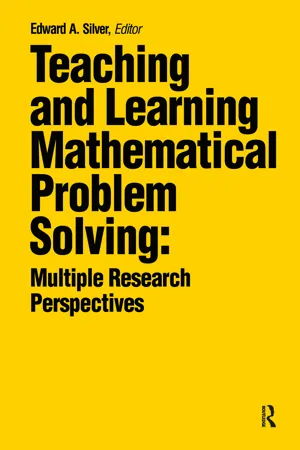
A provocative collection of papers containing comprehensive reviews of previous research, teaching techniques, and pointers for direction of future study. Provides both a comprehensive assessment of the latest research on mathematical problem solving, with special emphasis on its teaching, and an attempt to increase communication across the active disciplines in this area.
eBook - ePub
Teaching and Learning Mathematical Problem Solving
Multiple Research Perspectives
- 484 pages
- English
- ePUB (mobile friendly)
- Available on iOS & Android
eBook - ePub
About this book
Information
PART C.
PROBLEM-SOLVING RESEARCH: THEMES AND DIRECTIONS
PROBLEM-SOLVING RESEARCH: THEMES AND DIRECTIONS
Research on Teaching Mathematical Problem Solving: Some Underrepresented Themes and Needed Directions
Edward A. Silver
San Diego State University
During the past few years, I have been struck by certain issues or themes that seemed very important for those of us interested in the teaching of mathematical problem solving but which were not seriously addressed in the literature. Closely connected to these fundamental issues is my assessment of some important directions in which research on problem solving should move in order to make substantial progress in the next decade. In some cases, these directions represent an attempt to connect research on mathematical problem solving with other active and potentially related fields of research. In other cases, these directions simply represent questions or issues which are fundamental and for which the time seems ripe for investigation. These observations led me not only to write this paper but also to ask a number of scholars in the field of mathematics education to write papers that are related to the directions in which I am suggesting we move. Thus, this paper serves not only as my personal view of some currently important issues to be addressed in research on mathematical problem solving but also as an introduction to the other papers in this section of the book.
LOOKING BACK: UNDERREPRESENTED THEMES
This section of the paper discusses some central themes which have received far less attention in the research literature than they deserve. In particular, the following three themes are discussed: (1) the role of the teacher in problem-solving instruction, (2) sensitivity to individual differences, and (3) acquisition of problem-solving expertise.
The Role of the Teacher in Problem-Solving Instruction
As I surveyed the problem-solving research literature to examine the role of the teacher in problem-solving instruction, I was struck by four general characteristics of the research reports that prevented me from making substantial progress in understanding the role of the teacher. The first of these was the lack of good description of what actually happened in the classroom when problem solving was taught. I read a number of studies which gave detailed statistical analyses of the significance of miniscule differences between experimental and control classes. In these studies, the authors tended to be philosophical about the implications of their research for the future of mathematics education, giving only brief and insufficient descriptions of what really transpired in the classroom when the instruction was being given to the experimental classes, and what transpired during the same period in the control classes. One of the early ideas in my project for NSF was to identify the characteristics that distinguished successful problem-solving instructional strategies from less successful ones. It soon became clear that the research reports rarely contained enough information on which to base a reasonable assessment of instructional characteristics. One exception to this general complaint was the large body of research studies in which the delivery system for instruction was a set of programmed instructional booklets, but these studies generally suffered from other deficiencies that are discussed below.
The second vexing general characteristic of the instructional studies was the systematic control of the so-called “teacher variable.” Researchers, seemingly obsessed with concerns for statistical independence of observations and control of sources of variability, often used an unnatural instructional delivery system—programmed instructional booklets—that deviated substantially from normal classroom behavior. One benefit of the use of programmed instructional booklets was that they allowed for a clear description of the treatment for the experimental group (since booklets were often included in the report or were available from some other source), but that benefit was offset by the lack of a realistic classroom situation in which to test the instructional methodology. Other techniques were also used to “control” the “teacher variable,” such as randomly assigning teachers to treatments or having teachers teach two classes, each with a different treatment. These approaches ignored completely the fact that teachers might prefer or might be more experienced using one or the other of the methods being compared.
A third disturbing characteristic of the instructional studies was the almost uniform failure to assess the direct effectiveness of the instruction. It was true that the studies included measures of problem-solving performance, usually using a test consisting of story problems, or sometimes even non-routine problems, but they rarely included tests of the direct effectiveness of the instruction. For example, a study that examined the relative effectiveness of two different methods of teaching children to solve arithmetic story problems would usually measure the effectiveness of the instruction solely on the basis of the number of problems solved correctly on a posttest by children in the experimental and control groups. Rarely did a study investigate whether or not the instruction resulted in students who exhibited the behaviors being modeled in the instruction. Surely, it is logically impossible to argue that an instructional treatment has or has not been effective solely on the basis of a problem-solving test, without specific attention to the behaviors that the instruction intended to elicit. Studies of heuristic processes have been as guilty of this flaw as any set of instructional studies. It was not at all uncommon for an author to have reached the conclusion that heuristic process instruction was or was not effective solely on the basis of counting correct answers to problems on a posttest, without regard for the students’ usage of the heuristic processes being modeled in the instruction.
The fourth and final serious flaw of these instructional studies was the lack of a sound theoretical base. Many of the studies seemed to have been based on pedagogical folklore or intuition. Naturally, the studies of heuristic processes were largely based on the work of Polya (1957, 1962). It is striking that, until the past few years, there was virtually no critical evaluation of Polya’s ideas as a possible theory of problem-solving instruction. Under reasonably close scrutiny, it is clear that Polya’s writings suggest useful heuristic principles for teaching problem solving in much the same way that they suggest such principles for doing problem solving, but Polya does not present a theory of instruction. Given the atheoretical nature of the research on problem-solving instruction, it is not surprising that no systematic knowledge base accrued and that it became so difficult to generalize from the results of a study or even a set of related studies.
As the above description of the state of the research literature on teaching mathematical problem solving indicates, it does little to illuminate exemplary teaching practices. Thus, teachers are faced with a popular pedagogical literature replete with suggestions for the teaching of problem solving (e.g., Socratic dialogue, idiosyncratic methods to teach solution of story problems) and virtually no research base on which to support or refute the suggestions. Moreover, we can point to very few instructional studies that have any direct relevance to the classroom mathematics teacher. In fact, one of the major conclusions that I drew from my review of this literature was that the implications for instruction that could be gleaned from problem-solving research were not drawn from the instructional studies but rather the non-instructional studies of problem solving. However, it is also clear that these recommendations are weakened because they have not been validated in instructional research.
Thus, it is important that a new wave of instructional studies be undertaken that seriously addresses important classroom-based issues in the teaching of mathematical problem solving and which is based on the substantial body of knowledge that has been accumulated in the non-instructional studies of the past two decades. Furthermore, it is important that this next wave of instructional research relate to the substantial bodies of research that have developed using the teacher decision making, teacher belief, or classroom process-product paradigms. Thus far, these bodies of research have remained largely unconnected to problem-solving research. In order to make substantial progress in the near future, it seems prudent to utilize the available theoretical paradigms and build from the extant research results.
Sensitivity to Individual Differences
In Robert Sternberg’s (1983) recent article, “Criteria for Intellectual Skills Training,” he argues that any program that aims at improving students’ general thinking and reasoning skills should be sensitive to individual differences. Although Sternberg was referring primarily to programs that seek to improve the performance of underachievers and low ability students, his criterion seems equally valid for any program seeking to improve higher level thinking skills in mathematics for all ability levels. As we look back at the research that has investigated the teaching of mathematical problem solving, we find very little evidence of this sort of concern for individual differences. Where are the programs that help students become aware of their cognitive strengths and weaknesses and that teach students to capitalize on their strengths and compensate for their weaknesses?
Nick Branca and I (in connection with his National Science Foundation project), interviewed a large number of fifth- and sixth-grade students and asked them to solve a wide range of mathematical problems. One striking observation that I made about their performance was that many students exhibited what I called “raw” heuristic tendencies. These “raw” heuristics were exhibited in a student’s tendency, prior to any overt instruction, to draw a diagram, to examine special cases, to generalize from test cases, and so on. It was clear that individual students showed differences in their tendency to use certain heuristic processes “au natural” (i.e., without specific instruction) and that some students had no evident “raw” heuristic tendencies. It was also clear for students who did exhibit such tendencies that their usage of these heuristic processes was primitive and in need of improvement before they were likely to be consistently useful. This observation leads me to speculate about the feasibility of studying the influence of instruction on these “raw” heuristic tendencies. Should we devise individually tailored courses that teach students to capitalize on and further develop their “raw” heuristic tendencies? Might these “raw” heuristics be a determining factor in the success or lack of success of instructional research that has aimed at the teaching of heuristic processes? How should these “raw” heuristics be measured and accommodated in subsequent research that aims at studying the teaching and learning of heuristic processes?
As noted above, problem-solving research would benefit from concern for issues of individual differences. There are a few exceptions to the general tendency to ignore individual differences. When individual differences have been considered, two approaches have dominated: the “cognitive correlates” approach, in which a general ability or cognitive style is examined with respect to its correlation with performance on some measure of problem-solving ability; and the “expert-novice” approach, in which the performance of a highly capable and experienced problem solver in a task domain is contrasted with that of a far less capable problem solver. Each approach has made some contributions to understanding some aspects of individual differences, but each also has serious limitations.
The “cognitive correlates” approach is chiefly associated with the ATI (aptitude-treatment-interaction) research paradigm. An unkind critic of the ATI approach to cognitive research might point out that the amount of time needed to read the typical ATI research report is usually longer than the time needed to conduct the treatment in the study. Thus, many are skeptical about the value of this approach in the study of problem-solving instruction. We usually expect problem-solving treatments to be lengthy, and we often feel that more longitudinal measures and approaches would be appropriate. Up to now, ATI research has not produced many generally useful results for mathematical problem-solving instruction, although the evidence that some individual difference characteristics that had been treated as stable characteristics of individuals may be modifiable might lead to some interesting studies related to problem solving. Moreover, the current approach to studying individual differences within an information-processing model of task performance on measures of aptitudes has considerable promise for providing teachers and researchers with useful information to guide problem-solving instruction. This is discussed in more detail in the second part of this paper.
Another type of problem-solving research that has used the “cognitive correlates” approach has examined the relationship of attitudes and interests on problem-solving performance. These studies have not been instructional in nature but have examined either the correlation between one’s attitude toward mathematics and one’s problem-solving performance or the relative problem-solving performance of students in solving problems that have contexts that do or do not match their interests. In general, these studies have not found a consistent pattern of positive relationship that one might expect. We shall discuss further the link between cognition and affect in a later part of this paper.
The other general approach to the study of individual differences in problem solving—the “expert-novice” paradigm—has become very popular in recent years, and it has led to some important observations about the nature of problem-solving expertise. For example, a consistent observation across a wide range of “expert-novice” studies in different domains, such as physics, chemistry, and mathematics, is that, when faced with a reasonably complex problem, expert problem solvers tend to perform a qualitative analysis of the problem’s conditions and relationships among the problem’s elements before attempting a quantitative solution. This observation, and others like it that can be gleaned from these studies contrasting the problem-solving behavior of exper...
Table of contents
- Cover
- Halftitle
- Title
- Copyright
- Acknowledgments
- Contributors
- Introduction
- Contents
- Part A. Problem-Solving Research: Mathematics Education Perspectives
- Part B. Problem-Solving Research: Cross-Discipline Perspectives
- Part C. Problem-Solving Research: Themes and Directions
- Summary
- Index
Trusted by 375,005 students
Access to over 1.5 million titles for a fair monthly price.
Study more efficiently using our study tools.
Frequently asked questions
Yes, you can cancel anytime from the Subscription tab in your account settings on the Perlego website. Your subscription will stay active until the end of your current billing period. Learn how to cancel your subscription
No, books cannot be downloaded as external files, such as PDFs, for use outside of Perlego. However, you can download books within the Perlego app for offline reading on mobile or tablet. Learn how to download books offline
Perlego offers two plans: Essential and Complete
- Essential is ideal for learners and professionals who enjoy exploring a wide range of subjects. Access the Essential Library with 800,000+ trusted titles and best-sellers across business, personal growth, and the humanities. Includes unlimited reading time and Standard Read Aloud voice.
- Complete: Perfect for advanced learners and researchers needing full, unrestricted access. Unlock 1.5M+ books across hundreds of subjects, including academic and specialized titles. The Complete Plan also includes advanced features like Premium Read Aloud and Research Assistant.
We are an online textbook subscription service, where you can get access to an entire online library for less than the price of a single book per month. With over 1.5 million books across 990+ topics, we’ve got you covered! Learn about our mission
Look out for the read-aloud symbol on your next book to see if you can listen to it. The read-aloud tool reads text aloud for you, highlighting the text as it is being read. You can pause it, speed it up and slow it down. Learn more about Read Aloud
Yes! You can use the Perlego app on both iOS and Android devices to read anytime, anywhere — even offline. Perfect for commutes or when you’re on the go.
Please note we cannot support devices running on iOS 13 and Android 7 or earlier. Learn more about using the app
Please note we cannot support devices running on iOS 13 and Android 7 or earlier. Learn more about using the app
Yes, you can access Teaching and Learning Mathematical Problem Solving by Edward A. Silver in PDF and/or ePUB format, as well as other popular books in Education & Education General. We have over 1.5 million books available in our catalogue for you to explore.