eBook - ePub
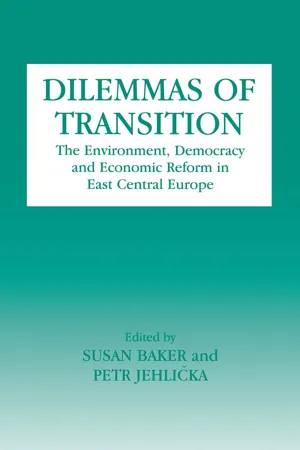
Dilemmas of Transition
The Environment, Democracy and Economic Reform in East Central Europe
- 224 pages
- English
- ePUB (mobile friendly)
- Available on iOS & Android
eBook - ePub
Dilemmas of Transition
The Environment, Democracy and Economic Reform in East Central Europe
About this book
This volume explores the impact of democratization and marketization on the environment in East Central Europe. The essays investigate: how the twin processes of change affect the physical environment; the expression of environmental interest; and environmental management policies.
Information
Environmental Policy and the Transition Process in Central and Eastern Europe
Geopolitics and the Environment in Eastern Europe
MICHAEL WALLER
The causes of the severe pollution that has affected parts of Eastern Europe lie in the production methods and the political authoritarianism of the Communist period, but the relationship between most of the region and Western Europe in developmental terms has to be taken into account. On either count the geopolitics of Eastern Europe was an important historical factor before 1989, and it has remained one since then, but with influences from the East being replaced by influences from the West. The change of economic and political system brought expertise and techniques capable of making production more sensitive to the protection of the environment, at the same time making the region safe for the inward foreign investment that it needed. But aid, expertise and advice brought an element of tutelage which has influenced the evolution of the environmental movement in the region, substituting itself for grass-roots activism and weakening environmental groups in relation to their governments.
The crisis of awareness that resources are finite and that humankind is destroying the world that it inhabits spread from the United States in the 1960s into a Europe whose diverse economies were at very different stages of industrial and technological development. Exaggerating these differences and imposing a particular pattern on them was the political division of Europe consequent on the onset of the cold war. This had a profound effect on the economies of individual countries, particularly those lying within the Soviet sphere of influence, in some cases - the German Democratic Republic (GDR) and Czechoslovakia - impeding the technological development of an industrialised economy, in others promoting industrialisation at a rhythm that transformed the urban/rural balance and created acute generational differences. Part of the heritage of the Communist years was a severe degradation of the environment in the region.
In what follows a brief account will be given of the factors that led to that degradation, and of the linking of concern for the environment to the broader movement of dissent against Communist rule in Eastern Europe. This will be followed by an examination of the important change that took place in the politics of the environment in the region when the Communist regimes fell. Finally, the impact of international factors on the process of marketisation and democratisation as concerns the environment will be analysed.
Whilst the environmental damage done to Eastern Europe can be attributed in large part to the region's Communist past, it is of the first importance in any analysis of Eastern European politics to take into account the deeper history of the region and of its individual countries in relation to the overall pattern of industrialisation in Europe. The authoritarian uniformity of Communist rule was viewed in Western Europe largely in current strategic terms. It defined the enemy. This distracted attention from the fact that the enemy was, taken as a whole and with significant exceptions, poorer and developing, in contrast to a Western Europe which, taken again as a whole, was developed and richer. It ignored also the quite marked differences in economic development within the region, and differences in the extent to which a given nation identified with the Soviet Union and its developmental problems. There was a great deal to distinguish Czechoslovakia, an industrial leader already in the inter-war years, Western Christian in its cultural and Habsburg in its political traditions, from agrarian and Orthodox Bulgaria with its folk memories of Russian aid in liberating the nation from the Turk in 1878. Czechoslovakia's advanced stage of economic development contrasted also with the position in neighbouring Poland, where the pall of smoke that hung over Cracow was the result of the post-war construction of the vast Nowa Huta steelworks, the workforce of which had to a great extent been recently recruited from the Polish countryside [Lane and Kolankiewicz, 1973].
To recount the current environmental problems of Eastern Europe solely with reference to the Communist past can therefore be misleading, since the diversity in the region that has been increasingly evident since 1989 derives from historical factors with a strong developmental content. It is true that without the intervention of Communism, there was nothing to prevent Prague from solving its problems of air pollution at about the same time as Manchester did. But the circumstances of Prague in Czechoslovakia were exceptional. Other countries of the region were still developing industrially during the Communist period, and the Communist leaderships were assigning what, in the circumstances, appeared to be appropriate priorities. The industrial development of the region could have been environmentally cleaner, and with Western investment and without Soviet intervention it no doubt would have been. But Western investment was working no great marvels in Bulgaria or Romania before Communism came along, and the economic impact of Soviet intervention varied considerably across the region.
Admittedly, it is difficult in the circumstances to tell whether the local leaderships were in fact following policies autonomously chosen, because of the extent of Soviet influence. In a later section we shall see how this situation has now been reversed: the choices open to the new governments are restricted by influences coming from the West. The point is to register the historical predicament of dependence of the region - and also the variety of its incidence and of the opportunities for escaping it. It is too simple to say - as is broadly true - that the populations of the region are more content with their present circumstances than they were with the old, and far too simple to assume that liberation from Soviet domination means complete autonomy. Nowhere is this more clear than in the environmental realm, where external influences, however benevolent, have had a significant impact on the policy options of the new governments, and on the development of autonomous participatory structures.
One effect of the removal of Communist uniformity and of the cold war is that the connotation of the term 'Eastern Europe' is now unclear, and its future value clearly in doubt. It will be retained in what follows to connote all non-Soviet countries that were members of the Soviet bloc during the Communist period - that is, Poland, the GDR, Czechoslovakia, Hungary, Bulgaria and Romania.
Influence from the East: The Communist Years
The environmental problems that the new regimes of Eastern Europe inherited from the Communist past have now been thoroughly documented in the literature [Carter and Turnock, 1993; French, 1990; IIEC, 1991; Kabala, 1991; Kramer, 1983; Russell, 1990; World Resources Institute, 1992; ZumBrunnen, 1990]. They affected the quality of all three of the air, the land and the water. Most striking in its impact was airborne pollution, affecting in particular the 'black triangle' formed by the south-east of the GDR, northern Bohemia and Polish Silesia. Not only the burning of lignite, which is high in sulphur content, but its mining through opencast methods, were environmentally extremely damaging and were given pride of place in external comment on the region's environmental problems. Prodigal use of pesticides in agriculture affected both land and water in the countryside throughout the region. Equally widely distributed was a deficiency in sewage treatment, the case of Warsaw, which discharged sewage directly into the Vistula (and still does), being a particularly striking and often quoted example.
There were a number of celebrated black spots, perhaps foremost among them being Copsa Mica in Romania, where the Carbosin plant spread a fine black dust produced in the processing of rubber over the whole town, and where the neighbouring Sometra plant emitted no fewer than 21 toxic substances, including zinc, cadmium and lead. Such cases acquired a particular prominence in the early 1980s as the peace movement of those years linked Western activists with Eastern dissidents. Often presented without any basis for comparison with pollution outside the region, and with a cavalier disregard for differentiation within the region, the accounts given by the publicists of those years were unfortunately largely accurate. They were corroborated by authenticated reports from occasional experts within the region who made a significant contribution to elevating the environmental issue to pride of place, though always behind that of human rights, in the symbolism of the dissidents' struggle with the ruling parties. This occurred as Gorbachev's policies of perestroika and glasnost in the Soviet Union began to undermine the power of those parties.
The literature has also dealt with those aspects of communist rule that were most to blame for the environmental damage [Manser, 1993; Waller and Millard, 1992]. First, political priorities working through the system of central command planning in the economy imposed an emphasis on quantitative indicators of production that took no account of environmental - or indeed any other - costs. The energy consumed per unit of production was universally very high in the region, and although legislation was passed to protect against the greatest damage to the environment, the laws were not adequately enforced, and managers knew that a failure to produce would count more heavily against them than an act of pollution. Secondly, whilst expert opinion circulated relatively freely except in certain value-laden spheres, the party exercised a control over the means of communication that ruled out the formation of public opinion, and a more general control that made it impossible to organise for political ends.
In such circumstances, public protest over environmental problems could only be muted. As noted, some experts working in the environmental field were prepared to present evidence in ways that did involve some risk to themselves. Interestingly, they were joined, in the case of some countries, by members of organisations that were actually sponsored by the ruling parties, including the very official peace committees and the parties' youth organisations. But most important of all was the adoption of the environmental issue by the major dissenting groups in the northern tier of countries - Poland, Czechoslovakia, the GDR (where the Evangelical churches functioned as the spearhead of a significant pacifist and environmental movement) and Hungary. Bulgaria was not affected until 1988, and Romania not at all [Waller, 1989].
Of particular interest, in view of the way in which things turned out, was the movement of protest in Hungary directed against the projected double damming of the Danube at Gabčikovo in Slovakia and at Nagymáros in Hungary itself. The activities of the Danube Circle, formed to contest the project, involved petitions and protest marches which mobilised thousands of supporters in the face of police harassment. There were strong nationalist overtones in that protest, concerning the awkward relations that have obtained between Hungary and the Slovaks in history and concerning also the particular attachment that Hungarians have towards the stretch of the Danube Bend where the Nagymaros dam was to be built [Manser, 1993: 140-42; Waller, 1992]. These historical points of reference had, of course, a contemporary relevance as dissent against the ruling party, and through it against Soviet domination, built up during the 1980s. Not only in Hungary, but in Poland and Czechoslovakia too, protest over environmental issues was linked to an overriding concern for human rights, which in the circumstances meant a concern for liberation. The fall of the Berlin Wall was not, in itself, a victory for any environmental movement. But it was the culmination of a rise in support in those four countries for a more general movement of liberation in which the issues of peace and protection of the environment featured prominently.
Thus even a brief examination or the early responses to environmental problems is sufficient to indicate their dependence on the circumstances of the time and, by the same token, the uncertainty of their future. The future was to prove as problematic as the past had been glorious, and the greening of Eastern Europe was not destined to outlive the system that it had done so much to discredit.
It remains to point out that, despite these features of Communist rule which led to a failure to check, and even a tendency to augment, a degradation of the environment, the Communist regimes were not blind to the need to provide technological, and indeed political, solutions to an industrial problem. For the first, they conformed to the almost universal policy of seeking to eliminate smoke by splitting atoms. Except in the cases of Poland and Romania, the latter of which used Canadian Candu reactors in its nuclear facility at Cernavodă, all the countries of the region used, or were planning to use, reactors made in the Soviet Union. The first generation of these were 400 megawatt reactors of the Voronezh WR model, but a second generation of 1,000 megawatt reactors was being installed at the moment of the change of regime. It might be noted in passing that the disaster at Chernobyl caused no check in this programme: the countries of the Council for Mutual Economic Assistance confirmed at the beginning of 1987 its plans in this domain that were made before the accident occurred.
As for political measures, the Communist regimes compensated for their refusal to tolerate autonomous organisation for political ends by providing their own, controlled, forms of organisation. It cost them nothing to create societies for the protection of nature, and this they did throughout the region. But the activities of these societies could never be allowed to interfere with governmental priorities and, whilst it would be quite misleading to suggest that they did not contribute to an awareness of at least a part of the range of environmental problems, their main political function was to serve as a shield behind which the ruling party could hide.
On the Cusp: The Change of Regine
All the Communist regimes of Eastern Europe fell in the one year of 1989. Everywhere a political monopoly in the hands of the ruling party gave way to competitive politics, and a start was made, rather fitfully, in replacing the system of central command planning by the market. The Western economic advisers who thereupon offered the benefit of their skills to the new governments of the region were not wrong in assuming that the task on which they embarked with such enthusiasm was a common one. The political steps that the new regimes took to transform monopoly into choice and voice were, likewise, common to all the regimes, and included notably laws establishing freedom of the press and of association, and an electoral law. Figure 1 presents a diagram of a generally-shared periodisation of the change of regimes reduced, for heuristic purposes, to a skeletal form.

FIGURE 1 GENERALLY SHARED PERIODISATION OF THE CHANGE OF REGIME
The foregoing has concerned the period from the Helsinki Accords up to the fall of the Communist regimes, given here as a convenient marker in the process of change which draws its chief relevance from the use that dissenters in the region made of the Accords. Now, however, it is the period immediately following the fall of the regimes that concerns us (X-c). It was a period packed with events as the social, political and economic system of each of these countries underwent profound change. It was marked by the universal prevalence of a sense of liberation, and a crude polarisation between Communism on the one hand and the aggregated forces for change on the other formed the basis for all aspects of the political competition that the new order ushered in. As concerns the politics of the environment, a number of developments merit attention.
First, the prospect of electoral success, which the prominence of the environmental issue in the movements of dissent prior to 1989 seemed to hold out to the green parties that formed to fight the elections, proved illusory. The electorate throughout the region made clear where its priorities lay as the material shock of the economic transition became evident, and the environmental issue slipped surprisingly abruptly down, and almost off, the political agenda. In circumstances where party profiles were necessarily indistinct, the green parties were at times even suspected of harbouring recycled Communists [Jehlička and Kostelecký, 1992: 75]. Only in Bulgaria did an environmental movement enter a parliament in any strength, and even there Ekoglasnost and the Green Party were part of the anti-Communist coalition of the Union for Democratic Forces. They were, moreover, to split, and when Filip Dimitrov assumed the mantle of premier in 1991 as leader of the UDF, it was as a member o...
Table of contents
- Cover
- Half Title
- Title
- Copyright
- Contents
- Dilemmas of Transition: The Environment, Democracy and Economic Reform in East Central Europe – An Introduction
- PART I: ENVIRONMENTAL POLICY AND THE TRANSITION PROCESS IN CENTRAL AND EASTERN EUROPE
- PART II: COUNTRY STUDIES
- Notes on Contributors
- Index
Trusted by 375,005 students
Access to over 1.5 million titles for a fair monthly price.
Study more efficiently using our study tools.
Frequently asked questions
Yes, you can cancel anytime from the Subscription tab in your account settings on the Perlego website. Your subscription will stay active until the end of your current billing period. Learn how to cancel your subscription
No, books cannot be downloaded as external files, such as PDFs, for use outside of Perlego. However, you can download books within the Perlego app for offline reading on mobile or tablet. Learn how to download books offline
Perlego offers two plans: Essential and Complete
- Essential is ideal for learners and professionals who enjoy exploring a wide range of subjects. Access the Essential Library with 800,000+ trusted titles and best-sellers across business, personal growth, and the humanities. Includes unlimited reading time and Standard Read Aloud voice.
- Complete: Perfect for advanced learners and researchers needing full, unrestricted access. Unlock 1.5M+ books across hundreds of subjects, including academic and specialized titles. The Complete Plan also includes advanced features like Premium Read Aloud and Research Assistant.
We are an online textbook subscription service, where you can get access to an entire online library for less than the price of a single book per month. With over 1.5 million books across 990+ topics, we’ve got you covered! Learn about our mission
Look out for the read-aloud symbol on your next book to see if you can listen to it. The read-aloud tool reads text aloud for you, highlighting the text as it is being read. You can pause it, speed it up and slow it down. Learn more about Read Aloud
Yes! You can use the Perlego app on both iOS and Android devices to read anytime, anywhere — even offline. Perfect for commutes or when you’re on the go.
Please note we cannot support devices running on iOS 13 and Android 7 or earlier. Learn more about using the app
Please note we cannot support devices running on iOS 13 and Android 7 or earlier. Learn more about using the app
Yes, you can access Dilemmas of Transition by Susan Baker,Petr Jehlicka in PDF and/or ePUB format, as well as other popular books in Politics & International Relations & Politics. We have over 1.5 million books available in our catalogue for you to explore.