- 302 pages
- English
- ePUB (mobile friendly)
- Available on iOS & Android
eBook - ePub
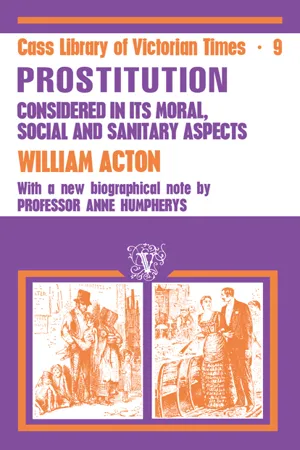
Acton: Prostitution Considered
About this book
Published in the year 1972, Action: Prostitution Considered is a valuable contribution to the field of History.
Trusted by 375,005 students
Access to over 1.5 million titles for a fair monthly price.
Study more efficiently using our study tools.
Information
Subtopic
Social HistoryIndex
Social SciencesChapter I.
Prostitution Defined.
ETYMOLOGY would, of course, at once suggest a “ standing forth, or plying for hire in open market,” as a definition of the word prostitution. Charitable and refined persons instinctively recoil from its general use, under the very natural impression that the essence of “ prostitution” is not so much the receipt of consideration as community ; but, on the other hand, many forcible divines and moralists have maintained that all illicit intercourse is prostitution, and that this word is as justly applicable as those of “ fornication” and “ whoredom”1 to the female who, whether for hire or not, voluntarily surrenders her virtue. According to them, her first offence is as much an act of prostitution as its repetition.
For the purpose of the politico-statistical researches which the French administrators have, since the time of the first Republic, made into prostitution, as well as everything else, they arrange disorderly women under two heads, femmes débauchées and prostituées. The former, instead of being, as would at first sight appear, a generic term, seems to distinguish the numerous group known as femmes galantes and filles clandestines, and corresponds with the “ kept mistresses” and more reserved class of prostitutes in this country. Over it, while a certain degree of self-respect is preserved, the police neither assert nor can maintain control. Its members enjoy to the full extent their civic rights, and a maxim of law is acknowledged in their favour, which their sisters of this country are obliged to maintain for themselves,—often to the disgust, and occasionally to the amusement, of the public. “Mulieris, quæ non palam sed passim et paucis sui copiam facit, actio competit ad versus eum qui earn meritricem vocavit.”
Into the second class, which answers to our common street-walkers, the French authorities do their best to drive such of the first as they consider to have forfeited their independent position. It is held that the legally established and repeated exercise of fornication as a calling, combined with public notoriety thereof, arrest in flagrante, proved by witnesses other than the informer or the police agent, constitute the “ prostitute.” The prostitute has been more particularly described by a French author as the woman who abjures society, repudiates its laws, and forfeits all claims upon it, by adopting those “ habitudes scandaleuses hardiment et constamment publiques,” through which she passes into “ cet état de brutalité scandaleuse dont l’autorité doit réprimer les excès.”2
According to the Board of Public Morals at Berlin, all voluntary- sexual abandonment for a consideration is held to be prostitution. The necessity of defining not only “ a prostitute” but “ a common prostitute” may be seen from a perusal of the evidence on which is formed the report of the Select Committee on the Contagious Diseases Act, printed by order of the House of Commons, and lately published (July, 1869):—
158. To the question by the Chairman, The Hon. T. C. Vivian,] What other new clause would you propose ?—Mr. Sloggett, Visiting Surgeon to the Devonport Lock Hospital, replies: I think that a new clause should be introduced defining more exactly the term “ common prostitute.”
159. What clause is there in this Bill which defines the term “ common prostitute ” ?—There is no such clause.
160. How would you propose to define a common prostitute?—I would first define them as women who habitually gain their livelihoods, partly or wholly, by the proceeds of prostitution.
161. Sir John Pakington.] Is there in the law of England no definition of a prostitute ?—I think not.
374. Again, Dr. Brewer asks,] What is your definition of a prostitute ? To which Mr. Parsons, Visiting Surgeon to the Portsmouth Lock Hospital, replies : Any woman whom there is fair and reasonable ground to believe is, first of all, going to places which are the resorts of prostitutes alone and at times when immoral persons only are usually out. It is more a question as to mannerism than anything else.
375. Must she be making her livelihood by it ?—Yes, she ought to be ; but, if you confine yourself to that definition, all I can tell you is, that your Act will never succeed. The amount of clandestine prostitution is very large. I think the definition here, of “common prostitute,” is very objectionable, inasmuch as I have heard it stated, by those who wish to object to the Act, that you have no right to bring under the provisions of the Act what may be called the better class of prostitutes, who, they say, are not common prostitutes.
Mr. John Simon, the Medical Officer of Health to the Privy Council, said, in reply to a question (1301) put to him :—“I do not see any practical definition of prostitution which could include women wishing to practise clandestinely. How are you to prove clandestine prostitution? Would those who propose such things take a woman on the mere ground of her having had sexual relations with more than one man, and put two and two together, and produce their evidence in a police court? It seems to me to be a thing which could not be done. The only kind of prostitution which can be dealt with, I suppose, is prostitution carried on by women who make it their calling, and live in gangs in brothels, or who publicly solicit men.”
Leaving those on whom the duty of passing Acts of Parliament devolves to discover the definition necessary for their purpose, I shall here content myself with a definition sufficiently accurate to point out the class of persons who ought, in my opinion, to become the objects of legislation, and shall assume, for the purpose of my present inquiry, that the fact of “hiring,” whether openly or secretly, whether by an individual or a plurality in succession, constitutes prostitution.
1 Whore, is past tense of verb to hire, means one hired.—HORN TOOKE.
Dutch, Hoer ; Swedish, Hoera ; German, Hure ; Anglo-Saxon, Hure; Danish, Hore. Derived from Hyran, conducere, to hire. “ W” has been idly prefixed, it is said.
2 Parent-Duchâtelet, troisième édition, tom. i. p. 25.
Chapter II.
Prostitution in England.
- EXTENT OF IN LONDON, ALDERSHOTT, &C.
- LIFE AND CAREER OF PROSTITUTES.
TO obviate the possibility of misapprehension, I remind the reader that I regard prostitution as an inevitable attendant upon civilized, and especially closely-packed, population. When all is said and done, it is, and I believe ever will be, ineradicable. Whether its ravages, like those of disease and crime, may not be modified by unceasing watchfulness—whether it may not be the duty of the executive, as a French writer suggests, to treat it as they do such ordinary nuisances as drains, sewers, and so forth, by diminishing its inconvenience to the senses, and, in fact, rendering, its presence as little noticeable as possible, it will be my business to inquire in a future chapter. In the present I shall offer as complete a survey of that portion of it which stalks abroad, tête levée, in this metropolis, and other parts of the kingdom, as the facts at any English writer’s disposal admit of.
The number of prostitutes in London has been variously estimated, according to the opportunities, credulity, or religious fervour of observers, and the width of interpretation they have put upon the word. To attempt to reconcile or construct tables upon the estimates I have met with would be a hopeless task. I can merely give a few of the more moderate that have been handed down by my predecessors. Mr. Colquhoun, a magistrate at the Thames Police Court, rated them at 50,000 some sixty years ago. The Bishop of Exeter spoke of them as reaching 80,000 ; Mr. Talbot, secretary of a society for the protection of young females, made the same estimate. The returns on the constabulary force presented to Parliament in 1839, furnished an estimate of 6,371—viz., 3,732 “ known to the police as kept by the proprietors of brothels,” and 2,639 as resident in lodgings of their own, and dependent on prostitution alone for a livelihood. It was estimated by the Home authorities in 1841, that the corresponding total was 9,409—which, I need hardly point out, does not include the vast numbers who regularly or occasionally abandon themselves, but in a less open manner.
I am indebted to the courtesy of Sir Richard Mayne, the late Chief Commissioner of Metropolitan Police, for the subjoined return, as well as for those of 1837 (made up in 1841) :—
A Return of the number of Brothels* and Prostitutes within the Metropolitan Police District, as nearly as could be ascertained at that date (May 20th, 1857).

A. Whitehall, the Parks, Palaces, Government Offices.
B. Westminster, Brompton, Pimlico, part of Chelsea.
C. St. James’s, Regent-street, Soho, Leicester-square.
D. Marylebone, Paddington, St. John’s Wood.
E. Between Oxford-street, Portland-place, New-road, and Gray’s-inn-lane.
F. Covent Garden, Drary-lane, St. Giles’s.
G. Clerkenwell, Pentonville, City-road, Shoreditch.
H. Spitalfields, Houndsditch, Whitechapel, Ratcliff.
K. Bethnal-green, Mile-end, and from Shad well to Blackwall.
L. Lambeth and Blackfriars, including Waterloo-road, &c.
M. Southwark, Bermondsey, Rotherhithe.
N. Islington, Hackney, Homerton, &c.
P. Camberwell, Walworth, part of Peckham.
R. Deptford, Greenwich, and neighbourhood.
S. Kilbum, Portland, Kentish and Camden Towns to Cattle Market.
T. Kensington, Hammersmith, North End, Fulham.
V. Walham-green, Fulham, Chelsea, Cremorne.
* The word brothel, or rather the French word bordel, is said to come from bord et eau, because houses of ill-fame were at first established on the borders of rivers or close to baths. This is corroborated by old records of London, which prove that such houses, called stews, were excluded from the city of London, but were allowed over the water in Southwark. Jeannel thus describes one—“For the brothel it is the sign, and in default of the sign it is notoriety. It is the incoming and outgoing of strange men which constitute public acts giving cause for the intervention of the police.”—JEANNEL, de la Prostitution, p. 214.
The headings of the above tables demand a few explanatory observations. It is, in the first place, desirable that the reader should understand the distinction between the three classes of houses, termed by the police, brothels. The first, or “ houses in which prostitutes are kept,” are those whose proprietors overtly devote their establishments to the lodging, and sometimes to the boarding, of prostitutes, and prostitutes only. At first sight it might appear that, by the phrase employed, were indicated houses in which prostitutes are harboured, fed, and clothed at the cost of speculators, who derive a revenue from the farm of their persons. Such is, however, not the intention of the framers of the document. The houses last mentioned are, doubtless, included in the first column of the above returns, but as will be seen from the last return, (page 6), these have now almost disappeared from the Metropolis.
By “ houses in which prostitutes lodge,” the reader must understand those in which one or two prostitutes occupy private apartments, generally with, though perhaps in rare cases without, the connivance of the proprietor. It often occurs, it must be remembered, that females of no virtue, are so desirous of preserving the appearance of it before those among whom they reside, that they will not introduce their paramours to their apartments ; but both they and their domicile, being generally known to the police, both figure on the return. “ Houses to which prostitutes resort” represent night houses —the brothels devoted to casual entertainment of these women and their companions, and the coffee-shops and supper-shops which they haunt.
The “ well-dressed, living in lodgings” prostitute is supposed to be the female who, though to all intents and purposes common, extending her pursuit of acquaintances over the town at large, or limiting it to the places of public recreation, eschews absolute “ street-walking.”
The “ well-dressed, walking the streets” is the prostitute errant, or absolute street-walker, who plies in the open thoroughfare and there only, restricting herself generally to a definite parade, whereon she may always be found by her friends, and hence becomes, of course, “ perfectly well known to the police.”
The “ low prostitute, infesting low neighbourhoods,” is a phrase which speaks for itself. The police have not attempted to include—in fact, could not have justly included, I might almost say—the unnumbered prostitutes, whose appearance in the streets as such never takes place—who are not seen abroad at unseemly hours—who are reserved in manners, quiet and unobtrusive in their houses or lodgings, and whose general conduct is such that the most vigilant of constables could have no pretence for claiming to be officially aware of their existence or pursuits. The recent (1869) Report on the Contagious Diseases Act enables us for the first time to show the proportions of common prostitutes to soldiers at Aldershott. Thus, Inspector Smith gave in a report proving that there were in June, 1869, 243 recognised prostitutes to about 12,000 troops. This paucity of prostitutes, according to Dr. Barr, causes some of them to have intercourse with 20 or 23 men in one night. Page 41.
I am further indebted to the good offices of Captain Harris, Assistant Commissioner of Police, for the subjoined return made up in 1868 :—
Metropolitan Police.
Abstract Return of the Number of Brothels and Prostitutes in Each Division.

The falling off (amounting almost to extinction of the class) of the number of “ houses where prostitutes are kept,” which is shown by the table of 1868, cannot fail to strike the reader, the number given being two only as against 410 in 1857 and 933 in 1841. It appears that of the eleven prostitutes returned, as inhabiting such houses, one only resides in one of these houses, and ten in the other ; this latter is kept by a French woman. It is satisfactory to find that this class of house is, if we may trust the police, rapidly disappearing from London. It is not too much to say that the Brothel where prostitutes are kept is an institution alien to English feelings, and that even if the Government should sanction the maintenance of such houses, which is far from probable, public opinion may be confidently expected to work their extinction. I may here call attention to a lesson taught us pretty clearly by these returns, which is, that to attempt to put down prostitution by law is to attempt the impossible. Notwithstanding the numerous prosecutions and parish raids which have been directed against prostitutes and their dwellings during the past few years, there were in the year 1868 1756 houses where prostitutes lodge, against 1766 in 1857. What can show more strongly the impossibility of, by the arm of the law, suppressing prostitution ? Eleven years ago I pointed out that if a prostitute is prosecuted for plying her trade in one parish, she will only move into another; the result has proved the truth of my prediction, and recent failures add their testimony to that of world-wide experience, and prove the impolicy of making attempts of this nature, except in cases when the houses proceeded against are shown to be productive of open scandal, or a cause of intolerable annoyance.
I must observe that these returns give but a faint idea of the grand total of prostitution by which we are oppressed, as the police include in them only those women and houses whose nature is well and accurately known to them. There can be little doubt that numbers of women who live by prostitution lead apparently respectable lives in the lodgings or houses which they occupy ; but all such are necessarily excluded from the returns.
Were there any possibility of reckoning all those in London who would come within the definition of prostitutes, I am inclined to think that the estimates of the boldest who have preceded me would be thrown into the shade. A few figures from the census tables may furnish material for more thought on this head than would be due to a wilderness of random conjectures.
In the year 1851, 42,000 children were born alive in England and Wales upon a total of 2,449,669 unmarried women, among whom widows were included for the purposes of calculation, between the ages of fifteen and fifty-five, or 1·7 per cent. Each of these mothers has taken the first step in prostitution ; and, conceding to each the trifling expectation of five years of unreformed life, we shall find that 210,000, or one in twelve, of the unmarried females in the country above the age of puberty have strayed from the path of virtue. This approximation may be objected to as erroneous, inasmuch as one woman may have two, three, or four illegitimate children ; but this is balanced by the undoubted fact that an enormous number of illicit connexions are unfruitful, or result in premature or unregistered births.
The Government commentator upon the Census argues from the above figures, that if as many unmarried women are living irregularly to every child born out of wedlock, as there are wives to every child born in wedlock—viz., 1000 to 212—then 186,920, or 1 in 13, of the unmarried women must be living so as to contribute as much to the births as an equal number of married women.
The registered births in 1851, out of 212,293 unmarried women in London, were 3203. The application of the first of the abo...
Table of contents
- Cover
- Half Title
- Title Page
- Copyright
- Biographical Note
- Preface
- Contents
- Chapter I. Prostitution Defined.
- Chapter II. Prostitution in England.
- Chapter III. Diseases the Result of Prostitution.
- Chapter IV. Existing Provision for the Control of Prostitutes.
- Chapter V. Prostitution Abroad.
- Chapter VI. Causes of Prostitution.
- Chapter VII. Recognition and Regulation of Prostitution as Regards the British Army and Navy
- Chapter VIII. Recognition and Regulation of Prostitution in Civil Life in England.
- Chapter IX. Amelioration of Prostitution.
- Chapter X. Prevention of Prostitution.
Frequently asked questions
Yes, you can cancel anytime from the Subscription tab in your account settings on the Perlego website. Your subscription will stay active until the end of your current billing period. Learn how to cancel your subscription
No, books cannot be downloaded as external files, such as PDFs, for use outside of Perlego. However, you can download books within the Perlego app for offline reading on mobile or tablet. Learn how to download books offline
Perlego offers two plans: Essential and Complete
- Essential is ideal for learners and professionals who enjoy exploring a wide range of subjects. Access the Essential Library with 800,000+ trusted titles and best-sellers across business, personal growth, and the humanities. Includes unlimited reading time and Standard Read Aloud voice.
- Complete: Perfect for advanced learners and researchers needing full, unrestricted access. Unlock 1.5M+ books across hundreds of subjects, including academic and specialized titles. The Complete Plan also includes advanced features like Premium Read Aloud and Research Assistant.
We are an online textbook subscription service, where you can get access to an entire online library for less than the price of a single book per month. With over 1.5 million books across 990+ topics, we’ve got you covered! Learn about our mission
Look out for the read-aloud symbol on your next book to see if you can listen to it. The read-aloud tool reads text aloud for you, highlighting the text as it is being read. You can pause it, speed it up and slow it down. Learn more about Read Aloud
Yes! You can use the Perlego app on both iOS and Android devices to read anytime, anywhere — even offline. Perfect for commutes or when you’re on the go.
Please note we cannot support devices running on iOS 13 and Android 7 or earlier. Learn more about using the app
Please note we cannot support devices running on iOS 13 and Android 7 or earlier. Learn more about using the app
Yes, you can access Acton: Prostitution Considered by William Acton in PDF and/or ePUB format, as well as other popular books in Social Sciences & Social History. We have over 1.5 million books available in our catalogue for you to explore.