- 288 pages
- English
- ePUB (mobile friendly)
- Available on iOS & Android
eBook - ePub
Basic Radio Journalism
About this book
Basic Radio Journalism is a working manual and practical guide to the tools and techniques necessary to succeed in radio journalism. It will be useful both to students starting a broadcasting career as well as experienced journalists wishing to develop and expand their skills.
Based on the popular Local Radio Journalism, this book covers the core skills of news gathering, writing, interviewing, reporting and reading with extensive hints and tips. It outlines working practices in both BBC and commercial radio. There are revamped legal and technical sections as well as a new chapter on the journalist as programme producer. For the student, there is extensive advice about getting a job, marketing yourself and dealing with job interviews.
The Foreword is by Lord Ryder of Wensum, vice chairman of the BBC.
Information
1 The structure of UK radio
OVERVIEW
Almost all radio stations in the UK are owned and operated by either the BBC or commercial companies. The BBC stations are funded publicly through the television licence fee. They provide a wide variety of entertainment and information in both music and speech formats. The commercial stations rely on advertising and sponsorship revenue. Many of these companies are now owned by large groups such as EMAP, GWR and Capital. The commercial stations are, in general, music and entertainment led, but also feature news and information.
There are two main radio transmitting systems in the UK. The most extensive and widely used is the conventional analogue system, which appears on four wavebands, FM and AM (also sometimes called Medium Wave), Long Wave and Short Wave. Analogue radio services are now being joined by digital transmissions, for which listeners need a new radio set.
NATIONAL RADIO
There are five main UK-wide BBC stations and three commercial national services. The BBC stations are: Radio One – a pop music station playing chart, dance, urban and alternative music, much of it new or released in the last few years, and including the Newsbeat programme; Radio Two – playing hit music from the 1960s to today and featuring well-known presenters such as Terry Wogan and Jonathan Ross; Radio Three – playing classical music but also featuring jazz and information about the arts; Radio Four – featuring intelligent speech including news, drama, comedy and current affairs, and the home of acclaimed and highly rated programmes such as Today, The World At One, PM and Any Questions?; and Radio Five Live – another speech network featuring live news and sport. There are also BBC radio stations for Scotland, Wales and Northern Ireland.
The three national commercial stations are: Classic FM – the UK’s first national commercial station, which went on the air in 1992 playing classical music; Virgin – playing rock and pop music; and TalkSPORT – featuring a variety of sport and news phone-ins, as well as sports commentaries. The latter two stations both broadcast on AM, although Virgin also simulcasts on an FM frequency in London.
In addition, the BBC operates the World Service, broadcasting global news and analysis in 43 different languages and funded directly by the government.
LOCAL RADIO
Local radio in the UK started at 12.45 p.m. on 8 November 1967, when the BBC opened Radio Leicester. Before that, there had been regional programmes on national radio but no truly local stations.
The BBC retained its monopoly for six years until the first commercial station, LBC, opened in London in 1973. It was followed a few days later by Capital Radio. Throughout the 1970s and early 1980s, the number of BBC and commercial stations continued to grow throughout the UK.
All local stations were given both an AM and FM frequency, but in the mid-1980s, commercial stations were encouraged to split transmissions, offering different programme services on their two frequencies. Many chose top 40 on FM and gold with more speech and information on AM.
Meanwhile, the BBC grew its local town-based stations into county-wide operations. Thus, Radio Medway became Radio Kent and Radio Brighton became Radio Sussex.
In the late 1980s and early 1990s, both commercial and BBC stations consolidated. Commercial stations, independently owned by local companies, were acquired by the larger groups and some BBC stations combined to cover more than just one English county. When re-licensing, the regulator introduced official Promises of Performance for each station to ensure local content and programming were maintained despite any change in ownership.
In the commercial sector, the battle for audiences became more fierce, with programming and promotional techniques imported from the USA and Australia, where commercial radio was better established. Commercial radio now has about half the total radio audience against all BBC services, national and local. In BBC local radio, more talk and speech has led to stations carving a niche for themselves among a generally older audience.
Despite the greater proliferation of stations, the total number of people listening to radio seems to stay the same. In order to compete with an ever-increasing choice, radio has to become more ‘ear-catching’ than ever. Localness and local news are essential tools for this task.
BBC LOCAL RADIO
BBC local radio is a speech-based network of stations focusing on local news, current affairs, topical information, community debate, social action and local sport linked by personality presenters with a convivial, friendly style. There are 38 BBC local stations across England serving different and contrasting communities. Some, such as GMR in Manchester and WM in the West Midlands, cover large conurbations while others, such as Radio Cornwall and Radio Lincolnshire, are based in predominantly rural areas.
Each station is on the air for an average 18 hours a day, typically from 6 a.m. to midnight. Many stations join together and become regional in the evenings.
The trend in the 1990s to merge stations for cost reasons has now been reversed. For example, both BBC Radio Oxford and BBC Radio Berkshire have been brought back and BBC Southern Counties produces three different breakfast shows for different parts of its area.
On average, BBC local radio’s speech content has increased from about 50 per cent to 75 per cent over the last decade. At breakfast and many afternoon drive times, the stations become all speech. The open line phone-in is an important part of each BBC station’s output. It is considered an open gateway for the audience in an era where interactivity will become commonplace.
More than half of all listeners to BBC local radio are over 55. Research shows that as people get older, their sense of local attachment becomes stronger, their roots deepen and their appetite for local radio increases. Because BBC local radio was established in the late 1960s and 1970s, they attract loyal listeners among the older generation.
COMMERCIAL LOCAL RADIO
Commercial radio survives on advertising revenue. In order to attract advertising, a commercial station has to attract a large audience and cater to the largest potential market. Therefore, most commercial stations play different sorts of music supplemented by local news and information.
There are more than 260 local commercial stations in the UK, together with 16 regional stations. Almost all of them broadcast 24 hours a day. The local stations include: big city stations such as Capital FM in London, Clyde FM in Glasgow and Metro FM in Newcastle; medium-sized stations such as Essex FM in Essex, Invicta FM in Kent, The Pulse in Bradford and Trent FM in Nottingham; and smaller stations in rural areas like Moray Firth in Inverness, Lincs FM in Lincolnshire and Stray FM in Harrogate. Some stations join together in a network in the evenings or automate their output using a computer playout system.
Regional stations cover populations ranging in size from one to five million and include stations such as the four Galaxy stations (owned by Chrysalis), three Century stations (owned by Capital), three Real Radio stations (owned by the Guardian Media Group) and others, such as Wave 105 in Southampton and Saga Radio in Birmingham and Nottingham.
There are also small-scale commercial stations serving just one town or city. Because of their size, some have struggled to break even financially. Others have formed alliances to share costs and expertise. Among the most popular are Spire FM in Salisbury, Sun FM in Sunderland and Rutland Radio.
Commercial stations have a variety of formats. Among the most popular are Contemporary Hit Radio (top 40 chart music), Gold (oldies from the 1960s and 1970s), Adult Contemporary (classic hits from the 1970s, 1980s and 1990s) and Dance (R’n’B and urban music). In London, there is a wider range of stations with more diverse formats including Jazz FM (jazz music), XFM (alternative music), Kiss (dance), Magic (easy listening) and Premier (Christian). London has two all-speech local stations in LBC and LBC News.
The commercial radio industry is regulated by OFCOM, a government-appointed body which awards licences, deals with complaints and ensures all stations adhere to their Promises of Performance of official formats – the detailed specification of content and style which form part of their licence.
DIGITAL RADIO
Digital radio, sometimes called DAB or Digital Audio Broadcasting, uses new technology to make radio sound better. It is a more efficient way to broadcast and this means a greater choice of stations as well as improved – almost CD type – sound quality with no interference. There is also space for the transmission of text and data services such as programme schedules and contextual information about programmes. In the future, digital radios will be able to record onto an internal hard disk within a DAB receiver, making it possible for listeners to turn back to something they have missed, such as a news bulletin or weather forecast.
Listeners will have to invest in new DAB capable radio sets to hear digital radio (Figure 1.1). These are more expensive than traditional radios. However, the price is gradually coming down and many more listeners are expected to make the switch to digital. Broadcast digital radio should not be confused with radios which simply have digital displays!
Digital stations are transmitted via multiplexes for specific areas where several services are grouped together and transmitted simultaneously. All the BBC national services are available in digital and the national commercial multiplex (operated by Digital One) carries the three national commercial stations in addition to new national commercial services. There is also an ever-increasing network of local multiplexes.
As well as the services simulcast on both analogue and digital transmitters, there is also a growing number of radio stations available on digital radio only. For the BBC, these include: 1 Xtra (the home of new black music); Five Live Sports Extra (exclusive sports coverage); BBC 6 Music (rock and pop music); BBC Asian Network (aimed at young British Asians); and BBC 7 (comedy, drama and children’s programmes). For commercial radio, digital-only stations include: Oneword (plays, books, comedy and reviews); Primetime (music and features for older listeners); and Core (club and chart hits).
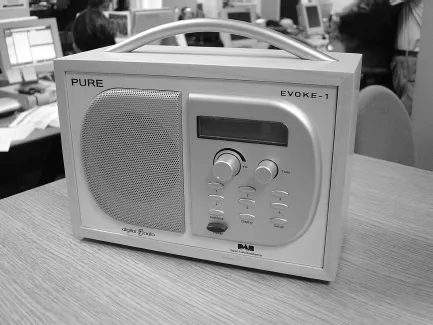
Figure 1.1
A typical DAB digital radio set
CABLE AND SATELLITE
There are other types of radio services which can be picked up, but these are not portable or mobile like conventional radio. Cable and satellite services are available through TV sets and have been around for some time. Listening to the radio via digital TV is becoming increasingly popular. Cable stations include volunteer-run community radio services such as CRMK in Milton Keynes and Radio Verulam in St Albans. There is a wide variety of satellite stations, including ethnic stations such as Club Asia and Panjab Radio; football fan stations such as Big Blue for Chelsea and The Saint for Southampton; stations for gay people such as Purple Radio; and shopping network stations like Homebase FM and Costcutter Radio, which are broadcast in shops and stores.
INTERNET RADIO
Radio over the Internet is growing. There are thousands of radio stations all over the world available to be heard, although sometimes you have to pay to listen. Internet radio is particularly useful for niche interest programming, audio clips on demand and for services not local to where you live. Many UK national, regional and local radio stations ‘stream’ their output over their website and can therefore be heard all over the world.
RESTRICTED SERVICE LICENCES
Restricted Service Licences or RSLs are low-powered temporary radio services authorized for a period of 28 days. RSLs are for a limited geographical coverage area, such as a town or up to two miles of a city. More than 3500 RSLs have been licensed since 1992.
Numerous groups or individuals run services covering a variety of events or themes such as arts festivals, religious celebrations, school projects, carnivals, charity and sporting events. Many RSLs are used for trial services if a group wants to apply for a permanent commercial radio licence and wishes to demonstrate a level of community support. There are also about 100 long-term RSLs covering hospital and college radio stations.
ACCESS RADIO
Access radio is an experiment which aims to introduce a new tier of small-scale radio stations to be used in innovative, creative, and socially and educationally constructive ways. The stations are non-profit making and many are likely to be funded by local authority grants. There are about 15 stations taking part in the experiment, ranging from Cross Rhythms City Radio for Christians in Stoke-on-Trent to Radio Fiza for the South Asian community in Nottingham.
PIRATE RADIO
There are hundreds of pirate radio stations broadcasting illegally in the UK, usually at weekends in the big cities. Although many play specialist music not heard on other stations, they are breaking the law. Their transmissions interfere with the signals of legal stations and in extreme cases affect emergency service radios and the frequencies used by air traffic controllers at airports. Because of their illegality, it is risk...
Table of contents
- Cover Page
- Title Page
- Copyright Page
- Contents
- Foreword
- Preface
- Acknowledgements
- Chapter 1 The structure of UK radio
- Chapter 2 Working in radio
- Chapter 3 News gathering
- Chapter 4 News writing
- Chapter 5 News bulletins
- Chapter 6 News presentation
- Chapter 7 Technicalities
- Chapter 8 Interviewing
- Chapter 9 News reporting
- Chapter 10 Newsdesk management
- Chapter 11 Legalities
- Chapter 12 Newsroom management
- Chapter 13 Small newsrooms
- Chapter 14 Programme production
- Chapter 15 Specialized programming
- Glosssary
- Index
Trusted by 375,005 students
Access to over 1.5 million titles for a fair monthly price.
Study more efficiently using our study tools.
Frequently asked questions
Yes, you can cancel anytime from the Subscription tab in your account settings on the Perlego website. Your subscription will stay active until the end of your current billing period. Learn how to cancel your subscription
No, books cannot be downloaded as external files, such as PDFs, for use outside of Perlego. However, you can download books within the Perlego app for offline reading on mobile or tablet. Learn how to download books offline
Perlego offers two plans: Essential and Complete
- Essential is ideal for learners and professionals who enjoy exploring a wide range of subjects. Access the Essential Library with 800,000+ trusted titles and best-sellers across business, personal growth, and the humanities. Includes unlimited reading time and Standard Read Aloud voice.
- Complete: Perfect for advanced learners and researchers needing full, unrestricted access. Unlock 1.5M+ books across hundreds of subjects, including academic and specialized titles. The Complete Plan also includes advanced features like Premium Read Aloud and Research Assistant.
We are an online textbook subscription service, where you can get access to an entire online library for less than the price of a single book per month. With over 1.5 million books across 990+ topics, we’ve got you covered! Learn about our mission
Look out for the read-aloud symbol on your next book to see if you can listen to it. The read-aloud tool reads text aloud for you, highlighting the text as it is being read. You can pause it, speed it up and slow it down. Learn more about Read Aloud
Yes! You can use the Perlego app on both iOS and Android devices to read anytime, anywhere — even offline. Perfect for commutes or when you’re on the go.
Please note we cannot support devices running on iOS 13 and Android 7 or earlier. Learn more about using the app
Please note we cannot support devices running on iOS 13 and Android 7 or earlier. Learn more about using the app
Yes, you can access Basic Radio Journalism by Paul Chantler,Peter Stewart in PDF and/or ePUB format, as well as other popular books in Languages & Linguistics & Communication Studies. We have over 1.5 million books available in our catalogue for you to explore.