eBook - ePub
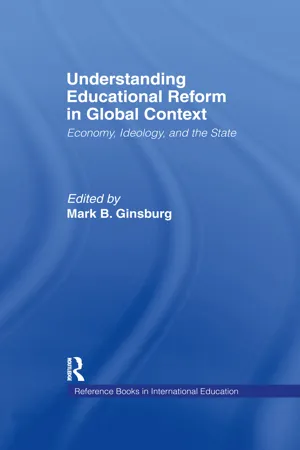
Understanding Educational Reform in Global Context
Economy, Ideology, and the State
- 424 pages
- English
- ePUB (mobile friendly)
- Available on iOS & Android
eBook - ePub
Understanding Educational Reform in Global Context
Economy, Ideology, and the State
About this book
This book focuses on important theoretical and policy debates on educational reform, with detailed analyses of reforms in 11 countries. It also explores the effects of geographical location, political ideology, and economic structure on shaping educational reform. Individual case studies are included on Australia, Cote d'Ivoire, England, Hungary, Israel, Mexico, New Zealand, Nicaragua, Spain, Tanzania, and the United States. The book covers the role of reform in changing education and addressing problems in the educational system, as well as its wider role in deflecting crises in the political and economic system, plus the effect of reform on educators, and educators upon reform. Extensive bibliography and reference lists accompany each chapter, including the introduction and conclusion. Contributors include: N'Dri Thérese Assié-Lumumba, John M. Barrington, Susan F. Cooper, Peter Darvas, Sara Morgenstern de Finkel, Esther E. Gottlieb, Tukumbi Lumumba-Kasongo, Don Martin, Henry D. R. Miller, Rolland Paulston, Rajeshwari Raghu, Susan Rippberger, Susan L. Robertson, Carlos Alberto Torres, George E. Urch, Roger R. Woock, and Hugo Zegarra.
Information
Educational Reform: Social Struggle, the State and the World Economic System1
Since the mid-1970s in every region of the world we have witnessed extensive rhetoric and activity identified as “educational reform” in nations characterized as “developed” and “developing,” as “capitalist” and “socialist,” and as “democratic” and “totalitarian” (Gumbert 1985). This is not to suggest that educational reform is only a recent phenomenon; indeed, such rhetoric and activity have a long, if not always remembered, history (Quick 1868; Simmons 1983; Cuban 1990). Nor is it to posit that what has been labelled as “educational reform” is always concerned with changing, let alone improving, education. Rather, as the quotations marks indicate, the practices, purposes, and consequences of “educational reform” must be treated as problematic, as something to be investigated, a text to be deconstructed (Cherryholmes 1988).
Thus, in this chapter, and in this book more generally, we seek to enhance our understanding of phenomena that have been subsumed under the rubric of “educational reform.” We hope to develop not only a clearer conceptualization of what is meant by “educational reform” but also a more comprehensive explanation of the timing and focus of associated rhetoric and activity.
In this chapter we critically review various theoretical approaches that have been employed to analyze “reform” talk and efforts. We examine both national level and world-system explanations and offer some suggestions for combining the contributions of both. With respect to both levels of explanation, we explore approaches developed within equilibrium and conflict paradigms and devote particular attention to the state and its relation to the economy. While we do not find the two paradigms equally compelling, we recognize the contributions of work done within both. At the same time we seek to avoid an overly deterministic account, one that explains “educational reform” without reference to the individual and collective actions of real people, that is sometimes represented by equilibrium and conflict structuralist perspectives.
Like others (Gumbert 1985; Paulston 1977; Simmons 1983a; Wirt and Harman 1986), we are attempting to develop our understanding of “educational reform” as a phenomenon occurring in economic, cultural, and political contexts. However, besides being oriented to theory building as a type of scholarly work and to comparative analysis as a basis for informing policy, our objective is to identify and clarify a number of issues to facilitate our reflection about and strategies for progressive action in relation to current and future “reform movements.”
Defining Educational Reform
Educational reforms, might be categorized in terms of the purposes for educational systems of the social transactions involved. For example, educational reforms have been described as focused on changes in the following aspects of education systems (Ginsburg, Wallace, and Miller 1988; Merritt and Coombs 1977; Sack 1981; Simmons 1983b):
- a) size or number of students, teachers, administrators, and buildings;
- b) goals and objectives;
- c) policy-making and administrative/managerial system or power structure;
- d) financing and budget making processes;
- e) level of funding;
- f) system organization: the types, statuses, and levels of as well as links and ages of transition between educational institutions;
- g) curriculum: content and organization of what is taught;
- h) pedagogy: social relations of teaching and learning;
- i) selection, evaluation, and promotion criteria and procedures for students; and
- j) selection, evaluation, and promotion criteria for educational workers (teachers, administrators, etc.).
However, not all educational reform activities can be understood as efforts designed with an intent to change some aspect(s) of an educational system. As Campbell (1982, 328) suggests about reform activity in general, educational reform may be seen as a “placebo,” that is, “symbolic gestures designed to indicate governmental [etc.] awareness of problems and sympathetic intentions, rather than serious efforts to achieve social change.” That is, the rhetoric and activity linked to “educational reform” may function to legitimate those with political power rather than to change education. And attention to education, whether serious and sustained or not, may, in fact, operate to deflect concern or conflict from economic, political and cultural problems (Mitchell 1987, 117-35; Cuban 1990).2 Thus, we need to examine both the manifest and latent functions or consequences (Merton 1968) of “educational reform” movements for both education and society.
In defining educational reform in terms of its latent and manifest functions for education, culture, politics, and economy, we do not adopt the assumption imbedded in many equilibrium paradigm structural functionalist analyses that the intended or unintended changes (or lack thereof) are necessarily “for the better” as, for example, Merritt and Coombs (1977, 25) do. Thus, when some writers (Merritt and Coombs 1977; Simmons 1983b; Spaulding 1988) concerned with educational reform characterize the purposes of educational reform as improving the system’s effectiveness, efficiency, and relevance or increasing equality, they are only focusing on certain possible outcomes viewed “positively” from one perspective.
One problem with viewing the consequences (or even the goals) of the rhetoric and activity of “educational reform” as improving education’s effectiveness, efficiency, and relevance is that such goals may be contradictory or incompatible (Altbach 1974; Apple 1986; Carnoy 1976; Ginsburg, Wallace, and Miller 1988). Thus, from one perspective improving the effectiveness, efficiency, and relevance of the education system by improving its “articulation with the world of work,” (Sack 1981, 43) may in fact, increase or at least reinforce inequalities in education and society.
A second problem with adopting the view of reform as improvement is that one must assume a consensual model of societal or global relations. In contrast, we think there are reality-based differences in perceptions of what the goals of education should be and in what ways education should prepare future generations for their participation in society. Thus, it is likely that many consequences will be viewed differently by different groups regarding whether effectiveness, efficiency, and relevance have been improved. As Altbach (1974) observes, what is constructive change to some people may be seen by others as either tokenism or destructive or regressive change to others. For instance, an educational system can be viewed to be as either moreor less effective and relevant when it becomes more effective in preparing male and female students for “traditional,” gender-differentiated roles that may characterize a particular society.
Explaining the Timing and Focus of Educational Reform
Over a decade ago Merritt and Coombs (1977, 249) commented that comparative educationists have tended to view “educational systems as largely autonomous, somewhat insulated, decision areas.” For example, Beeby (1966, 69) adopting an evolutionary variant of equilibrium theory, stresses the autonomy of education systems when he claims that “there are certain stages of growth through which all school systems must pass … [and that] the stage of development is determined by … the level of education of the teachers, and the amount of training they have received.” And, more recently, Green, Ericson, and Seidman (1980) suggest a high degree of autonomy for the education system, emphasizing that the education system of a particular society has a “life of its own.” They argue that an educational system has a “logic” or “practical rationality” such that “the behavior of the system, its inherent processes, may become intelligible in a way that is independent of differences in political and economic ideology” (Green, Ericson, and Seidman 1980, xiii).
Merritt and Coombs (1977, 249) go on to say, nevertheless, that “the evidence is now incontrovertible that in most nations virtually all educational decisions, certainly including efforts at major reform, are highly interrelated with concurrent events in the cultural, social, economic, and political realms.” Simmons (1983a, 72) proffers a similar claim, that “fp]olitical and economic factors arc more important in shaping educational reforms than are factors internal to the educational system itself.”3 In agreeing with this, however, we do not adopt an overly-deterministic perspective in which education systems and the actors involved in them are completely structured by external systems or forces. As we will discuss further in the concluding section of this chapter education may be interrelated to broader societal dynamics but be relatively autonomous nonetheless.
Regardless of one’s assumption about the degree of relative autonomy of the education system, one may incorporate cultural, economic, and political dynamics into one’s model for explaining educational reform. In doing so, one’s analysis can be based on assumptions of equilibrium theory and/or conflict theory, and one may conceptualize these relationships as occurring at the national and/or the world-system level. Therefore, we organize the discussion below around the following four general theoretical models defined by the cross-classification of the two above mentioned dichotomies: 1) national level equilibrium, 2) national level conflict, 3) world-system level equilibrium, and 4) world-system level conflict. While there is some important intra-model variation, each of the four approaches is built on a basic set of assumptions about the way education functions in political, economic, and cultural context. In discussing these four models we will identify the contributions and limitations of each. In addition, we will devote special attention to the “state,” a concept we view to be central to understanding education and educational reform.
National Level Explanations of Educational Reform
In his “review of major theoretical perspectives on educational change-cum-reform at the national level,” Paulston (1977, 370) distinguishes between “equilibrium” and “conflict” paradigms (see also Paulston 1983; Simmons 1983b). Within the equilibrium paradigm change in education tends to be portrayed as natural movements toward ever-higher stages of societal development or adaptations required by system imbalances or societal needs. In equilibrium approaches it is assumed that society is fundamentally consensual and operates based on homeostatic principles. The “equilibrium paradigm … stresses the importance of functional integration, harmony, and stability [and] it assumes a priori that all members of society implicitly agree what the functional necessities are” (Simmons and Esping-Anderson 1983, 423-424). In contrast, the conflict paradigm emphasizes “the inherent instability of social systems and the conflicts over values, resources, and power that follow as a natural consequence” (Paulston 1977, 376). From a conflict perspective educational change occurs through conflict and competition between social class, ethnic, national, religious, and gender groups, whose interests are incompatible or when structural contradictions (e.g., in the economy) are not being successfully mediated4.
National Level Equilibrium Approaches
In national level equilibrium approaches the analysis of educational reforms is focused within the boundaries of nation-stales, and functional, evolutionary, or system theory assumptions dominate. Paulston (1977, 28) illustrates the structural-functionalist variant of an equilibrium perspective when he says that education reform is:
the result of interaction between society and the schools and follows five steps: (1) a need arises in society; (2) the school is assigned the task of meeting the need; (3) change in the educational structure takes place to accommodate the new function; (4) the new role is assumed by the schools; and (5) latent and manifest changes take place in society as a consequence of the new educational functions.
Merritt and Coombs (1977, 247) provide an example of this approach in explaining why “education in Europe and North America change[d] from a cottage industry into a gigantic, highly bureaucratized enterprise.” They see the explanation of such changes in education to reside in changing societal needs for “workers with such basic skills as reading, writing and arithmetic, soldiers, who could handle the increasingly complicated technologies and tactics of warfare; and … an electorate that is literate and politically sophisticated.” According to the assumptions of the equilibrium paradigm, education is changed because the needs of modern, industrialized, and urbanized society are not being fulfilled by the existing organization, content, and processes of education. The education system, as part of a larger homeostatic and consensual social system, is seen to evolve as society evolves or to adapt as functional incompatibilities or dysfunctions arise.5 As societies become “modern” and “rational” their needs change, and educational systems must adjust to this change. The timing and focus of reform of the education subsystem are determined by the needs of the society to maintain an equilibrium in a homeostatic system undergoing change in other subsystems.
National Level Conflict Approaches
From a conflict perspective educational reform is not viewed as part of a homeostatic system’s response to functional incompatibility that may arise from time to time. Rather educational reform is seen to be part of on-going struggles between groups, whose interests are fundamentally in conflict, and in the context of social relations that are inherently contradictory. Conflict approaches, especially those drawing on Marxist perspectives, explain the timing and focus of educational reform with reference to class relations under the capitalist mode of production (or sometimes to gender and racial groups involved in contradictory social relations). For example, Carnoy and Levin (1986, 37) explain that the “dynamic of education … can best be understood as a condensation of a much wider social conflict inherent in capitalist development.”
From this perspective education, the state, and other superstructural institutions mediate (or, alternatively, exacerbate) contradictions in the economic base of society, and as a result of this education and the state in capitalist societies contain contradictions as well (Apple 1986; Baudelot and Establet 1971; Carnoy 1982; Dale 1989; Ginsburg 1988; Ginsburg, Wallace, and Miller 1988; Levin 1982). Dale (1982, 130-133) argues that the “dynamic for education systems” arises out of “three core problem areas confronting state education systems,” which can only be solved by mutually contradictory strategies. These core problems are the 1) “support of the capital accumulation process,” 2) “guaranteeing a context for its continued expa...
Table of contents
- Cover
- Title
- Copyright
- TABLES OF CONTENTS
- SERIES EDITOR’S FOREWORD
- AUTHORS
- PREFACE
- EDUCATIONAL REFORM: SOCIAL STRUGGLE, THE STATE AND THE WORLD ECONOMIC SYSTEM
- RESTRUCTURING EDUCATION AND THE STATE IN ENGLAND
- THE POLITICAL ECONOMY OF EDUCATIONAL “REFORM” IN AUSTRALIA
- STATE CORPORATISM, EDUCATIONAL POLICIES, AND STUDENTS’ AND TEACHERS’ MOVEMENTS IN MEXICO
- THE SCENARIO OF THE SPANISH EDUCATIONAL REFORM
- IDEOLOGICAL PLURALISM IN NICARAGUAN UNIVERSITY REFORM
- SHIFTS IN SOCIOECONOMIC AND EDUCATIONAL POLICY IN TANZANIA: EXTERNAL AND INTERNAL FORCES
- PERSPECTIVES OF EDUCATIONAL REFORM IN HUNGARY
- THE STATE, ECONOMIC CRISIS, AND EDUCATIONAL REFORM IN CôTE D’IVOIRE
- EDUCATIONAL REFORM IN NEW ZEALAND
- GLOBAL RHETORIC, LOCAL POLICY: A CASE STUDY OF ISRAELI EDUCATION AND TEACHER TRAINING
- THE POLITICAL ECONOMY OF SCHOOL REFORM IN THE UNITED STATES
- EDUCATIONAL REFORM, THE STATE, AND THE WORLD ECONOMY: UNDERSTANDING AND ENGAGING IN IDEOLOGICAL AND OTHER STRUGGLES
- INDEX
Trusted by 375,005 students
Access to over 1.5 million titles for a fair monthly price.
Study more efficiently using our study tools.
Frequently asked questions
Yes, you can cancel anytime from the Subscription tab in your account settings on the Perlego website. Your subscription will stay active until the end of your current billing period. Learn how to cancel your subscription
No, books cannot be downloaded as external files, such as PDFs, for use outside of Perlego. However, you can download books within the Perlego app for offline reading on mobile or tablet. Learn how to download books offline
Perlego offers two plans: Essential and Complete
- Essential is ideal for learners and professionals who enjoy exploring a wide range of subjects. Access the Essential Library with 800,000+ trusted titles and best-sellers across business, personal growth, and the humanities. Includes unlimited reading time and Standard Read Aloud voice.
- Complete: Perfect for advanced learners and researchers needing full, unrestricted access. Unlock 1.5M+ books across hundreds of subjects, including academic and specialized titles. The Complete Plan also includes advanced features like Premium Read Aloud and Research Assistant.
We are an online textbook subscription service, where you can get access to an entire online library for less than the price of a single book per month. With over 1.5 million books across 990+ topics, we’ve got you covered! Learn about our mission
Look out for the read-aloud symbol on your next book to see if you can listen to it. The read-aloud tool reads text aloud for you, highlighting the text as it is being read. You can pause it, speed it up and slow it down. Learn more about Read Aloud
Yes! You can use the Perlego app on both iOS and Android devices to read anytime, anywhere — even offline. Perfect for commutes or when you’re on the go.
Please note we cannot support devices running on iOS 13 and Android 7 or earlier. Learn more about using the app
Please note we cannot support devices running on iOS 13 and Android 7 or earlier. Learn more about using the app
Yes, you can access Understanding Educational Reform in Global Context by Mark Ginsburg, Mark B. Ginsburg in PDF and/or ePUB format, as well as other popular books in Education & Education General. We have over 1.5 million books available in our catalogue for you to explore.