Published in 1986, Media Diplomacy is a valuable contribution to the field of Military & Strategic Studies.
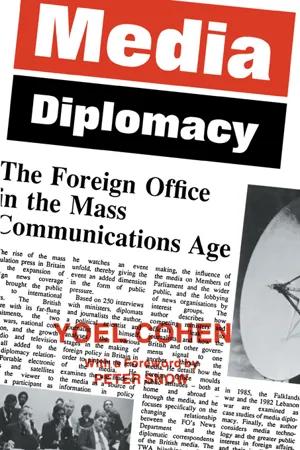
- 197 pages
- English
- ePUB (mobile friendly)
- Available on iOS & Android
eBook - ePub
About this book
Information
Chapter One
Introduction
At weekends the machinery of British foreign policy comes to a halt. But on Sunday, 23 February 1969, a hum of activity filled the Foreign and Commonwealth Office (FCO). There was no crisis in the sense of war. But a diplomatic crisis was brewing, one that graphically illustrates the effect which mass media can have on modern diplomacy. Normally on a Sunday afternoon a single duty officer in News Department is available to answer journalists’ inquiries. But on this Sunday the chief spokesman, the head of News Department, was telling the assembled journalists that President de Gaulle of France had traduced his European partners, and was seeking British support to liquidate NATO in return for British admission to the European Economic Community. To back him up, the under-secretaries who constitute the office’s senior echelon were in attendance. Nearly every known foreign affairs journalist was there, as well as some who were unheard of.
What became known as the Soames affair began in 1968 with the political appointment by the foreign secretary, George Brown, of Christopher Soames to the post of ambassador in Paris. He had the task of persuading de Gaulle to favour British membership of the EEC. De Gaulle was critical of NATO and the EEC in general, and had proposed the creation of an enlarged European economic association with a small inner council composed of France, Britain, West Germany and Italy. An atmosphere of mutual suspicion existed between London and Paris. It was, therefore, not surprising that de Gaulle in making the proposal – which he said should have come from Britain rather than France – was less trying to fulfil British aspirations and more exploiting the opportunity to drive a wedge between Britain and her allies in Europe, with Britain being perceived as trying to destroy the rights and liberties of smaller states like the Netherlands and Belgium.
Although the de Gaulle-Soames conversation was confidential, Harold Wilson, the prime minister, saw the need to inform European governments about the conversation lest once it became known, as it inevitably would, Britain would become suspect in European eyes. Europe’s governments were informed in confidence in mid-February. Indications of a British-French crisis began to appear in the media. Who leaked first – London or Paris – is unclear. Le Figaro and France Soir published a version of the conversation on Thursday, 20 February. On the same day diplomatic correspondents in London were told by the FCO about the conversation, although they would have to ‘wear’ the story at their own risk and could not indicate its source.
An interesting aspect of the affair was that No 10 Downing Street was kept in the dark about this briefing. Instead, on the next day, Friday, 24 February, the FCO suggested to Wilson’s chief press spokesman, Joe Haines, that since the French media had broken the story the previous day the British had to get their position across. ‘On this occasion, the FCO were after a bigger prize than a “purely procedural” victory’, Haines noted.1 It would be an opportunity to expose the perfidy of the French and display the innate decency and desire to be good Europeans of the British. The FCO’s News Department proposed that the British version should be leaked to the Rome newspaper, Il Messagero.
The Italian government rather than the British government would be thought of as being the source of the leak. Wilson vetoed this proposal: if the French decided to leak the story Britain could not stop them, but he did not want London accused of being responsible.
The FCO decided to brief correspondents that same day notwithstanding No 10’s veto, telling them that there was a grave difference of opinion between France and Britain over the EEC, NATO, and Europe in general. Correspondents could even hint that the information came from ‘sources close to Whitehall’. This was followed on Sunday by what amounted to a full-scale press conference. ‘We’ve seen the blighter off’, a journalist was told by an FCO official.2 A rupture in Anglo-French relations as bad as occurred in 1963, when de Gaulle first vetoed Britain’s application to join the EEC, resulted from the affair. But the rupture did not last long because within 18 months de Gaulle and Wilson both relinquished office enabling their successors, President Pompidou and Edward Heath, to start afresh. As a diplomatic manoeuvre the leaks and counterleaks were in the best style: a classic illustration of how the media have become the tools of trade of the professional diplomat.
Another example of media diplomacy was the expulsion from the Soviet Union of six British foreign correspondents – from BBC Television, the Daily Telegraph, the Daily Mail, The Observer and two from Reuters news agency – in September 1985. It served as a reminder of the difficulties facing a foreign correspondent there. The first hurdle is to obtain a visa from the authorities. Most correspondents live in the foreigners’ ghetto enabling the authorities to keep watch over their activities as well as, according to some journalists, to stop correspondents from seeing the realities of Soviet life. The Novosti Press Agency and the Soviet Foreign Ministry’s Press Department are the official points of contact, with the latter deciding on all requests for press interviews and for trips outside of Moscow. News reporting is monitored by the Soviet embassy in London and reporters displeasing the authorities may be summoned to the foreign ministry or denounced by name in the Soviet press. More severe measures range from unexplained interruptions on telephones and telex machines, to not granting requests for interviews, to physical assault, and finally to non-renewal of visas or expulsion.
It would, however, be wrong to suggest that reporting is impossible because while formal interviews require approval it is possible to speak to ordinary citizens as long as they are not quoted by name. In addition to limited off the record official contacts for purposes of calculated leaks or disinformation, some correspondents have been used for competitive leaking by middle or higher ranking officials who have failed to achieve a particular objective by working within the system. Dissidents seek contact with, and in varying degrees are sought after by, correspondents, although their views are not necessarily typical of the population as a whole. However, when compared to the pluralist society, from which the British correspondent comes, with its open debate and investigative journalism, reporting from Moscow is very restrictive. The expulsion of the six journalists emasculated the British press corps in Moscow from 14 to 8 journalists, and in effect reduced further an already limited flow of information which British audiences receive about the superpower.
The relationship between the media and international affairs has been examined using a number of approaches. One is to analyse the nature of news content. This is particularly relevant to a study of international affairs given that distorted images and perceptions compound conflicts of interest between states. Accordingly, within the study of international relations there is a trend away from examining disputes in terms of objective issues and events towards a subjective dimension of asking why and how the image of world affairs held by other nations may differ from our own.3 The analysis of news content is valid in considering the formation of attitudes of the wider public, most of whose information about international affairs is drawn from the media, but it is less relevant in the case of ministers and officials most of whose information is in the form of the flow of messages from the diplomatic missions and internal reports.
Another approach is to focus on the institutional and occupational characteristics of journalism. Tunstall has examined the characteristics of correspondents, news sources, and news organisations for factors explaining differences in news-gathering behaviour and outputs.4 Sigal has observed the internal operations and news flow of the New York Times and the Washington Post,5 and Argyris has examined interpersonal communication between reporters and editors.6
A third approach, which will be emphasised in this study, is to examine the relationship between the media and foreign policy. Early studies of democracy and foreign policy dealt in terms of an undifferentiated public. Almond identified four key participants in the opinion-policy process each of which play different roles: the general public, which participate in an indirect and passive way; the attentive public, before whom informed discussion takes place; policy and opinion elites, which compete for public support and influence; and the official leadership, which makes policy.7 Few studies examine the opinion-policy process as a two-way one, in terms of both the effects of the media on policy, and the effects of policymakers on the media. In their review of works on the relationship of media and government, Rivers, Miller and Gandy postulate four categories: governmental impact on the media, governmental information systems, the media’s impact on government, and the nature of the media.8 Several studies have examined governmental impact on the media in terms of the channels, techniques, and processes by which officials disseminate information to journalists. Nimmo studied relations between government information officials and specialist correspondents.9 Chittick examined relations between US State Department information and policy officials, reporters, and interest groups in terms of cooperation and antagonism.10
Although these studies generated new hypotheses about the interaction of reporters and officials, the question remains what is the final impact of these interactions on the media. It is, similarly, not enough to know which media are seen by policymakers, but also necessary to ask what impact the media have on policy. Rosenau has argued against tracing the flow of influence in a political system because the researcher has to examine both the behaviour which precipitated the influence and the behaviour to which that influence may have contributed, and must then examine what the latter behaviour might have been if it had not been modified by the influence. The measurement of ‘might-have-beens’ is only possible through the manipulation of variables in controlled experiments.11 The effect of the media may, however, be observed when behaviour is a necessary and sufficient cause of something – that is, nothing else could cause it and the media need no assistance. In a lesser sense the media’s effect is also observable when the media are a catalyst or occasion an event which might have happened anyway but not otherwise in that form or at that time.12
Media–Diplomacy Relationships
The different types of relationships between the media and diplomacy may be categorised as follows.
- The media, overseas and British, are a source of information to members of diplomatic missions abroad and to officials and ministers in London. The British media influence foreign policy as a result of their effect on policymakers, MPs, interest groups, and the wider public. The media are in addition sources of information and agenda setters for these and are used by interest groups and MPs as channels to reach the official policymakers and the public.
- The media are also channels of communication among policymakers, British and foreign. They are used by British government departments, individual officials and ministers at the policy formulation stage to disclose information in order to advance or hinder policy options. At the stage of policy implementation, as illustrated by the Soames affair, the media are used in international negotiations by Britain and other governments as a device through which to manoeuvre another government.
- The media are also used to gain public support for policy. The channels include, abroad, the building by diplomatic missions abroad of relations with the local media, and the distribution of printed and visual material to them; and in London, with the foreign press corps and the BBC External Services. The British media are means for the FCO to explain policy to the British public.
Are there any common elements among the aforementioned interactions between media and foreign policy from which a theory of media diplomacy may be generated? These interactions appear initially to vary in type and to differ in the roles they play in the policy process. As a source of information to policymakers and the public, the media behave as channels connecting them to the world outside. In terms of the relationship of the media to public opinion, and of public opinion to policy, the media do not act as a channel but influence the substance of policy. As a channel of communication the media supplement the official diplomatic network through which governments communicate with one another. In being used by a policymaker to disclose information, whether in the formulation or implementation of policy, the media do not serve as diplomatic channels but create certain political effects that hinder or advance policy. And the explanation of policy to overseas and domestic publics should be distinguished from the implementation of policy, since the former takes place outside the policy process after policy has been implemented between two countries.
To busy professional diplomats an all-encompassing theory of media diplomacy would seem improbable. The role of the media in reporting international affairs makes the media one additional source of information to policymakers, in a way that has nothing to do with the use of the media by officials to reflect public thinking. Officials and ministers deny that they use the media to disclose information at the stages of policy formulation and policy implementation, or that they channel messages and signals to other governments through the media. And if this technique is admitted to, it is only one among a number of diplomatic channels between policymakers. None of these media roles has anything in common with overseas information programmes – in which the role of the media is recognised by diplomats – nor with the foreign ministry’s relations with journalists from their own country. If diplomats do have a concrete media policy, it involves questions of the type of overseas information policy to adopt, such as the distribution of information attachés in diplomatic posts. Any policy of media diplomacy would, therefore, be simply the sum of overseas information policies around the world.
Yet, notwithstanding seemingly non-integrated connections of the media and diplomacy, media diplomacy does exist as one type of diplomacy. Other types of diplomacy – also with differentiated, and seemingly unintegrated, elements – include, for example, economic diplomacy with such diverse diplomatic tools as loans and grants, embargoes, the terms of trade, the manipulation of financial currencies, and technical assistance. Each involves an overlap of economics and of diplomacy, and each is designed to change directly or indirectly the behaviour or policies of a government. Media and diplomacy are two different types of communication which run along different paths, in many instances never crossing. This book deals with those points where overlap occurs. The rise of a mass circulation press and expansion of foreign news coverage have brought the public closer to international affairs. The British Empire with its far-flung commitments, national conscription, the two world wars and developments in mass communications including the telegraph, radio, cable, telephone and television have each added to the media-diplomacy relationship. Television, for example, has revolutionised foreign news gathering. Actuality brings the drama of an event into the living room of the viewer in a way that print cannot. Portable cameras and satellites enable the viewer to watch an event as it is happening and become a participant in it, giving the event an added dimension in the form of public pressure. The ‘new diplomacy’ has replaced the ‘old diplomacy’ in which diplomats made foreign policy without due regard for any public reaction, few governmental structures existed for explaining policy, and governments communicated to one another through the conventional diplomatic channels.
Still, the overlap between media and diplomacy is partial. Many aspects of the media, such as domestic news, coverage of the arts, sport, and entertainment, to name a few, are not the concern of diplomacy. And many aspects of diplomacy, including international economic relations, bilateral political relations, and cultural ties are not defined as ‘news’ by the media. Yet crises, war and peace are the stuff of both journalists and diplomats. Policymakers and the public use the media as a source of information. The media influence the public, thereby bringing pressure on policymakers. The media are often used to cause tactical manoeuvres during international negotiations. The media are primary means by which policymakers gain public support for their policies. Media diplomacy is thus to be distinguished from ‘public diplomacy’ in that the latter encompasses not only information work and cultural activities, where the media are involved, but all public aspects of foreign policy – speeches, trips, public appearances by the prime minister, the foreign secretary, and other senior officials, and the support and cultivation of political groups and forces abroad that may serve the long-term interests of Britain and the West generally. Media diplomacy includes all those aspects of public diplomacy where the media are involved as well as others not associated with public diplomacy including the sending of signals by governments through the media, and the use of the media as a source of information.
Furthermore, the elements of media diplomacy are interrelated. A chain of linkage between these elements begins with the image of the world as portrayed by the media. The image will determine those policies and issues where the media exert influence. Information which does not make the threshold of news includes that from culturally distant regions like Latin America, or which concerns economic and scientific developments, or which cannot be reported because journalists are barred access by a government. The influence of that information which passes through the news threshold is dependent on the reactions of Parliament, interest groups, and the wider public. These rely on the media for their primary sources of information about international affairs. Further, in the absence of Parliament discussing international affairs in depth, the media set the agenda for ‘issues’ of debate and act as forums of discussion. The extent to which this process results in a change of policy somewhat depends on the attitudes about such domestic pressures as the media held by ministers and officials. To officials, domestic opinion does not necessarily coincide with the longer-term national interest. Few elections have been fought on foreign issues. Ministers, who have an interest in avoiding criticism of government policy, try to take this into account if not in altering the substance of policy at least in changing the way policy is presented. ...
Table of contents
- Cover
- Half Title
- Title Page
- Copyright
- Contents
- Dedication
- Foreword
- Preface
- 1. Introduction
- 2. Origins
- 3. Information
- 4. Image of the World
- 5. Public Opinion
- 6. International Negotiation
- 7. Moulding Opinion Abroad
- 8. Moulding Opinion at Home
- Case Studies
- Notes
- Bibliography
- Index
Trusted by 375,005 students
Access to over 1.5 million titles for a fair monthly price.
Study more efficiently using our study tools.
Frequently asked questions
Yes, you can cancel anytime from the Subscription tab in your account settings on the Perlego website. Your subscription will stay active until the end of your current billing period. Learn how to cancel your subscription
No, books cannot be downloaded as external files, such as PDFs, for use outside of Perlego. However, you can download books within the Perlego app for offline reading on mobile or tablet. Learn how to download books offline
Perlego offers two plans: Essential and Complete
- Essential is ideal for learners and professionals who enjoy exploring a wide range of subjects. Access the Essential Library with 800,000+ trusted titles and best-sellers across business, personal growth, and the humanities. Includes unlimited reading time and Standard Read Aloud voice.
- Complete: Perfect for advanced learners and researchers needing full, unrestricted access. Unlock 1.5M+ books across hundreds of subjects, including academic and specialized titles. The Complete Plan also includes advanced features like Premium Read Aloud and Research Assistant.
We are an online textbook subscription service, where you can get access to an entire online library for less than the price of a single book per month. With over 1.5 million books across 990+ topics, we’ve got you covered! Learn about our mission
Look out for the read-aloud symbol on your next book to see if you can listen to it. The read-aloud tool reads text aloud for you, highlighting the text as it is being read. You can pause it, speed it up and slow it down. Learn more about Read Aloud
Yes! You can use the Perlego app on both iOS and Android devices to read anytime, anywhere — even offline. Perfect for commutes or when you’re on the go.
Please note we cannot support devices running on iOS 13 and Android 7 or earlier. Learn more about using the app
Please note we cannot support devices running on iOS 13 and Android 7 or earlier. Learn more about using the app
Yes, you can access Media Diplomacy by Yoel Cohen in PDF and/or ePUB format, as well as other popular books in Politics & International Relations & Military & Maritime History. We have over 1.5 million books available in our catalogue for you to explore.