- 232 pages
- English
- ePUB (mobile friendly)
- Available on iOS & Android
eBook - ePub
Stairs
About this book
Stairs are a fundamental and universal feature of buildings. The late Alan Blanc had a lifetime's obsession with stairs and steps and provided a definitive reference source that bridges the aesthetic and practical aspects of staircase design. His wife Sylvia, who worked with him on the first edition, presents this updated, abridged version alongside a complimentary web site where the historical elements of the subjects are described and discussed in pictures and diagrams.
The book is a practical guide to designing circulation spaces. It is extensively detailed with working drawings and photographs. Construction methods using a variety of materials are discussed as well as the influence of new technology on vertical circulation. The guidance on codes and regulations covers the UK and US. The latest high profile international case studies inspire and inform the reader.
Information
1 Introduction
As I commenced the task of writing this book, I might have been asked ‘Why another book on stairs?’ This is, however, an abridged version of my husband Alan Blanc's book Stairs, Steps and Ramps which was published in 1996, the year after his death. True to Alan's thoroughness, the book was too long with too many illustrations and it was very expensive. I have now reduced it, in some cases by condensing the size of the diagrams, in others by omitting unnecessary examples, at the same time bringing in illustrations from recent buildings. The history of stairs has been omitted, but can be found on the publishers’ website or, of course, in the original book.
Alan and I worked together for 50 years, first as students and then in architectural practice, and I was therefore very involved in the original book.
Alan had an obsession with stairs, starting with the London Blitz in 1940 when taking shelter night after night in the ‘understairs’ cupboard of his parents’ Victorian terraced house. The actual space was of triangular section, panelled on one side, with a rough brick party wall on the other, whilst overhead there existed the full panoply of the carpenter's art, with glued and wedged treads and risers set into pine strings. The local ARP Warden advised ‘understairs’ for sheltering as the strongest structure within the home. A couple of houses further down the road were destroyed, so the young Blanc decided, as a game, to replan the family house in case theirs required rebuilding. He measured up the structure, and found that the stair was the most difficult feature to plan. How long was each step and rise, and what about headroom – do you hit your head on the first floor landing? This was his earliest planning exercise into architecture and it is not surprising that architecture became his vocation five years later.
The second turning point followed with the sudden flush of funds that permitted a buying spree in Tiranti's around 1948. The purchases included two volumes of L'Architecture Vivante, en Allemagne (Erich Mendelsohn and Weissenhof) together with his most prized acquisition, Franz Schuster's Treppen. The book is prewar but was resurrected and reprinted by Hoffman of Stuttgart in 1949. Schuster gave detailed advice with inspirational concern for geometry that makes the art of stair construction equal to furniture in terms of exactness and line (Figure 1.1). These volumes still sit on our bookshelf together with a number of other books on the same subject.
The greatest influence in Alan's architectural education was working for Walter Segal on leaving college, where the pros and cons of Franz Schuster were fully aired, Segal having known this work pre-war. Working with Walter meant drawing out staircases to full size, including the balustrade, pinning the tracing to the wall where the stair was to be installed in order that the visual effect could be fully established. These stairs were often very finely detailed, leaving almost an unsafe structure. Today, Codes of Practice and Section K of the National Building Regulations rule out those risks for domestic stairs where small children may use them unsupervised, but it is worth recalling that the minimal elegance achieved in the designs of Eva Jiricna is only obtainable by working in close collaboration with a qualified engineer, designing for public buildings where there are no children or where they are deemed to be supervised.
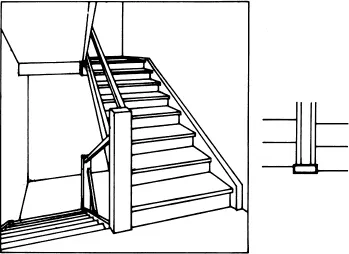 |
Figure 1.1 Variations at well end (from Schuster, F., Treppen, Hoffman Verlag, 1949)
a Solid newel at well end |
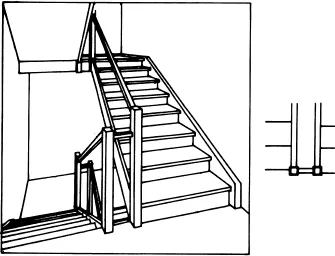 |
b Twin newels at well end |
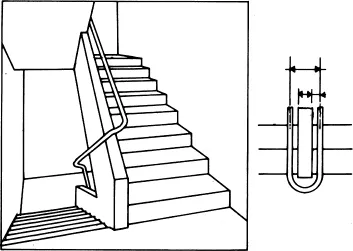 |
c Swept handrail (balustrade not shown but will infill between rail and strings) |
The historical references within Treppen started our interest in photographing stairs and in discovering the architecture of Gunnar Asplund, Roland Rohn or Otto Salvisberg that were drawn upon by Schuster. It is not possible to isolate the detailing solution from the context of the design. A typical example is Asplund's Courthouse at Gothenburg (Figure 2.7), where the movement sequence from entry court to loggia and stairhall leads with formal splendour to the courtrooms at first floor and thence by secondary means to the offices at upper levels. Such a ‘promenade in space’ is perhaps the finest achievement that well-designed stairs can attain. The open vertical circulation eloquently arranged at the core of buildings can certainly become the most captivating experience. Designs as diverse as Garnier's Paris Opera, Le Corbusier's Villa La Roche-Jeanneret and Lasdun's National Theatre in London all reveal the magic that is possible with creative designers.
Today, lifts and stairs as well as escalators form the core of all multi-storey plans, sadly often hidden behind solid enclosures to form uninteresting fire compartment zones. Modern technology using heat resistant glazing releases the architect from boxed-in solutions. Visual connection is once more feasible between vertical circulation and the spaces served. Pressure controlled environments can exclude smoke without recourse to the complication of double lobbies. Research for this book amongst older masterpieces in London often revealed that double lobbies are thwarted by having one set of doors permanently wedged open or simply propped ajar with a fire extinguisher. Today it is obligatory to provide access for the disabled, either by ramp or by stairlifts or hoists.
Outstanding developments such as the Lloyd's Building, London, or the Hong Kong and Shanghai Bank explore the new technologies and reveal that staircases and their modern equivalents can recapture the visual excitement that Piranesi (Figure 1.2) or Leonardo da Vinci awarded to stairs within the interior volume of their designs.
I hope that this new textbook will allow the reader to gain Alan's information in a condensed form, but at the same time to be enthused by our pictures and sketches. I hope Alan approves of my new version of his book.
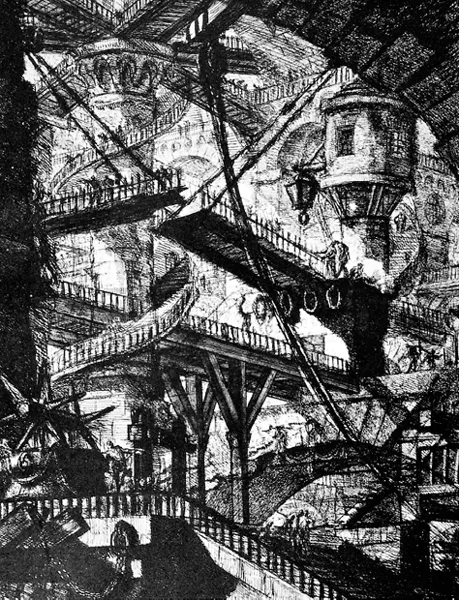
Figure 1.2 An obsession with stairs, extract from Piranesi's Carceri, Plate VII (from Scott, J., Piranesi, Academy Editions, 1975)
2 Civic and public stairs
Steps and stairs have always been an essential part of building since primitive man first built a shelter. To be a few feet off the ground was to be protected against dangerous animals or the dampness of the ground in rainy periods. Ropes were twined from vegetation, or ladders formed from small branches tied together.
As time went by the various civilizations built their temples or place of worship to their gods. As the gods lived in the heavens such places were built high up on a mountain, or a high structure was erected if no mountain existed, and to get to the altar at the top a long ceremonial stair was created (Figures 2.1a and 2.1b). In Greek temples the floor or podium was raised approximately 1 500 mm so that the crowd looked up at the priest in his aloof position. The Parthenon has a triple-block plinth, each block 500 mm × 750 mm, on the west front. Such a stylobate is difficult to scale and forms the intended barrier to the temple domain (Figure 2.1c). Roman temples were designed for the public to gain access to the altar spaces, thus a straight flight of stairs was created leading to the front entrance, as at Maison Carrée, Nîmes (Figure 2.1d).
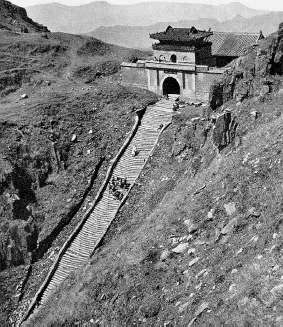
Figure 2.1a A Jacob's ladder in landscape terms: steps called ‘the skyladder’ at Tai Shan, China (551 BC) (from Schuster, F., Treppen, Hoffman Verlag, 1949)

Figure 2.1b El Castillo, Chichén-Itzá, Yucatán, Mexico, thirteenth century (courtesy of Judith Blanc)
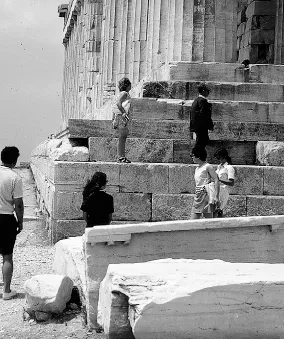
Figure 2.1c Parthenon steps
2.1 Categories of stairs
The direct flight is the most popular ceremonial approach, but there are many ways of providing vertical circulation. Figure 2.2 depicts the various categories of stairs and shows the elaboration that can be achieved by adding turned steps or landings. Floor-to-floor heights are not always constant within buildings, and the strategy in adopting landings and return steps often helps to accommodate differing storeys without increasing the basic stairwell. The direct flight or single return version will occupy a greater floor area once the extent of upper landings is taken into account. The popularity of dog-leg or three-turn flights rests with the minimal core dim...
Table of contents
- Front Cover
- Half Title
- Title Page
- Copyright
- Contents
- Foreword
- 1 Introduction
- 2 Civic and public stairs
- 3 Commercial stairs
- 4 Domestic stairs
- 5 External stairs
- 6 Detailed construction: timber
- 7 Detailed construction: iron, steel and other metals
- 8 Concrete stairs
- 9 Stonework and composite construction
- 10 Design codes and procedures
- 11 Elevators and mechanical circulation
- 12 International case studies
- 13 Case studies in the UK
- Epilogue
- Index
Trusted by 375,005 students
Access to over 1.5 million titles for a fair monthly price.
Study more efficiently using our study tools.
Frequently asked questions
Yes, you can cancel anytime from the Subscription tab in your account settings on the Perlego website. Your subscription will stay active until the end of your current billing period. Learn how to cancel your subscription
No, books cannot be downloaded as external files, such as PDFs, for use outside of Perlego. However, you can download books within the Perlego app for offline reading on mobile or tablet. Learn how to download books offline
Perlego offers two plans: Essential and Complete
- Essential is ideal for learners and professionals who enjoy exploring a wide range of subjects. Access the Essential Library with 800,000+ trusted titles and best-sellers across business, personal growth, and the humanities. Includes unlimited reading time and Standard Read Aloud voice.
- Complete: Perfect for advanced learners and researchers needing full, unrestricted access. Unlock 1.5M+ books across hundreds of subjects, including academic and specialized titles. The Complete Plan also includes advanced features like Premium Read Aloud and Research Assistant.
We are an online textbook subscription service, where you can get access to an entire online library for less than the price of a single book per month. With over 1.5 million books across 990+ topics, we’ve got you covered! Learn about our mission
Look out for the read-aloud symbol on your next book to see if you can listen to it. The read-aloud tool reads text aloud for you, highlighting the text as it is being read. You can pause it, speed it up and slow it down. Learn more about Read Aloud
Yes! You can use the Perlego app on both iOS and Android devices to read anytime, anywhere — even offline. Perfect for commutes or when you’re on the go.
Please note we cannot support devices running on iOS 13 and Android 7 or earlier. Learn more about using the app
Please note we cannot support devices running on iOS 13 and Android 7 or earlier. Learn more about using the app
Yes, you can access Stairs by Sylvia Blanc,Alan Blanc in PDF and/or ePUB format, as well as other popular books in Architecture & Architecture General. We have over 1.5 million books available in our catalogue for you to explore.