- 456 pages
- English
- ePUB (mobile friendly)
- Available on iOS & Android
eBook - ePub
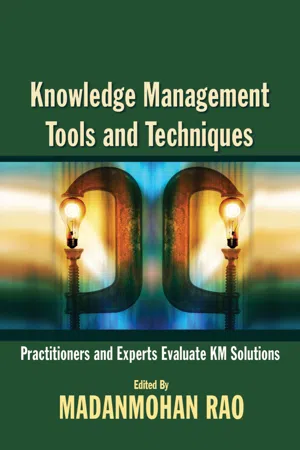
Knowledge Management Tools and Techniques
About this book
Knowledge management (KM) - or the practice of using information and collaboration technologies and processes to capture organizational learning and thereby improve business performance - is becoming one of the key disciplines in management, especially in large companies. Many books, magazines, conferences, vendors, consultancies, Web sites, online communities and email lists have been formed around this concept.
This practical book focuses on the vast offerings of KM solutions—technology, content, and services. The focus is not on technology details, but on how KM and IT practitioners actually use KM tools and techniques. Over twenty case studies describe the real story of choosing and implementing various KM tools and techniques, and experts analyse the trends in the evolution of these technologies and tools, along with opportunities and challenges facing companies harnessing them. Lessons from successes and failures are drawn, along with roadmaps for companies beginning or expanding their KM practice.
The introductory chapter presents a taxonomy of KM tools, identifies IT implications of KM practices, highlights lessons learned, and provides tips and recommendations for companies using these tools. Relevant literature on KM practices and key findings of market research groups and industry consortia such as IDC, Gartner and APQC, are presented.
The majority of the book is devoted to case studies, featuring clients and vendors along the entire spectrum of solutions: hardware (e.g. handheld/wearable devices), software (e.g. analytics, collaboration, document management) and content (e.g. newsfeeds, market research).
Each chapter is structured along the "8Cs" framework developed by the author: connectivity, content, community, commerce, community, capacity, culture, cooperation and capital. In other words, each chapter addresses how appropriate KM tools and technologies help a company on specific fronts such as fostering adequate employee access to knowledge bodies, user-friendly work-oriented content, communities of practice, a culture of knowledge, learning capacity, a spirit of cooperation, commercial and other incentives, and carefully measured capital investments and returns. Vendor history, product/service offerings, implementation details, client testimonials, ROI reports, and future trends are highlighted.
Experts in the field then provide third-party analysis on trends in KM tools and technique areas, and recommendations for KM practitioners.
1 Overview: The Social Life of KM Tools
DOI: 10.4324/9780080478869-1
The wise see knowledge and action as one.Bhagavad Gita
This is not the first book you should be reading about knowledge management, but it certainly should be your second.
Concepts and practices of knowledge management (KM) are soon approaching mainstream adoption, and this book focuses not on fundamental definitions of knowledge and strategy, but on more practical applications of KM tools and technologies in industry. KM tools, in a sense, are the “face and place” as well as the “nuts and bolts” of knowledge in the 21st century workspace.
“If the smart manager knows one thing, it is that knowledge management is not just about technology. But, if the smart manager knows two things, the second is that in today’s age of technology-driven communication and information-production, the role technology can play to facilitate knowledge management should be examined,” according to Koulopoulos and Frappaolo (1999).
Information and communication technologies (ICTs) play a key role in facilitating KM in today’s globalized company, which operates in a complex web of partnerships and alliances. However, it is important to keep in mind that technology is not the panacea for a KM practice, though an easy-to-use knowledge-sharing infrastructure is an important enabler. Organization-wide access to KM architecture, Web-based applications, groupware, datamining tools, mobile devices, worldwide access, high performance, user friendliness, a standardized structure, and an easily administered controlling system are key requisites of the supporting KM infrastructure.
“We realized fairly early that the KM initiative has to be, of essence, people-centric. Nevertheless, technology has been an important dimension in our efforts to demonstrate the multiple possibilities of KM to our people, draw them to the movement, and help keep them committed. In this journey, a key lesson we have learnt is that unless people are able to see and experience the direct benefits of KM, no amount of incentives, rewards or recognitions are likely to elicit sustained enthusiasm, participation and involvement,” according to Kris Gopalakrishnan, COO of Infosys, Most Admired Knowledge Enterprise (MAKE) award winner in 2003.
KM-enabling tools thus play a useful facilitating role in learning organizations, especially in dealing with the “info-glut” or information overload that is plaguing most organizations that have launched an intranet, enterprise resource planning (ERP), or business intelligence system.
While amplifying existing knowledge processes, information technology (IT) tools can also create new kinds of knowledge experiences in the long run, particularly among generations of users who grow up in IT-pervasive environments. “Technology enables new knowledge behaviours,” according to Paul McDowall, KM advisor at the Treasury Board of Canada Secretariat.
Tools that currently fall under the KM umbrella have evolved in various phases since the 1980s, starting off with IT tools for computation and databases, followed by publishing and communication tools, and then accompanied by sophisticated platforms for collaboration, wireless delivery, search, and network modelling. From automated agents to workflow tools, KM technologies span almost the entire alphabetical spectrum.
Sidebar 1
KM Tools: The Alphabet Soup
Abstraction, agents, authoring systems, best practice repository, blogging, business intelligence, case-based reasoning, categorization, clustering, competitive intelligence, content management, collaboration, collaborative filtering, creativity tools, datamining, document management, e-learning, expert systems, expertise directories, expertise locators, groupware, heuristic software, idea management, intellectual property inventory, knowledge blogs, knowledge dashboard, knowledge discovery, knowledge mapping, knowledge mobilization, knowledge portals, knowledge visualization, meta-data, neural networks, online communities of practice, personal KM, profiling, P2P knowledge networking, search, semantic nets, Skandia navigator, skill inventories, smart enterprise suites, social net-work analysis, story templates, taxonomy, text mining, topic maps, validation, workflow, ….
While technologies and tools should not be the sole focus of KM efforts—culture and capacity building are as important—KM tools are finding increasing support from management in terms of being able to address some of their business pressures.
According to a new study by the consulting firm Bain & Company, companies are increasingly leaning on more and better methods of assessing economic uncertainty to reach elusive growth targets. “Most notably, CRM, contingency planning and KM rose through the ranks, both in usage and satisfaction,” according to Darrell Rigby, Director of Bain & Company and founder of the “Management Tools & Trends” survey.
About this Book
This book situates KM tools in their right place as key enablers of knowledge behaviors and value in modern organizations, while also highlighting some of their limitations and shortcomings. While it does address the strengths and advances in KM tools, it cautions against the use of only KM tools for knowledge sharing; tools are identified as one of the many ingredients in the complex process of KM, but they work best only in the right supportive cultures.
“No matter how much we emphasise that cultural and organisational change is fundamentally what KM is all about, there remains the fact that KM today is IT-enabled and IT issues are of extreme importance,” according to Srikantaiah and Koenig (2001).
This book is not intended to provide a detailed comparison of KM products or a competitive analysis of KM vendors. These are better dealt with by the various management and IT consulting firms and trade magazines. While some vendor and product names are identified, these are mainly in the course of narratives about KM implementation in an organization.
This book is targeted at organizations and communities that have decided to launch (or revamp) their KM practice and are looking at tools and technologies for implementing the practice. More precisely, the book is targeted at management professionals who are convinced of the importance of KM and are now looking for practical tips based on case studies, learnings, and recommendations from fellow KM practitioners in the field. So this is a book largely by peers for peers in the growing field of KM.
This chapter sets the stage for the book: it profiles KM tools in action, reviews recent literature on KM tools, provides a framework for analysis of tools in KM processes, captures the highlights of the KM tool case studies by the contributing authors, and identifies key learning areas and trends.
This chapter is followed by a journey through more than 20 first-hand narratives and case studies of KM tools in action in organizations around the world and in numerous categories: corporate, non-profit, government, independent professionals, and multilateral organizations. The narratives, from over ten countries, are presented directly by KM practitioners in delightfully different writing styles. The profiled companies include eight of the Top 50 companies in the world in the MAKE rankings for 2003: Accenture, American Productivity & Quality Center, Ernst & Young, Ford, HP, KPMG, Unilever, and the World Bank.
The next section of the book consists of seven expert commentaries on key KM tool areas: collaboration, portals, social network analysis, personal KM, e-learning, and blogging. The writers of these chapters are well-established consultants, market research analysts, or full-fledged KM authors in their own right, and they bring to the table years of experience and expertise in KM.
The last section of the book provides perspectives from six vendors in content management, expertise discovery, visualization, collaboration, competitive intelligence, and customer support. Each chapter provides a set of case studies of the benefits derived from deploying KM tools. Five of these vendors feature in KM World magazine’s 2003 list of 100 companies that matter in KM: AskMe, Entopia, iManage, Inxight, and LexisNexis.
KM Tools in Action
KM can be defined as a systematic discipline and set of approaches to enable information and knowledge to grow, flow, and create value in an organization. This involves people, information, workflows, enabling tools, best practices, alliances, and communities of practice.
The 21st century business landscape is marked by increasing economic and political turbulence, a faster pace of innovation, an inter-networked organizational structure, a focus on intellectual capital, and an increasing employee churn rate. Within this context, KM is being interpreted as a critical discipline for risk management, increasing productivity, knowledge retention, and more efficient innovation.
According to IDC estimates, approximately 3.2% of corporate knowledge is incorrect or becomes obsolete every year. An estimated 4.5% of knowledge is lost or hidden due to employee turnover, information mismanagement, and knowledge hoarding. While some of these are cultural problems, others can be resolved by properly aligning content management systems, information policies, and knowledge work.
This section profiles the following key sets of KM tools, as described in action in organizations around the world: content management, taxonomies, groupware, online communities of practice, portals, social network analysis, e-learning, storytelling, wireless platforms, innovation management tools, and inter-organizational knowledge-sharing platforms.
The material in this section is drawn from first-hand interviews with KM practitioners in the Americas, Europe, Asia, and Australia; consulting assignments for KM initiatives; and participation and reports from over two dozen KM conferences and workshops around the world in 2002 and 2003. (See the Online References section at the end of the chapter for links to full-length interviews, case studies, and conference reports featuring these tools.) Sidebars also provide analysis of KM tool usage in two industry verticals: infotech and pharmaceutical. Full-length case studies of KM tools in action are provided by other KM practitioners in another chapter of this book.
As these KM tools increase in popularity and intensity of usage, a growing body of literature is focusing on their adoption and strategies for utilization; this literature is reviewed in the next section. A framework for analysis of such tools in knowledge work and processes is presented in the subsequent section.
Content Management
A growing number of companies today have instituted content management systems for best practices, lessons learned, product development knowledge, customer knowledge, human resource management knowledge, and methods-based knowledge. Content teams, meta-data, knowledge maps, and a workflow contextualization can ensure effective reuse of content. Content-centric KM approaches like codification focus on efficiency and effectiveness of operationally focused value chains, while collaborative strategies focus on reinvention and advancement in innovation-focused value chains.
Adva...
Table of contents
- Cover Page
- Half Title Page
- Knowledge Management Tools and Techniques
- Copyright Page
- Table Of Contents
- Preface
- 1 Overview: The Social Life of KM Tools
- Part I
- Part II
- Part III
- About the Contributors
- About the Editor
- Index
Trusted by 375,005 students
Access to over 1.5 million titles for a fair monthly price.
Study more efficiently using our study tools.
Frequently asked questions
Yes, you can cancel anytime from the Subscription tab in your account settings on the Perlego website. Your subscription will stay active until the end of your current billing period. Learn how to cancel your subscription
No, books cannot be downloaded as external files, such as PDFs, for use outside of Perlego. However, you can download books within the Perlego app for offline reading on mobile or tablet. Learn how to download books offline
Perlego offers two plans: Essential and Complete
- Essential is ideal for learners and professionals who enjoy exploring a wide range of subjects. Access the Essential Library with 800,000+ trusted titles and best-sellers across business, personal growth, and the humanities. Includes unlimited reading time and Standard Read Aloud voice.
- Complete: Perfect for advanced learners and researchers needing full, unrestricted access. Unlock 1.5M+ books across hundreds of subjects, including academic and specialized titles. The Complete Plan also includes advanced features like Premium Read Aloud and Research Assistant.
We are an online textbook subscription service, where you can get access to an entire online library for less than the price of a single book per month. With over 1.5 million books across 990+ topics, we’ve got you covered! Learn about our mission
Look out for the read-aloud symbol on your next book to see if you can listen to it. The read-aloud tool reads text aloud for you, highlighting the text as it is being read. You can pause it, speed it up and slow it down. Learn more about Read Aloud
Yes! You can use the Perlego app on both iOS and Android devices to read anytime, anywhere — even offline. Perfect for commutes or when you’re on the go.
Please note we cannot support devices running on iOS 13 and Android 7 or earlier. Learn more about using the app
Please note we cannot support devices running on iOS 13 and Android 7 or earlier. Learn more about using the app
Yes, you can access Knowledge Management Tools and Techniques by Madanmohan Rao in PDF and/or ePUB format, as well as other popular books in Business & Business General. We have over 1.5 million books available in our catalogue for you to explore.