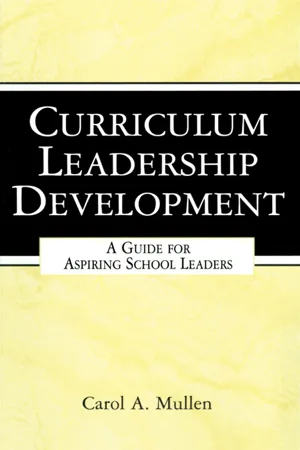
Curriculum Leadership Development is an up-to-date, user-friendly textbook offering unique approaches to help readers understand the complexity of curriculum leadership. It is grounded in current and relevant theory, research, legislation, and application in the closely related areas of curriculum leadership, development, and scholarship. The text solidifies the concepts of curriculum and leadership in experiential learning contexts, and promotes democratic action and critical thinking.
Author Carol A. Mullen uses a descriptive, qualitative approach that integrates case study, data analysis, personal reflection, and lessons learned. Among the most important elements of the book are:
*the inclusion of the voice and curricular experiences of the professional student who is a seasoned teacher or beginning adminstrator;
*detailed illustrations of practitioners' experiences as curriculum makers and action researchers;
*an articulation of the links among curriculum development, constructivist curricula, and mentoring scaffolds; and
*practical exercises to accompany case studies.
Graduate and advanced undergraduate students in education will find this textbook of value in their coursework, as will curriculum professionals who teach practicing teachers.
- 296 pages
- English
- ePUB (mobile friendly)
- Available on iOS & Android
eBook - ePub
About this book
Information
I
Trends and Issues in the Study of Curriculum Leadership
1
Changing Times for School Curriculum Leaders
As curriculum leaders, we are called [on] to be “cathedral builders.” … We no longer have a direct impact on the students in our buildings the way we did as class-room teachers. Instead, the way we increase the level of achievement for our students is through the things we do to increase the ability of our teachers to “see” a school that could be and their competency to meet that challenge. It will demand all that is within us—intellectually, physically, and ethically. But such is the calling of a cathedral builder.
—Retired elementary principal and superintendent (Schermer, 2005, p. 5)
Real change is not easy—it is nonlinear, multifaceted, uncertain, and even chaotic at times (English & Larson, 1996; Hargreaves & Fullan, 2000). The role of teaching and administering, managing, and leading had dramatically changed over a short time: “… the emerging competitive marketplace in education, with its reliance on test scores as the arbiters of “quality,” has elevated curriculum leadership to the forefront in determining effective curriculum practices in schools” (English & Steffy, 2005, p. 425). Along with other actions taken, democratically accountable curriculum leaders are changing the status quo by
• turning inequitable power structures and relationships in their own school communities into different and promising social relationships;
• promoting instructional competence and preparing their faculties to improve the academic performance of all students;
• transforming autocratic decision making into shared governance through distributed leadership strategies that engage teachers and students;
• developing the capacity of staff to think critically and expand professionally while satisfying school goals.
In discussing professional development as a tool for change, since the 1990s research has shown that teacher learning can have a positive effect on student achievement where it focuses on curriculum. Specifically, teachers are more likely to change their practices when their in-service training, for example, clearly connects curriculum to subject matter content, curriculum materials and instruction, and standards and assessments (Research Points, 2005).
Who better to turn to for insight into such changing agendas than the insiders themselves? Practitioners who are highly capable in their multiple roles make excellent informants. As stated by master’s students in an educational leadership course I teach,
Principals who pursue site-based management must respond positively to the change from autocratic decision making to collaborative decision making. Site-based management of schools will be effective only if administration integrates high-quality performance in diverse dimensions of the role as curriculum leader—mentor, evaluator, politician, manager, and cultural expert. (Anonymous, course paper, 2005)
Teachers and principals who study the issues they identify as important not only speak as informed authorities, but also as action researchers seeking to make a difference.
This book brings together just such an exemplary group of emerging leaders, empowered here through the lenses of action researcher and scholar practitioner. Action researchers “want their research findings to have an impact on the situation or context as the intervention takes place, and [action research] sees the practitioner as researcher” (Robertson, 2005, p. 76). Scholar practitioners “use theory to inform their practice and allow their reflections upon their practice to inform theory.” Their reflections can be “non-critical or critical, or critical in the traditional or radical sense” (Horn, 2002, p. 101; for an essay on this subject, see Mullen, 2005b). With support from insiders, then, Curriculum Leadership Development depicts the interiority of present-day schools, displaying the shifting ideologies and evolving practices of educators. Clandinin and Connelly (e.g., 1992, 1995) have long credited teachers as a group with personal and professional knowledge worth mining. In my experience, practitioners who study in higher education degree programs while attending to their school responsibilities are especially capable of sparking and sustaining constructive dialogue about curriculum and its multifaceted nature (Mullen, 2004a, 2004b). Leadership aspirants are now seen as curriculum leaders. Agreeing with this assessment, a doctoral student/veteran teacher who is currently preparing for site-based administration, wrote,
Without a strong curriculum foundation and awareness of new leadership styles (e.g., knowing how to engage in shared leadership and mentor staff), aspiring school leaders may not experience success. There is an implied importance that these two major components be built into all administration preparation support programs. However, based on my own experiences new teachers see the need for these to be incorporated into university programs and hence in their own administrative background. (Anonymous, course paper, 2006)
Learning what these insiders know and experience will enrich the collective wisdom of teachers, principals, professors, and policymakers. Toward this end, I have guided my contributors to work closely with me and one another on producing scholarship around these questions:
1. What does the concept of curriculum leadership mean to you, and how do you make sense of it in practice as an action researcher?
2. What do you believe are the flagship curricular questions and challenges facing schools and society today?
3. What changes in the role of curriculum leaders most affect teachers and principals personally as well as professionally?
The 17 school-based contributors address this general framework in their scholarly cases (Part II). Many other teachers studying at the University of South Florida also provided reflective statements and tool-kit ideas included as data sources in Parts I and III. Major areas highlighted through action research (data collection and analysis, and interpretation and discussion) are administrator coaching, curricular interruptions, high-stakes testing, literacy leadership, magnet academies, student progression, teacher certification, technology leadership, transitional leadership, school culture, site-based leadership, and special education.
One lesson learned from these studies is that despite the narrow legislative treatment of curriculum as high-stakes testing outcomes, at least some practitioners conceive of curriculum in nontraditional or broad and humane terms. They have explored how curriculum is planned, enacted, experienced, and assessed within teaching/learning spaces that stretch beyond the class-room. For this group of aspiring leaders, curriculum development is a comprehensive school-wide improvement process that comprises effective program design and teaching strategies.
Yet another lesson learned is that curriculum, as a multifaceted, holistic concept, should not be equated with student achievement, test scores, grades, prepackaged curriculum materials, academic or professional standards, policies, guidelines, or tests. As a group, we recognize that each of these areas has become a crucial part of the whole within today’s national policy climate. Finally, curriculum is not restricted to the academic domain by the authors either, as we recognize its personal, professional, and political dimensions.
Importantly, the contributing authors together expose hidden aspects of the curriculum of schooling by examining “what is not being taught” (Poeske, Stober, Dyson, & Cheddar, 2005, p. 45) to many aspiring and practicing teachers in such areas as information literacy (chap. 5) and classroom interruption (chap. 8). As concerns school leadership, they also examine what is not sufficiently modeled by “cathedral builders” in such domains as inclusive settings for students with disabilities (chap. 6). They are not blind to “the hidden curriculum of domination” and the tendency of school cultures to perpetuate “the classical canon and [the] meanings and knowledge that have stood the test of time” (Poeske et al., 2005, p. 44), yet each holds onto shared values, communal cultures, and curricular cohesion. And they understand that what appears fundamentally rational and knowable, as in the case of academic and professional teaching standards, is often rife with uncertainty and tension at the level of local implementation.
The reader will see that a spirit of hope and possibility, enthusiasm and even empowerment characterizes these developing leaders’ attitudes toward educational change. This is testimony to the fact that although “curriculum decisions made at the local level have been vastly reduced since the 1960s as federal and state constraints on local policymaking have increased, … local decisions are still important” (Marsh & Willis, 2003, p. 16, emphasis added).
BACKGROUND
The empirical cases selected for this book represent issues similar to those that practicing teachers in my graduate classes have generally addressed. This makes the cases appearing here all the more relevant because the topics selected for inquiry are not unique—curriculum leaders should already be familiar with all of the core issues presented and aspiring leaders should be making every concerted effort to become so. However, the approach taken to each issue, the observations made, and the personal writing style and voice of each writer carry that individual’s unique stamp.
It only stands to reason that this volume does not exhaustively depict all priorities for school leadership today, including excessive site-based leadership turnover, and school safety and student discipline, including zero-tolerance policies, and leadership preparation through universities and schools. (Other publications of mine cover these particular issues, see, e.g., Mullen, 2004a, 2004b). Further, even though diverse educational meanings and situations are depicted in these pages, it is simply not possible to cover all facets of curriculum in a single text. What one person would consider a legitimate example of curriculum, another would not. We have not intended to focus on particular aspects of the curriculum while shutting out others, a problem that Marsh and Willis (2003) say pervades curriculum texts. A combination of space constraints and enthusiasm for certain topics has resulted in the selections made. As mentioned in the preface, all of the author chapters appearing in this book were jointly produced with me in 2005; my own conceptual input and scholarly writing and research significantly influenced each.
CASE STUDY
For this book, four major bodies of literature—school curriculum, school improvement, teacher development, and administrative leadership—were consulted, in addition to many specialized topics, such as inclusion, technology leadership, and school culture. Together, these navigational guides supported the development of the practitioners’ case studies and the kaleidoscope we present.
To clarify, what is case study? Narrative research in the form of case study has become an honored tradition within the human and natural sciences. It serves as a proven reflective tool that connects knowledge with practice for school personnel eager to make sense of often fast-paced situations. Case studies, unlike cases, are more than school stories. These empirical, narrative treatments of research blend story, data, and analysis for eliciting insight into salient issues and circumstances (Merriam, 1998; Mullen, 2004b). At the same time, the importance of sharing personal and professional experiences is celebrated; by doing so, we gain “access to new stories, new wrinkles in established patterns; in other words, new sources of meaning” (Kenyon, 1996, p. 32). Gardner (1991) connects the value of storytelling to the lives of administrators and other curriculum leaders: “Leadership is a process that occurs within the minds of individuals who live in a culture—a process that entails the capacities to create stories, to understand and evaluate these stories, and to appreciate the struggle among stories” (cited in Sergiovanni, 2000, p. 169). By understanding and evaluating our stories, we become empowered to change those that can help bring coherence and continuity to our experiences (Clandinin & Connelly, 1992, 1995).
For teachers who aspire to lead schools, the case study method offers an outlet for meaning making as well as a strategy for framing issues and learning skills, and within a relatively short time frame. Clinical or field-based internships are often the curriculum students prefer; however, this option is not always realistic for part-timers and understaffed programs (Mullen & Cairns, 2001). Besides, action research is not a substitute for the internship, as it has its own unique rewards. In becoming action researchers with a public voice, teachers learn how to conduct inquiries in areas of interest, complete with results, by bringing together scholarship and ideas with data and analysis.
Schools need internal experts who know how to collect and analyze data, substantiate assertions with evidence, and convincingly report results to their public constituents. Such scholarly activities have, in fact, become performance indicators of outstanding school leaders (Lortie, 1998). As revealed in chapter 2, practitioners who can identify biases and the hidden curriculum as well as test assumptions implicit in policy and change models (e.g., zero-tolerance policies make schools safer) can help transform their immediate school communities.
CONTRIBUTOR PROFILES AND WRITING PROCESS
This book’s master’s and doctoral writers are a diverse group of males and females (though they are predominantly White, like the educational leadership field itself) in their 30s, 40s, and 50s who have worked in various states and countries. Everyone holds responsibilities as teacher mentors, lead teachers, department heads, and directors. They are also specialists in technology, reading, mainstreaming, and other areas at their schools and possess certifications in specialty areas as well as university degrees. These writers all aspire to be educational leaders, typically principals, and, to a lesser extent, professors; superintendent is a more remote possibility.
For their chapters, the contributors chose topics of genuine interest for which they had unresolved questions. They felt motivated to make selections that could prove informative for their administration and stakeholder groups, as well as policymakers. They offer perspectives on their topic that accommodate the views of stakeholder groups and promote personal reflection. These writers collected data by designing their own research instruments in close consultation with me and engaged students, teachers, administrators, parents, or recognized experts in their research explorations. Although some opted to conduct formal conversations or taped interviews, others distributed original surveys and analyzed school and policy documents. They all obtained official permission for conducting their research and used anonymity to protect their participants and school contexts.
The chapters were launched with a written proposal, and subsequent drafts ensued in which I provided ongoing, intensive feedback and writing. Peers also provided input and critique. Students were guided through the steps of creating research instruments, resolving study obstacles (e.g., unreturned phone calls), and electronically sharing information and texts. Other specialized, interactive activities provided further support. One such support system featured conventions and alternatives for analyzing the data collected, as students would feel at a loss when it came to interpreting interview transcripts, completed surveys, and more.
The writers used the three questions framed at the outset as a guide for probing issues of curriculum, leadership, and curriculum leadership. As a writing scaffold, they also followed my case study model for guiding scholar practitione...
Table of contents
- Cover
- Halftitle
- Title
- Copyright
- Contents
- List of Figures and Tables
- Preface
- PART I. Trends and Issues in the Study of Curriculum Leadership
- PART II. Curriculum Leadership Cases for Schools and Faculties
- PART III. University-Based Curriculum Leadership Exercises
- References
- Author Index
- Subject Index
Trusted by 375,005 students
Access to over 1.5 million titles for a fair monthly price.
Study more efficiently using our study tools.
Frequently asked questions
Yes, you can cancel anytime from the Subscription tab in your account settings on the Perlego website. Your subscription will stay active until the end of your current billing period. Learn how to cancel your subscription
No, books cannot be downloaded as external files, such as PDFs, for use outside of Perlego. However, you can download books within the Perlego app for offline reading on mobile or tablet. Learn how to download books offline
We are an online textbook subscription service, where you can get access to an entire online library for less than the price of a single book per month. With over 1.5 million books across 990+ topics, we’ve got you covered! Learn about our mission
Look out for the read-aloud symbol on your next book to see if you can listen to it. The read-aloud tool reads text aloud for you, highlighting the text as it is being read. You can pause it, speed it up and slow it down. Learn more about Read Aloud
Yes! You can use the Perlego app on both iOS and Android devices to read anytime, anywhere — even offline. Perfect for commutes or when you’re on the go.
Please note we cannot support devices running on iOS 13 and Android 7 or earlier. Learn more about using the app
Please note we cannot support devices running on iOS 13 and Android 7 or earlier. Learn more about using the app
Yes, you can access Curriculum Leadership Development by Carol A. Mullen in PDF and/or ePUB format, as well as other popular books in Education & Education General. We have over 1.5 million books available in our catalogue for you to explore.