- 392 pages
- English
- ePUB (mobile friendly)
- Available on iOS & Android
eBook - ePub
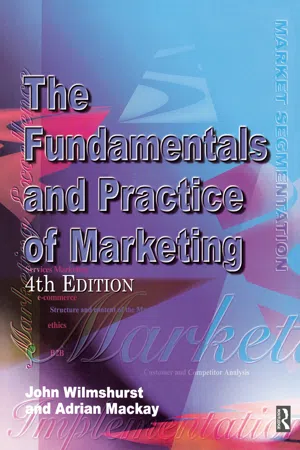
Fundamentals and Practice of Marketing
About this book
The fourth edition of this seminal text retains the clarity and simplicity of its predecessors in communicating the basic themes and principles of contemporary marketing.
'The Fundamentals and Practice of Marketing' has been substantially revised to take into account recent developments in the field - most particularly the changes wrought by new technology. It now follows a new structure and includes:
* New chapters on: direct marketing, public relations; integrated marketing planning; wholesale and retail operations; relationship marketing;
* Material on: services marketing, e-commerce, ethics and social responsibility, B2B marketing and external marketing environment
* A range of new examples
The book is accompanied by online resources for tutors which include: guidance notes on teaching methods for each chapter, case studies with suggested solutions and approaches, questions for discussion, and OHP masters.
Part
1
The Fundamentals of
Marketing – Preparing

Chapter
1
What marketing is all
about
Introduction
By the end of this chapter you will:

‘Marketing is the management process responsible for identifying, anticipating and satisfying customer requirements profitably.’
Chartered Institute of Marketing Definition
1.1 What Marketing Means
Before going any further, look back at the Chartered Institute of Marketing's definition of marketing at the start of this chapter. What for you is the key word in the definition?
Is it customer? Indeed, marketing is about customers. The whole purpose of many an organization has to do with dealing with customer requirements and making a profit.
So is it profitably? Certainly, one needs to profit from the interaction between customers and the organization and so much the better if both the customer and the organization are satisfied by some sort of ‘profit’.
Or perhaps you feel that the key word is satisfying? Well, no business is going far without satisfying the needs of those with a financial stake in the business, the creditors and the employees; and these are satisfied in the long term only when customers continue to be satisfied. But how do we know what they need?
Then does identifying needs seem paramount? Clearly this is going to be crucial, yet so will many other organizations be aiming to identify the same needs so there may be more than just satisfying identified needs alone.
Thus anticipating needs suggests that, if we can do this better than our competitors, we will keep ahead. So, perhaps this is the most fundamental point. But without being able to satisfy the current need, the organization may not survive long enough to deal with those anticipated needs!
All that is left is ‘management process’. If one takes a moment to reflect, how do any of the above happen without someone making sure that they do? How can an organization identify, anticipate or satisfy any given customer requirement and make a profit without someone managing the process? Thus, the management process is the foundation for all successful marketing.
So, in the Chartered Institute of Marketing's definition, it is the management process that is responsible for ‘identifying, anticipating and satisfying customer requirements profitably’ and that enables everything else to happen. And this process is the duty of all the people in an organization whose activities make up all the stages that ultimately deliver what the customer needs. These are the marketing people to whom this book is directed.
However, the term ‘marketing’ is used in different ways by different people; so, to avoid talking at cross purposes, it is necessary to disentangle these differences at the outset. Commonly, there are three ways in which people use the term:
- As a description for some part of the organization or in a person's function or job title, such as the ‘marketing department’ or ‘marketing director’.
- To describe certain techniques used by the organization. Such activities as advertising, market research, and sometimes sales or product development, can be conveniently described by the collective term ‘marketing’ to distinguish them from other activities coming under the headings ‘production’ or ‘finance’ or other similar main subdivisions of an organization. Some organizations feel that producing the brochure or launching the web page is doing the ‘marketing’.
- To indicate a particular approach to business, or a management attitude, in relation to customers and their needs. This ‘business philosophy’ has become known as the ‘marketing concept’.
It is in this third way that the term is mainly used in this book, and the meaning and implication of the marketing concept are discussed fully later in this chapter. However, we must look briefly at the other two uses of the term in order to get them in perspective.
1.1.1 Marketing as an Organizational or Functional Term
There are fashions in management jargon as in everything else. In recent years ‘marketing’ has become one of the more fashionable management words. This means it is often used widely without too much attention to its true meaning. For example, many a sales or complaints department has been renamed the ‘marketing department’ overnight with no change in its function or attitudes. The term is often used to describe advertising and public relations activities, market research or merchandising. All this means is that it is sometimes wise to ask ‘What do you understand by “marketing”?’. Are they focusing on the fundamental management processes that go on in the organization that deliver customer solutions, or are they simply classifying a certain set of techniques that are the visible manifestations or outputs of those activities?
One of the direct drawbacks of having a marketing department, or someone with that specific job title, is that they get labelled with ‘doing the marketing’. This seems to absolve everyone else in the organization from any responsibility of having to worry about customers, and gives them cover if the ‘marketing’ should fail.
1.1.2 Marketing to Describe Certain Techniques
Many activities are particularly concerned with a company's relations with its customers – for example, market research, public relations, customer enquiries and advertising. Often these activities are grouped together under the collective term ‘marketing’.
Since we all see advertising, buy products and services, or get direct mail through our letter boxes, we all ‘consume’ great volumes of ‘marketing’ and, therefore, become immediate experts. Since it appears so simple to the man (or woman) in the street, the role is often added to some poor hapless individual's task list with varying, and often poor, results.
As we shall see in the next section, marketing in its fullest sense must motivate the whole company. The managing director, production people, accountants, keyboard operators – all must be concerned with marketing. To put the marketing label on some parts of the business can be read as indicating that they and only they are concerned with marketing. This, in turn, would mean that they and only they are concerned about the customers on which the business depends. The saying ‘Marketing is too important an activity to be trusted to the marketing department’ contains a great deal of truth. A fairly common solution to the problem is to label these specialist departments ‘Marketing services’ (see Section 1.9.1).
Be that as it may, we do commonly find within a company structure a marketing department set up something along the following lines:
Marketing is one of the three basic areas of activity in the typical industrial business. It begins by influencing the format of the product to secure maximum acceptance in the market. It also defines the prices at which and the quantities in which the product should be offered in any given period to secure the maximum return to the business in the long term.
It normally includes:
This is a perfectly valid and worthwhile approach, provided it does not obscure the need for the whole company to be committed to the management process that ‘identifies, anticipates and satisfies customer requirements efficiently and profitably’.
1.2 The Marketing Concept
During the 1960s there emerged what is known as the ‘marketing concept’. This is how we refer to the way in which many modern businesses have come to look at the total activity of their company in a different light. William J. Stanton, Professor of Marketing at the University of Colorado, stated:


As we can see, in its fullest sense, the marketing concept is a philosophy of business. Simply state...
Table of contents
- Front Cover
- Half Title
- Dedication
- Title Page
- Copyright
- Contents
- Preface to the fourth edition
- Part 1 The Fundamentals of Marketing - Preparing
- Part 2 - Section A The Practice of Marketing - Communications
- Part 2 - Section B The Practice of Marketing - Delivery
- Index
Trusted by 375,005 students
Access to over 1.5 million titles for a fair monthly price.
Study more efficiently using our study tools.
Frequently asked questions
Yes, you can cancel anytime from the Subscription tab in your account settings on the Perlego website. Your subscription will stay active until the end of your current billing period. Learn how to cancel your subscription
No, books cannot be downloaded as external files, such as PDFs, for use outside of Perlego. However, you can download books within the Perlego app for offline reading on mobile or tablet. Learn how to download books offline
Perlego offers two plans: Essential and Complete
- Essential is ideal for learners and professionals who enjoy exploring a wide range of subjects. Access the Essential Library with 800,000+ trusted titles and best-sellers across business, personal growth, and the humanities. Includes unlimited reading time and Standard Read Aloud voice.
- Complete: Perfect for advanced learners and researchers needing full, unrestricted access. Unlock 1.5M+ books across hundreds of subjects, including academic and specialized titles. The Complete Plan also includes advanced features like Premium Read Aloud and Research Assistant.
We are an online textbook subscription service, where you can get access to an entire online library for less than the price of a single book per month. With over 1.5 million books across 990+ topics, we’ve got you covered! Learn about our mission
Look out for the read-aloud symbol on your next book to see if you can listen to it. The read-aloud tool reads text aloud for you, highlighting the text as it is being read. You can pause it, speed it up and slow it down. Learn more about Read Aloud
Yes! You can use the Perlego app on both iOS and Android devices to read anytime, anywhere — even offline. Perfect for commutes or when you’re on the go.
Please note we cannot support devices running on iOS 13 and Android 7 or earlier. Learn more about using the app
Please note we cannot support devices running on iOS 13 and Android 7 or earlier. Learn more about using the app
Yes, you can access Fundamentals and Practice of Marketing by Adrian Mackay,John Wilmshurst in PDF and/or ePUB format, as well as other popular books in Business & Business General. We have over 1.5 million books available in our catalogue for you to explore.