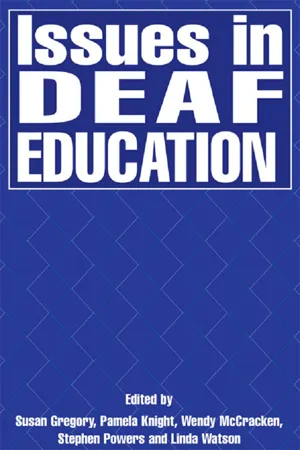
The way in which education is provided for deaf children is changing, as are the demands made on teachers, both in special settings and in mainstream schools. This book offers a comprehensive account of recent research and current issues in educational policy, psychology, linguistics and audiology, as they relate to the education of the deaf and includes detailed information about further reading. It should be of interest to student teachers and teachers of the deaf, teachers in mainstream schools, academics working in the area of deafness and disability, audiologists and cochlear implant teams, parents of deaf children, and members of the deaf community.
- 306 pages
- English
- ePUB (mobile friendly)
- Available on iOS & Android
eBook - ePub
Issues in Deaf Education
About this book
Information
SECTION 1
THE DEVELOPING DEAF CHILD AND YOUNG PERSON
Introduction
This section takes a number of perspectives on the developing deaf child and young person. The first three chapters focus on different aspects of development; relationships, personality and cognition. These general areas, while not always considered in looking at issues in education, have clear implications for teachers and those involved in making educational decisions. The last two chapters take particular groups of deaf children as their focus; those that have additional special needs and those from minority ethnic groups. While much that is written about deaf children in general also applies to these groups, the education of these pupils raises particular issues which are considered here.
In their chapter, Susan Gregory and Pamela Knight look at the social development of deaf children and young people, both within their families and in their relationships with their peers. They point out that for deaf children and their families there are a number of issues with implications for education. In addition, language and communication choices are often seen as an educational issue, but they have far-reaching consequences for the family and for friendship patterns. While educational decisions about school placement that are made for deaf pupils will often focus on those aspects that are specifically educational such as access to the curriculum, their relationship with peers is also significant for their experience of the educational process. Later as the deaf young person leaves school, their transition to work or college will be affected by social factors as well as educational attainment.
The notion of deaf personality, whether deaf people have particular personality characteristics, has been explored in the literature for many years. Often the notion of a deaf personality has been used to suggest that deaf people are immature or inadequate in some way. Sharon Ridgeway describes this research and looks at some of the implications. She also considers in depth the related notion of Deaf identity. This suggests that Deaf people who are members of the Deaf community and are sign language users, identify with other Deaf people and thus have a Deaf identity. Of course, not all deaf people do identify with the Deaf community, and some may identify with both the hearing and Deaf communities. Ridgeway looks, in particular, at the importance of Deaf identity for those deaf children who grow up to have sign language as their first or preferred language and considers the implications for mental health and development.
A further issue is whether deaf children think and process information differently as, if they do, this has implications for education. Early studies of the relationship between deafness and cognition suggested that deaf people could be considered as without language, a view now discounted. In her chapter Mairead MacSweeeney explores the evidence relating to deaf children’s cognition in some detail, looking particularly at IQ and short-term memory. She examines the impact of deafness and use of sign language at both neurological and perceptual levels. She also discusses the evidence relating to the importance of early exposure to language for language development.
A substantial minority of deaf children have additional disabilities, but as Wendy McCracken points out in her chapter, there is lack of understanding of the nature of this group or issues that they pose for education. McCracken considers a range of factors including identification, aetiology, incidence and heterogeneity that are important in considering this population. She also looks at the education of particular groups including those with learning difficulties and those with multi-sensory impairments. In considering how education can best be provided for these pupils, McCracken considers the importance of auditory assessment and decisions about communication. As she argues, in all of these areas, appropriate training of teachers is crucial.
There are particular issues that arise for children and families from minority ethnic communities beyond those that are concerns for all families with deaf children. In their chapter, Rampaul Chamba, Waqar Ahmad, Aliya Darr and Lesley Jones consider Asian deaf children and discuss issues of language, communication and identity and how they impact on education. They consider the complexity of the choices that may face families, particularly with respect to decisions about language and mode of communication. These are set in the wider context of culture, ethnicity and perceptions of deafness. The need for teachers to be more aware of these issues is a theme of this chapter.
Susan Gregory
Chapter 1.1
Social development and family life
Introduction
In this chapter we look at the social development of deaf children and young people, both within their families and in their relationships with their peers. For deaf children and their families there are a number of issues with implications for education. These include the impact of diagnosis of deafness on the family and the subsequent language and communication choices that are made within the family. Patterns of interaction and family relationships are important, not simply in terms of the immediate family, parents and siblings, but also those relationships with the extended family, including grandparents. While educational decisions about school placement that are made for deaf pupils will often focus on those aspects that are specifically educational such as access to the curriculum, their relationship with peers is also significant for the pupils’ experience of the educational process. Later as the deaf young person leaves school for work or college, their transition will be effected by social factors as well as educational attainment.
The impact of deafness on the family
To have a child diagnosed as deaf has far-reaching effects on the family as it becomes a family with a disabled child and the focus of professional advice and attention. Some of those decisions which with hearing children are made relatively easily, e.g. school placement, have to be explicitly thought out by the family with a deaf child and subsequently they may be more dependent on professionals for information about what to expect of their child rather than on friends and relations (for a discussion of these issues see Gregory 1991.)
While these issues may not all be apparent to families at the time of the initial diagnosis, to have a child who is deaf is completely unexpected for most hearing and some deaf parents. Most hearing parents will never have met a deaf person before and have little idea what deafness means. It is not therefore surprising that parental and family reaction to the diagnosis of deafness in their child is strong and variable. Erting (1992) describes two very different reactions from parents. She describes how a mother recalled feeling scared when she and her husband first realised that their daughter (Cathy) was deaf. The father remembers feeling disappointed, more for his daughter than himself. She goes on to say that for others the discovery of deafness is not a tragedy. She describes a father holding his daughter (Mary) and crying for joy. She accounts for these contrasting reactions very simplistically: ‘of course, the essential difference between the first set of parents and the second is that Cathy’s parents are hearing and Mary’s parents are deaf’ (p. 29). There can be no automatic assumption, however, that all deaf parents will welcome the news of a deaf child. For Sutherland (1991) who is deaf herself, and therefore in a position to understand what deafness means, admits to being completely taken aback. ‘Deep down I knew he was deaf but to be stone deaf was extremely rare ... to say I was a bit upset was an under-statement.’ (p. 29) Nevertheless it is generally accepted that deaf parents will respond more positively to the birth of a deaf child than hearing parents (Freeman, Carbin and Boese 1981) particularly if sign language is the language of the home.
Ninety per cent of deaf children are born to hearing families and, in the context of this chapter, concerns surrounding the impact of diagnosis and parental reactions will focus on these hearing families. It is recognised that the initial reactions of hearing parents to the diagnosis of a deaf child are likely to be negative, highly emotional and have a profound effect on the family (Luterman and Ross 1991, Moores 1996). Gregory et al. (1995) report that the memory of the moment of diagnosis is often indelibly fixed on parents’ minds, such that they can remember verbatim what was said many years later. Some have likened the periods of stress felt by the family to a bereavement (Moores 1996). Mahshie (1995) asserts that the impact is on the family. ‘It is the family, not the child, that is in turmoil’ (p. 63). As far as the deaf children themselves are concerned ‘all is well’ (p. 63).
Although there is an accumulated body of knowledge about the impact of deafness on a family, nevertheless for each individual family it is a different process which has to develop in its own unique way. Erting (1992) identifies some common parental needs, at the time of diagnosis:
• emotional support ‘through the crisis to a new vision of themselves as parents’ (p. 39)
• information on all aspects of deafness
• experience of meeting deaf adults and other children and their families
• guidance through possible education programmes
• establishment of a route to communication with their child.
Moores (1996) comments on the importance of acknowledging that families go through periods of stress throughout the child’s development. Often families are described as whether or not they have come to terms with the deafness, but coming to terms may mean different things at different ages. Some parents find the deafness of a baby relatively easy to accept but have great difficulty with a deaf teenager (Gregory et al. 1995). Problems within families seem to arise at times of transition. Moores (1996) highlights four significant periods during the families’ development. First, the time of diagnosis brings overwhelming feelings of inadequacy and a lack of knowledge. Secondly, there is the entrance of their child into the formal school situation which involves both changes in family relationships and parents in critical choices in relation to educational placement. Thirdly, adolescence brings its own tensions to the family and for the deaf child there may be additional feelings of the lack of a positive identity, both within the family and the wider social community. Finally, there are tensions in the family as the young deaf adult prepares to leave the nuclear family and begin an independent existence.
Language choice and the family
Often the earliest choices made about the form and language to use with the deaf child are made within the family. In families where one or both parents are deaf the choice is often, though not inevitably, sign language. Where parents are hearing, the choice is more complex and the variety of language and modes available means that for parents there is an issue about language and communication. Factors effecting language choice and use can be many and diverse. Some will be related to early advice, as until recently, the positive choice to use sign with deaf infants was rare and unsupported by professional advice. The choice of language is more than a pragmatic one relating to ease of communication, and the relationships with other family members and friends may have to be taken into account. For those children whose hearing loss falls within the mild/moderate categories, the chosen mode of communication by both child and the family is likely to be a spoken one: that of the home. While this may seem initially less problematic for the family, there are issues of language and communication for these families although these receive less attention in the literature. Spoken language may seem the language which potentially provides communication with the largest number of family members but may be difficult for some deaf children to acquire. While the choice to sign may enhance communication, it may also marginalise some family members. Many studies show that even when parents or other members learn to sign they do not necessarily acquire high levels of competency but rather more basic day-to-day communication (Foster 1996). If few hearing family members achieve competence in the use of sign it can mean that the burden of communication can fall on one or two family members and marginalise others. This can have wide-ranging effects for relationships within the family.
Roles within the family
It is often the mother who becomes the most effective communicator with their child which can effect the nature of the relationship. While this may be very satisfying and at one level very helpful, it can also create a burden (Luterman and Ross 1991). In effect, mother may become recipient of all information and experience and regarded as the fount of knowledge and information. This creates pressure both to understand and absorb the information open to her and to transmit it to a wide variety of other people. It places her in the role of interpreter in many situations, where instead of being able to develop her position as a mother, she becomes the child’s intermediary (Luterman and Ross 1991). This may not only be in social situations but also in more relaxed home-based settings. The result of these two factors, the mother as the source of information and as the effective communicator, is that she may be carrying a heavy and disproportionate burden in the context of the whole family. This may be reflected in other members, particularly fathers, becoming both deskilled and unsure of their role, leading to a possible imbalance in family dynamics with resulting areas of stress.
The role of parents in fostering the cognitive and linguist development of their own children is accepted and implicit in the parenting role. Parents with deaf children are often expected to take a more explicit and conscious teaching role (Meadow 1980; Gregory 1991). This can interfere with the fundamental parenting role in that it can affect both the child–parent relationship and the style of interaction and linguistic input. Making behaviour explicit, which is usually implicit, can change the nature of that behaviour. For example, focusing a parent’s attention on aspects of their own behaviour and communication can prevent them taking the child’s perspective in a way that is characteristic of much early parental interaction with hearing children. Professional support to parents should highlight the fact that teaching is incidental to parenting, ‘it should never try to make teachers of parents’ (Luterman and Ross 1991, p. 37).
Interactions in the family
The child’s early interaction within the family and the importance of them for their social and linguistic development is well documented and the nature and quality of these interactions are explored further in Section 2, Chapter 2.1. However the diagnosis of deafness in a hearing family can disrupt the relationship between parents and children (Bouvet 1990, Gregory and Barlow 1989), brought about by parental feelings about the deafness. While parents are the most appropriate people to foster that early linguistic development in their own children, at the time these skills are needed they may have very substantial emotional needs of their own (Erting 1992).
As the child becomes older, regardless of the means of communication, there are issues relating to the dynamics of communication in the family. While one-to-one communication may be relatively straightforward, group or family communication can be more difficult, whatever the means of communication used. In a study of hearing families with deaf sons or daughters (Gregory et al. 1995), many parents reported difficulties in communication, described in terms of a loss of immediacy or difficulty in explaining issues they felt need explaining. Often, the problems arose, not through reluctance to communicate, but because communication within the family could be an effort, and some family members could feel excluded. Sometimes extra attention was given to managing social situations and often the mother assumed significant responsibilities for communication. Sometimes specific plans had to be implemented to allow a deaf son or daughter to join in. Often parents were aware of a responsibility in conveying information and consciously took steps to do so. These difficulties were not a consequence of deafness per se but of the nature of communication at the interface between deaf and hearing world.
In this study, deaf young people themselves reported feeling left out of family gatherings or, alternatively, feeling embarrassed by attempts to involve them. An indication of the way in which deaf young people could be left out is the finding that often parents assumed that the deaf person was aware of information that was generally known in the family, even though they were not. The young people were asked whether there were important family matters that they had not known about until a later time and four out of five of those responding said that had happened to them. The events included such major family occurrences as deaths in the family, pregnancy, marital breakdown. This clearly has implications for their relationships within the family and notions of being a family member.
Family relationships and the extended family
Moores argues that the practice of viewing the ‘deaf child as a member of a hearing family’ is potentially negative (Moores 1996). He suggests that the birth of any child into a family fundamentally changes the nature of that family unit. The family changes into a new stage of adjustment with disruption to the previous family routine. The advent of a deaf child in the family similarly changes the nature of the family. By continuing to view them as a hearing family with a deaf child, the implication is that the child is differ...
Table of contents
- Cover Page
- Title Page
- Copyright Page
- Contents
- Acknowledgement
- List of Contributors
- General introduction
- Section 1 The Developing Deaf Child and Young Person
- Section 2 Language and Communication
- Section 3 Teaching and Learning
- Section 4 Audiology
- Section 5 The Context of the Education of Deaf Children
- Bibliography
- Index
Trusted by 375,005 students
Access to over 1.5 million titles for a fair monthly price.
Study more efficiently using our study tools.
Frequently asked questions
Yes, you can cancel anytime from the Subscription tab in your account settings on the Perlego website. Your subscription will stay active until the end of your current billing period. Learn how to cancel your subscription
No, books cannot be downloaded as external files, such as PDFs, for use outside of Perlego. However, you can download books within the Perlego app for offline reading on mobile or tablet. Learn how to download books offline
We are an online textbook subscription service, where you can get access to an entire online library for less than the price of a single book per month. With over 1.5 million books across 990+ topics, we’ve got you covered! Learn about our mission
Look out for the read-aloud symbol on your next book to see if you can listen to it. The read-aloud tool reads text aloud for you, highlighting the text as it is being read. You can pause it, speed it up and slow it down. Learn more about Read Aloud
Yes! You can use the Perlego app on both iOS and Android devices to read anytime, anywhere — even offline. Perfect for commutes or when you’re on the go.
Please note we cannot support devices running on iOS 13 and Android 7 or earlier. Learn more about using the app
Please note we cannot support devices running on iOS 13 and Android 7 or earlier. Learn more about using the app
Yes, you can access Issues in Deaf Education by Ruth Swanwick in PDF and/or ePUB format, as well as other popular books in Education & Education General. We have over 1.5 million books available in our catalogue for you to explore.