- 240 pages
- English
- ePUB (mobile friendly)
- Available on iOS & Android
eBook - ePub
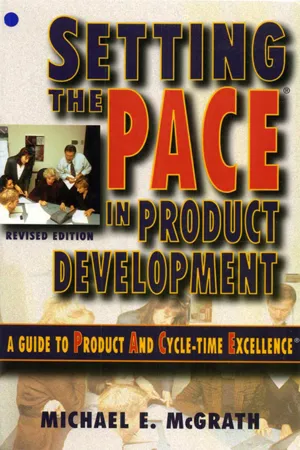
Setting the PACE in Product Development
About this book
Setting the PACE in Product Development describes how to effectively manage the key ingredients of successful product development: time, quality, talent and resources.
This revised edition of Product Development provides essential insight as to how to efficiently organize people, resources and processes to dramatically improve financial results, strategic positions, internal morale and customer satisfaction. The PACE techniques integrate vital company-wide functions, engaging the entire company and focusing its collective energy on strategically and financially important goals.
Chapter 1
The Dramatic Change Taking Place in Product Development
Michael E. McGrath
In the first edition, published in 1992, we declared that product development would be the industrial battleground of the 1990s and into the next century, just as manufacturing was the industrial battleground of the 1970s and 1980s. Not only has this happened, but the impact is even greater than we had imagined.
The advantages that come from cutting time-to-market in half and consistently developing better products are so significant that the competitive balance in some industries is changing in favor of companies that can achieve these goals first. Companies introducing more new products, reacting faster to market and technology changes, and developing superior products are winning the battle over competitors.
There are many similarities between the change that took place in manufacturing in previous decades and the change taking place in product development today. Each is significant enough to achieve a real competitive advantage and is sustainable through continual improvement. In each case, the opportunity stems from redefining the underlying process using new management concepts.
The benefits attained by improving product development can be strategically significant, including increased revenue, improved development productivity, and operational efficiencies. Understanding the expected benefits establishes the performance levels that companies should expect from improving their product development processes. This is important because some companies mistakenly think that they have already made sufficient changes to their product development processes, even though they have not seen a significant performance improvement.
Benefits of a More Effective Product Development Process
For most companies, improving the product development process will have a greater strategic impact than any other improvement they can make. They will grow faster. They will react to opportunities and threats faster than their competitors. They will significantly improve product development productivity and increase efficiencies in other operational areas as well.
Faster time-to-market is the most visible improvement, but as time-to-market improves, many other benefits result. And time-to-market has been steadily improving.
A 1995 benchmarking study on product development showed an average improvement in time-to-market of almost 10% from 1992 to 1994.1 However, this average improvement was not the result of every company improving by 10%; it came from a small percentage of companies making significant improvements while the rest made little or none. As can be seen in Figure 1-1, the best-in-class companies (top 20%) had a time-to-market of 50% or less of the other companies in their industry. While this difference varies a little by industry, it was almost 50% in all technology-based industries. Figure 1-1 also shows the trend expected. While other companies expect to improve time-to-market by 40% by 1998, they will still not be where the best-in-class companies are today, and the best-in-class will continue to get even better.

Figure 1–1 Comparative improvement in time-to-market (TTM) in technology-based companies.
In our experience, most companies can cut time-to-market in half with a better product development process. For example, the Codex division of Motorola cut its average product development time by 46% over a two-year period.2 Similarly, Bolt, Beranek and Newman dramatically reduced time-to-market by 50%-60% for the first product developed with its new process.3
Increased Revenue
In most companies, significant improvements in time-to-market can fuel revenue growth, at least until competitors catch up by improving their own product development processes. Alternatively, if competitors are able to improve their product development process first, a company may see a decline in revenue.
Figure 1-2 clearly illustrates this difference in electronic systems companies.4 The best-in-class companies have a much higher concentration of new products. Two years out, 75.3% of their revenue comes from new products, compared to a median of 44.7%. An increased level of new products usually leads to faster growth. It may also produce more profit, since new products can frequently be priced higher.

Figure 1–2 New product revenue as a percentage of total revenue in electronic systems companies.
Higher new product revenue comes from increased product life-cycle revenue, increased market penetration, success in time-sensitive markets, and more successful products.
Increased Product Life-Cycle Revenue
A significant improvement in time-to-market increases revenue throughout a product’s life cycle. Figure 1-3 illustrates how this happens. The lightly shaded curve represents a typical product life cycle of approximately four years, with a ramp-up in the beginning, a peak after two and one-half years, and then a ramp-down until the product is terminated or replaced by a newer product.
When a product is first introduced, early adopters are the primary customers. The broader base of customers beyond early adopters may be reluctant to try new products too early. Some customers are interested in trying one before they buy more, and more potential customers need to become aware of the new product before sales begin to climb. The image and reputation of the product need to develop.

Figure 1–3 Product life-cycle curves with normal and faster time-to-market.
Sales climb substantially if the new product satisfies customers. Early adopters will continue purchasing, and more conservative customers will begin to follow their lead. New competitors may enter the market at this point, and existing competitors will introduce new product features in an attempt to expand the total market.
Eventually sales growth slows as the product enters a state of relative maturity. After a period of little or no growth, sales eventually decrease in the face of improved products from competitors or replacement products. At this point, most companies cease manufacturing and selling the product.
When a new product is brought to market earlier, it not only generates incrementally higher sales in the initial period but also maintains higher sales throughout its life cycle. This can be seen graphically in Figure 1-3, in which the darker-shaded curve shows product sales with a reduction of 45% in development time. Frequently there is a misconception that the only sales difference occurs during the time period from when the product could have been on the market to when it was actually introduced. While there are earlier revenues, there are also higher revenues at every stage of the product’s life. Whenever a product is released to market, it follows a life-cycle curve. Incremental revenue accumulates every year until the peak is reached, and the peak is frequently higher for the earlier entry. Only in the last half of the life cycle may the rates converge.
Increased Market Penetration as a Result of Being First to Market
A product that is first to market has the potential to establish a leadership position in the market. This potential can arise from three sources: being the first to respond to a new market opportunity, being the first to apply new technology, or being able to respond more quickly to changes in the market. The vice-chairman of Conner Peripherals, Bill Schroeder, stated this succinctly: “The first guy to market cleans up.”5
Apple Computer was the first to respond to the opportunity for improving ease of use in personal computers with the Lisa and then the Macintosh computers. The Lisa did not succeed because of its high price, but Apple was able to deliver the same icon-based user interface in the lower-priced Macintosh before any other similar interface hit the market. This enabled it to significantly differentiate its personal computer and capture a specific segment of the market. If another personal computer company had beaten Apple to market with a user-friendly graphical interface, the Macintosh would have been much less successful.
Motorola (the former Codex division) was able to beat competitors to market with a new modem (CyberSURFER) that enabled connection to Internet and other on-line services over cable TV lines. Personal computers can run on the World Wide Web 1,000 times faster using this product. Motorola developed CyberSURFER in twelve months and immediately received significant orders from the major cable operators.
In some volume-sensitive industries, the competitor who captures significant market share first is likely to be the low-cost producer. Costs continue to decline with experience, and second-tier competitors can never be as profitable.
Being first to market, however, does not always guarantee success. EMI developed the original CAT scanner but did not have the support and service necessary to be successful. Competitors such as GE and Technicon offered better service and support and were capable of developing a successful product. In 1979 EMI received the Nobel prize for the CAT scanner, but the company had to be acquired in order to be saved.
Success in Time-Sensitive Markets
In some industries, the windows of market opportunity remain open for only a short time. In these cases, the ability to make any sales at all depends on time-to-market. Customer-specific components such as custom semiconductor devices fall into this category. If a company can develop the component in time for it to be designed into the customer’s end product, then the company may be able to get that customer’s business; if it can’t, a competitor gets it. Time-to-market and predictability become sources of significant competitive advantage in industries such as these.
The computer workstation market is an example of a time-sensitive market. Most workstations are purchased by systems integrators, companies that integrate their own proprietary equipment and applications software into a system that they sell to specific users. While the life cycle of a new generation of workstations may be three to four years, the systems integrator selects the workstation around which it will build its system very quickly after the release of a new generation.
Sun Microsystems believes that it has only a year to convince customers to buy its new products. If customers select Sun in that first year, they are likely to continue to order products for another three or four years. If Sun is late by a year, however, the company feels it has missed the market. At the end of 1985, Sun introduced the Sun 3 product line to replace the Sun 2 product line introduced in 1983. The Sun 3 was developed in approximately one year, giving Sun a significant advantage. Because it came to market sooner, more systems integrators selected it as the basis for their systems. Sun Microsystems’ revenue skyrocketed from $115 million in 1985 to more than $1 billion in three years. Sun’s market share also leaped from 16% to 28%, while that of its major competitor, Apollo, dropped from 51% to 31%.
More Successful Products
Our experience in improving product development processes has also shown dramatic improvement in the success of new products. This stems from some of the aspects of a better process, such as the synergy of having people work more closely together, the design improvements of a more methodical process, and the impact of better decision making. Marketing and engineering, for example, can make better trade-offs and find new opportunities. When this is combined with the discipline of a more structured process, it helps to define the right characteristics for the product.
Sometimes overlooked as a benefit is how shorter time-to-market provides an advantage in defining product requirements. The opportunity and requirements for a new product are defined at the beginning of a product development project, but the market can change during the time it takes to develop the product. Customers may become interested in different features. Prices may drop. Competitors may introduce new, more innovative products.
A shorter product development cycle reduces the interval during which market conditions can change while the product is being developed. As Figure 1-4 shows, the accuracy in estimating market conditions declines further in the future, usually with a precipitous drop at some point. While the slope of this curve varies, the shorter the time horizon, the greater the accuracy. A shorter development cycle also enables a company to respond more rapidly to emerging market opportunities. With product development flexibility, a company can be much more market oriented and respond much more quickly to customer needs.

Figure 1–4 Increased accuracy in anticipating customer requirements comes from faster time-to-market.
Improved Product Development Productivity
Product development productivity does not come from working people harder. Motivating developers to work day and night only temporarily increases capacity and can reduce overall effectiveness. Increased product development productivity is derived from shorter cycle times, less development waste, better resource utilization, and the ability to attract the best people. Again, the parallels to improvements in manufacturing should be obvious.
Shorter Development Cycle Times
Most product development investments are run-rate based, meaning that a certain number of people work on a product development project until it is completed. For example, twenty people may work on developing a new product for three years. Development costs are highly correlated to cycle time: if the cycle time is reduced, development costs are lower. This is the same relationship between cost and cycle time that exists in manufacturing. The relationship between project cost and development cycle time is shown in Figure 1-5.
With an improved process, product development cycle time is reduced and project costs go down. In the previous example, if the project could be completed in one and one-half years (half the time), it would not require forty people (although it may require a few more than twenty to remove some constraints). Therefore, the project cost would be lower. This cost reduction, while related to the reduction in cycle time, is not directly proportional because other costs, such as capital equipment, tooling, and outside expenses, may not be reduced with shorter cycle time. We have found that a 50% reduction in product development cycle time typically leads to direct reduction of development costs of between 30% and 35%.

Figure 1–5 Relationship of product development cycle time and project cost.
The resources saved through increased productivity can be reinvested in additional product development projects to bring more new products to market, or a company can reduce the total amount of money it spends on developing new pr...
Table of contents
- Cover
- Half Title
- Title Page
- Copyright
- Dedication
- Table of Contents
- Preface
- 1. The Dramatic Change Taking Place in Product Development
- 2. PACE: An Integrated Process for Product And Cycle-time Excellence
- 3. The Phase Review Process and Effective Decision Making
- 4. The Core Team Approach to Project Organization
- 5. Structured Product Development
- 6. Design Techniques and Automated Development Tools
- 7. The Process of Product Strategy
- 8. Technology Management
- 9. Pipeline Management
- 10. Stages in the Evolution of the Product Development Process
- 11. Implementing PACE: How to Make It Real and Make It Lasting
- Glossary
- Index
Trusted by 375,005 students
Access to over 1.5 million titles for a fair monthly price.
Study more efficiently using our study tools.
Frequently asked questions
Yes, you can cancel anytime from the Subscription tab in your account settings on the Perlego website. Your subscription will stay active until the end of your current billing period. Learn how to cancel your subscription
No, books cannot be downloaded as external files, such as PDFs, for use outside of Perlego. However, you can download books within the Perlego app for offline reading on mobile or tablet. Learn how to download books offline
Perlego offers two plans: Essential and Complete
- Essential is ideal for learners and professionals who enjoy exploring a wide range of subjects. Access the Essential Library with 800,000+ trusted titles and best-sellers across business, personal growth, and the humanities. Includes unlimited reading time and Standard Read Aloud voice.
- Complete: Perfect for advanced learners and researchers needing full, unrestricted access. Unlock 1.5M+ books across hundreds of subjects, including academic and specialized titles. The Complete Plan also includes advanced features like Premium Read Aloud and Research Assistant.
We are an online textbook subscription service, where you can get access to an entire online library for less than the price of a single book per month. With over 1.5 million books across 990+ topics, we’ve got you covered! Learn about our mission
Look out for the read-aloud symbol on your next book to see if you can listen to it. The read-aloud tool reads text aloud for you, highlighting the text as it is being read. You can pause it, speed it up and slow it down. Learn more about Read Aloud
Yes! You can use the Perlego app on both iOS and Android devices to read anytime, anywhere — even offline. Perfect for commutes or when you’re on the go.
Please note we cannot support devices running on iOS 13 and Android 7 or earlier. Learn more about using the app
Please note we cannot support devices running on iOS 13 and Android 7 or earlier. Learn more about using the app
Yes, you can access Setting the PACE in Product Development by Michael E. McGrath in PDF and/or ePUB format, as well as other popular books in Business & Business General. We have over 1.5 million books available in our catalogue for you to explore.