- 336 pages
- English
- ePUB (mobile friendly)
- Available on iOS & Android
eBook - ePub
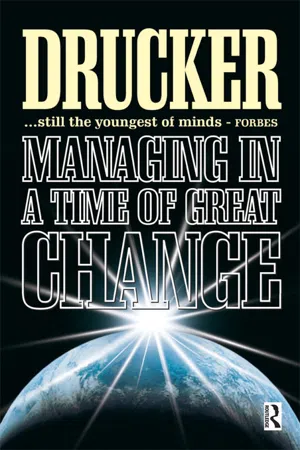
Managing in a Time of Great Change
About this book
'It is not so very difficult to predict the future. It is only pointless...what is always far more important are fundamental changes that happened though no one predicted them or could possible have predicted them.' (quote taken from this book)
It is these unpredictable and irreversible changes from the past, and their effect on the role of the executive which Peter Drucker examines in his latest book.
The management of change is a subject which has been, undoubtedly, the principal preoccupation of management thinkers in the 1990s. Peter Drucker, the guru's guru, brings together a group of his own original essays and interviews on this vitally important topic. As ever, he provides invaluable food for thought for all executives and students of business and management.
Part One
Management
1
The theory of the business
Not in a very long time – not, perhaps, since the late 1940s or early 1950s – have there been as many new major management techniques as there are today; downsizing, outsourcing, total quality management, economic value analysis, benchmarking, re-engineering. Each is a powerful tool. But with the exceptions of outsourcing and re-engineering, these tools are designed primarily to do differently what is already being done. They are ‘how-to-do’ tools.
Yet what to do is increasingly becoming the central challenge facing managements, especially those of big companies that have enjoyed long-term success. The story is a familiar one: a company that was a superstar only yesterday finds itself stagnating and frustrated, in trouble and, often, in a seemingly unmanageable crisis. This phenomenon is by no means confined to the United States. It has become common in Japan and Germany, The Netherlands and France, Italy and Sweden. And it occurs just as often outside business – in labour unions, government agencies, hospitals, museums, and churches. In fact, it seems even less tractable in those areas.
The root cause of nearly every one of these crises is not that things are being done poorly. It is not even that the wrong things are being done. Indeed, in most cases, the right things are being done – but fruitlessly. What accounts for this apparent paradox? The assumptions on which the organization has been built and is being run no longer fit reality. These are the assumptions that shape any organization’s behaviour, dictate its decisions about what to do and what not to do, and define what the organization considers meaningful results. These assumptions are about markets. They are about customers and competitors, their values and behaviour. They are about technology and its dynamics, about a company’s strengths and weaknesses. These assumptions are about what a company gets paid for. They are what I call a company’s theory of the business.
Every organization, whether a business or not, has a theory of the business. Indeed, a valid theory that is clear, consistent, and focused is extraordinarily powerful. In 1809, for instance, the German statesman and scholar Wilhelm von Humboldt founded the University of Berlin on a radically new theory of the university. And for more than one hundred years, until the rise of Hitler, his theory defined the German university, especially in scholarship and scientific research. In 1870, George Siemens, the architect and first CEO of Deutsche Bank, the first universal bank, had an equally clear theory of the business: to use entrepreneurial finance to unify a still rural and splintered Germany through industrial development. Within twenty years of its founding, Deutsche Bank had become Europe’s premier financial institution, which it has remained to this day in spite of two world wars, inflation, and Hitler. And in the 1807s, Mitsubishi was founded on a clear and completely new theory of the business, which within ten years made it the leader in an emerging Japan and within another twenty years made it one of the first truly multinational businesses.
Similarly, the theory of the business explains both the success of companies like General Motors and IBM, which have dominated the US economy for the latter half of the twentieth century, and the challenges they now face. In fact, what underlies the current malaise of so many large and successful organizations worldwide is that their theory of the business no longer works.
Whenever a big organization gets into trouble – and especially if it has been successful for many years – people blame sluggishness, complacency, arrogance, mammoth bureaucracies. Plausible explanations? Yes. But rarely relevant or correct. Consider the two most visible and widely reviled ‘arrogant bureaucracies’ among large US companies that have recently been in trouble.
Since the earliest days of the computer, it had been an article of faith at IBM that the computer would go the way of electricity. The future, IBM knew and could prove with scientific rigour, lay with the central station, the ever more powerful mainframe into which a huge number of users could plug. Everything – economics, the logic of information, technology – led to that conclusion. But then, suddenly, when it seemed as if such a central-station, mainframe-based information system was actually coming into existence, two young men came up with the first personal computer. Every computer maker knew that the PC was absurd. It did not have the memory, the database, the speed, or the computing ability necessary to succeed. Indeed, every computer maker knew that the PC had to fail – the conclusion reached by Xerox only a few years earlier, when its research team had actually built the first PC. But when that misbegotten monstrosity – first the Apple, then the Macintosh – came on the market, people not only loved it, they bought it.
Every big, successful company throughout history, when confronted with such a surprise, has refused to accept it. ‘It‘s a stupid fad and will be gone in three years,’ said the CEO of Zeiss upon seeing the new Kodak Brownie in 1888, when the German company was as dominant in the world photographic market as IBM would be in the computer market a century later. Most mainframe makers responded in the same way. The list was long: Control Data, Univac, Burroughs, and NCR in the United States; Siemens, Nixdorf, Machines Bull, and ICL in Europe; Hitachi and Fujitsu in Japan. IBM, the overlord of mainframes with as much in sales as all the other computer makers put together and with record profits, could have reacted in the same way. In fact, it should have. Instead, IBM immediately accepted the PC as the new reality. Almost overnight, it brushed aside all its proven and time-tested policies, rules, and regulations and set up not one but two competing teams to design an even simpler PC. A couple of years later, IBM had become the world’s largest PC manufacturer and the industry standard setter.
There is absolutely no precedent for this achievement in all of business history; it hardly argues bureaucracy, sluggishness, or arrogance. Yet despite unprecedented flexibility, agility, and humility, IBM was floundering a few years later in both the mainframe and the PC business. It was suddenly unable to move, to take decisive action, to change.
The case of GM is equally perplexing. In the early 1980s – the very years in which GM’s main business, passenger cars, seemed almost paralysed – the company acquired two large businesses: Hughes Electronics and Ross Perot’s Electronic Data Systems. Analysts generally considered both companies to be mature and chided GM for grossly overpaying for them. Yet within a few short years, GM had more than tripled the revenues and profits of the allegedly mature EDS. And ten years later, in 1994, EDS had a market value six times the amount that GM had paid for it and ten times its original revenues and profits.
Similarly, GM bought Hughes Electronics – a huge but profitless company involved exclusively in defence – just before the defence industry collapsed. Under GM management, Hughes has actually increased its defence profits and has become the only big defence contractor to move successfully into large-scale non-defence work. Remarkably, the same bean counters who had been so ineffectual in the car business – thirty-year GM veterans who had never worked for any other company or, for that matter, outside of finance and accounting departments – were the ones who achieved those startling results. And in the two acquisitions, they simply applied the policies, practices, and procedures that had always been used by GM.
This story is a familiar one at GM. Since the company’s founding in a flurry of acquisitions eighty years ago, one of its core competencies has been to ‘overpay’ for well-performing but mature businesses – as it did for Buick, AC Spark Plug, and Fisher Body in those early years – and then turn them into world-class champions. Very few companies have been able to match GM’s performance in making successful acquisitions, and GM surely did not accomplish those feats by being bureaucratic, sluggish, or arrogant. Yet what worked so beautifully in those businesses that GM knew nothing about failed miserably in GM itself.
What can explain the fact that at both IBM and GM the policies, practices, and behaviours that worked for decades – and in the case of GM are still working well when applied to something new and different – no longer work for the organization in which and for which they were developed? The realities that each organization actually faces have changed quite dramatically from those that each still assumes it lives with. Put another way, reality has changed, but the theory of the business has not changed with it.
Before its agile response to the new reality of the PC, IBM had once before turned its basic strategy around overnight. In 1950, Univac, then the world’s leading computer company, showed the prototype of the first machine designed to be a multipurpose computer. All earlier designs had been for single-purpose machines. IBM’s own two earlier computers, built in the late 1930s and 1946 respectively, performed astronomical calculations only. And the machine that IBM had on the drawing board in 1950, intended for the SAGE air defence system in the Canadian Arctic, had only one purpose: early identification of enemy aircraft. IBM immediately scrapped its strategy of developing advanced single-purpose machines; it put its best engineers to work on perfecting the Univac architecture and, from it, designing the first multipurpose computer able to be manufactured (rather than handcrafted) and serviced. Three years later, IBM had become the world’s dominant computer maker and standard bearer. IBM did not create the computer. But in 1950, its flexibility, speed, and humility created the computer industry.
However, the same assumptions that had helped IBM prevail in 1950 proved to be its undoing thirty years later. In the 1970s, IBM assumed that there was such a thing as a ‘computer’, just as it had in the 1950s. But the emergence of the PC invalidated that assumption. Mainframe computers and PCs are, in fact, no more one entity than are generating stations and electric toasters. The latter, while different, are interdependent and complementary. In contrast, mainframe computers and PCs are primarily competitors. And in their basic definition of information, they actually contradict each other: for the mainframe, information means memory; for the brainless PC, it means software. Building generating stations and making toasters must be run as separate businesses, but they can be owned by the same corporate entity, as General Electric did for decades. In contrast, mainframe computers and PCs probably cannot co-exist in the same corporate entity.
IBM tried to combine the two. But because the PC was the fastest-growing part of the business, IBM could not subordinate it to the mainframe business. And because the mainframe was still the cash cow, IBM could not optimize the PC business. In the end, the assumption that a computer is a computer – or, more prosaically, that the industry is hardware driven – paralysed IBM.
GM had an even more powerful, and successful, theory of the business than IBM had, one that made GM the world’s largest and most profitable manufacturing organization. The company did not have one setback in seventy years – a record unmatched in business history. GM’s theory combined in one seamless web assumptions about markets and customers with assumptions about core competencies and organizational structure.
Since the early 1920s, GM assumed that the US car market was homogeneous in its values and segmented by extremely stable income groups. The resale value of the ‘good’ used car was the only independent variable under management’s control. High trade-in values enabled customers to upgrade their newcar purchases to the next category – in other words, to cars with higher profit margins. According to this theory, frequent or radical changes in models could only depress trade-in values.
Internally, these market assumptions went hand in hand with assumptions about how production should be organized to yield the biggest market share and the highest profit. In GM’s case, the answer was long runs of mass-produced cars with a minimum of changes each model year, resulting in the largest number of uniform yearly models on the market at the lowest fixed cost per car.
GM’s management then translated these assumptions about market and production into a structure of semi-autonomous divisions, each focusing on one income segment and each arranged so that its highest-priced model overlapped with the next division’s lowest-priced model, thus almost forcing people to trade up, provided that used-car prices were high.
For seventy years, this theory worked like a charm. Even in the depths of the Depression, GM steadily gained market share. But in the late 1970s, its assumptions about the market and about production became invalid. The market was fragmenting into highly volatile ‘lifestyle’ segments. Income became one factor among many in the buying decision, not the only one. At the same time, lean manufacturing created an economics of small scale. It made short runs and variations in models less costly and more profitable than long runs of uniform products.
GM knew all this but simply could not believe it. (GM’s union still doesn’t.) Instead, the company tried to patch things up. It maintained the existing divisions based on income segmentation, but each division now offered a ‘car for every purse’. It tried to compete with lean manufacturing’s economics of small scale by automating the large-scale, long-run mass production (losing some $30 billion in the process). Contrary to popular belief, GM patched things up with prodigious energy, hard work, and lavish investments of time and money. But patching only confused the customer, the dealer, and the employees and management of GM itself. In the meantime, GM neglected its real growth market, where it had leadership and would have been almost unbeatable: light trucks and minivans.
A theory of the business has three parts. First, there are assumptions about the environment of the organization: society and its structure, the market, the customer, and technology.
Second, there are assumptions about the specific mission of the organization. Sears, Roebuck and Company, in the years during and following the First World War, defined its mission as being the informed buyer for the American family. A decade later, Marks & Spencer in Great Britain defined its mission as being the change agent in British society by becoming the first classless retailer. AT&T, again in the years during and immediately after the First World War, defined its role as ensuring that every US family and business have access to a telephone. An organization’s mission need not be so ambitious. GM envisioned a far more modest role – as the leader in ‘terrestrial motorized transportation equipment’, in the words of Alfred P. Sloan, Jr.
Third, there are assumptions about the core competencies needed to accomplish the organization’s mission. For example, West Point, founded in 1802, defined its core competence as the ability to turn out leaders who deserve trust. Marks & Spencer, around 1930, defined its core competence as the ability to identify, design, and develop the merchandise it sold, instead of the ability to buy. AT&T, around 1920, defined its core competence as technical leadership that would enable the company to improve service continuously while steadily lowering rates.
The assumptions about environment define what an organization is paid for. The assumptions about mission define what an organization considers to be meaningful results; in other words, they point to how it envisions itself making a difference in the economy and in the society at large. Finally, the assumptions about core competencies define where an organization must excel in order to maintain leadership.
Of course, all this sounds deceptively simple. It usually takes years of hard work, thinking, and experimenting to reach a clear, consistent, and valid theory of the business. Yet to be successful, every organization must work one out.
What are the specifications of a valid theory of the business? There are four.
1 The assumptions about environment, mission, and core competencies must fit reality. When four penniless young men from Manchester, England – Simon Marks and his three brothers-in-law – decided in the early 1920s that a humdrum penny bazaar should become an agent of social change, the First World War had profoundly shaken their country’s class structure. It had also created masses of new buyers for good-quality, stylish merchandise like lingerie, blouses, and stockings – Marks & Spencer’s first successful product categories. Marks & Spencer then systematically set to work developing brand-new and unheard-of core competencies. Until then, the core competence of a merchant was the ability to buy well. Marks & Spencer decided that it was the merchant, rather than the manufacturer, who knew the customer. Therefore, the merchant, not the manufacturer, should design the products, develop them, and find producers to make the goods to his design, specifications, and costs. This new definition of the merchant took five to eight years to develop and to make acceptable to traditional suppliers, who had always seen themselves as ‘manufacturers’, not as ‘subcontractors’.
2 The assumptions in all three areas have to fit one another. This was perhaps GM’s greatest strength in the long decades of its ascendancy. Its assumptions about the market and about the optimum manufacturing process were a perfect fit. GM decided in the mid-1920s that it also required new and as-yet-unheard-of core competencies: financial control of the manufacturing process and a theory of capital allocations. As a result, GM invented modern cost accounting and the first rational capital-allocation process.
3 The theory of the business must be known and understood throughout the organization. That is easy in an organization’s early days. But as it becomes successful, an organization tends increasingly to take its theory for granted, becoming less and less conscious of it. Then the organization becomes sloppy. It begins to cut corners. It begins to pursue what is expedient rather than what is right. It stops thinking. It stops questioning. It r...
Table of contents
- Cover Page
- Half Title Page
- Series
- Title Page
- Copyright Page
- Contents
- Preface
- Acknowledgements
- Interview: The post-capitalist executive
- Part One Management
- Part Two The Information-based Organization
- Part Three The Economy
- Part Four The Society
- 26 Conclusion
- Index
Trusted by 375,005 students
Access to over 1.5 million titles for a fair monthly price.
Study more efficiently using our study tools.
Frequently asked questions
Yes, you can cancel anytime from the Subscription tab in your account settings on the Perlego website. Your subscription will stay active until the end of your current billing period. Learn how to cancel your subscription
No, books cannot be downloaded as external files, such as PDFs, for use outside of Perlego. However, you can download books within the Perlego app for offline reading on mobile or tablet. Learn how to download books offline
Perlego offers two plans: Essential and Complete
- Essential is ideal for learners and professionals who enjoy exploring a wide range of subjects. Access the Essential Library with 800,000+ trusted titles and best-sellers across business, personal growth, and the humanities. Includes unlimited reading time and Standard Read Aloud voice.
- Complete: Perfect for advanced learners and researchers needing full, unrestricted access. Unlock 1.5M+ books across hundreds of subjects, including academic and specialized titles. The Complete Plan also includes advanced features like Premium Read Aloud and Research Assistant.
We are an online textbook subscription service, where you can get access to an entire online library for less than the price of a single book per month. With over 1.5 million books across 990+ topics, we’ve got you covered! Learn about our mission
Look out for the read-aloud symbol on your next book to see if you can listen to it. The read-aloud tool reads text aloud for you, highlighting the text as it is being read. You can pause it, speed it up and slow it down. Learn more about Read Aloud
Yes! You can use the Perlego app on both iOS and Android devices to read anytime, anywhere — even offline. Perfect for commutes or when you’re on the go.
Please note we cannot support devices running on iOS 13 and Android 7 or earlier. Learn more about using the app
Please note we cannot support devices running on iOS 13 and Android 7 or earlier. Learn more about using the app
Yes, you can access Managing in a Time of Great Change by Peter Drucker in PDF and/or ePUB format, as well as other popular books in Business & Management. We have over 1.5 million books available in our catalogue for you to explore.