This edited volume establishes a state-of-the-art perspective on theory and research on gender, power, and communication in human relationships. Both theoretical essays and review chapters address issues relevant to female and male differences in power, dominance, communication, equality, and expectations/beliefs. All chapter contributors share two commonalities. First, each provides a 1990s assessment of power and equality in female and male relationships. Second, each reviews respective programs of research and focuses attention on the relevance of this research to understanding the relationships of women and men.
Unique because it incorporates a multidisciplinary approach to the study of gender and the communication of power in human relationships, this book includes the original work of intellectuals with national and international reputations in the social sciences. The volume provides both scholastic breadth and centralized treatment of issues that form the very foundation of social and personal relationships. It will appeal to scholars working in the disciplines of communication and psychology as well as other areas of social science research.
eBook - ePub
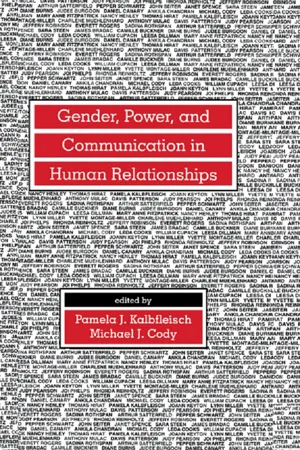
Gender, Power, and Communication in Human Relationships
- 384 pages
- English
- ePUB (mobile friendly)
- Available on iOS & Android
eBook - ePub
Gender, Power, and Communication in Human Relationships
About this book
Information
Part I
Introduction and Overview
Chapter 1
Power and Communication in the Relationships of Women and Men
University of Wyoming
University of Southern California
Men who run the world today are “… a bunch of shallow, bald, middle aged men with character disorders. They don’t have the emotional capacity it takes to qualify as human beings. One good thing about these white, male, almost extinct mammals is that they are growing old. We get to watch them die. ”
—a 36-year-old female trucking-company executive (Gates, 1993, p. 49)
I want everything to be just like it was before.
—D-Fens quoted from the movie, Falling Down
Why this Book Now?
We write the introduction to this volume in January 1994 exactly 1 year after the inauguration of Bill (and Hillary) Clinton. The Clintons promised change, changes in leadership, welfare program, health care program, domestic programs and, of course, changes in women’s roles. Make him president, Bill said, “and you get two for the price of one.” “You do not have to tear a woman down to build a man up,” Clinton admonished during his campaign. Now, 1 year into their term in office, we have witnessed some (limited) changes in public power held by women. Of course, critics are plentiful—changes too slow, changes too fast, or as D-Fens mourns, change should be reversed.
We advocate change in roles for men and women, and our goal in this volume is to chronicle changes, both the changes that are occurring and changes that need to occur. Indeed, all the contributors to this volume are familiar with change: All have devoted considerable attention to women and men in this society and changes that have or that should have occurred. Of course, we are not interested in change just for the sake of change. We are guided by two goals: equality for women and men (in power, income rights and privileges), and improved quality in female/male relationships and human relationships in general. It is clear, considering that what some people have to say (such as those quoted in the introduction), that some women loath men for not changing, and that some men are anxious, defensive, or angry about the changes that have already occurred. Obviously, there is much work to do in order to facilitate change and to improve relationships.
Further, it is clear that all matters concerning relationships between women and men are of paramount interest to scholars and are clearly in the center stage of the public’s focus. Of course, there are (highly visible) stories: reactions to the movie Thelma and Louise, to the Hill-Thomas hearings, to the Tailhook Incident, to the spousal abuse trials of the Bobbitt couple, and so forth. However, general issues are proven to be important every day. Consider a few of the highlights from the Los Angeles Times for 1 week during fall 1993:
Los Angeles Times, September 30, 1993, “Early Obesity Tied to Social, Economic Woes for Women.” by John Schwartz, The Washington Post. This article reports on a publication in the New England Journal of Medicine detailing how overweight women complete less education, are 20% less likely to get married, hold poverty rates at 10% higher than non-obese women, and earn $6,710 less per year than non-obese women. Only one of these findings was replicated for men: Obese men were 11 % less likely to be married than thinner men.
Los Angeles Times, October 2,1993, “Women a Comedy Force? No Joke,” by Chuck Crisafulli, in a “Special to the Times.” The article deals with the fact that women have to work hard to break into the comedy circuit, or find ways to nurture a career outside the “boys’ club” mainstream clubs.
Los Angeles Times, October 2, 1993, “Wilson Signs Bills to Expand Rape Laws,” by Daniel M. Weintraub and Mark Gladstone, Times staff writers. Incredulous as it seems, only in 1993 did the Governor of California (a state accounting for more than 11% of the nation’s population) sign a bill changing the rape laws so that “spousal rape” is now considered a felony, the same as the rape of a stranger. Spousal rape (because of the “assumed consent” for sexual relationships between a husband and a wife) used to warrant a misdemeanor. Governor Pete Wilson also signed a “gender-neutral rape bill” that will now allow women who commit sex crimes with minors to be punished as rigorously as men.
Los Angeles Times, October 4,1993, “Is Violence a Male Hormone Problem?”: “Dear Dr. Brothers... It seems that almost all this tendency to violence is somehow related to testosterone. Has anyone considered a medicine that would lessen the amount of this male hormone and act as an antidote to violence?”
Los Angeles Times’ Youth Opinion, October 4, 1993, “Does Rap Music Disrespect Women, Girls?” As one 17-year-old woman observed:
Rap gives women a bad image when it calls them things like bitch, slut, and whore. Videos make them seem like sex objects. They focus on their bodies, not their intelligence or their minds. All you ever see is girls in bikinis. Guys listen to that music, and it influences how they talk to girls. If guys look up to rappers, that’s a bad role model for them to be following.
Women also give themselves bad images. In Dr. Dre’s song, “Nothing But a G-Thing,” women do things for the video they didn’t have to do if they didn’t want to. Women shouldn’t put themselves in the position of putting themselves down. If they took a stand, it would help the [women’s] cause. (“Does Rap,” 1993, p. E5)
Los Angeles Times, October 5, 1993, “Women’s Groups Re-emerge in Workplace,” from Associated Press. The article details a few successes in the workings of a “Women’s Advisory Committee” that promotes the advancement of women in top positions of management. Indeed, J.C. Penney is credited with creating such an advisory committee 3½ years ago in order to help place more women in senior positions. The history of such advisory committees, however, is not overly positive. When such “networking” groups were formed in the 1970s, many were discouraged by management because they were perceived as “adversarial.” Still, some died out in the early 1980s when women did make some advances on managerial positions. Frustration with employment during the last recession has prompted networking groups (or “mentoring” partnerships) to organize again. However, the article points out some trouble spots:
Still, high-level women executives often don’t participate in the corporate groups, said Dana Friedman, co-president of the New York-based Families and Work Institute. ‘They have the attitude, ‘If I did it, why can’t others?”’ Friedman said. “Women at the top rarely advocate for women’s issues.” (“Women’s Groups,” p. D15)
Los Angeles Times, October 8, 1993, “Caught in a Vicious, Bitter Trap,” by Dianne Klein, Times Staff Writer, documents the problem of men who marry noncitizen brides from the Philippines and elsewhere, and the women ultimately are abused. If the women complain, the husbands withdraw sponsorship and the INS deports the woman. Unless laws are changed, an unknown number of women will live in jeopardy, fear, and pain.
If such issues and problems surface in only 1 week, it is clear that society (the media, governments, etc.) are decidedly and keenly focused on reflecting on men and women, their relationships, and their problems.
Further, it is clear that despite several decades of advocacy, persistent problems plague women, their concerns, and their progress. Programs of research that have focused on improving equality of women and men date back to the middle of this century. However, in some ways, little seems to have changed. Today, women’s salaries still lag behind men’s, and fiscal inequality directly relates to dyadic power inequality among couples. Women’s occupational status is strongly and adversely affected by dated stereotypes. Women have hit glass ceilings and they do not appear to benefit from the same mentoring relationships that benefit men on the job. They, until recently, watched spouses who raped them be charged with only mild misdemeanors, they are devalued in music videos and lyrics, they are judged harshly on the basis of physical appearance, and they watch as backlash occurs whenever solid progress has been made in political, domestic, and employment areas (Faludi, 1991).
What happened? Are things as bleak as they appear to be from reading newspapers and watching talk shows concerning interpersonal relationships?
In sum, we edited this book in order to document research on women and men living, working, and being together. Our concern is to have scholars in special areas chronicle their line of research (theory and empirical evidence) and report on the progress (or lack of) in equality and relational quality. An assessment is long overdue and timely—both given the focus on gender studies today and given the particular time in history in which leaders advocate deliberate, planned changes for gender roles. As we approach the year 2000, just how much have women and men progressed as participants in interpersonal relationships and in society as a whole?
Overview of the Volume
This edited book establishes a state-of-the-art perspective on theory and research in many (but admittedly not all) aspects of power in female/male relationships. The goal of the volume is to provide in one text both theoretical essays and review chapters that address issues relevant to female and male approaches to power, dominance, communication, equality, beliefs, and expectations. All contributors to this volume share two commonalities. First, each contributor provides a 1990s assessment of power and equality in female/male relationships. Second, each contributor reviews perspective programs of research and focuses attention on the relevance of his/her research on understanding the relationships between men and women.
The chapters are organized into three parts (Parts II-IV). First we focus attention on gender-based expectations and beliefs. Chapters in this part deal with issues concerning our expectations about how men and women are, or have been stereotyped, their roles, their characteristics, and their behaviors as “appropriate” for females and for males. Although expectations and beliefs based on gender are important in the lines of research discussed later in the book, the contributors in this section capitalize in the formation and maintenance of long-term, enduring, gender-based beliefs concerning verbal and nonverbal behaviors and the roles of women and men. Part III focuses attention on men and women interacting with one another—dating, negotiating safe sex, giving and receiving advice, influencing, coping with anger and conflict, and facilitating intimacy in their relationships. It is the longest of the three parts for the obvious reason that communicating and dyadic power is of central concern to most scholars, students, and members of society. Part IV adopts a macrolevel view of gender research. Contributors to this section focus directly on proposed major changes in television portrayals, in social influence and perceptions of women and men, and in how gender and power are studied by the research establishment. These chapters also propose some fundamental changes in how research should be conducted in the areas of persuasion, relational communication, and gender studies.
In Henley’s chapter, she reexamines, extends, clarifies, and defends her 1970s work on “Body Politics” (Henley, 1977). Henley provides a set of testable hypotheses, emphasizing the association of specific nonverbal behaviors to social power. She continues her goal of revealing how certain nonverbal behaviors are seemingly irrelevant to power (behaviors reflecting two functions: intimacy and dominance) and reflect a fundamental gender bias at the societal level, allowing males greater license and freedom to behave and dominating asymmetric unequal patterns of behaviors.
In a companion piece on nonverbal communication and power, Burgoon and Dillman review literature concerning the “classic” view of “gender displays” in nonverbal behaviors. Although previous research clearly suggests that mal...
Table of contents
- Cover
- Half Title
- Title Page
- Copyright
- Dedication
- Contents
- Contributors
- Preface
- Part I: Introduction and Overview
- Part II: Gender-Based Expectations and Beliefs
- Part III: Women and Men Together
- Part IV: Women and Men in Society
- Author Index
- Subject Index
Trusted by 375,005 students
Access to over 1.5 million titles for a fair monthly price.
Study more efficiently using our study tools.
Frequently asked questions
Yes, you can cancel anytime from the Subscription tab in your account settings on the Perlego website. Your subscription will stay active until the end of your current billing period. Learn how to cancel your subscription
No, books cannot be downloaded as external files, such as PDFs, for use outside of Perlego. However, you can download books within the Perlego app for offline reading on mobile or tablet. Learn how to download books offline
We are an online textbook subscription service, where you can get access to an entire online library for less than the price of a single book per month. With over 1.5 million books across 990+ topics, we’ve got you covered! Learn about our mission
Look out for the read-aloud symbol on your next book to see if you can listen to it. The read-aloud tool reads text aloud for you, highlighting the text as it is being read. You can pause it, speed it up and slow it down. Learn more about Read Aloud
Yes! You can use the Perlego app on both iOS and Android devices to read anytime, anywhere — even offline. Perfect for commutes or when you’re on the go.
Please note we cannot support devices running on iOS 13 and Android 7 or earlier. Learn more about using the app
Please note we cannot support devices running on iOS 13 and Android 7 or earlier. Learn more about using the app
Yes, you can access Gender, Power, and Communication in Human Relationships by Pamela J. Kalbfleisch,Michael J. Cody in PDF and/or ePUB format, as well as other popular books in Languages & Linguistics & Communication Studies. We have over 1.5 million books available in our catalogue for you to explore.