Dinner Talk draws upon the recorded dinner conversations of, and extensive interviews with, native Israeli, American Israeli, and Jewish American middle-class families to explore the cultural styles of sociability and socialization in family discourse. The thesis developed is that family dinners in Western middle-class homes fulfill important functions of sociability for all participants and, at the same time, serve as crucial sites of socialization for children through language and for language use. The book demonstrates the way talk at dinner constructs, reflects, and invokes familial, social, and cultural identities and provides social support for easing the passage of children into adult discourse worlds.
Family discourse at dinner emerges as a particularly rich site for discursive socialization and a highly meaningful enactment of sociable behavior in culturally patterned ways. Although all the families studied have a commom Eastern European background, Israeli and Jewish American families are shown to differ extensively in their interactional styles, in ways that enact historically different, community-related interpretations of the dialectics of continuity and change. Native Israeli, American Israeli, and Jewish American families differ culturally in the ways they negotiate issues of power, independence, and involvement through various speech activities such as the choice and initiation of topics, conversational story-telling, naming practices, metapragmatic discourse, politeness strategies, and in immigrant, bilingual families, language choice and code switching. Dinner Talk demonstrates the unique interactional style of each of the groups, linking the observed communication patterns to the ideological, sociocultural, and historical contexts of their respective communities.
This innovative study of family discourse from a cross-cultural perspective will appeal to students and specialists in sociolinguistics, communication, anthropology, child language, and family and Jewish studies, as well as to all interested in patterns of communication within families.
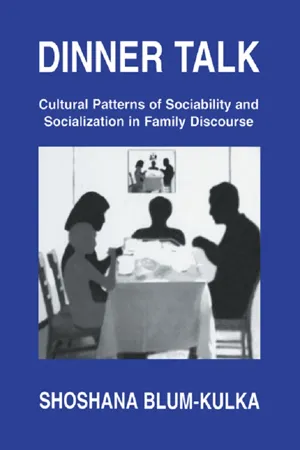
eBook - ePub
Dinner Talk
Cultural Patterns of Sociability and Socialization in Family Discourse
- 326 pages
- English
- ePUB (mobile friendly)
- Available on iOS & Android
eBook - ePub
Dinner Talk
Cultural Patterns of Sociability and Socialization in Family Discourse
About this book
Information
Chapter
1
1
CULTURAL PATTERNS OF COMMUNICATION
This book is about cultural patterns of communication in family discourse. More precisely, it juxtaposes the dinner table conversations of Israeli and Jewish American families, exploring the relations between linguistic use and cultural codes and the role of discourse in shaping and invoking familial, social, and cultural identities. The relationship between language, society, and culture–seen as a set of ideas, values, or symbolic codes–has challenged linguists and social scientists for more than a century. My approach shares the assumptions of those traditions in sociolinguistics, conceived in terms of the ethnography of communication formulated by Gumperz and Hymes in the early 1960s, which view the patterns of language usage as intimately linked with the social and cultural lives of the communities studied (cf. Hymes, 1974). It is an approach that insists on the need for detailed analysis of discursive practices in particular settings and events to show how language in itself is a form of cultural behavior and how patterning of communicative behavior constitutes one of the systems of culture. In exploring the culture-specific systematicity of the discursive patterns studied I follow micro-sociolinguistic discourse analytical methods, enriched by insights from pragmatics, and draw upon several traditions in the study of face-to-face interaction.1
The perspective developed here for the study of situated communicative practices is further enriched by two insights from phenomenological approaches to human communication such as Garfinkel’s and Sacks’ ethnomethodology and Goffman’s interactional approach and conversational analysis: Even the most mundane instances of face-to-face interaction are complex social performances and social meanings are jointly and dynamically negotiated rather than static and individual. Hence, their process of formation is located in the context of face-to-face interaction. I follow a culture-sensitive reading of these ideas, searching for the cultural meanings embedded and negotiated in mundane instances of interaction at the family dinner table, in some ways an undertaking similar to Varenne’s (1992) exploration of cultural patterns in familial talk. The ideas of the phenomenologists have a close affinity to those of the social theorists such as Berger and Luckman (1966), Ricoeur (1983), and Foucault (1972), who strongly argued for the primary role of language in the social construction of reality, and the cultural theorists who view culture as a web of interconnected symbolic meanings, continually in the process of being recreated and renegotiated by its members (Geertz, 1973; Schneider, 1976).
This book is based on a comparative case study of family discourse in middle-class Jewish American, native Israeli, and American-born Israeli families of European origin. The database for the study comprises natural conversations at dinnertime and extensive interviews. Three analytical concerns motivated the study. The first concern is cultural variation in ways of speaking as manifested in the dynamics of dinner talk. This concern is motivated by the quest for the degree of diversity in interactional styles between present-day Jewish communities sharing a common past. As Hymes (1974) proposed, the general problem for “socially constituted linguistics” is
to identify the means of speech and ways of speaking of communities; to find, indeed, where are the real communities, for language boundaries do not give them, and a person or a group may belong to more than one–to characterize communities in terms of their repertoires of these; and through ethnography, comparative ethnology, historical and evolutionary considerations, become able to explain something of the origin, development, maintenance, obsolescence, and loss of ways of speaking and types of speech communities. (p. 203)
The problem of characterizing communities in terms of their ways of speaking is particularly intriguing due to the specific history of the communities involved. It is my goal to demonstrate that the Jewish Americans, native Israelis, and Israeli Americans diverge in their ways of speaking to an extent that warrants considering their styles as culturally distinct.
A second, related concern is enculturation. The third group studied comprises of American-born old-time immigrants to Israel. Processes of immigration necessarily bring different cultures into contact on an unequal footing, requiring linguistic and sociocultural accommodation on the part of the immigrants to the cultural patterns of the host country. The social imbalance associated with immigration may be somewhat compensated for by the high prestige associated with English, the immigrants’ native tongue. Indeed, the families studied strive to maintain English in the home.
Against the background of cultural diversity found between Jewish Americans and Israelis, the issue investigated in the case of the immigrant families is the degree of congruity between the interactional style of this group and that of its two contact cultures. An additional issue is the nature of bilingual usage in the family. The findings demonstrate a particularly rich case of intercultural style: These American immigrants to Israel, fully competent in two languages (English and Hebrew), create an intercultural way of speaking that is both related to and distinct from the styles prevalent in the two substrata, a style on which they rely regardless of the language being used. From the point of view of bilingual practices, of particular interest is the finding that these families represent a successful case of mother tongue maintenance, the children cooperating with the parents to keep English as the main language of the home.
A third concern is the role of dinner talk in pragmatic socialization. By pragmatic socialization I mean the ways in which children are socialized to use language in context in socially and culturally approriate ways. Cultures differ to a great extent in their beliefs about and practices of language socialization (e.g., Ochs & Schieffelin, 1984), particularly with regard to the pragmatic aspects of language use. To become competent conversationalists, children have to learn how to choose and introduce topics for talk, respond appropriately, tell a story, or develop an argument. Cultural variation in opportunities provided for children to participate in dinner talk, or in the ways children’s participation is monitored, may result in different pathways to access to adult discourse, may reflect variation in perceptions of the relations between power and language, and may result in different socialization agendas for children. The study explores the ways in which dinnertime serves a culturally distinctive role in pragmatic socialization by juxtaposing the three groups studied with regard to children’s modes of participation in dinner talk and parental beliefs and attitudes toward pragmatic socialization.
The Cross-Cultural Perspective
The cross-cultural angle of the study is pursued foremost by comparing Jewish families from two communities, Israeli and American.2 This comparison does not assume a priori that these two communities represent two different cultures but rather attempts to discover whether observed differences between them in interactional styles link up with broader parameters of culture in the respective societies. The comparison is complicated by the fact that the communities studied intersect with each other in a multiplicity of ways, both diachronically and synchronically.
On the one hand, all the families in the study come from an Eastern and Central European Jewish background. Whereas the parent generation of the families studied are native Israelis or Americans who speak Hebrew or English as their first language, the parents or grandparents of our subjects were born and educated in Europe, and many spoke Yiddish in the home. The two communities are thus tied to a common Jewish heritage; furthermore, they share the belief in a common ancestry, common history, and a sense of shared peoplehood. This Judaic heritage meets Geertz’s (1973) definition of a culture as a “historically transmitted pattern of meanings embedded in symbols, a system of inherited conceptions expressed in symbolic forms by means of which men communicate, perpetuate and develop their knowledge about attitudes towards life” (p. 89).
On the other hand, sociologists of Jewish culture, such as Liebman and Cohen (1990), claim that these two societies have developed sharply distinct conceptualizations of Judaism, warranting their recognition as two distinct cultures.3 This claim is based on the assumption that Judaism is indeed a culture but that the originally shared transmitted patterns of meanings and symbolic forms were reinterpreted and reconceptualized to a degree that by now sharply differentiates the two societies. Divergent impacts of modernity and statehood have brought about radical reformulations of shared myths as well as of moral values and beliefs. Consider, for example, the meanings attached to the shared myths of the Jewish holiday of Hannukah. Liebman and Cohen noted that American Jews relate the story of Hannukah as the account of a successful fight by courageous Jews against the forces of Hellenization (assimilation), and the holiday is celebrated as an alternative to Christmas, symbolizing the ongoing struggle against cultural and religious assimilation. To Israelis, Hannukah recalls a successful military struggle of national liberation from foreign domination; in Handelman’s (1990) formulation, it symbolizes “the struggle of the Jewish people to create a unified national homeland” (p. 170).
The focus of this study is on language; by following patterns of communication in the family in these two communities I show how observed differences in interactional style reflect and shape cultural identities. From a synchronic point of view, the study lends support to Liebman and Cohen’s (1990) claims with regard to cultural diversity between these two communities. The findings of this study reveal that the two groups have developed unique interactional styles, styles that are deeply grounded in cultural patterns of the respective societies at large. From a diachronic point of view, the issue is which of the two communities shows more affinity in style to what might be considered as the premodern, Eastern European Jewish way of speaking. The search for continuity in this regard is complicated by the impossibility of a truly systematic diachronic comparison; what we know about traditional ways of speaking can be inferred indirectly either from anthropological (but nostalgic) attempts to reconstruct the life in the Shtetl, based on recollection and historical research (e.g., Zborowski & Herzog, 1952), or from discussion of the speech patterns of elderly Jews of Eastern European origin (Myerhoff, 1978), sociolinguistic studies of current American Jewish ways of speaking (Schiffrin, 1984b; Tannen, 1981a, 1981b, 1984), and sociolinguistic studies of interactional patterns in the Ashkenazi synagogue and Yeshiva (Spolsky & Walters, 1985). Both Tannen and Schiffrin have identified distinctive features of style that they attribute to the Jewish identity of the speakers. In the context of Tannen’s and Schiffrin’s studies, this “Jewish” style distinguishes its speakers from other Americans, presumably indexing their Jewish, Eastern European personal or family origins. In the Israeli American comparative context developed here, the characteristics of this style, as well as those identified by Spolsky and Walters for the interactional style of Ashkenazi synagogues, become a yardstick for comparing American and Israeli ways of speaking and their degree of affinity with traditional ways of speaking.
Surprisingly, the findings suggest that the features of the Jewish style are more prominent in the Israeli than the Jewish American ways of speaking. It seems to be the case then that the Israeli discursive practices, rather than the Jewish American, more clearly carry on a dialogic relationship (in Bakhtin’s, 1981, sense of dialogue) with practices embedded in the historic past. The family histories of the families involved provide a crucial background against which these issues need to be considered.
Family Origins: A Microcosm of Historical and Cultural Divergence
Three groups of families participated in the study: native-born Jewish Americans (n = 12), native-born Israelis (n = 11), and American Israeli (Jewish) immigrants to Israel (n = 11). All adult participants were university-educated, middle-to upper-middle-class, from an Ashkenazi (European) background and non-observant (see the Method section for further details).
The search for diversity in cultural patterns that is aimed at in this study has been carried out against a considerable level of shared historical and linguistic background common to all families. To assess the degree of commonality, we asked the adults in the families to provide us with demographic information about their families, going back two generations (see section on Method). The responses confirmed the common roots: Between 67% to 82% of our subjects’ parents came from families that originated in Russia and Poland. However, there is an interesting difference between the groups in the historical distancing from this common past. In the Israeli sample, the vast majority (93%) of individuals in the subjects’ parent generation immigrated to Palestine as young adults; in both the American and American Israeli groups, about half of the parents (45% to 53%) were born and raised in the United States as sons and daughters of Jewish immigrants from Eastern Europe. This means that the Israelis are all first generation, whereas in the other two groups half of the adults are second or even third generation born to immigrant parents.
The proximity of the Israeli families to their Eastern European origins is also apparent in the distribution of languages in the subjects’ parent generation. In response to the question, “what languages did your parents speak at home when you were a child?” Yiddish was mentioned as one language by 59% of the Israeli adults, 65% of the American Israelis,4 and only 37% of the American households. This divergence in family histories means that about half of the American-born parents come from families that have been part of American society for at least ...
Table of contents
- Cover Page
- Half Title page
- Title Page
- Copyright Page
- Dedication
- Contents
- Preface
- 1 Cultural Patterns of Communication
- Part 1 Cultural Styles of Sociability
- Part 2 Pragmatic Patterns of Socialization
- References
- Aappendix A Appendixes
- Author Index
- Subject Index
Trusted by 375,005 students
Access to over 1.5 million titles for a fair monthly price.
Study more efficiently using our study tools.
Frequently asked questions
Yes, you can cancel anytime from the Subscription tab in your account settings on the Perlego website. Your subscription will stay active until the end of your current billing period. Learn how to cancel your subscription
No, books cannot be downloaded as external files, such as PDFs, for use outside of Perlego. However, you can download books within the Perlego app for offline reading on mobile or tablet. Learn how to download books offline
Perlego offers two plans: Essential and Complete
- Essential is ideal for learners and professionals who enjoy exploring a wide range of subjects. Access the Essential Library with 800,000+ trusted titles and best-sellers across business, personal growth, and the humanities. Includes unlimited reading time and Standard Read Aloud voice.
- Complete: Perfect for advanced learners and researchers needing full, unrestricted access. Unlock 1.5M+ books across hundreds of subjects, including academic and specialized titles. The Complete Plan also includes advanced features like Premium Read Aloud and Research Assistant.
We are an online textbook subscription service, where you can get access to an entire online library for less than the price of a single book per month. With over 1.5 million books across 990+ topics, we’ve got you covered! Learn about our mission
Look out for the read-aloud symbol on your next book to see if you can listen to it. The read-aloud tool reads text aloud for you, highlighting the text as it is being read. You can pause it, speed it up and slow it down. Learn more about Read Aloud
Yes! You can use the Perlego app on both iOS and Android devices to read anytime, anywhere — even offline. Perfect for commutes or when you’re on the go.
Please note we cannot support devices running on iOS 13 and Android 7 or earlier. Learn more about using the app
Please note we cannot support devices running on iOS 13 and Android 7 or earlier. Learn more about using the app
Yes, you can access Dinner Talk by Shoshana Blum-Kulka in PDF and/or ePUB format, as well as other popular books in Languages & Linguistics & Linguistics. We have over 1.5 million books available in our catalogue for you to explore.