- 276 pages
- English
- ePUB (mobile friendly)
- Available on iOS & Android
eBook - ePub
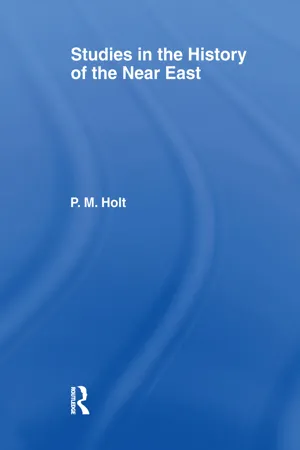
Studies in the History of the Near East
About this book
First Published in 1973. This volume brings together a number of studies concerned with the Near East and its history from the sixteenth century. They fall into three groups. The first is concerned with English Arabists of the seventeenth and early eighteenth centuries, and particularly with Edward Pococke. The papers in the second group deal with the history of the Nilotic Sudan, and especially attempt to exploit the sparse source-materials available on the Funj Sultanate and to throw some light on developments between the sixteenth and the nineteenth century. Another dark age in modern Near Eastern history is the subject of the third group of papers-the period of Egyptian history from the Ottoman conquest in 1517 to the French occupation in 1798.
III
STUDIES IN EGYPTIAN HISTORY
9
OTTOMAN EGYPT (1517–1798): AN ACCOUNT OF ARABIC HISTORICAL SOURCES
HISTORICAL writing in Arabic on Ottoman Egypt during the period from the conquest to the French occupation is reasonably copious and varied in kind. It has not yet been adequately evaluated, and its full exploitation is still far in the future. Very little of the material has been published, nor has much work been done on the manuscript sources. The consequence of this is that writers on the period have depended excessively on the few published works, especially on the chronicle of al-Jabartī, and on the writings of French scholars, especially those who were associated with Bonaparte's expedition to Egypt. This in turn has led to a certain distortion of the history of the first two centuries of Ottoman rule, owing to the retrojection of conditions and institutions of the later eighteenth century.
The historical writing which will be surveyed in this paper was produced in Egypt by persons who were domiciled in, or native to, that country. A certain amount of information may also be obtained from external Arabic sources.1 The Egyptian material is mostly in the form of chronicles, the framework of which, however, is not necessarily strictly annalistic. There are two grave limitations on the scope of this material. First, there is an almost complete absence of contemporary writing for about seventy years from the termination of Ibn Iyās's chronicle in 928/1522, and this period is only thinly covered by later writers. This lack of contemporary chronicles, and the sparseness of the data provided by sources of the eleventh/seventeenth century, suggest that this “dark age” was, in fact, a time in which there were few dramatic political occurrences. Nevertheless it was an important period of institutional transition, and our ignorance of developments in the middle and later tenth/sixteenth century seriously affects our understanding of events in the following period.
The second limitation of scope of the Egyptian material persists throughout the whole of the period here surveyed. The data provided refer almost exclusively to Cairo, and particularly to the governing and military élite of the city. While it is no doubt true that the capital dominated the political life of Egypt, and the military grandees dominated the capital, there were, even in the political sphere, developments outside Cairo of which we obtain only infrequent and inadequate glimpses from the chroniclers. It is, for example, clear that for nearly three centuries after the Ottoman conquest, Upper Egypt played a political role of immense importance: over long stretches of time it was a virtually autonomous region, under tribal or beylical rulers; alternatively, it was a territory of refuge for members of factions defeated in the capital. This we can trace from the chroniclers, but only in episodic fashion. Another grave deficiency is the lack of data on the tribes. Here again it is clear that the nomads and semi-nomads of the desert fringe had an important and complex influence on Egyptian political history, but it is impossible to study their significance in detail, by regions and periods. Since our information even on political events is so limited and one-sided, it goes without saying that the chroniclers alone are inadequate sources for reconstructing the social and economic history of Ottoman Egypt.
The following survey gives a brief account of various sources in chronological order. It is not exhaustive, but includes all the works with which I am personally acquainted.2
(A) WRITING OF THE EARLY OTTOMAN PERIOD IN EGYPT
1. Al-Ishbīlī, al-Durr al-muṣān
This short work, which was completed on 10 Ṣafar 923/4 March 1517 (i.e. while Selim I was still in Egypt) is an Arabic literary fethname.3 Written in a mixture of saj‘ and verse, it is full of encomia of Selim, who is presented as the successor of the Patriarchal Caliphs, and as a quasi-messianic figure engaged in holy war against the Safavids and Mamluks. The historical events reviewed are the Chāldirān campaign and its sequel, the overthrow of ‘Alā’ al-Dawla, and in much greater detail the operations against the Circassian Mamluk sultanate. As a record of events, the work should be regarded with caution, but it throws an interesting light on the propaganda used to justify Selim's warfare against other Muslim sovereigns.
2. Ibn Iyās, Badā’i‘ al-zuhūr
The author's eyewitness account of the collapse of the Circassian Mamluk sultanate, and the establishment of Ottoman rule in Egypt, forms the last portion only of a long and detailed chronicle. It is the sole reliable first-hand account in Arabic of developments from the appearance of the Ottoman threat to the events immediately following the death of the viceroy, Khā’ir Bey (Muḥarram 922—Dhu’l-Ḥijja 928/February 1516—November 1522.)
3. Ibn Zunbul, Ta’rīkh ghazwat al-sulṭān Salīm khān ma‘ al-sulṭān al-Ghawrī
Although this work appears to supplement that of Ibn Iyās in providing a history of the Ottoman conquest and early Ottoman period, it must be used with very great caution. Dating from the middle years of the tenth/sixteenth century, it is a collection of heroic prose sagas rather than a sober narrative. The campaign of Selim against al-Ghawrī forms only the first part of the work, and is contained in pages 2 to 24 of the published edition. The core of this romance of chivalry (for such it is), is constituted by an account of the valiant life and death of Ṭūmān Bāy, who is depicted as a kind of Circassian Roland, a doomed hero encountering overwhelming odds. This saga of Ṭūmān Bāy occupies pages 24 to 113. It is characterized by literary devices and legendary features. Ṭūmān Bāy and his faithful followers stand in contrast to the traitors to their race, Khā’ir Bey, Jānbirdī al-Ghazālī, the kāshif Jānim al-Sayfī, and to the treacherous Arab chief, Ḥasan b. Mar‘ī. Sultan Selim is a somewhat colourless figure, the tool of Khā’ir Bey. Numerous speeches by the leading figures give an impression that the narrator is possessed of inside knowledge, not to say omniscience, but these should be regarded as purely literary devices, incidental to the unfolding of the plot. The narrator then goes on to describe the dispositions made in Egypt by Selim, his return to Istanbul and his death (pages 113 to 120). A final section (pages 120 to 129) deals with the revolt of Jānbirdī al-Ghazālī in Damascus against Sultan Süleyman, and brings the story down to the death of Khā’ir Bey (Dhu’l-Qa‘da 928/October 1522) and the participation of the contingent which he had sent from Egypt in the conquest of Rhodes (Ṣafar 929/December 1522). This appears to be the original end of the work, although additional material is tacked on in some of the manuscript versions.
The central theme of Ibn Zunbul's romance is the decline and fall of the Circassians in Egypt. He does not seek to elucidate historical causation: it is sufficient that God willed the end of the Circassian sultanate and the Ottoman triumph. Nevertheless he harks back repeatedly, and resentfully, to the Ottoman use of artillery and firearms. It was these unfair weapons which, under God, brought about the destruction of the Circassian chivalry.
(B) WRITINGS OF THE ELEVENTH/SEVENTEENTH AND TWELFTH/EIGHTEENTH CENTURIES
4. Al-Isḥāqī, Akhbār al-unwal
This work has acquired an unmerited importance through publication: it is by no means in the same category as the other published chronicles, those of Ibn Iyās and al-Jabartī. It is a jejune compendium of Islamic and Egyptian history in ten chapters. Of these, only the tenth, amounting to under an eighth of the whole work, deals with events in Ottoman Egypt, but an account of the actual conquest appears in the previous chapter under the notice of Sultan Selim I. The tenth chapter deals in succession with the viceroys from Khā’ir Bey to Ibrāhīm Pasha, who was recalled in Ramaḍān 1032/July 1623. The practice of using the periods of office of viceroys as units of chronology, in preference to writing annals in the strict sense, was widely followed by later historians of Ottoman Egypt.
5. The Continuation of al-Isḥāqī
A manuscript in the Bibliothèque Nationale (MS. arabe 1854), which lacks both a title and the name of the author, is a recension and continuation of the ninth and tenth chapters of al-Isḥāqī's Akhbār al-uwal. Within the period covered by the original, there is some additional material, notably accounts of the revolts of Jānim and Īnāl (fols. 52a–57a), and of Khā’in Aḥmad Pasha (fols. 58a–63a). Th...
Table of contents
- Cover
- Half Title
- Full Title
- Copyright
- Contents
- Introduction
- Short References
- I: Early Students of Arab History in England
- II: Studies in Sudanese History
- III: Studies in Egyptian History
- Index
Trusted by 375,005 students
Access to over 1.5 million titles for a fair monthly price.
Study more efficiently using our study tools.
Frequently asked questions
Yes, you can cancel anytime from the Subscription tab in your account settings on the Perlego website. Your subscription will stay active until the end of your current billing period. Learn how to cancel your subscription
No, books cannot be downloaded as external files, such as PDFs, for use outside of Perlego. However, you can download books within the Perlego app for offline reading on mobile or tablet. Learn how to download books offline
Perlego offers two plans: Essential and Complete
- Essential is ideal for learners and professionals who enjoy exploring a wide range of subjects. Access the Essential Library with 800,000+ trusted titles and best-sellers across business, personal growth, and the humanities. Includes unlimited reading time and Standard Read Aloud voice.
- Complete: Perfect for advanced learners and researchers needing full, unrestricted access. Unlock 1.5M+ books across hundreds of subjects, including academic and specialized titles. The Complete Plan also includes advanced features like Premium Read Aloud and Research Assistant.
We are an online textbook subscription service, where you can get access to an entire online library for less than the price of a single book per month. With over 1.5 million books across 990+ topics, we’ve got you covered! Learn about our mission
Look out for the read-aloud symbol on your next book to see if you can listen to it. The read-aloud tool reads text aloud for you, highlighting the text as it is being read. You can pause it, speed it up and slow it down. Learn more about Read Aloud
Yes! You can use the Perlego app on both iOS and Android devices to read anytime, anywhere — even offline. Perfect for commutes or when you’re on the go.
Please note we cannot support devices running on iOS 13 and Android 7 or earlier. Learn more about using the app
Please note we cannot support devices running on iOS 13 and Android 7 or earlier. Learn more about using the app
Yes, you can access Studies in the History of the Near East by P.M. Holt in PDF and/or ePUB format, as well as other popular books in History & Historiography. We have over 1.5 million books available in our catalogue for you to explore.