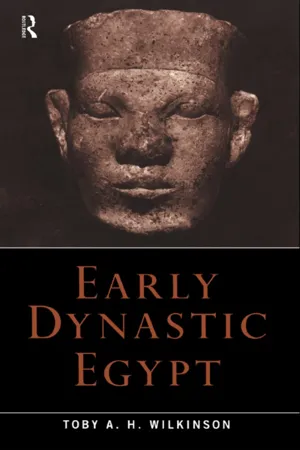
Early Dynastic Egypt spans the five centuries preceding the construction of the Great Pyramid at Giza. This was the formative period of ancient Egyptian civilization, and it witnessed the creation of a distinctive culture that was to endure for 3,000 years. This book examines the background to that great achievement, the mechanisms by which it was accomplished, and the character of life in the Nile valley during the first 500 years of Pharaonic rule.
The results of over thirty years of international scholarship and excavation are presented in a single highly illustrated volume. It traces the re-discovery of Early Dynastic Egypt, explains how the dynasties established themselves in government and concludes by examining the impact of the early state on individual communities and regions.
- 440 pages
- English
- ePUB (mobile friendly)
- Available on iOS & Android
eBook - ePub
Early Dynastic Egypt
About this book
PART I
INTRODUCTION
CHAPTER ONE EGYPTOLOGY AND THE EARLY DYNASTIC PERIOD
THE PIONEERS: 1894–1935
Abydos: Amélineau and Petrie
The history of Egypt began at Abydos. Here in Upper Egypt, on the low desert beneath the towering western escarpment (Plate 1.1), the Predynastic rulers of the region, and their descendants, the earliest kings of a united Egypt, were buried with their retainers and possessions. Amongst the tombs of the ancestral royal cemetery, a burial of unparalleled size was prepared around 3150 BC for a leader who may already have ruled over most, if not all, of Egypt. About a century later, another king was buried nearby: Narmer, who was apparently regarded by his immediate successors as the founder of the First Dynasty, and whose ceremonial palette recalls the unification of the Two Lands, in ritual if not in fact. The mortuary complex of Narmer’s successor, Aha, was also constructed at Abydos. Aha’s reign may mark the systematic keeping of annals, and it may thus be regarded as the beginning of Egyptian history in a strict sense of the word.
Egyptian history also began at Abydos in another sense: it was here, in the dying years of the nineteenth century and in the early years of the twentieth, that archaeologists first uncovered evidence of Egypt’s remote past. The excavation and re-excavation of the royal cemetery at Abydos—which still continues after more than a century—has transformed our understanding of the earliest period of Egyptian history. Today, as a hundred years ago, each new discovery from the sands of Abydos enhances or modifies our picture of the Nile valley during the formative phase of ancient Egyptian civilisation. As we shall see, many other sites have contributed to the total picture, but none more so than Abydos. Abydos, above any other site, holds the key to Egypt’s early dynasties.
Before the first excavations in the royal cemetery at Abydos, there was not a single object in the Egyptian Museum that could be dated securely to the First or Second Dynasty (de Morgan 1896:181). Indeed, before excavators began unearthing the burials of the Early Dynastic kings, ‘the history of Egypt only began with the Great Pyramid’ (Petrie 1939:160). The pyramids of the late Third/early Fourth Dynasty at Maidum and Dahshur were the oldest monuments known to scholars. The Step Pyramid complex at Saqqara had not yet been excavated from the drift sand. As for the kings of the first three dynasties recorded in the king lists of the New Kingdom and in Manetho’s history, they were no more than names, legendary figures for whom no historical evidence existed.

Plate 1.1 The Umm el-Qaab at Abydos, burial ground of Egypt’s early rulers (author’s photograph).
Emile Clément Amélineau (1850–1915) was the first to clear the royal tombs of the First and late Second Dynasties in a systematic way, although Auguste Mariette (1821– 81) had worked at the site some forty years before. Amélineau’s excavations at Abydos from 1894 to 1898 yielded important results, but his unscientific methods drew criticism, especially from his great rival and successor at Abydos, Petrie. It is probably fair to say that the Mission Amélineau was driven more by the ambition of private collectors than by academic or scientific concerns for the culture of early Egypt. However, the same was undoubtedly true of many other excavations in the Nile valley at that time and later. Amélineau’s contribution—in bringing the importance of Abydos to the attention of Egyptologists —should not be dismissed, despite his obvious failings by modern standards. The objects he found in the royal tombs were published in four volumes (Amélineau 1899, 1902, 1904, 1905) and were sold at auction in Paris in 1904. Some entered museums, others ended up in private collections. Scholarly interest in Egypt’s earliest historical period had now been well and truly awakened, and archaeologists were swift to follow in Amélineau’s footsteps.
William Matthew Flinders Petrie (1853–1942), the founding father of Egyptian archaeology, had been interested in Egypt’s formative period for some years. His pioneering mission to Coptos in 1893–4 revealed material of the late Predynastic and Early Dynastic periods for the first time—most famously the colossal statues of a fertility god—and effectively pushed back Egyptian history by some 400 years, from the beginning of the Old Kingdom to the beginning of the First Dynasty (Petrie 1896). Petrie’s subsequent excavations at Naqada and Ballas in 1895 yielded extensive Predynastic material (Petrie and Quibell 1896) and led him to formulate his famous sequence dating system, the principle of which has been used by scholars ever since to date Predynastic contexts.
Petrie’s ‘discovery’ of the Predynastic period was followed by new insights into the earliest dynasties, gained through his excavations at Abydos in 1899–1903. He rushed to the Early Dynastic royal cemetery following the departure of Amélineau and was able ‘to rescue for historical study’ (Petrie 1900:2) what had been left behind. Petrie no doubt exaggerated Amélineau’s failings and his own achievements, but there is no denying that Petrie’s discoveries were of great significance, and dramatically enhanced understanding of Egypt’s early history, not least by establishing the order of the First Dynasty kings (Petrie 1900, 1901). In the later seasons, Petrie turned his attention to the early town and temple of Abydos (Petrie 1902, 1903). His excavations uncovered a small cemetery of the early First Dynasty, a jumble of walls belonging to the Early Dynastic temple, and three deposits of votive objects.
At the same time as Petrie was re-excavating the royal tombs at Abydos, his colleague John Garstang (1876–1956) was investigating Predynastic and Early Dynastic sites a little to the north, in the vicinity of the villages of Mahasna, Reqaqna and Beit Khallaf. Near the first two he revealed a cemetery of Third Dynasty tombs (Garstang 1904), while on the low desert behind Beit Khallaf he excavated several huge mastabas of mudbrick (Plate 1.2), also dated to the Third Dynasty (Garstang 1902). From the point of view of Early Dynastic history, the most important finds from Beit Khallaf were the sealimpressions. One of these, from mastaba K2, shows the name of King Sanakht opposite the lower end of a cartouche. This is the earliest attested occurrence of the frame used to enclose the royal name, and the sealing provides the sole evidence for equating the Horus name, Sanakht, with the cartouche name, Nebka.

Plate 1.2 Mastaba K1 at Belt Khallaf, dating to the reign of Netjerikhet, Third Dynasty (author’s photograph).
Discoveries further south: de Morgan, Quibell and Green
Whilst Amélineau and Petrie were arguing over the spoils of Abydos, discoveries in southern Upper Egypt were shedding important new light on Early Dynastic Egypt, its rulers and their achievements. Together with Abydos, two sites are of key significance for the process of state formation and for the early development of Egyptian civilisation, Naqada and Hierakonpolis, and it was at these two sites that excavations at the turn of the century yielded spectacular results. One of the outstanding achievements of Jacques Jean Marie de Morgan (1857–1924) was the discovery and excavation of the royal tomb at Naqada (de Morgan 1897). Identified at first as the tomb of the legendary Menes (Borchardt 1898), but subsequently as the burial of Queen Neith-hotep (probably the mother of Aha), this was the first substantial structure of the First Dynasty to be excavated in Egypt, and it demonstrated the scale of monumental architecture at the very beginning of Egyptian history. De Morgan also established the link between the Predynastic period and the early dynasties, thus implicitly recognising the Early Dynastic period as the culmination of a long sequence of cultural development.
In the same year as de Morgan’s great discovery at Naqada, excavations began on the town mound at Hierakonpolis, the Kom el-Ahmar. They were directed by James Edward Quibell (1867–1935), who had excavated with Petrie at Coptos in the pioneering season of 1893–4. Assisted by Frederick Green and Somers Clarke, he worked at Hierakonpolis from 1897 to 1898, before handing over to Green for the following season (Quibell 1900; Quibell and Green 1902). In the temple area of the town mound the archaeologists found a circular revetment belonging to the Early Dynastic temple and a crude limestone cylindrical statue similar to the colossi from Coptos. The temple also yielded spectacular objects of Old Kingdom date, including life-size copper statues of two Sixth Dynasty kings and a golden hawk head. Most significant for Early Dynastic studies was the discovery—in circumstances which remain unclear—of the so-called ‘Main Deposit’, a hoard of early votive objects including the famous Scorpion and Narmer maceheads and the Narmer palette. These provided the earliest images of Egyptian kings, bringing life to the otherwise obscure royal names attested at Abydos and Naqada. They also represent the earliest expression of the classic conventions of Egyptian artistic depiction, and indicate that these principles were formalised and canonised at the very beginning of the Egyptian state. The complex iconography of the palette reveals much about early conceptions of kingship, whilst the quality of workmanship gives an indication of the sophisticated taste of the early Egyptian court. Since its discovery, the Narmer palette has acquired something of the status of an icon of early Egypt. Today it is displayed in the entrance hall of the Egyptian Museum, where it serves as an admirable starting-point for the glories of Egyptian civilisation. The palette, together with the other Early Dynastic objects that had flooded into the museum since Amélineau’s work at Abydos, was catalogued by Quibell in his capacity as a member of staff of the Antiquities Service. The two volumes of Archaic objects (Quibell 1904–5) represent the first published corpus of early material.
Excavation intensifies: Petrie and Quibell joined by Reisner, Junker and Firth
The first two decades of the twentieth century witnessed a substantial increase in the number of early sites excavated. Spurred on by the spectacular discoveries at Abydos and Hierakonpolis, archaeologists turned their attention to cemeteries throughout Egypt. The American interest in the early periods of Egyptian civilisation began in earnest with the Hearst Expedition to Egypt, directed by George Andrew Reisner (1867–1942). From 1901 to 1903, Reisner excavated the sequence of cemeteries at Naga ed-Deir, a site on the east bank of the Nile in the Abydos region, directly opposite the modern town of Girga. Assisted first by Green, fresh from his excavations at Hierakonpolis, and subsequently by Arthur Mace, Reisner uncovered graves of virtually every period at Naga ed-Deir, stretching from the early Predynastic period to modern times (Reisner 1908; Mace 1909). The Early Dynastic period was particularly well-represented, with four cemeteries covering the period of the first three dynasties (Cemeteries 1500, 3000, 3500 and 500). By the standards of the time, Reisner’s excavations were conducted in a thorough and professional manner. As well as providing a wealth of information on Early Dynastic burial practices and provincial culture, the Naga ed-Deir excavations yielded a few finds which indicated contacts between Egypt and other early civilisations of the Near East. Contacts of some form had already been suggested by the decoration of late Predynastic élite objects (palettes and knife handles) which included elements of Mesopotamian iconography. The discovery of cylinder seals—a class of object indisputably Mesopotamian in origin—in graves at Naga ed-Deir offered tangible evidence for trade between the two cultures.
In concentrating on the rich remains of Upper Egypt, Reisner was following the pioneering missions of the late nineteenth century. At the end of the first decade of the twentieth century a change of emphasis occurred, and sites in the Memphite area were investigated for the first time. Petrie (1907) excavated a series of Early Dynastic mastabas to the south of Giza, one of which had already been investigated by Daressy (1905) for the Cairo Museum. However, the pioneer of archaeological investigation in the Memphite area was Hermann Junker (1877–1962). He significantly enhanced the understanding of Early Dynastic Egypt by his work at Tura, a site on the east bank of the Nile about 10 kilometres south of central Cairo. It was Junker’s first excavation in Egypt, and he certainly struck lucky. During the winter of 1909–10, a large cemetery of some 500 late Predynastic and Early Dynastic graves was revealed, together with a wealth of grave goods, particularly pottery (Junker 1912). This was the first time that early material had been discovered on the east bank of the Nile in the Memphite region, and it paved the way for later excavations in the vicinity by Brunton and Saad. What made the Tura cemetery so important for future studies was its linear growth over time: the earliest graves were located in the southern part of the site, the latest graves in the northern part. The contents of each grave were recorded in detail; this information, in conjunction with the cemetery plan, could therefore be used to chart the development of artefact assemblages over time, and the growth of the cemetery itself.
In 1911, responding to reports of looting by local villagers, Petrie turned his attention back to early Egypt and to the extensive cemetery on the desert edge behind the hamlet of Kafr Tarkhan (Plate 1.3), near the entrance to the Fayum (Petrie et al.1913; Petrie 1914). In two seasons of excavation, from 1911 to 1913, Petrie uncovered many hundreds of tombs dating to the very beginning of Egyptian history, including several large mudbrick mastabas decorated with recessed niches, in the style exemplified by the royal tomb at Naqada. The wealth of grave goods shed considerable light on the accomplishments of the Early Dynastic Egyptians, particularly in the spheres of arts and crafts. A number of burials contained objects inscribed with early royal names. Analysis of the other objects in these graves enabled characteristic types of pottery and stone vessels to be associated with the reigns of particular kings. This provided useful comparative material to help with the dating of other tombs which did not contain any inscriptions. Just as important, Petrie’s work at Tarkhan enabled him to extend his sequence dating system down to the Third Dynasty, thus linking the first three dynasties with the preceding Predynastic period in one continuous sequence of ceramic development. This built upon de Morgan’s work at Naqada and firmly established the cultural and historical context of the Early Dynastic period.

Plate 1.3 The Early Dynastic cemetery at Tarkhan (author’s photograph).
Following his spectacularly productive excavations at Hierakonpolis, Quibell was appointed to the post of Chief Inspector at Saqqara. His attention turned to the myriad monuments of the Saqqara plateau, and he began by excavating two small areas of the Early Dynastic cemetery in the years 1912 to 1914. This marked the beginning of a period of intensive archaeological investigation in the cemeteries of Memphis, which was to continue for over forty years. Quibell uncovered many tombs, including that of Hesira, a high official in the reign of Djoser/Netjerikhet (Quibell 1913, 1923). The systematic excavation of Netjerikhet’s Step Pyramid complex-perhaps the outstanding architectural achievement to have survived from Early Dynastic Egypt—occupied QuibelPs later years (Firth and Quibell 1935). He directed work at the complex from 1931 until his death in 1935.

Plate 1.4 An élite First Dynasty tomb at North Saqqara (author’s photograph).
The complex of buildings surrounding the Step Pyramid had been discovered by Cecil Mallaby Firth (1878–1931), who had succeeded Quibell as Inspector of Antiquities at Saqqara in 1923. Firth conducted excavations at the complex from 1924 to 1927, his results completely transforming theories about the origins of stone architecture in Egypt. Excavation and restoration of the Step Pyramid complex has continued ever since, yielding important information on many aspects of early Egypt, including material culture, architecture, kingship, the order of succession and, of course, funerary religion. After he handed control of the Step Pyramid excavations to Quibell, Firth turned his attention to the Early Dynastic cemetery at North Saqqara (Plate 1.4). The excavation of this site was to have been Firth’s second major project, but fate cruelly intervened. He was about to start clearing the cemetery when he returned to England on leave in 1931. On the journey home he contracted pneumonia and within a few days he was dead. It was left to his young assistant, Emery, to carry out Firth’s plans, with spectacular results.
THE CEMETERIES OF MEMPHIS: 1936–1956
Emery at North Saqqara
Walter Bryan Emery (1903–71) took over as director of excavations at North Saqqara in 1935, in succession to Firth. Rejecting the piecemeal approach to excavation pursued by his predecessors, Emery decided that only a systematic clearance of the entire cemetery would do the site justice and produce the best results. He was keenly aware of the importance of the cemetery for the early history of Egypt (Emery 1938: vii), and his first season of excavation did not disappoint. In 1936 he cleared the tomb of Hemaka, which Firth had partially excavated five years earlier (Emery 1938). The tomb’s contents included several masterpieces of Egyptian craftsmanship, notably an inlaid gaming disk and the earliest roll of papyrus ever discovered. Although uninscribed, it proved that this writing medium—and therefore a cursive version of the Egyptian script for use on papyrus—already existed in the First Dynasty. In the following season of 1937–8, Emery and his team excavated the earliest tomb in the élite cemetery, number 3357, dated to the reign of Aha (Emery 1939). The Second World War interrupted work at Saqqara, but Emery returned to the site to re-commence excavations in 1946. Another break of three years followed from 1949 to 1952, before Emery was able to complete his work in the cemetery during the years 1952 to 1956. The years of excavation succeeded in revealing an entire sequence of large First Dynasty tombs, strung out along the edge of the escarpment (Emery 1949, 1954, 1958). Emery was particularly impressed by the size and splendour of the tombs, especially by comparison with the contemporary royal tombs at Abydos. He formed the belief that the Saqqara tombs were the true burial places of the First Dynasty kings, and that the Abydos monuments excavated by Petrie were merely cenotaphs. Thus began a long debate between Egyptologists, one which continues to this day. There can be no doubt that Emery’s results at North Saqqara represented ‘the...
Table of contents
- Cover Page
- Title Page
- Copyright Page
- Plates
- Figures
- Prologue
- Acknowledgements
- Note
- Part I Introduction
- Part II The Establishment of Authority
- Part III The Diversity of Local Experience
- Epilogue
- Glossary
- Bibliography
Trusted by 375,005 students
Access to over 1.5 million titles for a fair monthly price.
Study more efficiently using our study tools.
Frequently asked questions
Yes, you can cancel anytime from the Subscription tab in your account settings on the Perlego website. Your subscription will stay active until the end of your current billing period. Learn how to cancel your subscription
No, books cannot be downloaded as external files, such as PDFs, for use outside of Perlego. However, you can download books within the Perlego app for offline reading on mobile or tablet. Learn how to download books offline
Perlego offers two plans: Essential and Complete
- Essential is ideal for learners and professionals who enjoy exploring a wide range of subjects. Access the Essential Library with 800,000+ trusted titles and best-sellers across business, personal growth, and the humanities. Includes unlimited reading time and Standard Read Aloud voice.
- Complete: Perfect for advanced learners and researchers needing full, unrestricted access. Unlock 1.5M+ books across hundreds of subjects, including academic and specialized titles. The Complete Plan also includes advanced features like Premium Read Aloud and Research Assistant.
We are an online textbook subscription service, where you can get access to an entire online library for less than the price of a single book per month. With over 1.5 million books across 990+ topics, we’ve got you covered! Learn about our mission
Look out for the read-aloud symbol on your next book to see if you can listen to it. The read-aloud tool reads text aloud for you, highlighting the text as it is being read. You can pause it, speed it up and slow it down. Learn more about Read Aloud
Yes! You can use the Perlego app on both iOS and Android devices to read anytime, anywhere — even offline. Perfect for commutes or when you’re on the go.
Please note we cannot support devices running on iOS 13 and Android 7 or earlier. Learn more about using the app
Please note we cannot support devices running on iOS 13 and Android 7 or earlier. Learn more about using the app
Yes, you can access Early Dynastic Egypt by Toby A.H. Wilkinson in PDF and/or ePUB format, as well as other popular books in History & Egyptian Ancient History. We have over 1.5 million books available in our catalogue for you to explore.