- 528 pages
- English
- ePUB (mobile friendly)
- Available on iOS & Android
eBook - ePub
Managing Innovation
About this book
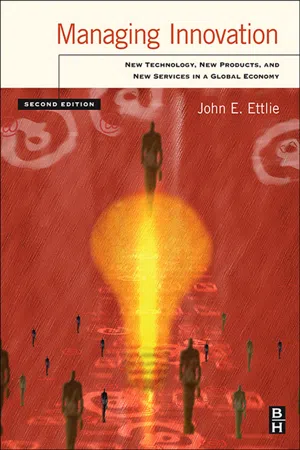
Managing Innovation: New Technology, New Products, and New Services in a Global Economy, 2nd Edition is devoted to providing a better understanding and better management of all of the causes and consequences of change that have technological implications in and around our global organizations. This text is a unique, original contribution and represents a significant alternative to the collection of chapters written by others.
The second edition has new cases with a few classics from the first edition that have been retained in response to reader feedback. The key subjects that are included have been significantly updated and treated in greater depth. The number of chapters has been reduced from 12 to 10 so it is easy to adapt to almost any course or training on the subject in any discipline or to any audience.
This exceptionally informative book provides a broad perspective on how technological change can be effectively managed in modern organizations. The text explains the conceptual frameworks supported by new and original case studies for start-up companies like Askmen.com, the complex challenges of managing international technology-based companies like NexPress (a joint venture of Kodak and Heidelberg) in the digital printing industry, and corporate sustainability using innovative new product technologies illustrated by the case of Evinrude's launch of the E-tec® outboard motor.
John E. Ettlie's three decades in the field of innovation as an instructor and researcher bring an exceptional perspective to this subject. His text is unique in its discussion of how technology has transformed the service sector. Few books on technology make the distinction between new offerings in manufacturing and the service sector which is emphasized in this text.
II The Innovation Process Unfolds
4 R&D Management
DOI: 10.4324/9780080479101-4
Chapter Objectives: To introduce the topic of management of the technical function of an organization; incorporate the concept of technology and innovation strategy in the R&D management discussion, follow the case of IBM from Chapter 3. The latest generation of corporate venturing is explored. Other objectives are to emphasize the importance of the idea of R&D collaboration and to introduce the concept of sustainable design and incorporating technology that takes the natural environment into account. An exercise on idea sourcing in R&D and two cases, the Kodak Single Use Camera and the Evinrude E-Tec, are included at the end of the chapter.
The purpose of the technical function of the firm is stated quite clearly by Roberts1 in the introduction to this edited book on generating technological innovation:
- Creating new knowledge
- Generating technical ideas aimed at new and enhanced products, manufacturing processes, and services
- Developing those ideas into working prototypes
- Transferring these ideas as embodied in new products and services to manufacturing, distribution, and use
It is often quite useful, at least at the outset, to characterize this process of innovation creation as quite orderly and manageable. For example, Steele2 presents the creation-application spectrum, which is reproduced in Figure 4-1, as beginning with basic research and ending with product service. The distinction between basic (create new knowledge) and applied research (solvea problem) is usually quite clear, and in the United States, most basic research is done in universities. But in practice, the distinction is often fuzzy. Furthermore, if customer voice is the only driving force behind innovation efforts, all gains tend to be incremental. Radical innovations—the ones that create new markets and real growth for the future of an organization—do not follow normal company routines. Preliminary findings from an on-going IRI (Industrial Research Institute) study indicate that breakthroughs often result from a very “topsy-turvy process … (and) generally evolve from projects that get repeatedly axed and restored.”3

Why R&D?
Organizations have to meet specifications set by their customers. But the timely response to customer problems often requires considerable lead-time in coming up with answers. Therefore, R&D and marketing are often working on the same issues, in parallel, not in series.
Stage models of the innovation process are, at best, an after-the-fact rationalization of what really happens during the innovation process. Not all customer problems can be solved and not all technology can be applied. But the basic idea holds: incremental and radical innovations are different. Ultimately, only the combined efforts of all the key functions of the firm, marketing, R&D, and operations will need to be integrated to satisfy customers.
Perhaps the quintessential challenge of technology managers is to harness the creative drive and energy of the most gifted people ever to be employed without destroying the creative spirit. Turnover among creative people tends to be higher than among other groups of employees, and yet, a calculated risk-taking climate often is not related to the number or type of innovative individuals in a firm.4
Basic Versus Applied R&D
The National Science Foundation (NSF)5 defines research in three categories:
- Basic Research. Basic research has as its objective “a fuller knowledge or understanding of the subject under study, rather than a practical application thereof.” To take into account industrial goals, NSF modifies this definition for the industry sector to indicate that basic research advances scientific knowledge “not having specific commercial objectives, although such investigations may be in fields of present or potential interest to the reporting company.”
- Applied Research. Applied research is directed toward gaining “knowledge or understanding necessary for determining the means by which a recognized and specific need may be met.” In industry, applied research includes investigations directed “to the discovery of new scientific knowledge having specific commercial objectives with respect to products or processes.”
- Development. Development is the “systematic use of the knowledge or understanding gained from research, directed toward the production of useful materials, devices, systems or methods, including design and development of prototypes and processes.”
Patents
An idea, which most people call an invention, can be patented if it is new, useful, and nonobvious (and not abstract—like a scientific theory or law of nature). Article I, Section 8 of the United States Constitution says “The Congress shall have Power To … promote the Progress of Science and useful Arts, by securing for limited Times to Authors and Inventors the exclusive Right to their respective Writings and Discoveries.” The Patent Law was established in 1790 and in laws thereafter, Congress described how patents would be granted. George Washington's proposal that entrepreneurs who imported new foreign inventions to the United States should have exclusive rights, in order to encourage industry in the new country, was dropped. The U.S. Patent Office was established in 1836. But laws are political compromises. The courts declared almost two-thirds of all patents ruled upon as invalid between 1921 and 1973. Commercial success has gained wide acceptance as an outcome measure, and so it is emphasized and links inventions with innovations.6
Although there was great domestic concern about the ratio of foreign to domestic applications for patents during the last decade, recent indications are that this upset was not well founded. Patent applications are up (see Figure 4-2), and considered by economists to be leading indicators of productivity gains. U.S. patent applications are running at a rate 50 percent above the 1980s. During the most recent period, this average has increased to about 286,000 patent applications (2000–2003).

The most recent patenting data available indicates a 40 percent increase in filings between 1992 and 2002 for Europe, Japan, and the United States. The top 112 firms across all industries (Delphion U.S. Patents database)varies considerably by industry, since firms operating in markets like beverages do not invest relatively high amounts in R&D and patents. U.S. firms dominate in three industries: aerospace/defense, medical equipment, and software/data services. For example, Honeywell International was awarded 593 patents in 2004, Medrontic had 298 patents, and Microsoft had 681 during this same period. IBM had 3,253 patents in 2004 and led the Computers and Office Equipment category; Canon was second with 1,904 patents; then came HP with 1,834 and Fujitsu 1,516; and finally Xerox with 725.7
Considerable applied research has been done using patents as an indictor of innovation. There is a great temptation to equate innovativeness as a concept with patent performance but it would be wise not to give in to this oversimplification. Patents are merely the promise of potential, with no guarantee of commercial success. Further, many ideas cannot be patented; like some engineering practices, and often firms are patenting inventions just to avoid other companies claiming rights later.
Having said that patents are not a perfect indicator of innovative potential or realization, they can be used to make inferences about how organizations change. For example, one recent study used the overlap in patent citations between alliance partners to indicate changes in technological capabilities as a result of their association. The sample included 792 alliances from 1985 to 1986, of which 132 (16%) were equity joint ventures, 226 (29%) were unilateral contract-based alliances like technology licenses and R&D contracts, and 434 (55%) were bilateral contract-based alliances like cross-licenses, joint development, and technology sharing agreements. In 280 (35%) of the alliances, both partners were U.S. firms. In 102 (13%)of the alliances, a U.S. and Japanese firm partnered. And, finally, in the remaining 410 alliances cases, a U.S. firm partnered with a firm from another country, primarily in Europe. The study also used a control sample of 858 nonallied firms. Equity arrangements were found to significantly promote greater knowledge transfer, but there are limits to this method of enhancing capabilities. Further, alliance activity tends to promote increased specialization in time periods subsequent to initial alliance encounters as partner firms actually develop divergent capabilities.8
One noteworthy, recent study using patents in manufacturing represents work-i...
Table of contents
- Cover Page
- Half Title Page
- Title Page
- Copyright Page
- Contents
- Preface to the Second Edition
- Preface to the First Edition
- Acknowledgements
- I Getting Started with Innovation
- II The Innovation Process Unfolds
- III The Context Of Innovating And Futures
- Subject Index
- Name Index
Trusted by 375,005 students
Access to over 1.5 million titles for a fair monthly price.
Study more efficiently using our study tools.
Frequently asked questions
Yes, you can cancel anytime from the Subscription tab in your account settings on the Perlego website. Your subscription will stay active until the end of your current billing period. Learn how to cancel your subscription
No, books cannot be downloaded as external files, such as PDFs, for use outside of Perlego. However, you can download books within the Perlego app for offline reading on mobile or tablet. Learn how to download books offline
We are an online textbook subscription service, where you can get access to an entire online library for less than the price of a single book per month. With over 1.5 million books across 990+ topics, we’ve got you covered! Learn about our mission
Look out for the read-aloud symbol on your next book to see if you can listen to it. The read-aloud tool reads text aloud for you, highlighting the text as it is being read. You can pause it, speed it up and slow it down. Learn more about Read Aloud
Yes! You can use the Perlego app on both iOS and Android devices to read anytime, anywhere — even offline. Perfect for commutes or when you’re on the go.
Please note we cannot support devices running on iOS 13 and Android 7 or earlier. Learn more about using the app
Please note we cannot support devices running on iOS 13 and Android 7 or earlier. Learn more about using the app
Yes, you can access Managing Innovation by John Ettlie in PDF and/or ePUB format, as well as other popular books in Business & Business General. We have over 1.5 million books available in our catalogue for you to explore.