Stuck for ideas, inspiration or just want to work differently? Management Extra brings all the best management thinking together in one package. The books are practical and well structured to provide an in depth treatment of these management topics.
Titles in the series:
* Business Environment
* Change Management
* Development for High Performance
* Effective Communications
* Financial Management
* Information and Knowledge Management
* Leadership and Management in Organisations
* Leading Teams
* Making Sense of Data and Information
* Managing Markets and Customers
* Managing for Results
* Managing Health, Safety and Working Environment
* Managing Legal and Ethical Principles
* Managing Yourself
* Positive Working Relationships
* Project Management
* Quality and Operations Management
* Reaching Your Goals Through Innovation
* Recruitment and Selection
* Reputation Management
The series fuses key theories and concepts with applied activities to help managers examine how they work in practice. The books are created with individuals in mind. They are designed to help you improve your management
skills. Management Extra can also be used in conjunction with management programmes of study aligned to standards.
Each of the books has case studies, self assessments and activities all underpinned by knowledge and understanding of the frameworks and techniques required to improve performance. Management Extra provides managers and trainers with a handbook for action and development.
"You found it – what a find! A practical resource packed with all the relevant theory and suggested activities to support your professional development. An essential resource to have at your fingertips, jump in and enjoy."
--Russell Jeans, Learning and Development Manager,
ntl
"All the essential concepts are here, presented in an easily digestible format with lots of up to date case studies and
references – but, most importantly, with plenty of thought provoking activities and self-diagnostic exercises to make the learning personal and transferable."
--Peter Manning, Head of Training & Development, News International Newspapers Ltd
- 112 pages
- English
- ePUB (mobile friendly)
- Available on iOS & Android
eBook - ePub
About this book

Image and reputation
Image and reputation are closely related but they are not the same. Here are two aspects that help explain the difference:
Image | Reputation |
Is built | Is earned |
You have to create and promote an image. It is very much something you build to show others. | A reputation is something you gain over time through your actions. It is very much what people see in you. |
Is a cost | Is an asset |
You pay to create it and you pay to project it. The more image-conscious your market, the more it may cost. | Reputation has a direct link to the bottom line because organisations with good reputations are likely to attract more customers. It will also act as a buffer. |
Some organisations have difficulties coming to terms with reputation, especially new companies that have a need for instant awareness and sales and so focus their efforts on image building. But for an image to remain credible in the longer term an organisation must also focus on building some substance – its reputation – to back it up.
In this theme you will:

Creating and managing a reputation
Organisations, like people, acquire complex reputations. The reputation may be good in some respects and bad in others, or it may be that the organisation has a reputation for a particular type of behaviour that is perceived as good by some people and bad by others.
The sources of knowledge which inform a reputation are:
Corporate reputations are aggregate perceptions of outsiders about the salient characteristics of firms.
Fombrun and Rindova (2000)
1 Direct experience of dealing with the organisation
2 Hearsay evidence from friends, colleagues and acquaintances
3 Third-party public sources such as newspaper articles, TV documentaries and published research
4 Organisation-generated information such as brochures, annual reports and advertising.
Figure 1.1 contrasts the degree of control that a PR manager has over these information sources with the influence of the information sources on attitude.
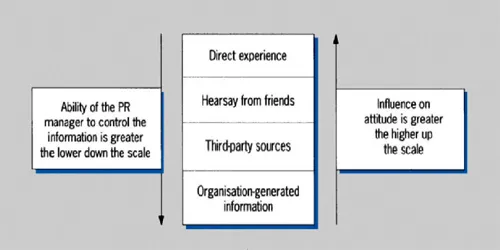
Figure 1.1 Hierarchy of information sources
Managing reputation is more than just an exercise in spin. Spin doctoring is a process of putting a good face on unacceptable facts, whereas managing reputation is a process of ensuring that the facts are themselves acceptable.
Managing reputation is about ensuring that everyone's experience of the organisation is in keeping with the reputation the organisation has or hopes to build. This means that everyone within the organisation has a role to play.
How attitudes are formed
Reputation and image both affect the attitudes that people hold towards an organisation. An attitude can be described as a tendency to behave in a certain way towards something. A person's attitude to an organisation might, for example, affect whether they would apply for a job or buy goods.
Figure 1.2 shows how attitudes are formed from three elements:

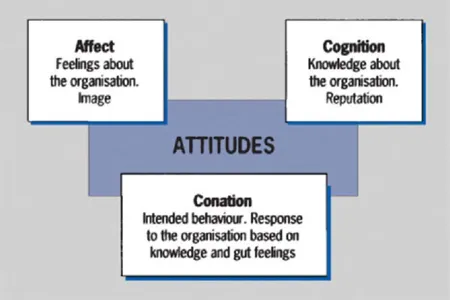
Figure 1.2 Components of attitude
In other words, someone's attitude might be formed on the strength of their knowledge of an organisation (cognition), or on a gut feeling (affect), an irrational sense that something is good or bad about the organisation or on a behavioural event (conation) like direct experience of dealing with the organisation.
Reputation describes the expectations that people have about the organisation's future behaviour. It is based on knowledge of the organisation and is the cognitive element of attitude.
Image, on the other hand, is the affective component of attitude. It is the gut feeling or the overall impression that the organisation's name and brands generate in the minds of the organisation's public.
By providing information that appeals either to the conscious, cognitive or to the affective, emotional aspect of a person's thinking, it is possible to destabilise and change existing attitudes.
Skoda was successful in doing this during the 1990s following the takeover by Volkswagen. Having shared with other Eastern manufacturers the reputation for being clumsy, unreliable and old-fashioned, the company was in desperate need of an improvement to its reputation. In order to change attitudes, the company needed first to destabilise the existing attitude and it chose to do so by using the direct route of providing new information. To do this, the company used the advertising slogan, ‘We've changed our cars – can you change your mind?’ This did not in itself change attitudes, but it did encourage people to question their attitudes towards Skoda and seek out further information. Subsequent advertising has appealed to the emotions in order to build a new attitude.
Activity 1
Assessing current attitudes
Objective
Use this activity to analyse the attitudes of your colleagues and friends towards the organisation. You can use the organisation you work for or another organisation with which you are associated – a club or hobby society would work just as well for the purposes of the exercise. The objective of this exercise is to enable you to evaluate current attitudes within the organisation; in many cases, this will indicate how altitudes need to be changed. In cases where the attitudes might be deemed to be appropriate, the exercise should help you consider ways to maintain those attitudes in the longer run.
Task
Using the matrix provided, analyse the attitudes of your colleagues towards the organisation. You can use the same matrix to analyse the attitudes of outsiders (for example, friends or family members) in order to make comparisons between insiders’ attitudes and outsiders’ attitudes. You will, of course, need to ensure that people's answers are brief!
Respondent | Knowledge about the organisation's re... |
Table of contents
- Front Cover
- Half Title
- Title Page
- Copyright
- Contents
- List of Activities
- List of Figures
- List of Tables
- Series preface
- Introduction: having a good reputation counts
- 1 Image and reputation
- 2 Creating and managing a corporate image
- 3 Creating and managing brand image
- 4 Managing the internal image
- 5 Managing the external image
- References
Trusted by 375,005 students
Access to over 1.5 million titles for a fair monthly price.
Study more efficiently using our study tools.
Frequently asked questions
Yes, you can cancel anytime from the Subscription tab in your account settings on the Perlego website. Your subscription will stay active until the end of your current billing period. Learn how to cancel your subscription
No, books cannot be downloaded as external files, such as PDFs, for use outside of Perlego. However, you can download books within the Perlego app for offline reading on mobile or tablet. Learn how to download books offline
Perlego offers two plans: Essential and Complete
- Essential is ideal for learners and professionals who enjoy exploring a wide range of subjects. Access the Essential Library with 800,000+ trusted titles and best-sellers across business, personal growth, and the humanities. Includes unlimited reading time and Standard Read Aloud voice.
- Complete: Perfect for advanced learners and researchers needing full, unrestricted access. Unlock 1.5M+ books across hundreds of subjects, including academic and specialized titles. The Complete Plan also includes advanced features like Premium Read Aloud and Research Assistant.
We are an online textbook subscription service, where you can get access to an entire online library for less than the price of a single book per month. With over 1.5 million books across 990+ topics, we’ve got you covered! Learn about our mission
Look out for the read-aloud symbol on your next book to see if you can listen to it. The read-aloud tool reads text aloud for you, highlighting the text as it is being read. You can pause it, speed it up and slow it down. Learn more about Read Aloud
Yes! You can use the Perlego app on both iOS and Android devices to read anytime, anywhere — even offline. Perfect for commutes or when you’re on the go.
Please note we cannot support devices running on iOS 13 and Android 7 or earlier. Learn more about using the app
Please note we cannot support devices running on iOS 13 and Android 7 or earlier. Learn more about using the app
Yes, you can access Reputation Management by Elearn in PDF and/or ePUB format, as well as other popular books in Business & Business General. We have over 1.5 million books available in our catalogue for you to explore.