- 380 pages
- English
- ePUB (mobile friendly)
- Available on iOS & Android
eBook - ePub
Managing Marketing
About this book
The newly qualified manager may well be equipped with the skills of the "What" of marketing and management, but not know the "How." The practicing marketer is well served with guides on strategy, mainly of the "four minute plan" variety, but poorly served in terms of basic advice on implementing the strategy and plans.
This book is therefore designed to give clear guidance in managing the marketing function as a practical entity and allowing the new marketer to grasp how the theory can be applied to the job. Written by practitioners who are also active in the marketing education and training sectors it gives the reader a clear overview of-
*How the key areas of marketing knowledge can be made operationally effective
*How to make marketing practical and measurable
*A huge range of examples and vignettes illustrating best practice
*A truly international perspective
The book will be an invaluable toolkit for the newly qualified and newly appointed marketer trying to apply their knowledge of the theory
Part I Organization
| 1 | Customers and value |
Introduction
As will be discussed in Chapter 2, products and their relationship to markets is central to our thinking. Managing products in markets and measuring the outcomes in terms of market share and perhaps customer satisfaction are almost unquestioned in the minds of many marketers. However, the dramatic and dynamic changes that are occurring in marketplaces have led to the role of marketing, and the contribution that it makes to business success, being questioned. It seemed in the boom times of the 1980s that marketing was enjoying something of a renaissance, but from then on its role has been increasingly in doubt.
The concept of relationship marketing provided a much greater focus on customers and other stakeholders rather than on products, features and benefits. This put the emphasis on longer-term, mutually profitable relationships, but one criticism of relationship marketing has been the absence of tools and techniques that enable managers to ‘do’ relationship marketing, and differentiate this from transaction marketing. Recognizing that the purpose of the business is to deliver value to shareholders and other stakeholders in the business, the ability to link marketing activity to the financial objectives of the organization is seen as an important one (see Chapter 12). A leading thinker, the late Peter Doyle (Doyle, 2000), wrote a book called Value Based Marketing, which has sparked much discussion and debate on this topic. This chapter will investigate some of the issues surrounding this area and present some concepts, tools and techniques to enable managers to address the issues more comprehensively.
The 4Ps – adequate but insufficient
The principles of marketing emerged as a consumer-focused, brand-orientated topic area characterized in the 1950s and 1960s by the acronym ‘4Ps’. Just as few of us would prefer to drive a car, watch a television or use a telephone made in the 1950s and 1960s, so we also have to question the validity of this original concept half a century later. Inevitably there has been enormous change in business and society, and those factors fundamental to change have been identified (Brookes and Palmer, 2004) by some recent research:
- Increasing emphasis on service aspects of products – it is increasingly difficult to compete on the basis of product features. Some products, such as mobile phones, now contain such a bewildering array of features that simple and straightforward phones are being sold as differentiated. Service has become a major source of differentiation and, in many developed economies, a critical aspect of marketing.
- Financial accountability, loyalty and value management – marketing is invariably seen as a cost rather than an investment, and marketers have to recognize the need to justify their actions in financial terms and demonstrate the contribution to profitability.
- Increased retailing power and ‘systemic’ relationships – the largest company in the world, Wal-Mart, is a retailer. Retailers, and other network builders and managers such as Toyota, have both the capability and the power to reach back to their suppliers in order to integrate systems and business processes.
- Organizational transformation and new organizational structures – organizations have changed in response to changes in the business environment, such as increasing consumer power, the increasing importance of service, demands for value and the trend towards globalization. Decision-making has moved from the top of the hierarchy to the front line in order to increase responsiveness, and organizations both cooperate and compete in a complex network of relationships.
- Interactive media and mass communication – before the Internet and the proliferation of media, mass communication was almost as simple as buying an advertising slot in the commercial break of a popular soap opera. Media of all kinds have proliferated – TV and radio channels, numerous niche newspapers and magazines, and of course the Internet – together with the changes in behaviour that this has brought about.
The media explosion
In the UK in 2006, it was estimated that there are:
- 739 radio stations
- 479 television stations
- 1680 magazines
- 1491 newspapers
- 4389 UK media brands on line
and that the average manager
- receives 99 emails a day
- spends 11.3 hours a week on the Internet.
(Source: Craig Hanna, e-consultancy)
Against this backdrop we have also seen a change in the value of the customer. When markets were buoyant and expanding, the conventional 4Ps or transactional style of marketing was a well-developed means of entering and gaining markets. As markets became more mature, gaining new customers became more expensive and the strategic value of current customers increased.
Increasingly, the battle is now not just for market share as the driver of volume. The drive for share combined with takeovers and rationalization has led to a position where many companies now enjoy the economies of scale and experience that have accrued in the industry; technology and its application is common amongst competitors.
The battle has developed from market share to market space as companies utilize their inherent resources and capabilities, the skills with which they utilize their resources, to drive their businesses forward. At the forefront of this are those retailers such as Tesco and Carrefour who, as well as battling for market dominance and leading the charge in the Chinese and east European markets, are also building on their skills and capabilities to diversify into new markets. Tesco, for example, is the largest Internet retailer in Europe, as well as having substantial interests in financial services and insurance, clothes and petrol retailing, and further expansion into household goods, pharmacies and optician services.
As the Chief Executive of Tesco, Sir Terry Leahy, said in a media interview in January 2004:
We have only got 5% of the non-food market in Britain, we've only got 6% of the convenience market and we have only got 2–3% of the banking market ... In all those examples we could be much bigger.
So competition is based not just on market share but also on share of customer spend. Hence the focus has moved from supplying products and services to understanding the value of the customer to the organization and how the company can in turn provide better value to that customer in order to capture an ever higher share of the customer's spend.
It is currently said that the only asset the company has is the ability to earn an income stream now and in the future from its customer base. Those customers are becoming more vociferous and harder to please, but, at least intuitively, many managers recognize the need to compete not just for share of the market but also for share of wallet – the proportion of the customer's total spend that they can capture.
The demanding customer
The case of the Ford Pinto is iconic in the history of consumerism. In 1968, Ford in the US started development of a small saloon car to be rushed into production to compete with Japanese cars that were beginning to eat into the market. Due to a design flaw, the fuel tank was much more prone to rupture in the event of a rear-end collision. The spillage and burning of fuel led to a much higher incidence of death and serious injury when these vehicles were involved in road accidents. It later emerged that the vehicle could have been easily modified at a cost of just a few dollars per car. Ford decided against this on the basis of a cost–benefit analysis that weighed the cost of the modification against financial calculation of the benefit of lives saved and injuries not incurred. There was outrage that such a value could be placed on human life, and that for only a few dollars per car so much death, pain and injury could have been avoided.
In developed economies, consumers have power and are not afraid to use it. Greenpeace took on and then defeated Shell, one of the largest companies in the world, concerning the issue of the disposal of the Brent Spar oil rig – a redundant oil rig that Shell planned to sink in a deep trench in the north Atlantic. Greenpeace mobilized its forces, arguing that this was environmentally unsound, and Shell eventually backed down.
The Internet has enabled not just organizations but also individuals with a grudge or complaints to air their concerns. Individuals can even develop their own websites, and whilst smaller sites may flower and then die, others, such as www.mcspotlight.org, have developed from a single issue – a legal case involving protesters and the McDonald's chain – into a sophisticated protest site directed at multinational companies. Another example is the disaffected customer of United Airlines in the USA who started a website – www.untied.com – and presented the pages in a parody of the United corporate style. Legal action by United and subsequent press publicity rapidly propelled the site to the ranks of the most visited, receiving hundreds of thousands of hits a day. If you enter ‘United Airlines’ into Google, this site usually appears third in the search list. More considered organization is provided by websites such as www.notgoodenough.org, an Australian website where individual consumers can air their grievances.
However, such protests and consumer engagement is not confined to sophisticated, developed markets. In China, tuangou (or team buying) is being used to exercise consumer muscle and drive down prices. Specialist websites such as www.teambuy.com.cn have quickly evolved to increase buyer power and coordinate consumer action. One tactic is for a coordinated group of buyers simply to arrive unannounced at a store and demand a high level of discount on the products they intend to purchase. Increasingly, the price on the ticket is seen as simply an invitation to start negotiation.
The Internet has redressed the balance of power between large corporations and individual consumers who are increasingly willing to engage – and win.
(Sources: The Economist, numerous websites)
Recognizing the shifts that have occurred in marketplaces, we have also seen a reorientation of the concept of marketing from a functionally orientated focus on managing products and the product range, with an emphasis on new product development and an escalating list of features and benefits for each new product, to a revised emphasis on the role of the customer in terms of relationship marketing. However, the business imperative is for profitability, and an understanding of value is important to marketers in helping them to relate more closely to the objectives of the business. This evolution in approach is demonstrated in Figure 1.1.
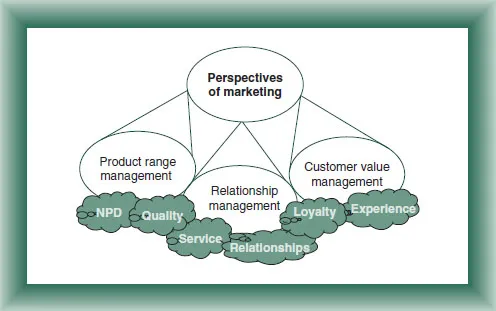
Figure 1.1 The changing emphasis of marketing
Figure 1.1 demonstrates some of the concepts that are linked together by these various perspectives of marketing. Three of these – quality, satisfaction and loyalty – are discussed here in a ...
Table of contents
- Cover Page
- Half Title Page
- Title Page
- Copyright Page
- Contents
- About the Authors
- Introduction
- Part I: Organization
- 1 Customers and value
- 2 Products and market
- 3 Management and culture
- 4 Organizations and the business environment
- Part II: People
- 5 Management skills
- 6 Leadership
- 7 Problem-solving, creativity and decision-making
- 8 Motivation
- 9 Communications and relationships
- Part III: Resources
- 10 Time and technology
- 11 Knowledge, information and intelligence
- 12 Money, measures and outcomes
- Index
Trusted by 375,005 students
Access to over 1.5 million titles for a fair monthly price.
Study more efficiently using our study tools.
Frequently asked questions
Yes, you can cancel anytime from the Subscription tab in your account settings on the Perlego website. Your subscription will stay active until the end of your current billing period. Learn how to cancel your subscription
No, books cannot be downloaded as external files, such as PDFs, for use outside of Perlego. However, you can download books within the Perlego app for offline reading on mobile or tablet. Learn how to download books offline
Perlego offers two plans: Essential and Complete
- Essential is ideal for learners and professionals who enjoy exploring a wide range of subjects. Access the Essential Library with 800,000+ trusted titles and best-sellers across business, personal growth, and the humanities. Includes unlimited reading time and Standard Read Aloud voice.
- Complete: Perfect for advanced learners and researchers needing full, unrestricted access. Unlock 1.5M+ books across hundreds of subjects, including academic and specialized titles. The Complete Plan also includes advanced features like Premium Read Aloud and Research Assistant.
We are an online textbook subscription service, where you can get access to an entire online library for less than the price of a single book per month. With over 1.5 million books across 990+ topics, we’ve got you covered! Learn about our mission
Look out for the read-aloud symbol on your next book to see if you can listen to it. The read-aloud tool reads text aloud for you, highlighting the text as it is being read. You can pause it, speed it up and slow it down. Learn more about Read Aloud
Yes! You can use the Perlego app on both iOS and Android devices to read anytime, anywhere — even offline. Perfect for commutes or when you’re on the go.
Please note we cannot support devices running on iOS 13 and Android 7 or earlier. Learn more about using the app
Please note we cannot support devices running on iOS 13 and Android 7 or earlier. Learn more about using the app
Yes, you can access Managing Marketing by Roger Palmer,Juanita Cockton,Graham Cooper in PDF and/or ePUB format, as well as other popular books in Business & Business General. We have over 1.5 million books available in our catalogue for you to explore.