- 212 pages
- English
- ePUB (mobile friendly)
- Available on iOS & Android
eBook - ePub
Woodland Habitats
About this book
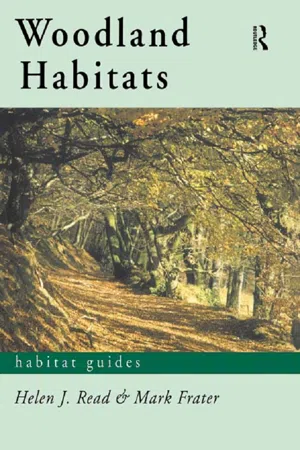
Woodland habitats explores the history and ecology of British woodland and explains why they a re such a valuable resource. It examines the wide range of different types of woodland habitats and the typical species that live within them. It offers a practical guide to all the key woodland issues including: *conservation and management * coppicing * grazing in woodlands * fire breaks * recreation * management for game * pasture woodland and commercial forestry Woodland Habitats also includes a guide to notable sites with location maps and illustrations, suggested practical projects and a full glossary of terms.
1 INTRODUCTION
GENERAL
Trees and woodlands are an integral part of Britain's heritage and culture. From pictures of kings hunting in leafy forests to the works of Thomas Hardy with their detailed descriptions of the lives of woodland occupants they are a part of our landscape which is often taken for granted (Plate 1.1). This is perhaps not surprising; our ancestors relied on wood to keep them warm, to provide fuel for cooking, as timber for building houses and ships and to make a myriad of other products which today we are no longer familiar with. Even now, the products of trees are central to our lives. The quantity of paper and packaging everyone uses is substantial and, although houses are no longer built solely from wood, it is still widely used in construction as well as in furniture and fittings.
Romantic notions of oak woods full of bluebells in the spring or the glorious colours of an autumn beech wood are, for many people, just a distant memory. As the population becomes increasingly urbanised, most people's experiences of woods are scrappy forgotten corners of land with a few sycamore trees and lots of brambles, or, a large, seemingly intimidating, area of dark conifers. Research has shown that many visitors dislike areas of dense woodland because they feel unsafe (Countryside Commission, 1995). Yet, as the population is more mobile and millions flock to areas such as the Lake District for holidays, parts of our landscape including our woods, are becoming holiday resorts.
Although the British woods have been shaped, and often formed, by human hand, this is not to say that they are important just for their products. The extensive felling of trees by humans after the last ice age substantially reduced the total area of woodland. The areas left, especially those that have never been clear felled, represent important resources for naturally occurring plants and animals. The complex three-dimensional structure of woods abounds with conditions suitable for a wide range of organisms. Some are generalists feeding on the dead leaves from the trees when they fall, others are incredibly specialised, living, for example, in a specific type of rot found on a particular tree species. As centres of diversity, woodlands are extremely important.

Plate 1.1 A woodland church in Exmoor
Woods and forests protect soils, retain moisture and store and recycle nutrients. They are also an essential part of the global environment, absorbing carbon dioxide and producing oxygen. They play a major role in maintaining the world climate, and their destruction releases carbon into the atmosphere causing climate change. More than 40 per cent of the earth's land surface used to be covered in trees. Today that has been reduced by a third and half of that remaining is degraded from its primary form (Myers, 1996).
This volume will explore the history and ecology of British woodlands and provide a description of the resource we have today. The management and conservation of woods is a complex subject which has stimulated much debate recently and which will, no doubt, continue well into the future. Case studies are presented of specific sites, which are good examples of particular types or illustrate relevant issues. Finally some examples of practical projects are given with the aim of stimulating the reader's interest in trees and woods wherever they live.
THE HISTORY OF WOODLAND IN BRITAIN
The last ice age to 4,500 years ago
The Pleistocene era in Britain was marked by a series of glacial and interglacial periods. The last ice age is known as the Weichselian and commenced about 70, 000 years ago. Although the ice sheet only reached as far south as East Anglia the conditions further south in the British Isles would have been similar to tundra. As the temperature warmed up and the ice retreated (roughly 10,000 years ago),

Figure 1.1 The vegetation of the British Isles in the last 14,000 years. From Godwin (1975).
trees slowly colonised from further south. At this stage Britain was not an island so plants and animals could spread from the rest of Europe without having to cross any sea.
The progression of the trees and the species concerned can be determined by the use of pollen analysis. The pollen grains from different plant species or genera can be distinguished. When the grains fall onto the surface of a peat bog, or wet area where peat is forming, they are preserved. Over thousands of years, as the peat builds up so the pollen grains of the trees, and other plants common at that time, also accumulate and a record is formed. This can be examined by extracting a core of the peat and examining it under a microscope.
Figure 1.1 shows the colonisation of the British Isles by different tree species. Around 4,500 years ago most of the country was probably wooded and Figure 1.2 shows the likely major composition of the woods in different parts of the country. The woodland of this time is called wildwood. This was a period of

Figure 1.2 The principal woodland types of the ‘wildwood’ (in addition there would have been alder dominated woods alongside lakes and rivers). From Marren (1990)
relative climatic stability (called the Atlantic period) which ended with a decline in the amount of elm pollen recorded and an increase in human activities. These two events may be linked, but other causes of the elm decline have been proposed including Dutch elm disease (Rackham, 1990).
From this point onwards humans start to have a significant impact on the woodlands in the British Isles.
4,500 years ago to 1914 AD
Woodland clearance started in the Neolithic period and continued thoughout the Bronze Age (approximately 4000–2500 BP). Rackham (1990) considers that the period of greatest clearance was perhaps the Iron Age (approximately 2500–2000 BP) by the end of which 50 per cent of England had ceased to be wooded. No mean feat for people with primitive tools! Due to human activities the tree composition also changed. The amount of small-leaved lime decreased while hazel (and to a lesser extent birch) became more abundant (Godwin, 1975; Rackham, 1990). The forests were not all destroyed, some were probably used for grazing and fodder for domesticated animals, while the trees themselves started to become a managed resource.
From Neolithic days humans have used the resulting growth when a tree was felled and the stump re-grew (coppice) for putting on trackways, some being interwoven like hurdles (Rackham, 1990). Thus the management of the woods and the extensive use of woodland products started to become an integral part of British life.
From 2,800 years ago up to the present day it becomes difficult to disentangle small-scale changes in climate from the impact of humans in the pollen record (Godwin, 1...
Table of contents
- Cover
- Half Title
- Habitat Guides
- Full Title
- Copyright
- Contents
- List of plates
- List of figures
- List of tables
- List of species boxes
- Acknowledgements
- Series introduction
- 1 INTRODUCTION
- 2 THE ECOLOGY OF WOODLAND HABITATS
- 3 MANAGEMENT AND CONSERVATION
- 4 CASE STUDIES
- 5 PRACTICAL WORK
- Glossary
- Species list
- Further reading
- References
- Index
- Species index
Trusted by 375,005 students
Access to over 1.5 million titles for a fair monthly price.
Study more efficiently using our study tools.
Frequently asked questions
Yes, you can cancel anytime from the Subscription tab in your account settings on the Perlego website. Your subscription will stay active until the end of your current billing period. Learn how to cancel your subscription
No, books cannot be downloaded as external files, such as PDFs, for use outside of Perlego. However, you can download books within the Perlego app for offline reading on mobile or tablet. Learn how to download books offline
Perlego offers two plans: Essential and Complete
- Essential is ideal for learners and professionals who enjoy exploring a wide range of subjects. Access the Essential Library with 800,000+ trusted titles and best-sellers across business, personal growth, and the humanities. Includes unlimited reading time and Standard Read Aloud voice.
- Complete: Perfect for advanced learners and researchers needing full, unrestricted access. Unlock 1.5M+ books across hundreds of subjects, including academic and specialized titles. The Complete Plan also includes advanced features like Premium Read Aloud and Research Assistant.
We are an online textbook subscription service, where you can get access to an entire online library for less than the price of a single book per month. With over 1.5 million books across 990+ topics, we’ve got you covered! Learn about our mission
Look out for the read-aloud symbol on your next book to see if you can listen to it. The read-aloud tool reads text aloud for you, highlighting the text as it is being read. You can pause it, speed it up and slow it down. Learn more about Read Aloud
Yes! You can use the Perlego app on both iOS and Android devices to read anytime, anywhere — even offline. Perfect for commutes or when you’re on the go.
Please note we cannot support devices running on iOS 13 and Android 7 or earlier. Learn more about using the app
Please note we cannot support devices running on iOS 13 and Android 7 or earlier. Learn more about using the app
Yes, you can access Woodland Habitats by Mark Frater,Helen J. Read in PDF and/or ePUB format, as well as other popular books in Physical Sciences & Geography. We have over 1.5 million books available in our catalogue for you to explore.