- 304 pages
- English
- ePUB (mobile friendly)
- Available on iOS & Android
eBook - ePub
About this book
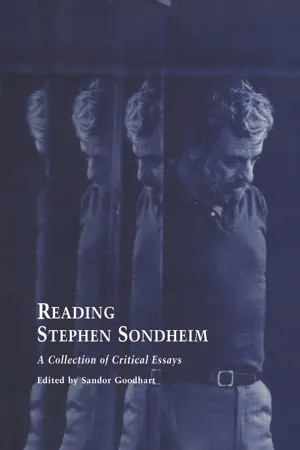
Stephen Sondheim is arguably the most important writer for the American musical stage today, the equivalent in his field of Miller, Albee, O'Neill, and Williams. Yet he has rarely been treated seriously within the academy. Reading Stephen Sondheim: A Collection of Critical Essays is an attempt to remedy that situation. Bringing together scholars and critics from a wide variety of literary and theoretical perspectives, this book undertakes to examine all of Sondheim's major productions and themes.
Information
PART 1
SOURCES,
INSTITUTIONS, THEMES
CHAPTER 1
The Sung and the Said
Literary Value in the Musical Dramas
of Stephen Sondheim
Thomas P. Adler
In 1974, Stephen Sondheim and Burt Shevelove collaborated on a musical adaptation of The Frogs, which does for Aristophanes pretty much what they had done for Plautus eight years earlier in A Funny Thing Happened on the Way to the Forum.1 In the later play, Dionysos, who believes that we “lack passion” in our lives, journeys to Hades to bring Bernard Shaw back to earth.2 After hearing a lively competition between Shaw and Shakespeare, however, Dionysos decides that instead of Shaw (who “stand[s] for the great abstractions: conscience, virtue, integrity” [116]) what the world and theater most need is “a poet … to lift [them] out of their seats” (120) so that they will be actively inspired to do something about salvaging the earth they have abused. In lyrics to a song entitled “The Sound of Poets” that might well express their writer's own artistic credo, the Chorus charges the poet to attempt the following:
Bring a sense of purpose,
Bring the taste of words,
Bring the sound of wit,
Bring the feel of passion,
Bring the glow of thought To the darkening earth. (124)
These are all achievements that Sondheim, the single most important creative force in the American musical theater from the 1960s through the 1990s, has accomplished since that night now almost forty years ago when New York audiences first heard his lyrics in the revolutionary dance musical West Side Story. And if the myopic critics did not even mention his name the next morning in their notices, they have had numerous occasions since then to remedy their oversight in reviewing the fifteen other shows in which Sondheim has been creatively involved either as lyricist or as lyricist-composer—including Company, Follies, and A Little Night Music, for which he won an unprecedented three successive Tony Awards, and Sunday in the Park with George, for which he won, with librettist James Lapine, a Pulitzer Prize.
In this essay, I will test out a number of critical approaches to Sond-heim's work—generic, formalist, thematic—in an attempt to assess his contribution to the musical as a form. In the first part, I will focus in particular on those shows (usually done in collaboration with producer-director Harold Prince) that depart most markedly from the integrated book musical epitomized by Rodgers and Hammerstein's Oklahoma! and South Pacific. And in the second part, I will center on those works since the beginning of the 1980s (in collaboration with George Furth, John Weidman, and James Lapine) in which Sondheim has explored somewhat darker, more modernist, themes, ones that have also interested other dramatists like Eugene O'Neill and Edward Albee. I will argue, ultimately, that Sondheim is distinct among writers for the American musical stage in that he has a philosophy, an ideology that he continually expresses and deepens throughout his musicals and that raises them above the realm of popular entertainment—though they are, happily, still that—and places them among those works for the American stage that can be said to have not only artistic merit but a literary value as well.
To say as much is not to suggest, of course, that there were no “serious” musicals before Sondheim—for we can go back as far as Kern, Hammerstein, and Ferber's Showboat, or the Gershwins' Porgy and Bess, or Blitzstein's The Cradle Will Rock for these. Nor is it to say that no composer-lyricist had ever before developed a distinctive style—for the urbane sophistication tinged with skepticism that Cole Porter displayed to the nth degree is that. Nor, finally, is it to imply that no team had ever before expressed a recurring outlook on life through a number of shows—for we can point to the optimistic faith in man found in such Rodgers and Hammerstein songs as “You'll Never Walk Alone” from Carousel, and “Climb Every Mountain” from The Sound of Music for that. But all these earlier efforts attempt something quite different from what Sondheim undertakes—which is to consistently embody and refine several themes into that rarest of all achievements in this popular context—a body of thought.
I
The integrated book musical which, in theory anyway, ideally permits only those songs that either advance the plot or reveal character, is an extension or outgrowth of the representational, illusion-of-reality drama that dominated the American stage at least until the beginning of World War II (and is still a potent force today). Yet when we acknowledge that no matter how realistic a play is in its trappings we, as audience, are still tacitly aware that we are in a theater watching only an imitation of reality, pretending that we are not pretending, then it becomes clear that the total illusion of reality is, strictly speaking, an artificial goal—though its very artificiality opens up the possibility of its becoming art. How much more true this claim must necessarily be of the musical, where the suspension of disbelief is even more complete, since most people do not go singing and dancing through life.
The aesthetic principle governing the occurrence of song in the organic book musical is analogous to that governing the use of poetry in drama. Just as poetry, according to T. S. Eliot, is appropriate in the drama only when prose is no longer capable of containing and conveying the emotion, so, too, one can justifiably break into song only when dialogue can no longer adequately express feeling or, in Sondheim's own words, “the climaxes of emotion and action erupt into music because they can't go further without it.”3
This eruption is perhaps nowhere better evident in the musicals with which Sondheim has been associated than at the end of Gypsy (1959, with book by Arthur Laurents and music by Jule Styne), which Sondheim calls— and I concur—“one of the two or three best shows ever written … the last good one in the Rodgers and Hammerstein form.”4 In “Rose's Turn,” the boundary between the sung and the said becomes virtually indistinguishable as Mama Rose, while admitting that she pushed her daughters into show business so that they could achieve in reality what she had dreamed of accomplishing for herself, desperately pleads for her own belated chance at stardom. Her knowledge that the talent, drive, and ego essential for success really did exist—and still are there—must now be emotionally supported and nurtured by her daughter, Gypsy Rose, in what Sondheim views as an imperative reversal of roles: “You outgrow your parents and then eventually they become your responsibility … they become your children.”5
Developments in the nonmusical drama in the 1940s and 1950s in the direction of nonrepresentational, nonillusionistic staging helped alter audience expectations about the musical theater as well, and their demand for the integrated book musical began to wane, opening the way for an acceptance of freer forms. So, by the 1960s, we have Jones and Schmidt's The Fantasticks and Celebration, Littlewood's Oh, What a Lovely War!, Leigh, Darion, and Wasserman's Man of La Mancha, and, especially, Kander, Ebb, and Mas-teroff's Cabaret, all of which, in their own way, are technically the equivalents of Wilder's Our Town and The Skin of Our Teeth, Williams' The Glass Menagerie and Miller's Death of a Salesman. All turn a seeming liability into a definite asset, deliberately emphasizing that we are in a theater, glorying in the theatrical form as form. Readily accepting nonrealistic devices of staging and structure in even our serious drama, we now no longer demand that every song lyric develop the plot line or enhance character motivation. Song can become commentative (or editorial, if you like), illustrative, connective, a punctuation device, or a device to be employed for exposition. It can also be used contrapuntally, or even serve—and this would ordinarily be anathema in the dramatic form—as a breather.
In short, when song can once again exist for itself and still, instead of detracting from the aesthetic design and integrity of the whole, complement it, the uses of song within the musical drama become almost boundless. Martin Gottfried and others have termed this new type of musical the “concept musical.”6 We might also, despite Sondheim's disparagement of the too exclusively didactic Brecht as “humorless” (“his points,” Sondheim writes, “[are] so obvious in the text itself that the songs have no surprise or wit”), call this new freer kind of musical the “epic musical,” if by epic we understand what Brecht did, namely, a play which narrates or relates rather than exclusively dramatizes or incarnates events.7 Some critics, including Emanuel Azenberg, who finds shows like Company and Follies “soulless,” would go so far as to attribute a dose of Brechtian alienation or estrangement to Sondheim's musicals.8 It seems to me, however, that Sondheim avoids this distancing precisely because his music is, by its very nature, emotional in its appeal, and also because there almost always is, with the exception of Pacific Overtures (which the scenic designer Boris Aronson says flatly is “about issues and not about people and moods”), a central figure(s) with whom we empathize (as there often is, too, in Brecht, his theory notwithstanding).9
Pacific Overtures (1976, with book by John Weidman) is the most unconventional of Sondheim's musical plays and, because it is political in its thrust, also the most overtly Brechtian. Musically, it blends a vaguely Oriental style throughout with, here and there, touches of the pulsating urban rhythms one finds in the Leonard Bernstein of On the Town and West Side Story, and even a splash of John Philip Sousa and a dash of the French cancan and a measure of Gilbert and Sullivan recitative for added flavor. Stylistically, it owes several debts to the Kabuki theater: first, for its Reciter, who is alternately observer, narrator, storyteller, ironic and/or moral commentator, and bridge between action and audience; second, for its black-clad stagehands who shift scenery; and finally, for its use of a hanamichi or runway.
Telling the story of the Westernization of Japan, the show takes its title directly from the journals of Commodore Perry who arrives there in 1853, in appearance “a lionlike figure of terror from a child's dream, complete with flowing white mane,” anxious to impose civilization—by barbarous force if necessary.10 (This achievement in itself would seem to qualify it for honors as the first Broadway musical directly spawned by our involvement in Vietnam.) As presented in the opening song, “The Advantages of Floating in the Middle of the Sea,” Japan is deliberately insular and isolated, a nation for whom “beauty is truth” (Keats's words) and the most valued activities are the painting of screens and the ritualized taking of bows. In general, scenes without music alternate with those with music; some of ...
Table of contents
- Cover Page
- Half Title page
- Series page
- Title Page
- Copyright Page
- Dedication
- Contents
- General Editor's Note
- Preface and Acknowledgments
- Contributors
- Introduction Reading Sondheim The End of Ever After
- Introduction Reading Sondheim The End of Ever After
- Part 1 Sources, Institutions, Themes
- Part 2 Plays
- Works Cited
- Index
Trusted by 375,005 students
Access to over 1.5 million titles for a fair monthly price.
Study more efficiently using our study tools.
Frequently asked questions
Yes, you can cancel anytime from the Subscription tab in your account settings on the Perlego website. Your subscription will stay active until the end of your current billing period. Learn how to cancel your subscription
No, books cannot be downloaded as external files, such as PDFs, for use outside of Perlego. However, you can download books within the Perlego app for offline reading on mobile or tablet. Learn how to download books offline
Perlego offers two plans: Essential and Complete
- Essential is ideal for learners and professionals who enjoy exploring a wide range of subjects. Access the Essential Library with 800,000+ trusted titles and best-sellers across business, personal growth, and the humanities. Includes unlimited reading time and Standard Read Aloud voice.
- Complete: Perfect for advanced learners and researchers needing full, unrestricted access. Unlock 1.5M+ books across hundreds of subjects, including academic and specialized titles. The Complete Plan also includes advanced features like Premium Read Aloud and Research Assistant.
We are an online textbook subscription service, where you can get access to an entire online library for less than the price of a single book per month. With over 1.5 million books across 990+ topics, we’ve got you covered! Learn about our mission
Look out for the read-aloud symbol on your next book to see if you can listen to it. The read-aloud tool reads text aloud for you, highlighting the text as it is being read. You can pause it, speed it up and slow it down. Learn more about Read Aloud
Yes! You can use the Perlego app on both iOS and Android devices to read anytime, anywhere — even offline. Perfect for commutes or when you’re on the go.
Please note we cannot support devices running on iOS 13 and Android 7 or earlier. Learn more about using the app
Please note we cannot support devices running on iOS 13 and Android 7 or earlier. Learn more about using the app
Yes, you can access Reading Stephen Sondheim by Sandor Goodhart in PDF and/or ePUB format, as well as other popular books in Literature & Literary Criticism in Drama. We have over 1.5 million books available in our catalogue for you to explore.