1
A TERRORIST ATTACK IN ITALY
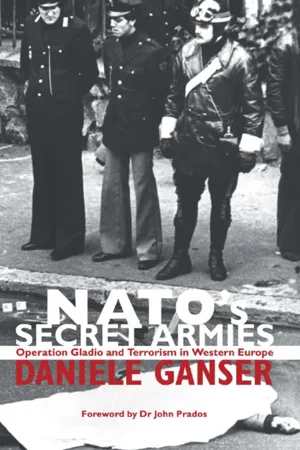
In a forest near the Italian village Peteano a car bomb exploded on May 31, 1972. The bomb gravely wounded one and killed three members of the Carabinieri, Italy’s paramilitary police force. The Carabinieri had been lured to the spot by an anonymous phone call. Inspecting the abandoned Fiat 500, one of the Carabinieri had opened the hood of the car that triggered the bomb. An anonymous call to the police two days later implicated the Red Brigades, a Communist terrorist group attempting to change the balance of power in Italy at the time through hostagetakings and cold-blooded assassinations of exponents of the state. The police immediately cracked down on the Italian left and rounded up some 200 Communists. For more than a decade the Italian population believed that the Red Brigades had committed the Peteano terrorist attack.
Then, in 1984, young Italian Judge Felice Casson reopened the long dormant case after having discovered with surprise an entire series of blunders and fabrications surrounding the Peteano atrocity. Judge Casson found that there had been no police investigation on the scene. He also discovered that the report which at the time claimed that the explosive used in Peteano had been the one traditionally used by the Red Brigades was a forgery. Marco Morin, an expert for explosives of the Italian police, had deliberately provided fake expertise. He was a member of the Italian right-wing organisation ‘Ordine Nuovo’ and within the Cold War context contributed his part to what he thought was a legitimate way of combating the influence of the Italian Communists. Judge Casson was able to prove that the explosive used in Peteano contrary to Morin’s expertise was C4, the most powerful explosive available at the time, used also by NATO. ‘I wanted that new light should be shed on these years of lies and mysteries, that’s all’, Casson years later told journalists in his tiny office in an eighteenth-century courthouse on the banks of Venice’s lagoon. ‘I wanted that Italy should for once know the truth.’1
On February 24, 1972, a group of Carabinieri had by chance discovered an underground arms cache near Trieste containing arms, munitions and C4 explosive identical to the one used in Peteano. The Carabinieri believed that they had unveiled the arsenal of a criminal network. Years later, the investigation of Judge Casson was able to reconstruct that they had stumbled across one of more than hundred underground arsenals of the NATO-linked stay-behind secret army that in Italy was code-named Gladio, the sword. Casson found that the Italian military secret service and the government at the time had gone to great lengths in order to keep the Trieste discovery and above all its larger strategic context a secret.
As Casson continued to investigate the mysterious cases of Peteano and Trieste, he discovered with surprise that not the Italian left but Italian right-wing groups and the military secret service had been involved in the Peteano terror. Casson’s investigation revealed that the right-wing organisation Ordine Nuovo had collaborated very closely with the Italian Military Secret Service, SID (Servizio Informazioni Difesa). Together they had engineered the Peteano terror and then wrongly blamed the militant extreme Italian left, the Red Brigades. Judge Casson identified Ordine Nuovo member Vincenzo Vinciguerra as the man who had planted the Peteano bomb. Being the last man in a long chain of command, Vinciguerra was arrested years after the crime. He confessed and testified that he had been covered by an entire network of sympathisers in Italy and abroad who had ensured that after the attack he could escape. ‘A whole mechanism came into action’, Vinciguerra recalled, ‘that is, the Carabinieri, the Minister of the Interior, the customs services and the military and civilian intelligence services accepted the ideological reasoning behind the attack’.2
Vinciguerra was right to point out that the Peteano terror had occurred during a particularly agitated historical period. With the beginning of the flower power revolution, the mass student protests against violence in general and the war in Vietnam in particular, the ideological battle between the political left and the political right had intensified in Western Europe and the United States in the late 1960s. The vast majority of people engaged in the left-wing social movements relied on non-violent forms of protest including demonstrations, civil disobedience and above all heated debates. In the Italian parliament the strong Communist Party (Partito Communisto Italiano, PCI), and to a lesser degree the Italian Socialist Party (Partito Socialisto Italiano, PSI), sympathised with the movement. They criticised the United States, the Vietnam War and above all the distribution of power in Italy, for despite their numerical strength in parliament the PCI was not assigned ministerial positions and hence was deliberately kept outside the government. Also the Italian right knew that this was a blatant discrimination and a violation of basic democratic principles.
It was in this Cold War context and the battle for power in Western Europe that the extreme left and the extreme right resorted to terror. On the extreme left the Italian Communist Red Brigades and Germany’s Rote Armee Fraktion (RAF) were the two most prominent terrorist groups in Western Europe. Founded by students of the University of Trento with little to no military training, the Red Brigades included Margherita Cagol, Alberto Franceschini and Alberto Curcio. Like the RAF, they were convinced that violence had to be employed in order to change the existing power structure that they perceived as unjust and corrupt. Like the RAF the terror of the Red Brigades did not attack mass gatherings of the population, but very selectively targeted individuals whom they thought represented the ‘state apparatus’, such as bankers, generals and ministers whom they kidnapped and often assassinated. Operating above all in the 1970s the death toll of the Red Brigades in Italy reached 75 people. Then, due to their limited military and strategic skills and experience they were rounded up, arrested, tried and imprisoned.
On the other side of the Cold War spectrum also the extreme right resorted to violence. In Italy the network included secret Gladio soldiers, the military secret services and fascist organisations such as Ordine Nuovo. Contrary to the terror of the left, the terror of the right aimed to strike fear to the bones of the entire society and hence secretly planted its bombs among the population to kill large numbers indiscriminately in order to wrongly blame the Communists. The Peteano terror, as judge Casson found, belonged to this sort of crime and continued a sequence that had started in 1969. In that year, shortly before Christmas four bombs had exploded in public places in Rome and Milan. The bombs killed 16 and maimed and wounded 80, most of which were farmers who after a day on the market had deposited their modest earnings in the Farmer’s Bank on the Piazza Fontana in Milan. According to an evil strategy the terror was wrongly blamed on the Communists and the extreme left, traces were covered up and arrests followed immediately. The population at large had little chances to find out the truth, as the military secret service went to great lengths to cover up the crime. In Milan one of the deadly bombs had not gone off due to timer failure, but in an immediate cover-up the bomb was destroyed on the scene by the secret service, while parts of a bomb were planted in the villa of well-known leftist editor Giangiacomo Feltrinelli.3
‘The official figures say that alone in the period between January 1, 1969 and December 31, 1987, there have been in Italy 14591 acts of violence with a political motivation’, Italian Senator Giovanni Pellegrino, president of Italy’s parliamentary commission investigating Gladio and the massacres, recalled the very violent period of Italy’s most recent history. ‘It is maybe worth remembering that these “acts” have left behind 491 dead and 1181 injured and maimed. Figures of a war, with no parallel in any other European country.’4 Following the Piazza Fontana massacre of 1969 and the Peteano terrorist attack of 1972, prominent massacres in Italy included a bomb which on May 28, 1974 exploded in Brescia in the midst of an anti-Fascist demonstration, killing eight and injuring and maiming 102. On August 4, 1974 another bomb exploded on the Rome-to-Munich train ‘Italicus Express’, killing 12 and injuring and maiming 48. The atrocities culminated on a sunny afternoon during the Italian national holiday when on August 2, 1980 a massive explosion ripped through the waiting room of the second class at the Bologna railway station, killing 85 people in the blast and seriously injuring and maiming a further 200. The Bologna massacre ever since ranges amongst the largest terrorist onslaughts that Europe had seen in the twentieth century.
Contrary to the Red Brigades who ended up in jail, the terrorists of the right mysteriously escaped after each massacre because, as Vinciguerra correctly pointed out, the security apparatus of the Italian state and the military secret services protected them. As the Piazza Fontana terror was years later traced back to the Italian right, Ordine Nuovo member Franco Freda was questioned whether in retrospect he feels that powerful people higher up in the hierarchy including Generals and Ministers had manipulated him. Freda, a declared admirer of Hitler who had published ‘Mein Kampf’ in Italian in his own small publishing house, replied that according to his understanding nobody can escape manipulation: ‘The life of every one is manipulated by those with more power’, right-wing terrorist Freda declared. ‘In my case I accept that I have been a puppet in the hands of ideas, but not in the hands of men from the secret services here [in Italy] or abroad. That is to say that I have voluntarily fought my own war, following the strategic design that came from my own ideas. That is all.’5
In March 2001 General Giandelio Maletti, former head of Italian counterintelligence, suggested that next to the Gladio secret army, the Italian secret service and a group of Italian right-wing terrorists, the massacres which had discredited the Italian Communists had also been supported by the White House in Washington and the US secret service CIA. At a trial of right-wing extremists accused to have been involved in the Piazza Fontana massacre, Maletti testified: ‘The CIA, following the directives of its government, wanted to create an Italian nationalism capable of halting what it saw as a slide to the left, and, for this purpose, it may have made use of right-wing terrorism.’ ‘The impression was that the Americans would do anything to stop Italy from sliding to the left’, the General explained and added: ‘Don’t forget that Nixon was in charge and Nixon was a strange man, a very intelligent politician, but a man of rather unorthodox initiatives.’ In retrospect the 79-year-old Maletti offered criticism and regret: ‘Italy has been dealt with as a sort of protectorate’ of the United States. ‘I am ashamed to think that we are still subject to special supervision.’6
Already in the 1970s and 1980s the Italian parliament, within which the Communist and Socialist parties controlled a large share of the power, had become increasingly alarmed by the fact that a seemingly endless chain of mysterious massacres shocked the country without that the terrorists nor the people behind them could be identified. Although rumours among the Italian left already at the time had it that the mysterious acts of violence represented a form of undeclared secret warfare of the United States against the Italian Communists, the far-fetched theory could not be proven. Then, in 1988 the Italian Senate established a special investigative parliamentary commission presided by Senator Libero Gualtieri under the telling name of ‘Parliamentary Commission of the Italian Senate for the Investigation of terrorism in Italy and the reasons why the individuals responsible for the massacres could not be identified: Terrorism, the massacres and the politicalhistorical contest.’7 The work of the parliamentary investigation proved to be extremely difficult. Witnesses withheld testimony. Documents were destroyed. And the commission itself, made up of the competing political parties from the Italian left and the Italian right, was split on what exactly the historical truth in Italy was, and disagreed on how many of its sensitive findings should be presented to the public.
Judge Casson, meanwhile from the testimonies of Peteano terrorist Vincenzo Vinciguerra and the documents he had discovered, started to understand the complex secret military strategy that had been employed. He gradually started to understand that he was dealing not with private, but with state terrorism, paid by tax money. Under the name ‘strategy of tension’ the massacres aimed to create tension among the entire population. The right-wing extremists and their supporters within NATO feared that the Italian Communists would become too powerful and hence in an attempt to ‘destabilise in order to stabilise’ the secret right-wing soldiers linked to the Gladio armies carried out massacres, which they blamed on the left. ‘As far as the secret services are concerned the Peteano attack is part of what has been called “the strategy of tension”’, Judge Casson explained the strategy to non-experts in a BBC documentation on Gladio. ‘That’s to say, to create tension within the country to promote conservative, reactionary social and political tendencies. While this strategy was being implemented, it was necessary to protect those behind it because evidence implicating them was being discovered. Witnesses withheld information to cover right-wing extremists.’8 Right-wing terrorist Vinciguerra, who like others with contacts to the Gladio branch of the Italian military secret service, had been killed for his political conviction, related: ‘You had to attack civilians, the people, women, children, innocent people, unknown people far removed from any political game. The reason was quite simple. They were supposed to force these people, the Italian public, to turn to the State to ask for greater security. This is the political logic that lies behind all the massacres and the bombings which remain unpunished, because the State cannot convict itself or declare itself responsible for what happened.’9
The monstrosity of the diabolic plan was only slowly being uncovered, and still today a great number of missing links remain and above all original documents are lacking. ‘With the massacre of Peteano, and with all those that have followed’, Vinciguerra explained on trial in 1984, ‘the knowledge should by now be clear that there existed a real live structure, occult and hidden, with the capacity of giving a strategic direction to the outrages’. The structure, he said, ‘lies within the state itself. There exists in Italy a secret force parallel to the armed forces, composed of civilians and military men, in an anti-Soviet capacity that is, to organise a resistance on Italian soil against a Russian army’. Without giving the code name this testimony revealed the NATO-linked Gladio secret stay-behind army. It is, Vinciguerra explained, ‘a secret organisation, a super-organisation with a network of communications, arms and explosives, and men trained to use them’. Vinciguerra disclosed that this ‘super-organisation which, lacking a Soviet military invasion which might not happen, took up the task, on NATO’s behalf, of preventing a slip to the left in the political balance of the country. This they did, with the assistance of the official secret services and the political and military forces.’10
More than two decades have passed since right-wing terrorist Vinciguerra had offered this far-reaching testimony, which for the first time in Italy’s history linked both the Gladio stay-behind and NATO directly to the terrorist massacres that the country had suffered from. Only now, years later, does a larger research public understand what Vinciguerra actually meant, as the existence of the secret staybehind network has been confirmed and the arms and explosives had been dug up. Is Vinciguerra thus a credible source? The events following the trial suggest that he is. The secret army was discovered in 1990. And in what amounted to an indirect confirmation that the right-wing terrorist had revealed the truth, Vinciguerra immediately lost all higher protection he had enjoyed during the previous years. In marked contrast to other right-wing terrorists that had collaborated with the Italian military secret service and walked free, Vinciguerra after his revelations was sentenced for life and imprisoned.
But Vinciguerra had not been the first to draw the link between Gladio, NATO and the massacres, he had not been the first to reveal the Gladio conspiracy in Italy. In 1974 the Italian investigating judge Giovanni Tamburino in the course of his investigation into right-wing terrorism in Italy had taken the unprecedented step of arresting General Vito Miceli, the chief of the Italian military secret service SID on the charge of ‘promoting, setting up, and organising, together with others, a secret association of military and civilians aimed at provoking an armed insurrection to bring about an illegal change in the constitution of the state and the form of government’.11
Miceli, previously responsible for the NATO Security Office, on trial on November 17, 1974 furiously revealed the existence of the Gladio army hidden as a special branch of the military secret service SID: ‘A Super SID on my orders? Of course! But I have not organised it myself to make a coup d’état. This was the United States and NATO who asked me to do it!’12 With his excellent transatlantic contacts Miceli got off lightly. He was released on bail and spent six months in a military hospital. Forced by the investigations of Judge Casson, Prime Minister Andreotti 16 years later exposed the Gladio secret in front of the Italian parliament. This angered Miceli greatly. Shortly before his death in October 1990 he shouted: ‘I have gone to prison because I did not want to reveal the existence of this super secret organisation. And now Andreotti comes along and tells it to Parliament!’13
In prison Peteano bomber Vinciguerra explained to judge Casson that not only Ordine Nuovo but also other prominent Italian right-wing organisations such as Avanguardia Nazionale had cooperated with the military secret service and the Gladio secret army to weaken the political left in Italy: ‘The terrorist line was followed by camouflaged people, people belonging to the security apparatus, or those linked to the state apparatus through rapport or collaboration. I say that every single outrage that followed from 1969 fitted into a single organised matrix.’ Right-wing terrorist and Ordine Nuovo member Vinciguerra explained that he and his fellow right-wing extremists had been recruited to cooperate with the Gladio secret army to carry out the most bloody operations: ‘Avanguardia Nazionale, like Ordine Nuovo, were being mobilised into the battle as part of an anti-Communist strategy originating not with organisations deviant from the institutions of power, but from the state itself, and specifically from within the ambit of the state’s relations within the Atlantic Alliance.’14
Judge Casson was alarmed at what he had found. In an attempt to eradicate this rotten core of the state he followed the traces of the mysterious Gladio underground army which had manipulated Italian politics during the Cold War and in January 1990 requested permission from the highest Italian authorities to extend his research to the archives of the Italian military secret service Servizio informazioni sicurezza Militare (SISMI), until 1978 known as SID. In July 1990, Italian Prime Minister Giulio Andreotti consented and allowed Judge Casson to research in the archives of Palazzo Braschi, the headquarters of SISMI in Rome. It was inside Palazzo Braschi where Casson discovered the documents, which proved for the first time that a secret army code-named Gladio existed in Italy as a sub-branch of the military secret service with the task to carry out unorthodox warfare. Moreover Casson found documents that connected both the biggest military alliance of the world, NATO, and the world’s only remaining superpower, the United States, to Gladio, subversion, and right-wing terrorists in Italy and also other countries in Western Europe. This knowledge meant that Casson for some time was in serious danger, of which he was aware, for Italian judges with too much knowledge had been shot in the streets of Italy before: ‘From July until October 1990 I was the only one who knew something [about operation Gladio], this could have been unfortunate for me.’15
As Casson survived, the knot unravelled. Based on the documents he had discovered, Casson contacted the parliamentarian commission, which under Senator Libero Gualtieri w...