The Civil Contingencies Act 2004 modernised the UK's approach to disaster and emergency management, taking into account the kinds of threats the country faces in the 21st century, including terrorist threats and threats to the environment. This third edition of the Tolley's Handbook of Disaster and Emergency Management has been fully updated to cover the topics and themes reflected in the Act, and collates all the key components of disaster and emergency planning for both the public and the private sector, covering both man-made and natural disasters. Written from a UK practitioner's point of view, using case studies and examples, it helps readers to understand and formulate disaster and emergency policies and systems for their workplace. Its practical approach will help organizations to ensure business continuity and safeguard the health and safety of their staff in the event of a disaster.
The new edition has been updated in line with the latest legislation:
* Civil Contingencies Act 2004
* Amendment to the Control of Major Accident Hazards (COMAH) Regulations
* Corporate Manslaughter Bill
eBook - ePub
Tolley's Handbook of Disaster and Emergency Management
- 728 pages
- English
- ePUB (mobile friendly)
- Available on iOS & Android
eBook - ePub
Tolley's Handbook of Disaster and Emergency Management
About this book
Information
1
Business Continuity Management: Principles and Approaches
In this chapter:
• Historical background.
• Terminology.
• Reasons for Business Continuity Management.
• Approaches.
• Comparative assessment.
• Conclusion.
1.1 Historical Background: ‘The King is dead. Long live the King’
‘Business Continuity’ is not a new discipline. Its origin is probably as old as anthropoids battling with natural and socio-economic catastrophes. Humans are not alone in the endeavour to survive as a social entity and to recover from tragedies. Creatures such as bees, hyenas, foxes, elephants and a range of other mammals employ bio-chemical methods of identifying threats, developing collective responses and recovering after loss.
There have been different global traditions to the development of ‘Business Continuity Management’ (BCM), some of which are summarised below.
1.2 Machiavelli
In his book, The Prince, Machiavelli’s answer to the loss suffered by a ruler, his wealth and the state was to behave like a ‘lion’ or ‘fox’ and to grab resources from others; continuity or survival does not have to be via legitimate means.
1.3 Russell Dynes
Sociologist Russell Dynes writes that the earthquake in Lisbon, Portugal at around 9.30 am on 1 November 1755, was probably the first instance in post-Enlightenment Europe where the nation-state had to take responsibility for the management of the consequence and the re-establishment of infrastructure, communications and civil defence. With the loss of around 70,000 people, the destruction to property and assets of the nobility and royalty, the State responded by creating continuity for Lisbon and its reputation as a centre for the arts and culture. Whilst this was a sort of reactive and ad hoc Business Continuity Strategy, it was one nevertheless that taught valuable lessons to other European states (International Journal of Mass Emergencies & Disasters, pp 97–115, Vol 18, No 1, March 2000).
1.4 Karl Marx
In Das Kapital (Volume 3) and Theories of Surplus Value, Karl Marx makes two key observations. First, he notes that when the markets have failed, the motive of re-establishing the factory is contingent on the entrepreneur and the market having a personal gain from investing. In the language of pre-Turnbull 1980–1990s, this meant the FTSE companies and the market itself will only invest in ‘business continuity’ if a direct, tangible and quantifiable gain can be forecasted. Second, Marx also notes that where there is surplus labour and the market value of labour is low, the entrepreneur does not need to worry extensively about ‘key persons’ being lost or property being destroyed as this can be recovered due to the low cost of re-establishing the enterprise. In both cases ‘business continuity’ will only happen and only work if it assists the particular interests of a group, company or nation state.
1.5 Malinowski
The Anthropologist Malinowski in his studies of the South Pacific Trobriand Islanders in the 1920s noted how they had developed rituals and rules that guided them when the fish catch was poor or when nature showed no mercy. These codes explained the event, the impact on other functions of their society, the actions to be taken to restore normalcy and the behaviours to be avoided in the future that displeased the gods.
1.6 Kibbutzim
The Israeli Kibbutzim is a model of how social enterprises share risks and if one was to suffer major loss or disaster, a mechanism for the transfer of resources exists from one Kibbutz to another. This reflects the principle of continuity through co-operation.
1.7 Continuity strategies
The experience of the USA in the 1800s saw major fires, earthquakes and flooding. For example, the Great Chicago Fire of 1871, The Boston Fire in 1872 (which destroyed 800 buildings) and, in 1886, the Charleston Earthquake in South Carolina which destroyed 90% of buildings in City. There was a growing realisation that without adequate ‘continuity’ strategies there would be dire economic and political implications.
1.8 IT recovery strategies
It was in the 1970s in the USA, with the growth of Information Technology (IT) and the large mainframe computers that risks of catastrophic failure were being mooted. The banking sector in particular began to consider IT recovery strategies. Not only was this required for internal financial survival but USA banks formed the basis of national and global financial economic stability. Failures in IT systems in one bank could have chaotic effects worldwide.
1.9 ‘Year 2000 Bug’
The most recent and important impetus to the formalisation of BCM as a discipline has been the ‘Year 2000 Bug’ (Y2K). The prognostication that failures to back-up data, make alternative IT arrangements and to ensure diagnostics of computers would lead to billions of dollars of losses led banks, governments, industry and professional bodies to develop various advisory documents. For example, the Health & Safety Executive (HSE) and the Department of Trade and Industry (DTI) produced various diagnostic guides, identifying how to ensure that computers could continue to function, back up systems, informing suppliers and customers etc.
1.10 Terminology
BCM is not the same as Disaster Recovery, Emergency Management, Disaster/Crisis Management or Contingency Management. All of these different approaches are dimensions of ‘Major Incident Management’ (managing those catastrophic but rare events that require special arrangements in the mobilisation of human, financial, physical and informational resources) – see Figures 1 and 2 below.
Figure 1 Different dimensions of Major Incident management
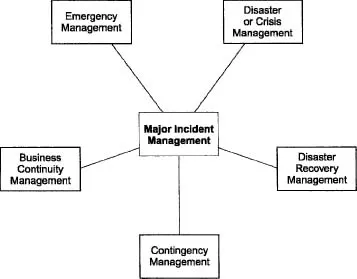
Figure 2 How BCM differs
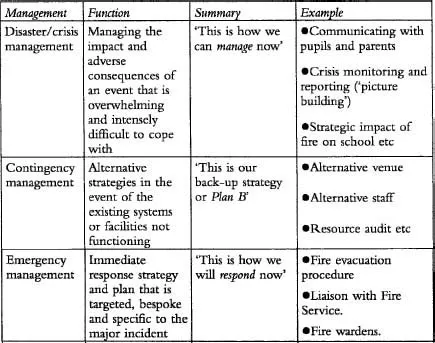
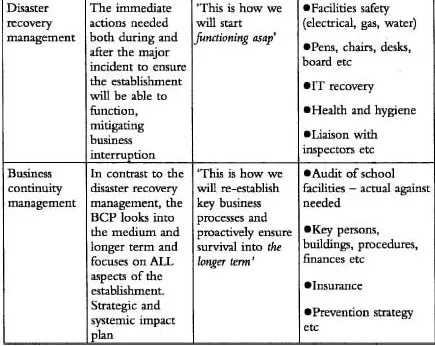
Note: To exemplify the differences, consider an example of a fire in a school.
Meaning of Business Continuity Management (BCM)
1.11 Three elements
The Manual, Emergency Preparedness, which accompanies the Civil Contingencies Act 2004, defines Business Continuity Management (BCM) as ‘a management process that helps manage the risks to the smooth running of an organisation or delivery of a service, ensuring that it can operate to the extent required in the event of a disruption’ (Glossary, p. 215).
The Office of Government Commerce (OGC) (‘A Guide to Business Continuity Management’ (2001) Stationery Office, p 12) tells us that BCM has three main elements:
• prevention;
• planning;
• transfer.
A related document called ‘An Introduction to Business Continuity Management’ (Central Computer & Telecommunications Agency (CCTA) (1995) HMSO, p 7) says:
‘BCM is concerned with managing risks to ensure that at all times an organisation can continue operating to, at least, a pre-determined minimal level’.
The CCTA also adds that BCM is about enhancing corporate performance, open ended, flexible, needs to be integrated into and with other core business functions and is an issue that needs to be lead from by senior management.
1.12 Multi-disciplinary process
Others such as the De Montfort University/IDS Study (‘Business Continuity Management: Preparing for the Worst’ (1999) IDS, p 5) say that BCM is an open, proactive, preventative, holistic, multi-disciplinary process involving a variety of stakeholders. It’s not just about ‘response’ but about ‘adding value’.
1.13 Preventative and recovery controls
Another definition of BCM is given in BS ISO/IEC 17799:2000 (‘Information Technology – Code of practice for information security management’, BSI, 2000, p 56), ‘Objective: To counteract interruptions to business activities and to protect critical business processes form the effects of major failures or Disasters. A business continuity management process should be implemented to reduce the disruption caused by Disasters and security failures (which may be the result of, for example, natural disasters, accidents, equipment failures, and deliberate actions) to an acceptable level through a combination of preventative and recovery controls’.
1.14 A business issue
The Business Continuity Institute (‘BCM: A Strategy for Business Survival’) says that:
‘BCM is not just about disaster recovery, crisis management, risk management or about IT. It is a business issue. It presents you with an opportunity to review the way your organisation performs its processes, to improve procedures and practices and increase resilience to interruption and loss’.
In addition,
‘Business Continuity Management is the act of anticipating incidents which will affect critical functions and processes for the organisation and ensuring that it responds to any incident in a planned and rehearsed manner’.
1.15 Characteristics of BCM
In summary, it can be inferred from these definitions, BCM has the following characteristics:
• Proactive – developing continuity solutions beforehand to be prepared when a Disaster or Emergency strikes.
• Resourcing and ensuring that money, people, machinery etc can be called upon to ensure business survival.
• Efficiency focused – BCM is not a drain on resources. Use cost benefit analysis to show the merits of the approach.
• Value adding – both financial, cor...
Table of contents
- Cover
- Halftitle
- Title
- Copyright
- Contents
- Foreword
- Preface
- Contributors
- Acknowledgements
- Abbreviations
- Table of Cases
- Table of Statutes
- Table of Statutory Instruments
- Table of European Legislation
- 1. Business Continuity Management: Principles and Approaches
- 2. Case Studies on International Disasters
- 3. Construction Related Disasters
- 4. Crisis Management
- 5. Disaster and Emergency Management Systems (DEMS)
- 6. Emergency Planning for COMAH and Non-COMAH Sites
- 7. Historical Context of Environmental Health and Communicable Disease Control within the UK
- 8. Environmental Management: The Consequences and Environmental Monitoring of Industrial and Technological Disasters
- 9. Fire Safety Management for ‘Public’ Buildings
- 10. Forensic Fire and Explosion Investigation
- 11. Human Error and Human Factors
- 12. International Aspects of Disasters
- 13. Insurance, Losses and Risk Management
- 14. The Law Relating to Emergencies and Disasters
- 15. The Medical Response to Disaster
- 16. Public Inquiries and other Investigations into Disasters and Major Emergencies
- 17. Recovery – Creating Crisis Resilient Communication and Information Systems
- 18. Rescue Equipment and Response
- 19. Terrorism
- 20. Training and Exercising for Effective Preparedness and Response
- Index
Trusted by 375,005 students
Access to over 1.5 million titles for a fair monthly price.
Study more efficiently using our study tools.
Frequently asked questions
Yes, you can cancel anytime from the Subscription tab in your account settings on the Perlego website. Your subscription will stay active until the end of your current billing period. Learn how to cancel your subscription
No, books cannot be downloaded as external files, such as PDFs, for use outside of Perlego. However, you can download books within the Perlego app for offline reading on mobile or tablet. Learn how to download books offline
We are an online textbook subscription service, where you can get access to an entire online library for less than the price of a single book per month. With over 1.5 million books across 990+ topics, we’ve got you covered! Learn about our mission
Look out for the read-aloud symbol on your next book to see if you can listen to it. The read-aloud tool reads text aloud for you, highlighting the text as it is being read. You can pause it, speed it up and slow it down. Learn more about Read Aloud
Yes! You can use the Perlego app on both iOS and Android devices to read anytime, anywhere — even offline. Perfect for commutes or when you’re on the go.
Please note we cannot support devices running on iOS 13 and Android 7 or earlier. Learn more about using the app
Please note we cannot support devices running on iOS 13 and Android 7 or earlier. Learn more about using the app
Yes, you can access Tolley's Handbook of Disaster and Emergency Management by Tony Moore, Raj Lakha, Tony Moore,Raj Lakha in PDF and/or ePUB format, as well as other popular books in Technology & Engineering & Insurance. We have over 1.5 million books available in our catalogue for you to explore.