eBook - ePub
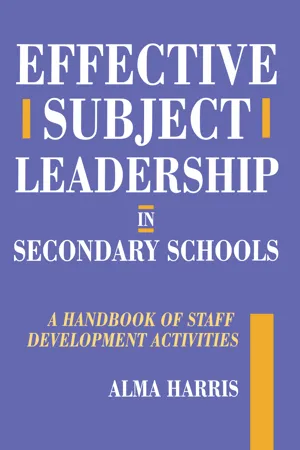
Effective Subject Leadership in Secondary Schools
A Handbook of Staff Development Activities
- 116 pages
- English
- ePUB (mobile friendly)
- Available on iOS & Android
eBook - ePub
Effective Subject Leadership in Secondary Schools
A Handbook of Staff Development Activities
About this book
First Published in 1999. Expectations placed on middle management have risen sharply in the last few years and their increased importance in the role of managing and developing others have been reflected in the new Teacher Training Authority (TTA) Subject Leader Standards. Consequently, the role of subject leader is one which necessitates careful preparation and development. Written in line with these Standards in an accessible style and format, this book supports INSET courses and days designed to develop the essential management skills required by secondary subject leaders; provides support for the Head of Department in developing an mor systematic approach to the management of an effective department; provides useful information for aspiring Heads of Department and Senior Managers who are endeavouring to improve the performance of middle management in their schools.
Information
CHAPTER 1
Introduction
It is now more than a decade since the 1988 Education Reform Act gave rise to the considerable delegation of administration and management to heads of department in secondary schools. During this time it has become increasingly apparent that departments have an integral role to play in school development and improvement. Research evidence concerning school improvement has underlined the importance of focusing change efforts at different levels within the organisation. (Creemers 1994; Hopkins et al. 1994; Hopkins 1996). Multi-level change, i.e. school-level, department-level and classroom-level change, has proved to be a consistent feature of successful school improvement programmes (Hopkins et al. 1996; Hopkins and Harris 1997).
It has also become apparent that for schools to develop and improve in a turbulent and changing environment, issues of management can no longer simply be seen as the exclusive preserve of senior staff (Earley 1998). For management to be most effective, staff at all levels in an organisation increasingly need to be involved in decision making and policy formation. As Peters, writing within a business context, remarked a decade ago, ‘in a fully developed organisation, the front line person should be capable of being involved in strategy making’ (1988, p. 34).
While subject leaders working with their departments are very much in the front line, this does not necessarily mean that they are involved in strategic matters, or organisation decision making. Levels of involvement are likely to vary according to the nature of the organisation, the management approach of senior staff and the culture of the organisation. Most importantly perhaps, levels of involvement are a function of the confidence, expertise and skill in management exhibited by the subject leader. Several research studies have shown that not only do subject leaders feel that they have insufficient time to be effective, but in the majority of cases they have had no preparation, or training for their particular management role (Earley and Fletcher-Campbell 1989; Harris 1998a).
This inevitably points to the need for training for aspiring subject leaders and the need for subject leaders to be equipped to manage more effectively. This need has been formally acknowledged by the TTA as part of a much wider initiative to establish a professional development framework for teachers and to define standards of performance within the profession at a number of key points. In 1998 the TTA introduced the Standards for Subject Leaders that, for the first time, set out the parameters of the subject leader's role. The Standards defined the core purpose of subject leadership as ‘providing professional leadership for a subject to secure high quality teaching and effective use of resources, and ensured improved standards of achievement’. The document goes on to say that:
a subject leader must provide leadership and direction for the subject and subject aims and objectives. While the headteacher and governors carry overall responsibility for school improvement, a subject leader has responsibility for the subject curriculum and for establishing high standards of teaching and learning in their subject as well as playing a major role in the development of school policy. (TTA 1998, p. 3)
The role of the subject leader essentially involves working with and through others in pursuit of particular goals. Subject leaders are agents who work on behalf of the whole staff in the interests of pupils, parents and other stakeholders. As they do so, inevitably tensions arise and competing demands result. With schools becoming ever more accountable, an increasing challenge is placed on those in key roles in schools to perform at even higher levels. The publication of test scores, examination results and OFSTED reports places increasing pressure upon subject leaders to deliver high-quality results. In addition, the concept of management is now securely located within the subject leader's brief. Consequently, this book draws together a range of practical activities designed to assist subject leaders in considering and developing their role.
Audience
The book is intended primarily for aspiring subject leaders and existing subject leaders in secondary schools. It is recognised however, that the key management tasks and skills facing all subject leaders, whether in primary or secondary schools, are inherently similar. Consequently, even though this book is intended for secondary teachers, it can be used by primary subject leaders who are interested in improving their management skills and extending their subject leadership capabilities.
Organisation
The book is organised into eight chapters. Following this introductory chapter, Chapter 2 provides an overview of the research findings on effective departmental working in order to highlight the need for particular management skills and abilities. It summarises the key features of effective departmental working and highlights good practice in management and teaching within effective departments. Chapter 3 begins with a consideration of effective subject leadership, as this is central to the book. This chapter explores issues of leadership, time management and interpersonal skills development.
Chapter 4 focuses particularly upon the strategic direction and development of the subject and effective teaching of the subject. This chapter considers departmental planning, monitoring and evaluation. Chapter 5 considers effective teaching and learning and reviews the literature in both areas. It provides a synthesis of the research evidence concerning effective teaching and learning with the prime purpose of giving subject leaders an overview of these two important fields.
Chapter 6 considers leading and managing staff. This chapter focuses upon teamwork, motivating others, staff development and appraisal. Chapter 7 examines the efficient and effective deployment of staff and resources. The issues addressed in this chapter include financial management, resource management, budgeting and staff allocation. The final chapter is a short commentary on the relationship between subject leadership and school improvement.
Using the book
This book is not intended as a ‘step-by-step’ guide to becoming a more effective subject leader. There is sufficient evidence to show that such approaches rarely work in practice. Although subject leaders can use broadly similar approaches and strategies to develop their management skills, there is no one way that is right for every subject leader. Consequently, the book provides a range of starting points and strategies for subject leaders in varying contexts and situations.
The book is essentially a staff development handbook for those who wish to become more effective subject leaders. Based upon the TTA's Standards, the staff development activities within this book have been designed to enable subject leaders to explore the skills, knowledge and understanding necessary for achieving these Standards. Although some of the activities are intended solely for subject leaders, the majority of staff development activities in the book can involve departmental or team members. Consequently, a key task for those planning or leading staff development days will be to select those activities that best suit the requirements of the training event planned.
Origins of the ideas
The book is based on a range of research evidence concerning effective schooling and effective departmental management (Harris and Busher 1998/9). Recent research conducted by the author on behalf of the TTA has informed the nature and design of the staff development activities. In addition, much of it has been derived from the author's own experience of working directly with subject leaders over the past few years in a research and developmental capacity. The book endeavours to blend theory and practice and to make empirical findings accessible and useful to subject leaders.
It is apparent from each successive book on the theme of subject leadership that effective management at this level is crucially important both in terms of school development and school improvement. It is hoped that this book will help teachers who aspire to subject leader positions or who are in subject leadership positions to become more effective for the benefit of their colleagues and their pupils.
CHAPTER 2
Effective subject departments
Introduction
Much has been written about school effectiveness over the last two decades and there now exists a wealth of research evidence that describes the features or characteristics of effective schools in some detail (Mortimore et al. 1998 Sammons et al. 1998). In addition, the school effectiveness field has highlighted the contribution of departmental effectiveness to whole-school effectiveness. Research in this area has shown that a substantial proportion of the variation in effectiveness among schools is due to variation within schools, particularly at the departmental level (Creemers 1994; Fitz-Gibbon 1992).
The largest study of differential school effectiveness in the UK highlighted the importance of differences between departments as an explanation for differences in school performance (Sammons et al. 1997). This research provided evidence that both schools and departments are differentially effective with pupils of varying abilities and from various social and ethnic backgrounds. While the available evidence concerning departmental effectiveness remains limited to a few studies in the UK, the findings concerning the characteristics of effective departments are highly consistent (Harris et al. 1995; Sammons et al. 1997).
Characteristics of effective departments
While the complexity and uniqueness of each school context is acknowledged, the research evidence (Harris et al. 1995) has shown that there are some generic features of effective departments:
- A climate for change. Effective departments tend to have a ‘climate for change’ or ‘a climate for improvement’, i.e. the department is committed to improvement and is prepared to change existing practices. Developing this climate has been found to be a necessary prerequisite of effective departmental change. Without this climate departments will continue to modify, rather than change, existing practices.
- A clear and shared sense of vision. The departmental vision is shaped by the head of department and can influence how teaching and learning is organised within the department. One of the most striking findings from the various research studies into departmental effectiveness has been the collegiate vision adopted by effective departments. Effective departments have been found to be ‘talking’ departments, marked by a constant interchange of professional information at both a formal and informal level. Within effective departments meetings tend to be frequent with all departmental members involved in the shaping of departmental policy.
- A leading professional. Effective departments are both collegiate and cooperative. This way of working is often a product of the style of management adopted by the head of department. The most typical management approach within an effective department is that of the ‘leading professional’. This is where the head of department is considered by other departmental members as a model to follow. In short, he or she is viewed as an expert practitioner and is viewed by members of the department as a source of good practice.
- Management and organisation. Effective departments are those with the ability to organise key elements of teaching and learning in an optimum way. Effective departments are highly organised and generate detailed and collectively agreed schemes of work.
- Management of resources. Effective depart...
Table of contents
- Cover
- Full Title
- Copyright
- Contents
- Acknowledgements
- Preface
- 1 Introduction
- 2 Effective subject departments
- 3 Effective subject leadership
- 4 Strategic direction and development of the subject
- 5 Teaching and learning
- 6 Leading and managing staff
- 7 Efficient and effective deployment of staff and resources
- 8 Subject leadership and school improvement: a commentary
- References
- Further reading
- Index
Trusted by 375,005 students
Access to over 1.5 million titles for a fair monthly price.
Study more efficiently using our study tools.
Frequently asked questions
Yes, you can cancel anytime from the Subscription tab in your account settings on the Perlego website. Your subscription will stay active until the end of your current billing period. Learn how to cancel your subscription
No, books cannot be downloaded as external files, such as PDFs, for use outside of Perlego. However, you can download books within the Perlego app for offline reading on mobile or tablet. Learn how to download books offline
Perlego offers two plans: Essential and Complete
- Essential is ideal for learners and professionals who enjoy exploring a wide range of subjects. Access the Essential Library with 800,000+ trusted titles and best-sellers across business, personal growth, and the humanities. Includes unlimited reading time and Standard Read Aloud voice.
- Complete: Perfect for advanced learners and researchers needing full, unrestricted access. Unlock 1.5M+ books across hundreds of subjects, including academic and specialized titles. The Complete Plan also includes advanced features like Premium Read Aloud and Research Assistant.
We are an online textbook subscription service, where you can get access to an entire online library for less than the price of a single book per month. With over 1.5 million books across 990+ topics, we’ve got you covered! Learn about our mission
Look out for the read-aloud symbol on your next book to see if you can listen to it. The read-aloud tool reads text aloud for you, highlighting the text as it is being read. You can pause it, speed it up and slow it down. Learn more about Read Aloud
Yes! You can use the Perlego app on both iOS and Android devices to read anytime, anywhere — even offline. Perfect for commutes or when you’re on the go.
Please note we cannot support devices running on iOS 13 and Android 7 or earlier. Learn more about using the app
Please note we cannot support devices running on iOS 13 and Android 7 or earlier. Learn more about using the app
Yes, you can access Effective Subject Leadership in Secondary Schools by Alma Harris in PDF and/or ePUB format, as well as other popular books in Education & Education General. We have over 1.5 million books available in our catalogue for you to explore.