Building on the success of companion volume Techniques for Coaching and Mentoring, this new volume from coaching gurus David Clutterbuck and David Megginson is a practical, pragmatic guide to the knowledge and techniques you need for successful coaching and mentoring.
Rather than adopting a particular school of coaching or mentoring, the authors pick the best from a range of models and frameworks that have developed since the first book published to help you enrich your practice. Further Techniques also features a new structure to make it more reader-friendly, with Part 1 putting the techniques into context, Part 2 covering the frameworks in eight contributed chapters and Part 3 including broader chapters that focus in on techniques for the client, techniques for the coach/mentor and techniques for working on the relationship between coach/mentor and client.
A selection of leading figures in the field contribute their techniques and models to the framework chapters in Part 2, taking you through the necessary principles and offering practical advice for newcomers and seasoned professionals alike.
Offering a wide portfolio of approaches for helping and developing others, this book is an invaluable resource for all coaches and mentors and a must read for anyone wanting to learn more about one-to-one coaching and mentoring.
Edited by David Megginson and David Clutterbuck. Contributors: Gladeana McMahon, Marion Gillie, Daniel Doherty, Megan Reitz, Alan Sieler, John Groom and Vivien Whitaker.

- 272 pages
- English
- ePUB (mobile friendly)
- Available on iOS & Android
eBook - ePub
Further Techniques for Coaching and Mentoring
About this book
Part 1 Contextualizing techniques
What are the arguments for and against the use of techniques? How do frameworks for coaching or mentoring serve to organize and focus these techniques? How does this book address the relationship between technique and framework? The introductory chapter that forms the first part of this book answers these questions and orients the reader to what follows.
Introduction
David Clutterbuck and David Megginson
DOI: 10.4324/9780080949420-1
Approaches to techniques
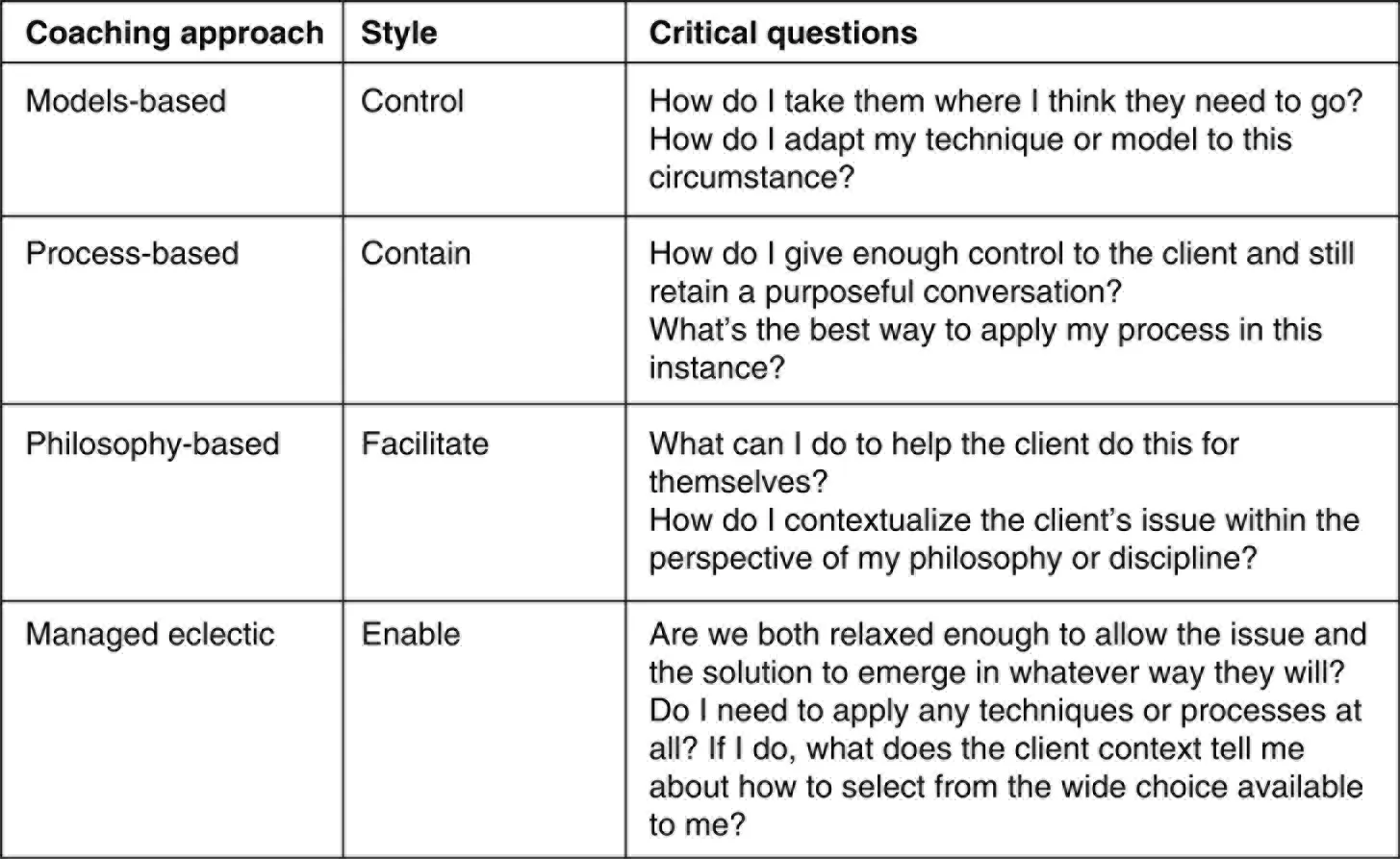
When we wrote the companion volume, Techniques for Coaching and Mentoring, we struggled to find resources beyond those which we had created or used in our own practice and experimentation. It seemed that most coaches were reliant on a very narrow range of models and techniques. Most commonly, coaches based their practice on the GROW model – an approach both of the authors have found in our separate researches to become inadequate as coaches/mentors acquired experience. Among the dangers of this ‘one model’ approach was that coaching becomes mechanistic, critical clues to the client context are missed or ignored, and, whatever may be claimed to the contrary, the client can easily become manipulated to fit the coach's agenda. This is especially true with regard to goal setting, where we find that fixing upon specific goals at the start of a relationship is primarily for the benefit of the coach or the sponsor, rather than that of the coachee.
Some coaches had progressed beyond a simplistic model to a process, which, in theory at least, allows for greater flexibility. For example, solutions focused coaching and clean language both add some level of theoretical rigour and expect the coach to exercise creativity in the order and structure of their approach. In practice, however, it can be very easy to fall back into mechanistic routines. A recent demonstration of ‘good practice’ in solutions focus observed by one of the authors at a conference was so robotic that the session could have been conducted by a machine. (In fact, a machine would have introduced fewer body-language distractions!)
Other coaches again were developing their practice within a particular discipline or theoretical framework – for example, cognitive-behavioural therapy, Gestalt or NLP – which offered a range of techniques within a broad philosophy of helping and human development. The aficionados of these philosophies or disciplines are often highly enthusiastic, but this enthusiasm may at times hide a dangerous man-trap – the implicit assumption that this philosophy, powerful as it may be, is always the best approach for every client.
Let us emphasize here that we are not decrying any of these approaches. All are valid ways of approaching coaching and mentoring assignments and all have – in appropriate circumstances – a track record of assisting people with major changes in their life, work and context. Our concern is that all can (and in observed cases of less effective practitioners, demonstrably do) lead to a rigidity of thinking about the client and their issues; and about the role and responsibilities of the coach or mentor. The toolkit (model, process, or theoretical framework) drives the learning conversation, rather than the learning conversation driving the selection of tools and techniques.
In the recent past, we have seen an encouraging growth of innovation in models, frameworks and processes. We have also observed the rise in highly confident and competent coaches of a fourth approach, which we call managed eclecticism. By this, we mean an intelligent, sensitive ability to select a broad approach, and within that approach, appropriate tools and techniques, which meet the particular needs of a particular client at a particular time. Central to this concept is that:
- The initial learning conversations provide the clues as to what approaches and frameworks may be best suited to the client;
- Every learning conversation is an experiment for both the coach/mentor and the client.
A cogent argument can be made that this scale from models to managed eclecticism is a measure of the relative maturity of a coach or mentor – of how they think and behave – similarly, for example, Kegan's (1992) scale of cognitive and socio-emotional development or Torbert's (Rooke and Torbert, 2005) scale of leadership development. This is perhaps a step too far, if only because we have no direct evidence other than from unstructured observation and the nodding of wise heads at gatherings of experienced coaches (and coaching and mentoring are already riddled with far too many unevidenced assumptions!)
It's important as well, we suggest, not to confuse managed eclecticism with the random gleanings of coaches, who collect techniques and processes in the way a jackdaw collects shiny objects. Decoupled from the philosophies from which they derive, techniques may become meaningless, or worse, harmful. In a presentation to the 2007 European Mentoring and Coaching Council (EMCC) conference in Stockholm, Helena Dolny of South Africa's Standard Bank referred to a subset of coaches, who went through the company's assessment centres. These people had a lot of techniques, which they had failed to integrate or fully understand. Such coaches have also been likened to a handyman, who clouts nails with a screwdriver and fixes screws with a hammer. No consistency of process may be worse than over-rigid models and processes. The true eclectics we have encountered share a number of characteristics:
- They do not share a common philosophy; rather, they have developed their own philosophy – one which continually expands and adapts, evolving as they absorb new knowledge and ideas.
- They place great importance on understanding a technique, model or process in terms of its foundations within an original philosophy.
- They use experimentation and reflexive learning to identify where and how a new technique, model or process fits into their philosophy and framework of helping.
- They judge new techniques, models and processes on the criterion of ‘Will this enrich and improve the effectiveness of my potential responses to client needs?’
- They use peers and supervisors to challenge their coaching philosophy and as partners in experimenting with new approaches.
If there is a ladder of coaching maturity along the lines suggested here (see Figure 1.1), then it is highly likely that coaches and mentors need to journey through each stage, before they are able to understand and encompass the next. Does this mean, then, that the inexperienced coach should stick to a very narrow range of tools and techniques? Our experience and observation suggests that, while trying to jump straight to the eclectic stage is unlikely to be beneficial, acquiring new techniques in response to specific experiences with clients is an important part of the maturation process. If the habits of purposeful technique acquisition and integration can be learned early on in the coaching journey, then the transition to full-fledged managed eclecticism ought to be faster and smoother.
A kaleidoscope of perspectives
In supporting coaches and mentors in becoming mature eclectics, we have structured this book into parts which we describe briefly below.
Part 1: Contextualizing techniques
Chapter 1. Introduction
In our introduction, which is this chapter, we outline our developing argument for how coach/mentors can approach techniques.
Part 2: Perspectives on techniques
Here, we give a chapter each to different frameworks from particular psychological or philosophical stances and others from a generative lens or perspective. Our criterion for inclusion of chapters here has been that the authors can present material in such a way that it displays the underlying principles of their framework and at the same time offers specific help in the practice of coaching/mentoring for those aspiring to the managed eclectic stance in Figure 1.1 Each of these frameworks is introduced below.
Chapter 2: Cognitive behavioural coaching
Gladeana McMahon, Vice-President of the Association for Coaching, has contributed a chapter on cognitive behavioural coaching (CBC). Like the chapters on Gestalt coaching and ontological coaching which follow, the framework is based on established psychological theory. CBC, however, differs from these other approaches by not being psychodynamic. Instead it is grounded in the study of rational thinking and of behaviour. For this reason, it may be seen as accessible to readers who do not have a psychodynamic background. Having said that, it is worth pointing out that each of the authors of the psychodynamic chapters has cast their contribution in a form that makes it useful for non-psychologist coaches who are open to working in a ‘psychological way’ (Lee, 2003).
This chapter is full of clear, structured and usable techniques, and it has some case studies of the technique in practice, which will allow readers to see or feel how they might apply the approach. The chapter begins with some preliminary techniques for orienting to the cognitive model used, including the thought record form and how to deal with cognitive distortions. There is then a section on techniques including cost/benefit analysis, contingency planning, allocating responsibility and dealing with negative emotions. The chapter concludes with a comprehensive and illuminating case study.
Mentors and coaches wanting to use this approach will need to understand the underlying principles of the framework that was developed in a counselling context. This framework is spelled out in outline in the chapter. There is quite a heavy emphasis on righting distortions and dealing with negatives. For those practitioners who like to emphasize the positive and the possible, this orientation may not be to their taste, but we found in studying this chapter that it addresses many of the career and life issues our clients face, and provides a means of going forward in a positive way.
Chapter 3: Gestalt coaching
Marion Gillie differentiates Gestalt coaching from its progenitor of Gestalt psychotherapy, which itself was developed by Fritz Perls from Gestalt psychology. Gestalt therapy approaches have been widely used in individual and organization development, going right back to Hermann and Korenich in 1977. Marion Gillie differentiates Gestalt coaching from Gestalt therapy or counselling by focusing on current material rather than earlier relationships with parents and other authority figures.
The core of this chapter, and indeed of Perls’ (1971) own approach to intervention, as we said in the companion volume to this book, is that Gestalt practitioners value spontaneity and aim to create unique responses to each situation. Marion captures the emergent nature of this approach by developing the chapter with a long, continuous case study that is woven through the accounts of approaches and principles. There is also enough formal exposition of these principles for newcomers to the approach to connect with its underlying rationale. Lee (2003) provides a useful plain coach's guide to the relevance of transference and counter-transference, two concepts mentioned but not discussed in the text.
Chapter 4: Ontological coaching
Alan Sieler's chapter offering his own brand of ontological coaching is an interesting synthesis of a number of other approaches, with a strong and helpful focus on purpose – on challenging the coachee/mentee to consider what they are here for. In contrast to Marion Gillie's account of Gestalt coaching, ontological coaching includes going back to address parental material. This may be inevitable – as getting to a core purpose must involve going back to old scripts and re-evaluating them.
This chapter too has some case studies which illuminate the processes described.
Chapter 5: Intuitive coaching
Intuitive coaching is not so much a brand or a discipline underlying coaching and mentoring. Rather, it represents a way of being a helper that can contribute, whatever types of mentoring or coaching you are using. Megan Reitz manages the difficult tightrope walk of giving a clear-sighted account of intuition in coaching, including summaries of key scientific studies of the topic, with a passionate case for enhancing the faculty of intuition in order to develop depth and focus in the one-to-one encounter.
This chapter is less technique oriented than most of the others in this book. This is entirely appropriate as intuition largely rests beyond the boundaries wherein technique operates. What Megan Reitz does instead is to help coaches think about the techniques that they can practice on themselves so that when they come into contact with their client, they have optimized the possibility of coming up with an intuitive response to what the client says. As such, it chimes in with Chapter 11, our coach/mentor focused techniques. Necessary warnings are offered against confusing intuition with giving gratuitous and unconsidered advic...
Table of contents
- Cover Page
- Half Title Page
- Title Page
- Copyright Page
- Contents
- Contributors
- Preface
- Acknowledgements
- PART 1 Contextualizing techniques
- PART 2 Frameworks
- PART 3 Different foci for coach/mentoring techniques
- Bibliography
- Index
Trusted by 375,005 students
Access to over 1.5 million titles for a fair monthly price.
Study more efficiently using our study tools.
Frequently asked questions
Yes, you can cancel anytime from the Subscription tab in your account settings on the Perlego website. Your subscription will stay active until the end of your current billing period. Learn how to cancel your subscription
No, books cannot be downloaded as external files, such as PDFs, for use outside of Perlego. However, you can download books within the Perlego app for offline reading on mobile or tablet. Learn how to download books offline
Perlego offers two plans: Essential and Complete
- Essential is ideal for learners and professionals who enjoy exploring a wide range of subjects. Access the Essential Library with 800,000+ trusted titles and best-sellers across business, personal growth, and the humanities. Includes unlimited reading time and Standard Read Aloud voice.
- Complete: Perfect for advanced learners and researchers needing full, unrestricted access. Unlock 1.5M+ books across hundreds of subjects, including academic and specialized titles. The Complete Plan also includes advanced features like Premium Read Aloud and Research Assistant.
We are an online textbook subscription service, where you can get access to an entire online library for less than the price of a single book per month. With over 1.5 million books across 990+ topics, we’ve got you covered! Learn about our mission
Look out for the read-aloud symbol on your next book to see if you can listen to it. The read-aloud tool reads text aloud for you, highlighting the text as it is being read. You can pause it, speed it up and slow it down. Learn more about Read Aloud
Yes! You can use the Perlego app on both iOS and Android devices to read anytime, anywhere — even offline. Perfect for commutes or when you’re on the go.
Please note we cannot support devices running on iOS 13 and Android 7 or earlier. Learn more about using the app
Please note we cannot support devices running on iOS 13 and Android 7 or earlier. Learn more about using the app
Yes, you can access Further Techniques for Coaching and Mentoring by David Megginson,David Clutterbuck in PDF and/or ePUB format, as well as other popular books in Business & Business General. We have over 1.5 million books available in our catalogue for you to explore.