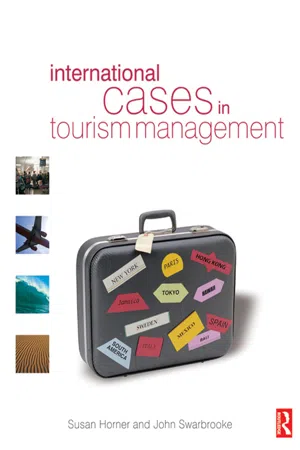
International Cases in Tourism Management includes:
* Profiles of individual companies
* Case studies on destination management and marketing
* Material on different management functions in tourism, such as marketing and human resource management
* Case studies of particular types of tourism, such as ecotourism and cultural tourism
The case studies are supplemented by exercises and questions, which ensure that for students and tutors alike the book is the ideal accompaniment to all tourism courses.
- 416 pages
- English
- ePUB (mobile friendly)
- Available on iOS & Android
eBook - ePub
International Cases in Tourism Management
About this book
Part 1 Introduction
DOI: 10.4324/9780080473116-1
In this part of the book, we offer three chapters that set the context for the book, as follows:
- Chapter 1 discusses the role of case studies in teaching and learning, and how best to make the most effective use of them. While mainly aimed at tutors, this chapter should also help students make use of the case studies.
- Chapter 2 features a brief discussion on some of the issues facing tourism organizations, destinations, and sectors today, given that the case studies have been selected to raise student awareness of some of these issues.
- Chapter 3 introduces the reader to the actual case studies – nearly 40 of them – which are the core of this book. In this chapter, we also identify which issues are covered in each case study as well as the links between the case studies.
The Role of Case Studies in Learning
DOI: 10.4324/9780080473116-2
We have endeavoured to provide you with a wide range of case studies in this book. By writing this book, we are obviously suggesting that the use of case studies is a valuable experience for students. This view really comes from our experiences of working with students in the classroom.
The purposes of this section of the book are to discuss the advantages of case studies and the methods that can be used in a teaching situation to help use case studies in an effective way. Case study teaching can include a range of different approaches ranging from the use as a simple illustration to complex scenario planning and decision-making by the student. We will be discussing this range of approaches in this section. The use of case studies also requires special teaching skills and preparation which we will also discuss in this section of the book.
What is a Case Study?
A case study is a description of actual situations in an organization, destination, or sector, that allows the teacher to develop discussions among the students and with the teacher as a facilitator. The case study is usually presented in a written form, and students are usually required to read the case study before the teaching session. The case study is written at a particular point of time and usually introduces particular issues facing an organization.
A second type of case study introduces a series of critical issues facing a particular sector. The underlying reason for using a case study is to allow the teacher to narrow the gap between theory and practice, and to allow the students to experience real-life situations.
The Value of Using Case Studies
We have found in our teaching careers that students learn a great deal from the use of case studies within the teaching and learning strategy. Why is this? There are a number of reasons why the uses of case studies are valuable and these can be summarized as follows:
- Case studies allow students to see real-life examples of issues in a classroom situation. In other words, the use of a case study allows the student to see how organizations operate and avoids the need for them to have to visit or work in an organization which is often impossible or time consuming.
- Case studies allow students to gain an appreciation of issues in other countries and regions of the world without the need to travel to these places. This is important in a truly internationalized industry such as tourism.
- Case studies allow the teacher to adopt a variety of methods in teaching and learning. What is clear though, is the fact that the use of a case study allows the teacher to actively involve the students in the learning process. Rather than being a didactic process, teaching becomes a two-way process and students are actively involved in the learning process.
- Case studies allow the students to see that there are a variety of ways of approaching particular organizational problems and issues, and that there are no right or wrong answers. This allows the students to understand the complexities of organizational life and tourism issues, and realize that there are no quick solutions or easy answers.
- Case studies allow the students to appreciate different roles in organizations and different perspectives on issues. In the extreme, the use of role play allows the students to actually feel what it is like to work in a particular job within an organization, or appreciate the different roles which different actors play in tourism issues. They can be asked to act in a much more senior role than they could expect to be given in a work experience or their first job after college or university. This can allow them to appreciate strategic rather than simply tactical issues that they tend to see in the practical work place.
- Case studies allow the teacher to develop high levels of involvement, reasoning, and group participation by the student group. It allows the teacher to ask ‘what would you do if you were faced with this particular set of circumstances and why?’ Learning becomes an active, rather than a passive experience, and students may also be encouraged to develop their own theories on the basis of the case study work. We will come back to this when we discuss the teaching strategies that can be adopted later in this section.
- Case studies allow the teacher to focus on the student’s level of understanding. The more able students who have a deeper understanding and breadth of knowledge are able to stretch themselves further, particularly if they are placed in a group of like-minded individuals. The less able students are able to work at their own pace and come to a series of conclusions which again stretches their understanding of the topic. The whole process if it is well managed allows the student to deal with realities and helps them to develop their own views in a group situation.
- Case studies allow the teacher to develop the emotional and intellectual skills of their students. Students are required to evaluate different scenarios, make decisions about the right direction, and often convince others of their own plans. They also often have to think how they would implement the decisions they have made. This provides the teacher with a powerful way of developing knowledge and personal skills, and qualities within their student group.
- Case studies can be used very effectively in an open book examination situation, where students receive the case study in advance, and then are asked to prepare themselves for an unseen open book examination. This turns an examination into a thinking experience, rather than a memory test. Students are asked to work with the materials and develop ideas during the examination process.
- Case studies can be written by the students themselves during the delivery of a particular course. These case studies can then be put to further use, say to write an article, or to be used for examination purposes. Students obviously have to be given instruction on case study writing if this type of teaching strategy is to be adopted.
Disadvantages of Using Case Studies
Obviously, we do not consider that there are many disadvantages of the case study method given the nature of this book. It is important, however for us to be critical to allow you to think about the possible pitfalls of using case studies in the class situation. Some of the disadvantages of using case studies were outlined by Clawson (1995) as follows:
- Case study teaching is highly teacher dependent and requires a high level of commitment. Some teachers are able to present a case study in an interesting and sometimes provocative way, but others may present it in a boring and superficial way according to their particular skills and abilities. In other words, a case study should not be used unless the teacher has the ability to deliver it.
- Case study method encourages the students to ask questions to the teacher, who is required to engage in the discussion and develop ideas. For some teachers this can be exciting and challenging, but for others perhaps with less experience this can be threatening. Certainly, case study method requires a great deal of preparation by the teacher before the actual teaching session.
- Case study method may be unnerving for the teacher because she or he may feel that the necessary course material has not been covered because of the way in which the discussion and debates have proceeded during the session. Our way around this particular issue is to combine the use of case studies with other forms of instruction – for example a traditional lecture to deliver the theory followed by a case study tutorial session to explore t...
Table of contents
- Cover Page
- Half-Title Page
- Title Page
- Copyright Page
- Table of Contents
- Preface
- Acknowledgements
- Part 1 Introduction
- Part 2 The Case Studies
- Bibliography
- Index
Trusted by 375,005 students
Access to over 1.5 million titles for a fair monthly price.
Study more efficiently using our study tools.
Frequently asked questions
Yes, you can cancel anytime from the Subscription tab in your account settings on the Perlego website. Your subscription will stay active until the end of your current billing period. Learn how to cancel your subscription
No, books cannot be downloaded as external files, such as PDFs, for use outside of Perlego. However, you can download books within the Perlego app for offline reading on mobile or tablet. Learn how to download books offline
Perlego offers two plans: Essential and Complete
- Essential is ideal for learners and professionals who enjoy exploring a wide range of subjects. Access the Essential Library with 800,000+ trusted titles and best-sellers across business, personal growth, and the humanities. Includes unlimited reading time and Standard Read Aloud voice.
- Complete: Perfect for advanced learners and researchers needing full, unrestricted access. Unlock 1.5M+ books across hundreds of subjects, including academic and specialized titles. The Complete Plan also includes advanced features like Premium Read Aloud and Research Assistant.
We are an online textbook subscription service, where you can get access to an entire online library for less than the price of a single book per month. With over 1.5 million books across 990+ topics, we’ve got you covered! Learn about our mission
Look out for the read-aloud symbol on your next book to see if you can listen to it. The read-aloud tool reads text aloud for you, highlighting the text as it is being read. You can pause it, speed it up and slow it down. Learn more about Read Aloud
Yes! You can use the Perlego app on both iOS and Android devices to read anytime, anywhere — even offline. Perfect for commutes or when you’re on the go.
Please note we cannot support devices running on iOS 13 and Android 7 or earlier. Learn more about using the app
Please note we cannot support devices running on iOS 13 and Android 7 or earlier. Learn more about using the app
Yes, you can access International Cases in Tourism Management by Susan Horner,John Swarbrooke in PDF and/or ePUB format, as well as other popular books in Business & Hospitality, Travel & Tourism Industry. We have over 1.5 million books available in our catalogue for you to explore.